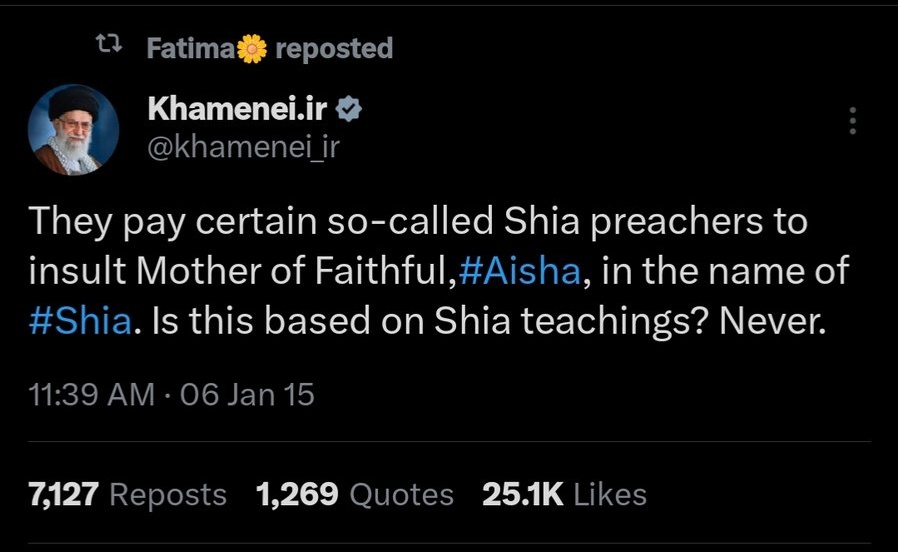
@YasirAlHanafi We won’t sacrifice the respect of the companions. How hard is this to get? There can be no unity with a people whose religion is based on distrust of Sahabas and disrespecting them. We can and should help in case of need but there will be no uniting with them.
Being able to unite with other Muslims requires us to sacrifice our egos. Our ego acts as a barrier to many things. Without overcoming it, we won’t be able to unite with our family members, let alone other Muslims. We might even struggle to get along well with our beloved parents, let alone anyone else.
Unity demands humility and sacrifice. Initiating a respectful conversation with your Muslim brother, despite your differences, may hurt our ego. But that is what is necessary. The more we humble ourselves, the weaker our ego becomes. Eventually, we gain control and are no longer driven by our weak whims.
The devil tries to mislead people, but it was the devil’s ego that led him astray. Our internal enemy is more perilous than our external enemy.
May Allah purify our souls. Amin.
@sarah_rara9@0xxOla@AkwaIbomMuslim@SharjilNow The permisibilty of a woman to work or not is ONLY dependent on wether her husband allows it or not, as long as he provides 100% financially.
Dear men in lslam, there's no 50/50 responsibilities in Islam. You are fully responsible for all the expenses of your family!!!
It's a bonus if your wife chooses to help you financially. It's not a must
@aiishadahir Alhamdulillah , we know exactly how favoured we are 🙏
“That is the فضل (favour) of Allah; He gives it to whom He wills. And Allah is the Possessor of great bounty.”
Qur’an 62:4
@anony_muslimah Women like you are bound to succeed. One thing is to accept something that is difficult for most people, another thing is to be pleased with it because Allah permitted it.
That is true submission, that is islam in its originality. May Allah elevate your mention 🙏
I think people find me weird whenever I say I love polygyny and pray that Allāh makes it easy for the man I married.
It’s something I’ve felt strongly about since childhood, so it would feel hypocritical for me to suddenly dislike it now. I don’t support men who practice it
We are firmly convinced that the Qurån is the Speech of Allåh
[Kalåmu’llåh], His Book [Kitåb], His Verbal Communication and His Inspired Revelation (wahi), which the angel Jibril brought down to His Messenger (Allåh bless him and give him peace).
Ref: (26:192–195)
@tyrantxalimo@AkwaIbomMuslim Good for you, may Allah bless your home...and islam is never against women working.
However: our Daughter and wife can never be better than the wives of the prophet salallahu aleyhi wa salam, they didn't work.
@HQconcept@AkwaIbomMuslim Don’t be a fragile man brother.
I don’t educate my daughters so that they can stay at home later.
My wife works and has done for decades. I provide everything but her work is important to her.
@SharjilNow@AkwaIbomMuslim Regardless, she hasn't said anything wrong. Also, correction have modalities if there's anything to correct.
Showing empathy and being kind gives a higher chance people will listen to us, if we are truthful about our desire to spread islam. Let her be brother 👏
@HQconcept@AkwaIbomMuslim Sorry. But these pseudo feminists have been trying to brainwash women in the name of islam really hard. They are so sneaky that it's almost undetectable. Very Jewish. I'm tired of this and feel it needs to be fought.
Went for a Nikkah today and half the girl's family didn't show up because she married a different race. Different race NOT different religion.
Such a sad reality we live in
@AkwaIbomMuslim@SharjilNow Leave her alone , let's just pray to Allah to bless her business and bless her with a spouse that aligns with what she likes. As long as it not haram...it's all good 🙂
Re: Blacklisting of Kitāb al-Tawḥīd
by Shaykh Muḥammad bin ʿAbd al-Wahhāb -rahimahulLāh-
I recently came across a post on X that blacklisted Kitāb al-Tawḥīd of Shaykh Muḥammad bin ʿAbd al-Wahhāb on the basis of flimsy reasons and watery, unsubstantiated allegations. Such attempts are not new; several similar efforts have been made in the past, all of which have failed, and this latest one is likewise destined to fail.
What I have recently observed is that most of those who pass such judgments on this blessed book are either ignorant of its contents, which consist primarily of direct quotations from the Qurʾān, the Sunnah, and the statements of the pious predecessors (al-salaf al-ṣāliḥ), or they are deliberate mischief-makers whose views are shaped by premeditated sectarian biases.
In my opinion, the most effective response to such individuals is not to engage in direct refutation of their claims, but rather to promote the teaching of the book itself. In this way, those who are genuinely curious about its contents can become enlightened and properly educated. It is for this reason that I recommend the Yoruba-language explanation of Kitāb al-Tawḥīd delivered by Shaykh Professor ʿAbd al-Razzāq A. Alaro, mni. Those who wish to benefit from the book in the Yoruba language may access the weekly classes on the Facebook page of the Assunnah Academy of Daʿwah. Previous classes are available via the following link:
(drive.google.com/drive/folders/…)
A pertinent illustration of this approach is the popular story of a scholar who had long been a vocal critic of Shaykh Muḥammad bin ʿAbd al-Wahhāb, having formed his opinion solely on the basis of reports he had heard from the Shaykh’s opponents. After some time, one of his students travelled to Saudi Arabia for advanced Islamic studies, which afforded him the opportunity for direct engagement with the Shaykh’s works under qualified teachers. During the holidays, the student presented Kitāb al-Tawḥīd to his teacher after first removing the cover pages that bore the author’s name. Upon returning later to inquire about his teacher’s opinion, he found that the scholar had expressed profound satisfaction with the book, remarking that it consisted entirely of Qāla Allāhu (“Allah says”) and Qāla al-Rasūl (“the Prophet says”). The teacher showered high praise upon whoever had authored such an excellent work. Only then did the student reveal the true identity of the author. From that moment onward, the teacher ceased his criticism of Shaykh Muḥammad bin ʿAbd al-Wahhāb.
A similar historical incident occurred between ʿAbdullāh ibn al-Mubārak and his teacher al-Awzāʿī. The latter had been a strong critic of Imām Abū Ḥanīfah on the basis of hearsay. This attitude persisted until Ibn al-Mubārak returned from Kūfah bearing some of the books he had studied under Abū Ḥanīfah and presented them to al-Awzāʿī without disclosing the author’s identity. The full account of the story, as narrated in Tārīkh Dimashq by Ibn ʿAsākir (32/399), is as follows:
"Al-Faḍl ibn ʿAbd al-Jabbār reported to us, saying: I heard Abū ʿUthmān Ḥamdūn ibn Abī al-Ṭūsī say: I heard ʿAbdullāh ibn al-Mubārak say: “I travelled to Syria to meet al-Awzāʿī and found him in Beirut. He said to me, ‘O Khurāsānī, who is this man who has appeared in Kūfa?’ -meaning Abū Ḥanīfa. “So I returned to my lodging, took up the books of Abū Ḥanīfa, and extracted from them some of his finest legal opinions. I spent three days occupied with them. “On the third day I went back to him. He was the muʾadhdhin and imam of their mosque, and I had the book in my hand. He asked, ‘What is this book?’ I handed it to him. “He opened it and looked at one of the issues I had marked, which read: ‘al-Nuʿmān ibn Thābit.’ After giving the adhān, he remained standing and read the opening section of the book. Then he placed it in his sleeve, stood up and led the prayer. After the prayer he took the book out again and continued reading until he reached that same issue. “Then he said to me, ‘O Khurāsānī, who is this al-Nuʿmān ibn Thābit?’ “I replied, ‘A scholar I met in Iraq.’ “He said, ‘This is a noble man among the scholars. Go and learn as much as you can from him.’ “I said, ‘This is Abū Ḥanīfa, the very one you warned me against.’”.
End of quote.
Abdul Qowiyy Olalekan Badmus
@HQconcept@IdrisAOni1 You should check the meaning of blacklisting.
If I use the following sign❌ for a book you wrote and unequivocally state that I do not recommend it, what does that mean?
@Aburoyaan@A_QowiyyBadmus@IdrisAOni1 He can, however: he cannot start talking about it's meaning and start making rulings based on his limited knowledge.
He can only understand the muhkamaat (clear verse) and not the mutashabihat (unclear).
A layman MUST seek tefsir (explanation) and tahweel (interpretation).
@AlDemWallem@AkwaIbomMuslim The prophet peace be upon him did not ask for Women to be leaders of his ummah, neither did any of the female companions come out in public to start preaching.
So where did you people get your islam from ?
Men shouldn't be talking about women's hijab or menstrual cycle. We have female scholars and Islamic speakers who can handle these topics better. Men should address men and women should address women