Mr. Hello รีทวีตแล้ว

Mr. Hello
60.9K posts


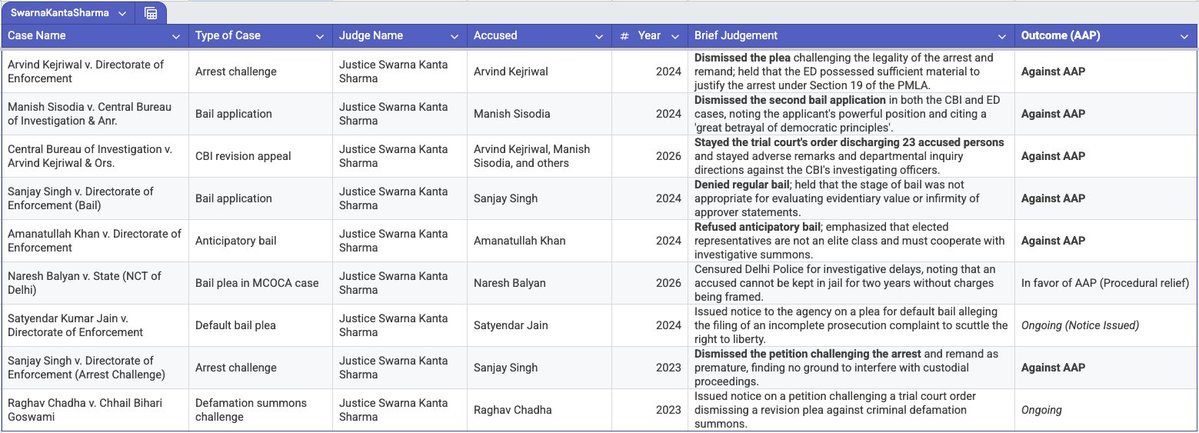
#ImportantNews: The controversy over the alleged Delhi liquor-scam case before Justice Swarana Kanta Sharma is no longer confined to courtroom conduct alone. Now more troubling questions of proximity, patronage, conflict-of-interest, and the appearance of bias have come to light. Several of the 23 dischargees in the case had formally sought Justice Sharma’s recusal from hearing the CBI’s challenge to their discharge. Even then, the judge has so far resisted calls to step aside, even as former Delhi Chief Minister Arvind Kejriwal himself appears in person to argue the recusal application. Arguments are now scheduled for Monday, 13 April 2026. In my last Case In Point column for @frontline_india, I had already revealed, through an analysis of all the 165 criminal revision petitions of the same category as Kejriwal’s case, that Justice Sharma clearly departed from her usual pattern of handling such matters and had taken an unusually strange interest in this case. That, along with many other details that if read in singularity can be met with a shrug, but when read together, reveals a troubling pattern and credible fears of apprehension of bias in the liquor case. These by itself had raised serious questions. You may read my piece here: frontline.thehindu.com/columns/delhi-… What has surfaced now makes those questions HARDER to dismiss. Justice Sharma’s son and daughter—Ishaan Sharma and Shambhavi Sharma—have both been empanelled by the Union government before the Delhi High Court and the Supreme Court. According to the empanelment details, both siblings were appointed on the very same days: 11 September 2025 for the Delhi High Court panels and 21 November 2025 for the Supreme Court panels. 1. Ishaan Sharma holds panels before both courts, including the highest Group A panel before the Supreme Court and Senior Panel Counsel status before the Delhi High Court. 2. Shambhavi Sharma, with mere four years of enrolment as advocate, too holds panels before both courts: Group C before the Supreme Court and Government Pleader before the Delhi High Court. 3. Ishaan Sharma also held a panel in the Delhi Development Authority (DDA), under the Union Housing Ministry, till at least 2024 (Check: sci.gov.in/sci-get-pdf/?d…). 4. He also held a panel in the Delhi State Legal Services Authority since 2021 until at least the end of 2024 (Check: cdnbbsr.s3waas.gov.in/s395b7a6d9a47c…). Panel counselship is among the most coveted forms of government legal patronage in the system. Ask any advocate and they will tell you how through these positions, the government allocates litigation, visibility, professional standing, and income. But the more important and troubling part is that they are positions held at the pleasure of the very government whose top law officers are now appearing before Justice Sharma in one of the most politically explosive cases in the country. And that is where the conflict sharpens. Of course, one need not prove an explicit bargain but justice must also be SEEN to be done, especially when it is a case of public interest. The test for seeking recusal of a judge is whether there exists a reasonable apprehension of bias and whether public confidence in the fairness of the process has been impaired. Like I had explained in my column, Indian law on recusal has long recognised that what matters is not just actual bias, but whether a litigant could REASONABLY FEEL that justice may NOT appear to be done. Here, several of the 23 dischargees feel justice may not be done impartially. And now this issue of one advocate, who happens to be the son of a judge, accumulating large number of panels within a relatively short post-enrolment period as an advocate. Ask any lawyer and they will tell you how many more accomplished, brilliant persons, with many more years as an advocate have failed to secure a panel through the formal process. The concerns are many. In this case, the question is whether a judge can continue to hear a politically sensitive challenge brought by the CBI, while her kin hold multiple Union government panels and receive work from the same legal establishment whose top officers allocate cases to them and are now appearing before her? Note this: as per one RTI reply I received, Ishaan Sharma was allocated 2,487 cases in 2023, 1,784 cases in 2024, and 1,633 cases in 2025. In both 2024 and 2025, he was allocated more case files than even Zoheb Hossain, the top, most publicly visible Enforcement Directorate lawyer—by 91 in 2024 and by 582 in 2025. This of course suggests the sustained and substantial allocation of state work before the son. The allocation is done by the topmost in the legal system. Also, this is not the first time that such questions of potential conflict of interest have arisen. In September 2024, I had highlighted the case of Padmesh Mishra, whose appointments across multiple union government and Rajasthan government positions drew scrutiny after his father, Justice Prashant Kumar Mishra, was elevated to the Supreme Court. Check: x.com/SauravDassss/s… The unease then was the same as it is now: when the children of sitting judges begin to accumulate government panels and positions in unusual concentration, something a regular lawyer, perhaps much more brilliant and of more history of practice, can only dream of, particularly after or around the parent’s rise within the judiciary, the issue is of institutional credibility. And no one really needs to state that that credibility is already under strain. Recently, Justice Manmohan of the Supreme Court himself publicly flagged corruption in the appointment of panel counsels by the Union government, questioning whether such appointments are really being made on merit at all. In a system where even a sitting Supreme Court judge is warning that panel-counsel appointments may be infected by extraneous considerations, the appearance of conflict in the present case becomes still harder to shrug away. Check: x.com/barandbench/st… Seen in that light, the present controversy is again not whether Justice Sharma is actually biased. It is about whether the institution can credibly insist that there is nothing to see here. The CBI has just filed an affidavit supporting Justice Sharma. A judge who I have documented, as per her own orders, to show unusual interest in a politically sensitive matter now finds herself in a position where her own kind hold/held as many as SIX government panels between them, while their bosses continue to appear before her. Even if one were to assume the absence of any actual impropriety, does this arrangement augur well for the appearance of judicial independence, especially in this case? The question is whether this not enough evidence of apprehension of bias that should suffice for a recusal. That is the question the High Court ought to have confronted with seriousness. Instead, by resisting recusal in these circumstances, the judge is unfortunately deepening this very suspicion that it should have avoided at all costs, or at least for the sake of institution.

#ImportantNews: The controversy over the alleged Delhi liquor-scam case before Justice Swarana Kanta Sharma is no longer confined to courtroom conduct alone. Now more troubling questions of proximity, patronage, conflict-of-interest, and the appearance of bias have come to light. Several of the 23 dischargees in the case had formally sought Justice Sharma’s recusal from hearing the CBI’s challenge to their discharge. Even then, the judge has so far resisted calls to step aside, even as former Delhi Chief Minister Arvind Kejriwal himself appears in person to argue the recusal application. Arguments are now scheduled for Monday, 13 April 2026. In my last Case In Point column for @frontline_india, I had already revealed, through an analysis of all the 165 criminal revision petitions of the same category as Kejriwal’s case, that Justice Sharma clearly departed from her usual pattern of handling such matters and had taken an unusually strange interest in this case. That, along with many other details that if read in singularity can be met with a shrug, but when read together, reveals a troubling pattern and credible fears of apprehension of bias in the liquor case. These by itself had raised serious questions. You may read my piece here: frontline.thehindu.com/columns/delhi-… What has surfaced now makes those questions HARDER to dismiss. Justice Sharma’s son and daughter—Ishaan Sharma and Shambhavi Sharma—have both been empanelled by the Union government before the Delhi High Court and the Supreme Court. According to the empanelment details, both siblings were appointed on the very same days: 11 September 2025 for the Delhi High Court panels and 21 November 2025 for the Supreme Court panels. 1. Ishaan Sharma holds panels before both courts, including the highest Group A panel before the Supreme Court and Senior Panel Counsel status before the Delhi High Court. 2. Shambhavi Sharma, with mere four years of enrolment as advocate, too holds panels before both courts: Group C before the Supreme Court and Government Pleader before the Delhi High Court. 3. Ishaan Sharma also held a panel in the Delhi Development Authority (DDA), under the Union Housing Ministry, till at least 2024 (Check: sci.gov.in/sci-get-pdf/?d…). 4. He also held a panel in the Delhi State Legal Services Authority since 2021 until at least the end of 2024 (Check: cdnbbsr.s3waas.gov.in/s395b7a6d9a47c…). Panel counselship is among the most coveted forms of government legal patronage in the system. Ask any advocate and they will tell you how through these positions, the government allocates litigation, visibility, professional standing, and income. But the more important and troubling part is that they are positions held at the pleasure of the very government whose top law officers are now appearing before Justice Sharma in one of the most politically explosive cases in the country. And that is where the conflict sharpens. Of course, one need not prove an explicit bargain but justice must also be SEEN to be done, especially when it is a case of public interest. The test for seeking recusal of a judge is whether there exists a reasonable apprehension of bias and whether public confidence in the fairness of the process has been impaired. Like I had explained in my column, Indian law on recusal has long recognised that what matters is not just actual bias, but whether a litigant could REASONABLY FEEL that justice may NOT appear to be done. Here, several of the 23 dischargees feel justice may not be done impartially. And now this issue of one advocate, who happens to be the son of a judge, accumulating large number of panels within a relatively short post-enrolment period as an advocate. Ask any lawyer and they will tell you how many more accomplished, brilliant persons, with many more years as an advocate have failed to secure a panel through the formal process. The concerns are many. In this case, the question is whether a judge can continue to hear a politically sensitive challenge brought by the CBI, while her kin hold multiple Union government panels and receive work from the same legal establishment whose top officers allocate cases to them and are now appearing before her? Note this: as per one RTI reply I received, Ishaan Sharma was allocated 2,487 cases in 2023, 1,784 cases in 2024, and 1,633 cases in 2025. In both 2024 and 2025, he was allocated more case files than even Zoheb Hossain, the top, most publicly visible Enforcement Directorate lawyer—by 91 in 2024 and by 582 in 2025. This of course suggests the sustained and substantial allocation of state work before the son. The allocation is done by the topmost in the legal system. Also, this is not the first time that such questions of potential conflict of interest have arisen. In September 2024, I had highlighted the case of Padmesh Mishra, whose appointments across multiple union government and Rajasthan government positions drew scrutiny after his father, Justice Prashant Kumar Mishra, was elevated to the Supreme Court. Check: x.com/SauravDassss/s… The unease then was the same as it is now: when the children of sitting judges begin to accumulate government panels and positions in unusual concentration, something a regular lawyer, perhaps much more brilliant and of more history of practice, can only dream of, particularly after or around the parent’s rise within the judiciary, the issue is of institutional credibility. And no one really needs to state that that credibility is already under strain. Recently, Justice Manmohan of the Supreme Court himself publicly flagged corruption in the appointment of panel counsels by the Union government, questioning whether such appointments are really being made on merit at all. In a system where even a sitting Supreme Court judge is warning that panel-counsel appointments may be infected by extraneous considerations, the appearance of conflict in the present case becomes still harder to shrug away. Check: x.com/barandbench/st… Seen in that light, the present controversy is again not whether Justice Sharma is actually biased. It is about whether the institution can credibly insist that there is nothing to see here. The CBI has just filed an affidavit supporting Justice Sharma. A judge who I have documented, as per her own orders, to show unusual interest in a politically sensitive matter now finds herself in a position where her own kind hold/held as many as SIX government panels between them, while their bosses continue to appear before her. Even if one were to assume the absence of any actual impropriety, does this arrangement augur well for the appearance of judicial independence, especially in this case? The question is whether this not enough evidence of apprehension of bias that should suffice for a recusal. That is the question the High Court ought to have confronted with seriousness. Instead, by resisting recusal in these circumstances, the judge is unfortunately deepening this very suspicion that it should have avoided at all costs, or at least for the sake of institution.


#ImportantNews: The controversy over the alleged Delhi liquor-scam case before Justice Swarana Kanta Sharma is no longer confined to courtroom conduct alone. Now more troubling questions of proximity, patronage, conflict-of-interest, and the appearance of bias have come to light. Several of the 23 dischargees in the case had formally sought Justice Sharma’s recusal from hearing the CBI’s challenge to their discharge. Even then, the judge has so far resisted calls to step aside, even as former Delhi Chief Minister Arvind Kejriwal himself appears in person to argue the recusal application. Arguments are now scheduled for Monday, 13 April 2026. In my last Case In Point column for @frontline_india, I had already revealed, through an analysis of all the 165 criminal revision petitions of the same category as Kejriwal’s case, that Justice Sharma clearly departed from her usual pattern of handling such matters and had taken an unusually strange interest in this case. That, along with many other details that if read in singularity can be met with a shrug, but when read together, reveals a troubling pattern and credible fears of apprehension of bias in the liquor case. These by itself had raised serious questions. You may read my piece here: frontline.thehindu.com/columns/delhi-… What has surfaced now makes those questions HARDER to dismiss. Justice Sharma’s son and daughter—Ishaan Sharma and Shambhavi Sharma—have both been empanelled by the Union government before the Delhi High Court and the Supreme Court. According to the empanelment details, both siblings were appointed on the very same days: 11 September 2025 for the Delhi High Court panels and 21 November 2025 for the Supreme Court panels. 1. Ishaan Sharma holds panels before both courts, including the highest Group A panel before the Supreme Court and Senior Panel Counsel status before the Delhi High Court. 2. Shambhavi Sharma, with mere four years of enrolment as advocate, too holds panels before both courts: Group C before the Supreme Court and Government Pleader before the Delhi High Court. 3. Ishaan Sharma also held a panel in the Delhi Development Authority (DDA), under the Union Housing Ministry, till at least 2024 (Check: sci.gov.in/sci-get-pdf/?d…). 4. He also held a panel in the Delhi State Legal Services Authority since 2021 until at least the end of 2024 (Check: cdnbbsr.s3waas.gov.in/s395b7a6d9a47c…). Panel counselship is among the most coveted forms of government legal patronage in the system. Ask any advocate and they will tell you how through these positions, the government allocates litigation, visibility, professional standing, and income. But the more important and troubling part is that they are positions held at the pleasure of the very government whose top law officers are now appearing before Justice Sharma in one of the most politically explosive cases in the country. And that is where the conflict sharpens. Of course, one need not prove an explicit bargain but justice must also be SEEN to be done, especially when it is a case of public interest. The test for seeking recusal of a judge is whether there exists a reasonable apprehension of bias and whether public confidence in the fairness of the process has been impaired. Like I had explained in my column, Indian law on recusal has long recognised that what matters is not just actual bias, but whether a litigant could REASONABLY FEEL that justice may NOT appear to be done. Here, several of the 23 dischargees feel justice may not be done impartially. And now this issue of one advocate, who happens to be the son of a judge, accumulating large number of panels within a relatively short post-enrolment period as an advocate. Ask any lawyer and they will tell you how many more accomplished, brilliant persons, with many more years as an advocate have failed to secure a panel through the formal process. The concerns are many. In this case, the question is whether a judge can continue to hear a politically sensitive challenge brought by the CBI, while her kin hold multiple Union government panels and receive work from the same legal establishment whose top officers allocate cases to them and are now appearing before her? Note this: as per one RTI reply I received, Ishaan Sharma was allocated 2,487 cases in 2023, 1,784 cases in 2024, and 1,633 cases in 2025. In both 2024 and 2025, he was allocated more case files than even Zoheb Hossain, the top, most publicly visible Enforcement Directorate lawyer—by 91 in 2024 and by 582 in 2025. This of course suggests the sustained and substantial allocation of state work before the son. The allocation is done by the topmost in the legal system. Also, this is not the first time that such questions of potential conflict of interest have arisen. In September 2024, I had highlighted the case of Padmesh Mishra, whose appointments across multiple union government and Rajasthan government positions drew scrutiny after his father, Justice Prashant Kumar Mishra, was elevated to the Supreme Court. Check: x.com/SauravDassss/s… The unease then was the same as it is now: when the children of sitting judges begin to accumulate government panels and positions in unusual concentration, something a regular lawyer, perhaps much more brilliant and of more history of practice, can only dream of, particularly after or around the parent’s rise within the judiciary, the issue is of institutional credibility. And no one really needs to state that that credibility is already under strain. Recently, Justice Manmohan of the Supreme Court himself publicly flagged corruption in the appointment of panel counsels by the Union government, questioning whether such appointments are really being made on merit at all. In a system where even a sitting Supreme Court judge is warning that panel-counsel appointments may be infected by extraneous considerations, the appearance of conflict in the present case becomes still harder to shrug away. Check: x.com/barandbench/st… Seen in that light, the present controversy is again not whether Justice Sharma is actually biased. It is about whether the institution can credibly insist that there is nothing to see here. The CBI has just filed an affidavit supporting Justice Sharma. A judge who I have documented, as per her own orders, to show unusual interest in a politically sensitive matter now finds herself in a position where her own kind hold/held as many as SIX government panels between them, while their bosses continue to appear before her. Even if one were to assume the absence of any actual impropriety, does this arrangement augur well for the appearance of judicial independence, especially in this case? The question is whether this not enough evidence of apprehension of bias that should suffice for a recusal. That is the question the High Court ought to have confronted with seriousness. Instead, by resisting recusal in these circumstances, the judge is unfortunately deepening this very suspicion that it should have avoided at all costs, or at least for the sake of institution.




#ImportantNews: The controversy over the alleged Delhi liquor-scam case before Justice Swarana Kanta Sharma is no longer confined to courtroom conduct alone. Now more troubling questions of proximity, patronage, conflict-of-interest, and the appearance of bias have come to light. Several of the 23 dischargees in the case had formally sought Justice Sharma’s recusal from hearing the CBI’s challenge to their discharge. Even then, the judge has so far resisted calls to step aside, even as former Delhi Chief Minister Arvind Kejriwal himself appears in person to argue the recusal application. Arguments are now scheduled for Monday, 13 April 2026. In my last Case In Point column for @frontline_india, I had already revealed, through an analysis of all the 165 criminal revision petitions of the same category as Kejriwal’s case, that Justice Sharma clearly departed from her usual pattern of handling such matters and had taken an unusually strange interest in this case. That, along with many other details that if read in singularity can be met with a shrug, but when read together, reveals a troubling pattern and credible fears of apprehension of bias in the liquor case. These by itself had raised serious questions. You may read my piece here: frontline.thehindu.com/columns/delhi-… What has surfaced now makes those questions HARDER to dismiss. Justice Sharma’s son and daughter—Ishaan Sharma and Shambhavi Sharma—have both been empanelled by the Union government before the Delhi High Court and the Supreme Court. According to the empanelment details, both siblings were appointed on the very same days: 11 September 2025 for the Delhi High Court panels and 21 November 2025 for the Supreme Court panels. 1. Ishaan Sharma holds panels before both courts, including the highest Group A panel before the Supreme Court and Senior Panel Counsel status before the Delhi High Court. 2. Shambhavi Sharma, with mere four years of enrolment as advocate, too holds panels before both courts: Group C before the Supreme Court and Government Pleader before the Delhi High Court. 3. Ishaan Sharma also held a panel in the Delhi Development Authority (DDA), under the Union Housing Ministry, till at least 2024 (Check: sci.gov.in/sci-get-pdf/?d…). 4. He also held a panel in the Delhi State Legal Services Authority since 2021 until at least the end of 2024 (Check: cdnbbsr.s3waas.gov.in/s395b7a6d9a47c…). Panel counselship is among the most coveted forms of government legal patronage in the system. Ask any advocate and they will tell you how through these positions, the government allocates litigation, visibility, professional standing, and income. But the more important and troubling part is that they are positions held at the pleasure of the very government whose top law officers are now appearing before Justice Sharma in one of the most politically explosive cases in the country. And that is where the conflict sharpens. Of course, one need not prove an explicit bargain but justice must also be SEEN to be done, especially when it is a case of public interest. The test for seeking recusal of a judge is whether there exists a reasonable apprehension of bias and whether public confidence in the fairness of the process has been impaired. Like I had explained in my column, Indian law on recusal has long recognised that what matters is not just actual bias, but whether a litigant could REASONABLY FEEL that justice may NOT appear to be done. Here, several of the 23 dischargees feel justice may not be done impartially. And now this issue of one advocate, who happens to be the son of a judge, accumulating large number of panels within a relatively short post-enrolment period as an advocate. Ask any lawyer and they will tell you how many more accomplished, brilliant persons, with many more years as an advocate have failed to secure a panel through the formal process. The concerns are many. In this case, the question is whether a judge can continue to hear a politically sensitive challenge brought by the CBI, while her kin hold multiple Union government panels and receive work from the same legal establishment whose top officers allocate cases to them and are now appearing before her? Note this: as per one RTI reply I received, Ishaan Sharma was allocated 2,487 cases in 2023, 1,784 cases in 2024, and 1,633 cases in 2025. In both 2024 and 2025, he was allocated more case files than even Zoheb Hossain, the top, most publicly visible Enforcement Directorate lawyer—by 91 in 2024 and by 582 in 2025. This of course suggests the sustained and substantial allocation of state work before the son. The allocation is done by the topmost in the legal system. Also, this is not the first time that such questions of potential conflict of interest have arisen. In September 2024, I had highlighted the case of Padmesh Mishra, whose appointments across multiple union government and Rajasthan government positions drew scrutiny after his father, Justice Prashant Kumar Mishra, was elevated to the Supreme Court. Check: x.com/SauravDassss/s… The unease then was the same as it is now: when the children of sitting judges begin to accumulate government panels and positions in unusual concentration, something a regular lawyer, perhaps much more brilliant and of more history of practice, can only dream of, particularly after or around the parent’s rise within the judiciary, the issue is of institutional credibility. And no one really needs to state that that credibility is already under strain. Recently, Justice Manmohan of the Supreme Court himself publicly flagged corruption in the appointment of panel counsels by the Union government, questioning whether such appointments are really being made on merit at all. In a system where even a sitting Supreme Court judge is warning that panel-counsel appointments may be infected by extraneous considerations, the appearance of conflict in the present case becomes still harder to shrug away. Check: x.com/barandbench/st… Seen in that light, the present controversy is again not whether Justice Sharma is actually biased. It is about whether the institution can credibly insist that there is nothing to see here. The CBI has just filed an affidavit supporting Justice Sharma. A judge who I have documented, as per her own orders, to show unusual interest in a politically sensitive matter now finds herself in a position where her own kind hold/held as many as SIX government panels between them, while their bosses continue to appear before her. Even if one were to assume the absence of any actual impropriety, does this arrangement augur well for the appearance of judicial independence, especially in this case? The question is whether this not enough evidence of apprehension of bias that should suffice for a recusal. That is the question the High Court ought to have confronted with seriousness. Instead, by resisting recusal in these circumstances, the judge is unfortunately deepening this very suspicion that it should have avoided at all costs, or at least for the sake of institution.

#ImportantNews: The controversy over the alleged Delhi liquor-scam case before Justice Swarana Kanta Sharma is no longer confined to courtroom conduct alone. Now more troubling questions of proximity, patronage, conflict-of-interest, and the appearance of bias have come to light. Several of the 23 dischargees in the case had formally sought Justice Sharma’s recusal from hearing the CBI’s challenge to their discharge. Even then, the judge has so far resisted calls to step aside, even as former Delhi Chief Minister Arvind Kejriwal himself appears in person to argue the recusal application. Arguments are now scheduled for Monday, 13 April 2026. In my last Case In Point column for @frontline_india, I had already revealed, through an analysis of all the 165 criminal revision petitions of the same category as Kejriwal’s case, that Justice Sharma clearly departed from her usual pattern of handling such matters and had taken an unusually strange interest in this case. That, along with many other details that if read in singularity can be met with a shrug, but when read together, reveals a troubling pattern and credible fears of apprehension of bias in the liquor case. These by itself had raised serious questions. You may read my piece here: frontline.thehindu.com/columns/delhi-… What has surfaced now makes those questions HARDER to dismiss. Justice Sharma’s son and daughter—Ishaan Sharma and Shambhavi Sharma—have both been empanelled by the Union government before the Delhi High Court and the Supreme Court. According to the empanelment details, both siblings were appointed on the very same days: 11 September 2025 for the Delhi High Court panels and 21 November 2025 for the Supreme Court panels. 1. Ishaan Sharma holds panels before both courts, including the highest Group A panel before the Supreme Court and Senior Panel Counsel status before the Delhi High Court. 2. Shambhavi Sharma, with mere four years of enrolment as advocate, too holds panels before both courts: Group C before the Supreme Court and Government Pleader before the Delhi High Court. 3. Ishaan Sharma also held a panel in the Delhi Development Authority (DDA), under the Union Housing Ministry, till at least 2024 (Check: sci.gov.in/sci-get-pdf/?d…). 4. He also held a panel in the Delhi State Legal Services Authority since 2021 until at least the end of 2024 (Check: cdnbbsr.s3waas.gov.in/s395b7a6d9a47c…). Panel counselship is among the most coveted forms of government legal patronage in the system. Ask any advocate and they will tell you how through these positions, the government allocates litigation, visibility, professional standing, and income. But the more important and troubling part is that they are positions held at the pleasure of the very government whose top law officers are now appearing before Justice Sharma in one of the most politically explosive cases in the country. And that is where the conflict sharpens. Of course, one need not prove an explicit bargain but justice must also be SEEN to be done, especially when it is a case of public interest. The test for seeking recusal of a judge is whether there exists a reasonable apprehension of bias and whether public confidence in the fairness of the process has been impaired. Like I had explained in my column, Indian law on recusal has long recognised that what matters is not just actual bias, but whether a litigant could REASONABLY FEEL that justice may NOT appear to be done. Here, several of the 23 dischargees feel justice may not be done impartially. And now this issue of one advocate, who happens to be the son of a judge, accumulating large number of panels within a relatively short post-enrolment period as an advocate. Ask any lawyer and they will tell you how many more accomplished, brilliant persons, with many more years as an advocate have failed to secure a panel through the formal process. The concerns are many. In this case, the question is whether a judge can continue to hear a politically sensitive challenge brought by the CBI, while her kin hold multiple Union government panels and receive work from the same legal establishment whose top officers allocate cases to them and are now appearing before her? Note this: as per one RTI reply I received, Ishaan Sharma was allocated 2,487 cases in 2023, 1,784 cases in 2024, and 1,633 cases in 2025. In both 2024 and 2025, he was allocated more case files than even Zoheb Hossain, the top, most publicly visible Enforcement Directorate lawyer—by 91 in 2024 and by 582 in 2025. This of course suggests the sustained and substantial allocation of state work before the son. The allocation is done by the topmost in the legal system. Also, this is not the first time that such questions of potential conflict of interest have arisen. In September 2024, I had highlighted the case of Padmesh Mishra, whose appointments across multiple union government and Rajasthan government positions drew scrutiny after his father, Justice Prashant Kumar Mishra, was elevated to the Supreme Court. Check: x.com/SauravDassss/s… The unease then was the same as it is now: when the children of sitting judges begin to accumulate government panels and positions in unusual concentration, something a regular lawyer, perhaps much more brilliant and of more history of practice, can only dream of, particularly after or around the parent’s rise within the judiciary, the issue is of institutional credibility. And no one really needs to state that that credibility is already under strain. Recently, Justice Manmohan of the Supreme Court himself publicly flagged corruption in the appointment of panel counsels by the Union government, questioning whether such appointments are really being made on merit at all. In a system where even a sitting Supreme Court judge is warning that panel-counsel appointments may be infected by extraneous considerations, the appearance of conflict in the present case becomes still harder to shrug away. Check: x.com/barandbench/st… Seen in that light, the present controversy is again not whether Justice Sharma is actually biased. It is about whether the institution can credibly insist that there is nothing to see here. The CBI has just filed an affidavit supporting Justice Sharma. A judge who I have documented, as per her own orders, to show unusual interest in a politically sensitive matter now finds herself in a position where her own kind hold/held as many as SIX government panels between them, while their bosses continue to appear before her. Even if one were to assume the absence of any actual impropriety, does this arrangement augur well for the appearance of judicial independence, especially in this case? The question is whether this not enough evidence of apprehension of bias that should suffice for a recusal. That is the question the High Court ought to have confronted with seriousness. Instead, by resisting recusal in these circumstances, the judge is unfortunately deepening this very suspicion that it should have avoided at all costs, or at least for the sake of institution.

#ImportantNews: The controversy over the alleged Delhi liquor-scam case before Justice Swarana Kanta Sharma is no longer confined to courtroom conduct alone. Now more troubling questions of proximity, patronage, conflict-of-interest, and the appearance of bias have come to light. Several of the 23 dischargees in the case had formally sought Justice Sharma’s recusal from hearing the CBI’s challenge to their discharge. Even then, the judge has so far resisted calls to step aside, even as former Delhi Chief Minister Arvind Kejriwal himself appears in person to argue the recusal application. Arguments are now scheduled for Monday, 13 April 2026. In my last Case In Point column for @frontline_india, I had already revealed, through an analysis of all the 165 criminal revision petitions of the same category as Kejriwal’s case, that Justice Sharma clearly departed from her usual pattern of handling such matters and had taken an unusually strange interest in this case. That, along with many other details that if read in singularity can be met with a shrug, but when read together, reveals a troubling pattern and credible fears of apprehension of bias in the liquor case. These by itself had raised serious questions. You may read my piece here: frontline.thehindu.com/columns/delhi-… What has surfaced now makes those questions HARDER to dismiss. Justice Sharma’s son and daughter—Ishaan Sharma and Shambhavi Sharma—have both been empanelled by the Union government before the Delhi High Court and the Supreme Court. According to the empanelment details, both siblings were appointed on the very same days: 11 September 2025 for the Delhi High Court panels and 21 November 2025 for the Supreme Court panels. 1. Ishaan Sharma holds panels before both courts, including the highest Group A panel before the Supreme Court and Senior Panel Counsel status before the Delhi High Court. 2. Shambhavi Sharma, with mere four years of enrolment as advocate, too holds panels before both courts: Group C before the Supreme Court and Government Pleader before the Delhi High Court. 3. Ishaan Sharma also held a panel in the Delhi Development Authority (DDA), under the Union Housing Ministry, till at least 2024 (Check: sci.gov.in/sci-get-pdf/?d…). 4. He also held a panel in the Delhi State Legal Services Authority since 2021 until at least the end of 2024 (Check: cdnbbsr.s3waas.gov.in/s395b7a6d9a47c…). Panel counselship is among the most coveted forms of government legal patronage in the system. Ask any advocate and they will tell you how through these positions, the government allocates litigation, visibility, professional standing, and income. But the more important and troubling part is that they are positions held at the pleasure of the very government whose top law officers are now appearing before Justice Sharma in one of the most politically explosive cases in the country. And that is where the conflict sharpens. Of course, one need not prove an explicit bargain but justice must also be SEEN to be done, especially when it is a case of public interest. The test for seeking recusal of a judge is whether there exists a reasonable apprehension of bias and whether public confidence in the fairness of the process has been impaired. Like I had explained in my column, Indian law on recusal has long recognised that what matters is not just actual bias, but whether a litigant could REASONABLY FEEL that justice may NOT appear to be done. Here, several of the 23 dischargees feel justice may not be done impartially. And now this issue of one advocate, who happens to be the son of a judge, accumulating large number of panels within a relatively short post-enrolment period as an advocate. Ask any lawyer and they will tell you how many more accomplished, brilliant persons, with many more years as an advocate have failed to secure a panel through the formal process. The concerns are many. In this case, the question is whether a judge can continue to hear a politically sensitive challenge brought by the CBI, while her kin hold multiple Union government panels and receive work from the same legal establishment whose top officers allocate cases to them and are now appearing before her? Note this: as per one RTI reply I received, Ishaan Sharma was allocated 2,487 cases in 2023, 1,784 cases in 2024, and 1,633 cases in 2025. In both 2024 and 2025, he was allocated more case files than even Zoheb Hossain, the top, most publicly visible Enforcement Directorate lawyer—by 91 in 2024 and by 582 in 2025. This of course suggests the sustained and substantial allocation of state work before the son. The allocation is done by the topmost in the legal system. Also, this is not the first time that such questions of potential conflict of interest have arisen. In September 2024, I had highlighted the case of Padmesh Mishra, whose appointments across multiple union government and Rajasthan government positions drew scrutiny after his father, Justice Prashant Kumar Mishra, was elevated to the Supreme Court. Check: x.com/SauravDassss/s… The unease then was the same as it is now: when the children of sitting judges begin to accumulate government panels and positions in unusual concentration, something a regular lawyer, perhaps much more brilliant and of more history of practice, can only dream of, particularly after or around the parent’s rise within the judiciary, the issue is of institutional credibility. And no one really needs to state that that credibility is already under strain. Recently, Justice Manmohan of the Supreme Court himself publicly flagged corruption in the appointment of panel counsels by the Union government, questioning whether such appointments are really being made on merit at all. In a system where even a sitting Supreme Court judge is warning that panel-counsel appointments may be infected by extraneous considerations, the appearance of conflict in the present case becomes still harder to shrug away. Check: x.com/barandbench/st… Seen in that light, the present controversy is again not whether Justice Sharma is actually biased. It is about whether the institution can credibly insist that there is nothing to see here. The CBI has just filed an affidavit supporting Justice Sharma. A judge who I have documented, as per her own orders, to show unusual interest in a politically sensitive matter now finds herself in a position where her own kind hold/held as many as SIX government panels between them, while their bosses continue to appear before her. Even if one were to assume the absence of any actual impropriety, does this arrangement augur well for the appearance of judicial independence, especially in this case? The question is whether this not enough evidence of apprehension of bias that should suffice for a recusal. That is the question the High Court ought to have confronted with seriousness. Instead, by resisting recusal in these circumstances, the judge is unfortunately deepening this very suspicion that it should have avoided at all costs, or at least for the sake of institution.
#ImportantNews: The controversy over the alleged Delhi liquor-scam case before Justice Swarana Kanta Sharma is no longer confined to courtroom conduct alone. Now more troubling questions of proximity, patronage, conflict-of-interest, and the appearance of bias have come to light. Several of the 23 dischargees in the case had formally sought Justice Sharma’s recusal from hearing the CBI’s challenge to their discharge. Even then, the judge has so far resisted calls to step aside, even as former Delhi Chief Minister Arvind Kejriwal himself appears in person to argue the recusal application. Arguments are now scheduled for Monday, 13 April 2026. In my last Case In Point column for @frontline_india, I had already revealed, through an analysis of all the 165 criminal revision petitions of the same category as Kejriwal’s case, that Justice Sharma clearly departed from her usual pattern of handling such matters and had taken an unusually strange interest in this case. That, along with many other details that if read in singularity can be met with a shrug, but when read together, reveals a troubling pattern and credible fears of apprehension of bias in the liquor case. These by itself had raised serious questions. You may read my piece here: frontline.thehindu.com/columns/delhi-… What has surfaced now makes those questions HARDER to dismiss. Justice Sharma’s son and daughter—Ishaan Sharma and Shambhavi Sharma—have both been empanelled by the Union government before the Delhi High Court and the Supreme Court. According to the empanelment details, both siblings were appointed on the very same days: 11 September 2025 for the Delhi High Court panels and 21 November 2025 for the Supreme Court panels. 1. Ishaan Sharma holds panels before both courts, including the highest Group A panel before the Supreme Court and Senior Panel Counsel status before the Delhi High Court. 2. Shambhavi Sharma, with mere four years of enrolment as advocate, too holds panels before both courts: Group C before the Supreme Court and Government Pleader before the Delhi High Court. 3. Ishaan Sharma also held a panel in the Delhi Development Authority (DDA), under the Union Housing Ministry, till at least 2024 (Check: sci.gov.in/sci-get-pdf/?d…). 4. He also held a panel in the Delhi State Legal Services Authority since 2021 until at least the end of 2024 (Check: cdnbbsr.s3waas.gov.in/s395b7a6d9a47c…). Panel counselship is among the most coveted forms of government legal patronage in the system. Ask any advocate and they will tell you how through these positions, the government allocates litigation, visibility, professional standing, and income. But the more important and troubling part is that they are positions held at the pleasure of the very government whose top law officers are now appearing before Justice Sharma in one of the most politically explosive cases in the country. And that is where the conflict sharpens. Of course, one need not prove an explicit bargain but justice must also be SEEN to be done, especially when it is a case of public interest. The test for seeking recusal of a judge is whether there exists a reasonable apprehension of bias and whether public confidence in the fairness of the process has been impaired. Like I had explained in my column, Indian law on recusal has long recognised that what matters is not just actual bias, but whether a litigant could REASONABLY FEEL that justice may NOT appear to be done. Here, several of the 23 dischargees feel justice may not be done impartially. And now this issue of one advocate, who happens to be the son of a judge, accumulating large number of panels within a relatively short post-enrolment period as an advocate. Ask any lawyer and they will tell you how many more accomplished, brilliant persons, with many more years as an advocate have failed to secure a panel through the formal process. The concerns are many. In this case, the question is whether a judge can continue to hear a politically sensitive challenge brought by the CBI, while her kin hold multiple Union government panels and receive work from the same legal establishment whose top officers allocate cases to them and are now appearing before her? Note this: as per one RTI reply I received, Ishaan Sharma was allocated 2,487 cases in 2023, 1,784 cases in 2024, and 1,633 cases in 2025. In both 2024 and 2025, he was allocated more case files than even Zoheb Hossain, the top, most publicly visible Enforcement Directorate lawyer—by 91 in 2024 and by 582 in 2025. This of course suggests the sustained and substantial allocation of state work before the son. The allocation is done by the topmost in the legal system. Also, this is not the first time that such questions of potential conflict of interest have arisen. In September 2024, I had highlighted the case of Padmesh Mishra, whose appointments across multiple union government and Rajasthan government positions drew scrutiny after his father, Justice Prashant Kumar Mishra, was elevated to the Supreme Court. Check: x.com/SauravDassss/s… The unease then was the same as it is now: when the children of sitting judges begin to accumulate government panels and positions in unusual concentration, something a regular lawyer, perhaps much more brilliant and of more history of practice, can only dream of, particularly after or around the parent’s rise within the judiciary, the issue is of institutional credibility. And no one really needs to state that that credibility is already under strain. Recently, Justice Manmohan of the Supreme Court himself publicly flagged corruption in the appointment of panel counsels by the Union government, questioning whether such appointments are really being made on merit at all. In a system where even a sitting Supreme Court judge is warning that panel-counsel appointments may be infected by extraneous considerations, the appearance of conflict in the present case becomes still harder to shrug away. Check: x.com/barandbench/st… Seen in that light, the present controversy is again not whether Justice Sharma is actually biased. It is about whether the institution can credibly insist that there is nothing to see here. The CBI has just filed an affidavit supporting Justice Sharma. A judge who I have documented, as per her own orders, to show unusual interest in a politically sensitive matter now finds herself in a position where her own kind hold/held as many as SIX government panels between them, while their bosses continue to appear before her. Even if one were to assume the absence of any actual impropriety, does this arrangement augur well for the appearance of judicial independence, especially in this case? The question is whether this not enough evidence of apprehension of bias that should suffice for a recusal. That is the question the High Court ought to have confronted with seriousness. Instead, by resisting recusal in these circumstances, the judge is unfortunately deepening this very suspicion that it should have avoided at all costs, or at least for the sake of institution.

#ImportantNews: The controversy over the alleged Delhi liquor-scam case before Justice Swarana Kanta Sharma is no longer confined to courtroom conduct alone. Now more troubling questions of proximity, patronage, conflict-of-interest, and the appearance of bias have come to light. Several of the 23 dischargees in the case had formally sought Justice Sharma’s recusal from hearing the CBI’s challenge to their discharge. Even then, the judge has so far resisted calls to step aside, even as former Delhi Chief Minister Arvind Kejriwal himself appears in person to argue the recusal application. Arguments are now scheduled for Monday, 13 April 2026. In my last Case In Point column for @frontline_india, I had already revealed, through an analysis of all the 165 criminal revision petitions of the same category as Kejriwal’s case, that Justice Sharma clearly departed from her usual pattern of handling such matters and had taken an unusually strange interest in this case. That, along with many other details that if read in singularity can be met with a shrug, but when read together, reveals a troubling pattern and credible fears of apprehension of bias in the liquor case. These by itself had raised serious questions. You may read my piece here: frontline.thehindu.com/columns/delhi-… What has surfaced now makes those questions HARDER to dismiss. Justice Sharma’s son and daughter—Ishaan Sharma and Shambhavi Sharma—have both been empanelled by the Union government before the Delhi High Court and the Supreme Court. According to the empanelment details, both siblings were appointed on the very same days: 11 September 2025 for the Delhi High Court panels and 21 November 2025 for the Supreme Court panels. 1. Ishaan Sharma holds panels before both courts, including the highest Group A panel before the Supreme Court and Senior Panel Counsel status before the Delhi High Court. 2. Shambhavi Sharma, with mere four years of enrolment as advocate, too holds panels before both courts: Group C before the Supreme Court and Government Pleader before the Delhi High Court. 3. Ishaan Sharma also held a panel in the Delhi Development Authority (DDA), under the Union Housing Ministry, till at least 2024 (Check: sci.gov.in/sci-get-pdf/?d…). 4. He also held a panel in the Delhi State Legal Services Authority since 2021 until at least the end of 2024 (Check: cdnbbsr.s3waas.gov.in/s395b7a6d9a47c…). Panel counselship is among the most coveted forms of government legal patronage in the system. Ask any advocate and they will tell you how through these positions, the government allocates litigation, visibility, professional standing, and income. But the more important and troubling part is that they are positions held at the pleasure of the very government whose top law officers are now appearing before Justice Sharma in one of the most politically explosive cases in the country. And that is where the conflict sharpens. Of course, one need not prove an explicit bargain but justice must also be SEEN to be done, especially when it is a case of public interest. The test for seeking recusal of a judge is whether there exists a reasonable apprehension of bias and whether public confidence in the fairness of the process has been impaired. Like I had explained in my column, Indian law on recusal has long recognised that what matters is not just actual bias, but whether a litigant could REASONABLY FEEL that justice may NOT appear to be done. Here, several of the 23 dischargees feel justice may not be done impartially. And now this issue of one advocate, who happens to be the son of a judge, accumulating large number of panels within a relatively short post-enrolment period as an advocate. Ask any lawyer and they will tell you how many more accomplished, brilliant persons, with many more years as an advocate have failed to secure a panel through the formal process. The concerns are many. In this case, the question is whether a judge can continue to hear a politically sensitive challenge brought by the CBI, while her kin hold multiple Union government panels and receive work from the same legal establishment whose top officers allocate cases to them and are now appearing before her? Note this: as per one RTI reply I received, Ishaan Sharma was allocated 2,487 cases in 2023, 1,784 cases in 2024, and 1,633 cases in 2025. In both 2024 and 2025, he was allocated more case files than even Zoheb Hossain, the top, most publicly visible Enforcement Directorate lawyer—by 91 in 2024 and by 582 in 2025. This of course suggests the sustained and substantial allocation of state work before the son. The allocation is done by the topmost in the legal system. Also, this is not the first time that such questions of potential conflict of interest have arisen. In September 2024, I had highlighted the case of Padmesh Mishra, whose appointments across multiple union government and Rajasthan government positions drew scrutiny after his father, Justice Prashant Kumar Mishra, was elevated to the Supreme Court. Check: x.com/SauravDassss/s… The unease then was the same as it is now: when the children of sitting judges begin to accumulate government panels and positions in unusual concentration, something a regular lawyer, perhaps much more brilliant and of more history of practice, can only dream of, particularly after or around the parent’s rise within the judiciary, the issue is of institutional credibility. And no one really needs to state that that credibility is already under strain. Recently, Justice Manmohan of the Supreme Court himself publicly flagged corruption in the appointment of panel counsels by the Union government, questioning whether such appointments are really being made on merit at all. In a system where even a sitting Supreme Court judge is warning that panel-counsel appointments may be infected by extraneous considerations, the appearance of conflict in the present case becomes still harder to shrug away. Check: x.com/barandbench/st… Seen in that light, the present controversy is again not whether Justice Sharma is actually biased. It is about whether the institution can credibly insist that there is nothing to see here. The CBI has just filed an affidavit supporting Justice Sharma. A judge who I have documented, as per her own orders, to show unusual interest in a politically sensitive matter now finds herself in a position where her own kind hold/held as many as SIX government panels between them, while their bosses continue to appear before her. Even if one were to assume the absence of any actual impropriety, does this arrangement augur well for the appearance of judicial independence, especially in this case? The question is whether this not enough evidence of apprehension of bias that should suffice for a recusal. That is the question the High Court ought to have confronted with seriousness. Instead, by resisting recusal in these circumstances, the judge is unfortunately deepening this very suspicion that it should have avoided at all costs, or at least for the sake of institution.
#ImportantNews: The controversy over the alleged Delhi liquor-scam case before Justice Swarana Kanta Sharma is no longer confined to courtroom conduct alone. Now more troubling questions of proximity, patronage, conflict-of-interest, and the appearance of bias have come to light. Several of the 23 dischargees in the case had formally sought Justice Sharma’s recusal from hearing the CBI’s challenge to their discharge. Even then, the judge has so far resisted calls to step aside, even as former Delhi Chief Minister Arvind Kejriwal himself appears in person to argue the recusal application. Arguments are now scheduled for Monday, 13 April 2026. In my last Case In Point column for @frontline_india, I had already revealed, through an analysis of all the 165 criminal revision petitions of the same category as Kejriwal’s case, that Justice Sharma clearly departed from her usual pattern of handling such matters and had taken an unusually strange interest in this case. That, along with many other details that if read in singularity can be met with a shrug, but when read together, reveals a troubling pattern and credible fears of apprehension of bias in the liquor case. These by itself had raised serious questions. You may read my piece here: frontline.thehindu.com/columns/delhi-… What has surfaced now makes those questions HARDER to dismiss. Justice Sharma’s son and daughter—Ishaan Sharma and Shambhavi Sharma—have both been empanelled by the Union government before the Delhi High Court and the Supreme Court. According to the empanelment details, both siblings were appointed on the very same days: 11 September 2025 for the Delhi High Court panels and 21 November 2025 for the Supreme Court panels. 1. Ishaan Sharma holds panels before both courts, including the highest Group A panel before the Supreme Court and Senior Panel Counsel status before the Delhi High Court. 2. Shambhavi Sharma, with mere four years of enrolment as advocate, too holds panels before both courts: Group C before the Supreme Court and Government Pleader before the Delhi High Court. 3. Ishaan Sharma also held a panel in the Delhi Development Authority (DDA), under the Union Housing Ministry, till at least 2024 (Check: sci.gov.in/sci-get-pdf/?d…). 4. He also held a panel in the Delhi State Legal Services Authority since 2021 until at least the end of 2024 (Check: cdnbbsr.s3waas.gov.in/s395b7a6d9a47c…). Panel counselship is among the most coveted forms of government legal patronage in the system. Ask any advocate and they will tell you how through these positions, the government allocates litigation, visibility, professional standing, and income. But the more important and troubling part is that they are positions held at the pleasure of the very government whose top law officers are now appearing before Justice Sharma in one of the most politically explosive cases in the country. And that is where the conflict sharpens. Of course, one need not prove an explicit bargain but justice must also be SEEN to be done, especially when it is a case of public interest. The test for seeking recusal of a judge is whether there exists a reasonable apprehension of bias and whether public confidence in the fairness of the process has been impaired. Like I had explained in my column, Indian law on recusal has long recognised that what matters is not just actual bias, but whether a litigant could REASONABLY FEEL that justice may NOT appear to be done. Here, several of the 23 dischargees feel justice may not be done impartially. And now this issue of one advocate, who happens to be the son of a judge, accumulating large number of panels within a relatively short post-enrolment period as an advocate. Ask any lawyer and they will tell you how many more accomplished, brilliant persons, with many more years as an advocate have failed to secure a panel through the formal process. The concerns are many. In this case, the question is whether a judge can continue to hear a politically sensitive challenge brought by the CBI, while her kin hold multiple Union government panels and receive work from the same legal establishment whose top officers allocate cases to them and are now appearing before her? Note this: as per one RTI reply I received, Ishaan Sharma was allocated 2,487 cases in 2023, 1,784 cases in 2024, and 1,633 cases in 2025. In both 2024 and 2025, he was allocated more case files than even Zoheb Hossain, the top, most publicly visible Enforcement Directorate lawyer—by 91 in 2024 and by 582 in 2025. This of course suggests the sustained and substantial allocation of state work before the son. The allocation is done by the topmost in the legal system. Also, this is not the first time that such questions of potential conflict of interest have arisen. In September 2024, I had highlighted the case of Padmesh Mishra, whose appointments across multiple union government and Rajasthan government positions drew scrutiny after his father, Justice Prashant Kumar Mishra, was elevated to the Supreme Court. Check: x.com/SauravDassss/s… The unease then was the same as it is now: when the children of sitting judges begin to accumulate government panels and positions in unusual concentration, something a regular lawyer, perhaps much more brilliant and of more history of practice, can only dream of, particularly after or around the parent’s rise within the judiciary, the issue is of institutional credibility. And no one really needs to state that that credibility is already under strain. Recently, Justice Manmohan of the Supreme Court himself publicly flagged corruption in the appointment of panel counsels by the Union government, questioning whether such appointments are really being made on merit at all. In a system where even a sitting Supreme Court judge is warning that panel-counsel appointments may be infected by extraneous considerations, the appearance of conflict in the present case becomes still harder to shrug away. Check: x.com/barandbench/st… Seen in that light, the present controversy is again not whether Justice Sharma is actually biased. It is about whether the institution can credibly insist that there is nothing to see here. The CBI has just filed an affidavit supporting Justice Sharma. A judge who I have documented, as per her own orders, to show unusual interest in a politically sensitive matter now finds herself in a position where her own kind hold/held as many as SIX government panels between them, while their bosses continue to appear before her. Even if one were to assume the absence of any actual impropriety, does this arrangement augur well for the appearance of judicial independence, especially in this case? The question is whether this not enough evidence of apprehension of bias that should suffice for a recusal. That is the question the High Court ought to have confronted with seriousness. Instead, by resisting recusal in these circumstances, the judge is unfortunately deepening this very suspicion that it should have avoided at all costs, or at least for the sake of institution.
#ImportantNews: The controversy over the alleged Delhi liquor-scam case before Justice Swarana Kanta Sharma is no longer confined to courtroom conduct alone. Now more troubling questions of proximity, patronage, conflict-of-interest, and the appearance of bias have come to light. Several of the 23 dischargees in the case had formally sought Justice Sharma’s recusal from hearing the CBI’s challenge to their discharge. Even then, the judge has so far resisted calls to step aside, even as former Delhi Chief Minister Arvind Kejriwal himself appears in person to argue the recusal application. Arguments are now scheduled for Monday, 13 April 2026. In my last Case In Point column for @frontline_india, I had already revealed, through an analysis of all the 165 criminal revision petitions of the same category as Kejriwal’s case, that Justice Sharma clearly departed from her usual pattern of handling such matters and had taken an unusually strange interest in this case. That, along with many other details that if read in singularity can be met with a shrug, but when read together, reveals a troubling pattern and credible fears of apprehension of bias in the liquor case. These by itself had raised serious questions. You may read my piece here: frontline.thehindu.com/columns/delhi-… What has surfaced now makes those questions HARDER to dismiss. Justice Sharma’s son and daughter—Ishaan Sharma and Shambhavi Sharma—have both been empanelled by the Union government before the Delhi High Court and the Supreme Court. According to the empanelment details, both siblings were appointed on the very same days: 11 September 2025 for the Delhi High Court panels and 21 November 2025 for the Supreme Court panels. 1. Ishaan Sharma holds panels before both courts, including the highest Group A panel before the Supreme Court and Senior Panel Counsel status before the Delhi High Court. 2. Shambhavi Sharma, with mere four years of enrolment as advocate, too holds panels before both courts: Group C before the Supreme Court and Government Pleader before the Delhi High Court. 3. Ishaan Sharma also held a panel in the Delhi Development Authority (DDA), under the Union Housing Ministry, till at least 2024 (Check: sci.gov.in/sci-get-pdf/?d…). 4. He also held a panel in the Delhi State Legal Services Authority since 2021 until at least the end of 2024 (Check: cdnbbsr.s3waas.gov.in/s395b7a6d9a47c…). Panel counselship is among the most coveted forms of government legal patronage in the system. Ask any advocate and they will tell you how through these positions, the government allocates litigation, visibility, professional standing, and income. But the more important and troubling part is that they are positions held at the pleasure of the very government whose top law officers are now appearing before Justice Sharma in one of the most politically explosive cases in the country. And that is where the conflict sharpens. Of course, one need not prove an explicit bargain but justice must also be SEEN to be done, especially when it is a case of public interest. The test for seeking recusal of a judge is whether there exists a reasonable apprehension of bias and whether public confidence in the fairness of the process has been impaired. Like I had explained in my column, Indian law on recusal has long recognised that what matters is not just actual bias, but whether a litigant could REASONABLY FEEL that justice may NOT appear to be done. Here, several of the 23 dischargees feel justice may not be done impartially. And now this issue of one advocate, who happens to be the son of a judge, accumulating large number of panels within a relatively short post-enrolment period as an advocate. Ask any lawyer and they will tell you how many more accomplished, brilliant persons, with many more years as an advocate have failed to secure a panel through the formal process. The concerns are many. In this case, the question is whether a judge can continue to hear a politically sensitive challenge brought by the CBI, while her kin hold multiple Union government panels and receive work from the same legal establishment whose top officers allocate cases to them and are now appearing before her? Note this: as per one RTI reply I received, Ishaan Sharma was allocated 2,487 cases in 2023, 1,784 cases in 2024, and 1,633 cases in 2025. In both 2024 and 2025, he was allocated more case files than even Zoheb Hossain, the top, most publicly visible Enforcement Directorate lawyer—by 91 in 2024 and by 582 in 2025. This of course suggests the sustained and substantial allocation of state work before the son. The allocation is done by the topmost in the legal system. Also, this is not the first time that such questions of potential conflict of interest have arisen. In September 2024, I had highlighted the case of Padmesh Mishra, whose appointments across multiple union government and Rajasthan government positions drew scrutiny after his father, Justice Prashant Kumar Mishra, was elevated to the Supreme Court. Check: x.com/SauravDassss/s… The unease then was the same as it is now: when the children of sitting judges begin to accumulate government panels and positions in unusual concentration, something a regular lawyer, perhaps much more brilliant and of more history of practice, can only dream of, particularly after or around the parent’s rise within the judiciary, the issue is of institutional credibility. And no one really needs to state that that credibility is already under strain. Recently, Justice Manmohan of the Supreme Court himself publicly flagged corruption in the appointment of panel counsels by the Union government, questioning whether such appointments are really being made on merit at all. In a system where even a sitting Supreme Court judge is warning that panel-counsel appointments may be infected by extraneous considerations, the appearance of conflict in the present case becomes still harder to shrug away. Check: x.com/barandbench/st… Seen in that light, the present controversy is again not whether Justice Sharma is actually biased. It is about whether the institution can credibly insist that there is nothing to see here. The CBI has just filed an affidavit supporting Justice Sharma. A judge who I have documented, as per her own orders, to show unusual interest in a politically sensitive matter now finds herself in a position where her own kind hold/held as many as SIX government panels between them, while their bosses continue to appear before her. Even if one were to assume the absence of any actual impropriety, does this arrangement augur well for the appearance of judicial independence, especially in this case? The question is whether this not enough evidence of apprehension of bias that should suffice for a recusal. That is the question the High Court ought to have confronted with seriousness. Instead, by resisting recusal in these circumstances, the judge is unfortunately deepening this very suspicion that it should have avoided at all costs, or at least for the sake of institution.