Yasser@yasser_elsaid_
At the start of 2024, I set a goal for Chatbase to reach $1M MRR by the end of the year.
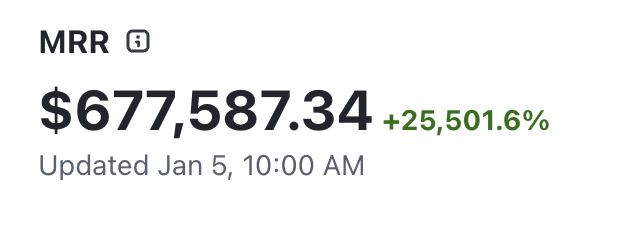
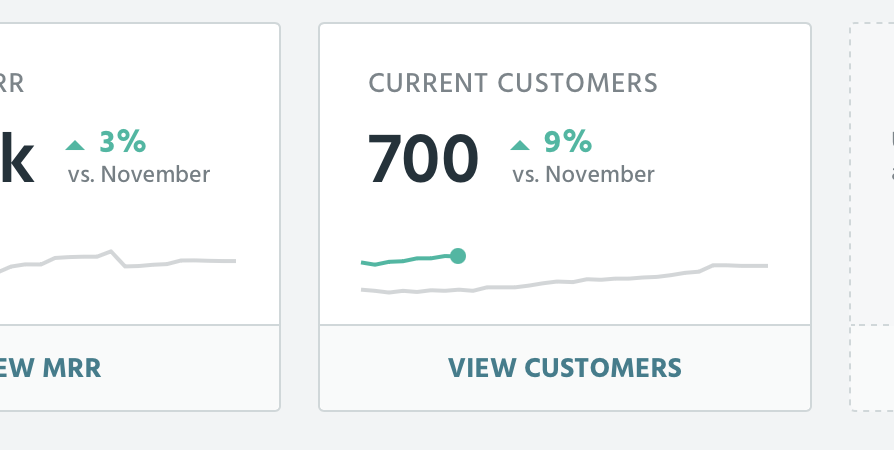
I failed. We're now at $390k MRR. Here is why I think I failed, what I learned, and my plan for this year.
1) I didn't realize how hard hiring is.
I was looking for people I can fully trust, who have common sense, taste, and skills.
These people are extremely rare. I realized that competence is a scarce resource and that common sense is not very common.
And once you find that person, convincing them to join is a different story, especially if they are already "discovered"—i.e., older with more experience, so the market already knows how good they are.
The skill you need as a founder is to be able to find the diamond in the rough, the undiscovered talent. Then you need to be able to convince them to join you. This means you need to have rizz, get used to rejections and "maybes," and be able to communicate why joining you is the best decision of their life.
Then it's a whole new journey after you hire to make sure people stay happy and motivated.
2) I needed to learn how to keep shipping fast with a bigger team.
Our engineering team is now 10 people. That's still not a lot, but you need to be very mindful of what slows you down.
With every new person, meetings become more expensive, more people have to give input even for simple problems, and more mistakes can happen.
I think there is no set process to do things here. Every company does what works for them, which means a lot of trial and error, and a lot of studying what other companies of similar size do.
What I found is that some of the principles for personal productivity still apply to teams: reduce context switching, allow time for deep work, Parkinson's Law, the 80/20 rule, etc.
I think we have now found our collective flow state where shipping is much more straightforward than it was.
But we will probably need to go through the process again once the team grows more.
3) I didn't know how enterprise deals worked.
A lot of people say enterprise deals take a long time because bigger companies move slower.
That's true in most cases, but it's due to a very critical mistake: not talking to the decision maker directly.
If you're talking with a junior product manager, they need to convince their manager, and their manager convinces their manager until it reaches the person who makes decisions.
But by then, all the value is not communicated properly because of all the layers it went through.
You need the convincing to move top-down, not bottom-up. This is much easier to do if you're doing sales yourself as the founder because you will be able to get the attention of decision makers.
The second way it can move faster is by meeting in person.
It's just easier to trust a startup with a core functionality of your product if you meet the founder in person and find that they seem competent and reliable.
4) The friction of making an enterprise change a tool they use.
I didn't realize how hard it is to convince an enterprise to switch to a new tool if they have something that works and their team is used to.
It's much easier to convince them to use something that complements it and shows ROI immediately.
Your goal is to make sure they basically don't have to do any work. You need to communicate that with very minimal effort from their end, they can see value if they use your tool.
After that works, it's a lot easier to convince them to put effort into switching tools that are so ingrained in their business.
That’s why we’re adding support for Salesforce and Zendesk ticketing and live chat for escalations, it removes that friction.
My plan for 2025:
- The hardest part, hiring, is now more manageable. I think we have the team that can get us to our goal. So, more focus on shipping.
- Experiment with doing work trials, Linear has an amazing blog on this.
- Find enterprise design partners and work closely with them to build the exact product they need. If you build a solution that works for one, it will probably work for others.
- More case studies and partnerships with other companies.
- Move to SF, see how beneficial networking with potential customers face-to-face is.
Also, I know I worked hard in 2024, and I am extremely happy with the result. I would be disappointed if I thought the failure was a result of a skill issue. It's not, it's just dealing with unknown unknowns.
This year, it's much clearer what we need to do to hit the goal, which is still the same: $1M MRR.
Very confident we will hit this before 2026.
If you hit all your goals, you're probably not ambitious enough.