HUBBLE

6.5K posts

HUBBLE banner
HUBBLE

HUBBLE

@HUBBLE_space

Official @ESA feed for #Hubble Space Telescope — the space-based observatory which has revolutionised modern astronomy. #BFFinSpace with @ESA_Webb

space เข้าร่วม Nisan 2010
435 กำลังติดตาม926.5K ผู้ติดตาม
HUBBLE
HUBBLE@HUBBLE_space·
Slithering through space with the cosmic sea slug! Access more space-themed .gifs at our giphy page: ow.ly/ajwY50YOTkq
GIF
English
0
7
50
2K
HUBBLE
HUBBLE@HUBBLE_space·
📷 @NASA , @ESA , STScI, N. Bartmann (ESA/Hubble), M. Zamani (ESA/Hubble), D. Bodewits (Auburn), J. DePasquale (STScI), B. Balick (University of Washington), G. Anand (STScI), and A. Benitez-Llambay (Univ. of Milan-Bicocca), D. O’Ryan, P. Gómez (European Space Agency), R. Crawford (STScI), D. Li (Utoronto), W. Blair (JHU) 🎶 Stan Dart - Organic Life 2/2
0
2
15
3.9K
HUBBLE
HUBBLE@HUBBLE_space·
☄️ A comet spotted crumbling in our Solar System 🦀 A return to the Crab Nebula  ⚫ And a starless relic from the early Universe Our latest episode of #SpaceSparks highlights some of Hubble's scientific discoveries from its 36th year of operations! 1/2
English
4
55
292
12.5K
HUBBLE
HUBBLE@HUBBLE_space·
Names like the “Trifid Nebula” can come from a variety of sources. Often it’s a research team studying a single celestial object who end up giving it a more familiar name as they work with it, and then that name sticks with other astronomers and eventually the public. Sometimes a name comes from the public, and of course many names are very old. In this case, the name “Trifid” is due to English astronomer John Herschel, and just means “three-lobed”. The three lobes are easier to see in the wide-field image: esahubble.org/images/heic260…
English
0
0
0
17
HUBBLE
HUBBLE@HUBBLE_space·
🆕 Hubble has turned to the Trifid Nebula for its 36th anniversary coming this 24 April. The Trifid Nebula lies about 5,000 light-years from Earth. This cloud of gas and dust somewhat resembles a marine sea lemon – a sea slug – undulating through the cosmos! 🌊 1/3
HUBBLE tweet media
English
8
147
905
69.3K
HUBBLE
HUBBLE@HUBBLE_space·
Read more here: esahubble.org/news/heic2608/ 📷 @NASA , @ESA , STScI, Leah Hustak (STScI), Christian Nieves (STScI). Image Processing: J. DePasquale (STScI), A. Pagan (STScI). Contributors: Subaru Telescope, R. Gendler. Acknowledgement: G. Bacon (STScI), J. Muzerolle (STScI), F. Summers (STScI) 3/3
English
1
10
50
4.3K
HUBBLE
HUBBLE@HUBBLE_space·
It moves up towards the left ‘horn’ of the nebula 😈 actually a Herbig-Haro object, a jet of plasma ejected by a young protostar within what appears to be the nebula’s ‘head’. To its left is a small, faint pillar. Much of its gas and dust has been blown away, but the densest material persists. 2/3
English
1
7
47
4.8K
HUBBLE
HUBBLE@HUBBLE_space·
Flying through the Trifid Nebula! This video ‘floats’ through the ridges of gas and dust in this distinctive nebula, captured anew by Hubble in an image as a gift for you to mark its 36th anniversary today. 1/3
English
10
217
1.1K
34.7K
HUBBLE
HUBBLE@HUBBLE_space·
📷 @ESA / @Hubble_Space & @NASA , STScI, N. Bartmann (ESA/Hubble), R. Indebetouw, M. Monelli, J. Dalcanton, Dark Energy Survey/DOE/FNAL/DECam/CTIO/NOIRLab/NSF/AURA, C. Murray, J. Maíz Apellániz, R. J. Foley (UC Santa Cruz), C. Kilpatrick, G. Duchêne, ESA Euclid/Euclid Consortium/NASA/Q1-2025, J.-C. Cuillandre & E. Bertin (CEA Paris-Saclay), Z. Tsvetanov, M. J. Koss, A. J. Barth, M. Postman, P. Kelly. 🎶 Tonelabs - Happy Hubble 2/2
Română
0
5
27
3.6K
HUBBLE
HUBBLE@HUBBLE_space·
Happy Anniversary! 🎊 Hubble was launched #onthisday in 1990 and, every year since, it has been surprising us with its cosmic views 📸🌌  Check out the best images Hubble had to offer in its 36th year in our latest #SpaceSparks episode! 1/2
English
22
214
862
42.8K
HUBBLE
HUBBLE@HUBBLE_space·
The jets seen in these images (HH 47, HH 34, and HH 2) are part of a series made to show their motion over time. They are roughly 1350 light-years from Earth – HH 34 and HH 2 reside near the Orion Nebula, in the northern sky. HH 47 is located in the southern constellation of Vela. Read more: esahubble.org/news/heic1113/ 📷 @NASA , @ESA , and P. Hartigan (Rice University) 2/2
English
0
9
33
4K
HUBBLE
HUBBLE@HUBBLE_space·
Our #HubbleTopImage features supersonic jets from young stars!  The glowing streams of material seen in these Hubble images are signs of star birth. Ejected episodically by young stars, the material tears across space at more than 700,000 kilometres per hour, confined to narrow beams by stellar magnetic fields. 1/2
HUBBLE tweet media
English
8
208
1K
24.2K
HUBBLE
HUBBLE@HUBBLE_space·
Hubble was launched on 24 April 1990. Since then, it has taken over 1.7 million observations, which have contributed to more than 23,000 publications 🤯 including almost 1,100 in 2025 alone! Read more: esahubble.org/news/heic2608/  📷@NASA , @ESA , STScI, Image processing: J. DePasquale (STScI) 3/3
English
0
14
72
4.7K
HUBBLE
HUBBLE@HUBBLE_space·
This isn’t the first time Hubble has taken in this scene. It observed the Trifid in 1997 and, returning now after all these years, has revealed subtle changes on a human time scale. 2/3
English
2
27
136
7.4K
HUBBLE
HUBBLE@HUBBLE_space·
Our #HubbleTopImage looks towards the disc around a black hole 🕳️👀 This image was snapped when a team of scientists used the NASA/ESA Hubble Space Telescope to observe a quasar accretion disc – a brightly glowing disc of matter that is being slowly sucked into its galaxy’s central black hole. The team’s study made use of gravitational lensing to give a boost to Hubble’s power! The incredible precision of the method allowed astronomers to directly measure the disc’s size and plot the temperature across different parts of the disc. Read more: ow.ly/3xG250YFtE9 📷 @NASA , @ESA , and J.A. Muñoz (University of Valencia)
HUBBLE tweet media
English
15
115
554
16.6K
HUBBLE
HUBBLE@HUBBLE_space·
Across a dying star 💀⭐ The Cat’s Eye Nebula is a planetary nebula. This type of object appeared round (planet-like!) in early telescopes, but the NASA/ESA Hubble Space Telescope has revealed a complex morphology – this is especially true of the Cat’s Eye Nebula! In this new image, Hubble captures the core of the billowing gas, its tapestry of concentric shells, and jets of high-speed gas and dense knots sculpted by shock interactions.1/2
English
6
219
943
28.1K
HUBBLE
HUBBLE@HUBBLE_space·
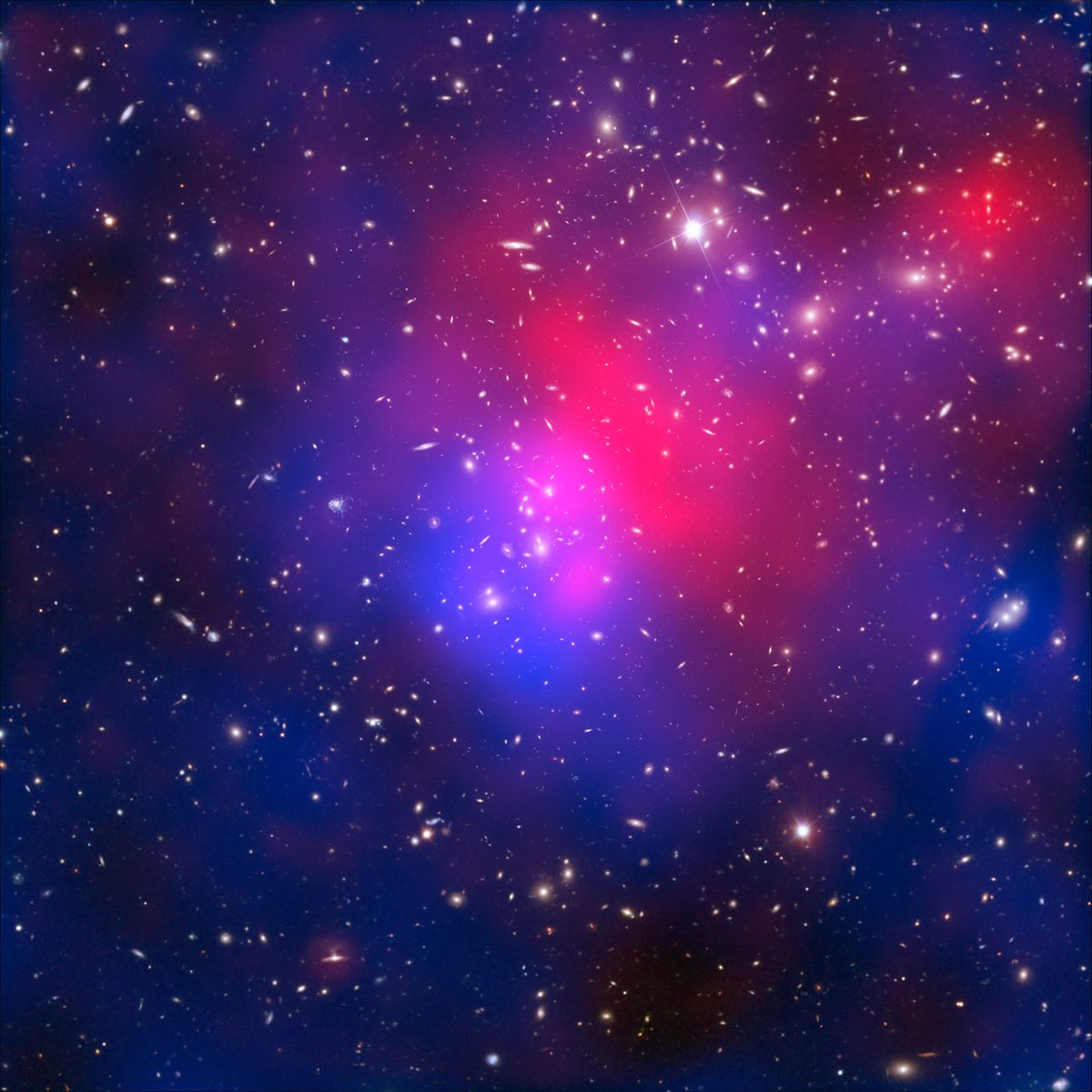
Data from Hubble, ESO’s Very Large Telescope, the Japanese Subaru telescope, and NASA’s Chandra X-Ray Observatory revealed that Pandora’s Cluster is probably the result of a simultaneous pile-up of at least four separate galaxy clusters – a collision that produced strange effects that had never been seen together before! 2/3
English
1
11
50
4.8K
HUBBLE
HUBBLE@HUBBLE_space·
Our #HubbleTopImage investigates a galactic crash 💥 This Hubble image, from 2011, helped astronomers piece together the violent history of Pandora’s Cluster (Abell 2744). When huge clusters of galaxies crash together, the resulting mess is a treasure trove of information for astronomers… 1/3
HUBBLE tweet media
English
4
84
421
13.6K