
Nas

74 posts

Nas banner
Nas

Nas

@ItsCryptoNas

Research | Ex-TradFi (PE,VC) | Early on the Next Big Thing

เข้าร่วม Mayıs 2023
999 กำลังติดตาม278 ผู้ติดตาม
Nas
Nas@ItsCryptoNas·
@shmilylt yea BTC was up but it was a super dry environment and mainly it was driven by Saylor and other big buyers not really retail
English
0
0
1
21
Ethan
Ethan@shmilylt·
@ItsCryptoNas I thought Apr has seen price up bitcoins and etc.
English
1
0
0
7
Nas
Nas@ItsCryptoNas·
Coinbase ( $COIN) just dropped Q1 earnings. Ignore the stock. The numbers tell you where the crypto market actually is. Crypto trading volumes were down 28% Q/Q. Spot down 37%. It was a slow quarter. People weren't trading. But stablecoin transaction volume hit $22T in Q1. USDC market cap reached an all time high of $80B in March. Base stablecoin volume grew 10x compared to last year. So trading slowed but actual usage didn't. That's a different market than we had in 2021. Back then everything was speculation. What's growing now is people actually moving money through crypto, not just gambling on prices. Whenever a pickup in trading volume gets layered on top of that the numbers will get very interesting very fast.
English
1
0
0
175
Nas
Nas@ItsCryptoNas·
@shmilylt Not really, April was really just a slow grind environment, wasn't a good trading environment at all for crypto, the outlook is based on the data they have till May 5.
English
1
0
0
20
Ethan
Ethan@shmilylt·
@ItsCryptoNas Any idea why Q2 outlook still looks weak? Crypto has picked up a bit.
English
1
0
0
25
Nas
Nas@ItsCryptoNas·
CoreWeave ( $CRWV) is one I've been watching really closely. Earnings just dropped and the numbers are worth going through. Revenue came in at $2.1B, up 112% year over year. They went from $982M in Q1 2025 to $2.1B in a single year. But the number that really stands out is the backlog. $99.4B in contracted future revenue, up from $25.9B a year ago. That's 284% growth in 12 months. And 75% of that is locked in for more than 2 years out. To put the backlog in context, Meta signed a $21B deal with them in March alone. Anthropic signed a multi year agreement. NVIDIA put $2B directly into the stock. These are huge customers. On paper they lost $740M this quarter. But most of that loss comes from two things: $1.15B in depreciation on all the infrastructure they're building out, and $536M in interest on the debt they're using to fund it. Strip those out and the underlying business generated $1.2B in profit on a 56% margin. They also brought in $3B in cash from operations while spending $6.8B building new data centers. The risk is the debt load. $24.9B and $536M in interest every quarter. The contracted revenue is largely take-or-pay so customers pay regardless, but CoreWeave still needs to keep financing the buildout and that's a lot of interest to carry every quarter. But the contracted revenue sitting on their books right now is genuinely unlike anything else I'm looking at.
English
0
1
5
1.2K
Nas
Nas@ItsCryptoNas·
$LNG is down 7% premarket on a $3.5 billion net loss that isn't real. It's a non-cash paper loss because of accounting rules. They have long-term gas supply contracts that have to be marked to market every quarter. International gas prices spiked hard in Q1 because of The Middle East supply issue, so the paper value of those contracts swung negative by $5.4 billion. No cash moved. The actual economics of those contracts haven't changed. If you remove this, the business had its best quarter ever. 187 cargoes exported, a record. $2.33B in Adjusted EBITDA, up 25% year over year. Distributable Cash Flow of $1.67B, up 31%. They bought back $537M of stock in the quarter and still raised full year guidance on both EBITDA and cash flow. The CEO called it an "excellent start to 2026" and pointed to elevated global energy volatility as exactly the reason the world needs more LNG capacity, not less. They have trains still coming online at Corpus Christi this year and a clear line of sight to $30 per share of run-rate distributable cash flow once expansions are complete. The business is the strongest it's ever been. The loss is just accounting rules forcing them to mark 15-year contracts against today's spot prices. Next quarter those same contracts could swing the other way and print a $3B profit. The underlying cash flow doesn't change either way.
English
0
2
7
462
Nas
Nas@ItsCryptoNas·
$IONQ Q1 2026 earnings just dropped. Revenue came in at $64.7M, up 755% year over year. Consensus was $49.7M so they beat by about 30%. Three quarters in a row of record growth. Q3 2025 was 222% YoY, Q4 2025 was 429% YoY, Q1 2026 is 755% YoY. EPS missed at -$0.34 vs -$0.26 expected but this is important to understand. The miss is entirely driven by $128M in stock based comp and $13M in acquisition costs. The core business is not underperforming, it's just an expensive period of expansion. Full year guidance raised to $260-270M and remaining performance obligations grew 554% year over year. A lot of future revenue is already contracted. This is the only pure play public quantum company actually generating real GAAP revenue at scale. Everyone else is still in the presentation stage. IonQ is shipping, winning contracts and raising guidance. At a $19B market cap you're paying around 70x forward revenue. Not cheap. But if you believe quantum computing is real, this is probably the only name where that valuation is even worth debating.
English
0
0
6
874
Nas
Nas@ItsCryptoNas·
$MSTR had their Q1 earnings call last night. A lot to unpack so let me break down what actually matters. Start with STRC. In 9 months they have grown it to $8.5B outstanding. It is now the largest tradeable preferred stock in the world. Trading $375M a day while the next largest preferred trades $15M. That is a 25x. The model as Sailor laid it out is actually pretty simple. Issue STRC at 11.5%. Buy Bitcoin. Bitcoin appreciates. Capital gains fund the dividend. Repeat. And as long as STRC issuance keeps growing, so does the Bitcoin stack. At 20% annual issuance rate they are projecting 17.7% BTC yield and accumulating 144,000 additional Bitcoin per year after paying all dividends. Now the part that Saylor is trying to change how you should think about the Bitcoin selling fear. The break even is 2.3%. That is the minimum Bitcoin needs to grow annually for the reserve appreciation alone to cover all dividends forever. At that point they sell small amounts of BTC, pocket the gain, fund the dividend without dilution. The MNAV break even for selling MSTR to buy Bitcoin is 1.22x, not 1.0x like most assume. Below 1.22x selling Bitcoin is actually the better move for shareholders than selling equity. So in a weak market, selling Bitcoin is not the worst case scenario. It is the plan. Sailor said they will probably sell some soon just to prove to the market that nothing breaks when they do.
English
0
0
3
221
Nas
Nas@ItsCryptoNas·
Quick breakdown on the two biggest US oil companies reporting today, Chevron ( $CVX )and ExxonMobil ( $XOM). Both had the same core problem this quarter: oil prices spiked hard in March, which triggered massive accounting timing effects where their paper derivative positions got marked to market at high prices while the physical barrels hadn't been delivered yet. This is a temporary mismatch that unwinds next quarter, but it made the headline numbers look ugly. - What they did well: CVX grew production 15% year over year to 3.86M barrels per day, largely from integrating Hess. US refineries ran at record crude throughput in March. They returned $6B to shareholders for the 16th straight quarter above $5B, which is genuinely impressive capital discipline. XOM had record production in Guyana, brought the first Golden Pass LNG train online adding 5% to US export capacity, and hit the highest first-quarter refinery utilization in over a decade on the US Gulf Coast. Their balance sheet is the strongest in the industry at 13% net debt-to-capital and they returned $9.2B to shareholders in a single quarter. - Where they struggled: Both companies got hammered in their downstream and trading books by those timing effects. XOM's Energy Products segment alone took a $3.4B non-cash timing hit. CVX downstream went from $823M profit in Q4 to an $817M loss in Q1 almost entirely because of this. Neither number reflects the actual economics of the business. The other headwind is the Middle East. The Strait of Hormuz situation cut XOM's production by roughly 430k barrels per day in Q1, and two Qatar LNG trains that got damaged stay offline even after Hormuz reopens. CVX has less than 5% of their portfolio in the region so the impact was more limited. The risk going into Q2 is that if oil prices fall from here, those timing effects that are supposed to unwind do so at lower prices, softening the recovery. And the Hormuz situation adds real production uncertainty for XOM specifically.
English
0
0
0
205
Nas
Nas@ItsCryptoNas·
Some thoughts around ( $CRWV) Sundar Pichai mentioned on last night's Google call that Cloud revenue would have been even higher than the 63% growth they reported if they had enough compute to meet demand. Their CFO added they are seeing unprecedented demand for AI compute from customers and internally. Google is not alone on this. Microsoft said customer demand is exceeding available capacity and they expect that to remain the case at least through the end of 2026. Amazon spent $44B in a single quarter on infrastructure. Meta raised their full year spending budget by $10B. All four are saying the same thing: demand is outpacing supply. This is a pretty direct tailwind for compute infrastructure companies like Coreweave ( $CRWV ). When the big cloud providers are at capacity, that demand goes somewhere else, and Coreweave is one of the main places it goes. They already count Google, Meta, Microsoft and Anthropic among their customers and have more than $90B in true backlog because they got more backlog recently this month. They report on May 7th. Last night gave a pretty good picture of the environment they are operating in.
English
0
0
0
97
Nas
Nas@ItsCryptoNas·
Big tech reported last night and all four beat expectations. Here is what matters. $GOOG: Google Cloud grew 63% and crossed $20B in revenue for the first time. Search revenue up 19% with more people using Google than ever. Their profit margins are expanding even as they spend more. Backlog of signed contracts hit $462B. $MSFT: Microsoft's Azure cloud business grew 40%. Their AI products are now generating $37B per year in revenue, more than doubling year over year. Copilot, their AI assistant for work, crossed 20 million paying users. $AMZN: Amazon's AWS grew 28%, the fastest in over three years. Their advertising business crossed $70B in annual revenue. Overall profit margins are improving. $META: Meta revenue up 33%. Ads are performing better and people are spending more time on their apps. Stock dropped around 6% after hours despite the strong results because they raised their spending budget for the year from $115 to 135B up to $125 to 145B. The main reason for the increase was higher component prices, particularly memory chips getting more expensive, not because the business is struggling. The bigger picture: these four companies are together spending around $600B this year building data centers and buying chips. For now the revenue growth across all four suggests they are on the right track. But free cash flow is getting squeezed everywhere as the spending ramps, and that is the thing worth keeping an eye on.
English
0
1
2
101
Nas
Nas@ItsCryptoNas·
Huge week next week
Nas tweet media
English
0
0
0
53
Nas
Nas@ItsCryptoNas·
A few more things on $PG because the organic growth was fine at 3%, the top line beat was real, but the quality of earnings underneath was weaker than the headline numbers suggest. the currency neutral core EPS was flat at $1.54. meaning all the EPS growth this quarter came from foreign exchange tailwinds, not actual business improvement. strip that out and they went nowhere year over year. also worth noting the gross margin compression in more detail. the 100 basis point core gross margin decline was driven by 180 basis points of unfavorable mix and 100 basis points of reinvestments. tariffs only contributed 50 basis points this quarter, but they flagged $400M for the full year, so that number is going to get heavier in Q4. and the Glad joint venture gain ($261M after tax) inflated the headline diluted EPS number. without that one time item, the reported EPS would have been closer to $1.52, below the $1.54 they did last year.
Nas@ItsCryptoNas

$PG reported earnings and the stock is relatively up premarket. Core EPS came in at $1.59 vs $1.57 expected. Revenue was $21.2B vs $20.6B expected. beat on both lines. but there are things worth paying attention to here. gross margin decreased 100 basis points versus last year. the main pressures are tariffs costing them $400M after tax for the full year, $150M in commodity costs, and they are increasing reinvestments in marketing and innovation on top of that. pricing only offset 50 basis points of those pressures. organic sales grew 3%, which is decent for a company this size. volume was up 2% and pricing contributed 1%. the standout segment was Beauty, up 7% organically. everything else was in the low single digits. now here's the important part. they maintained full year guidance, but then said EPS is expected to come in toward the lower end of the range. that range is $6.83 to $7.09. so while they didn't cut guidance, they quietly told you where in the range to look. the tariff impact is real. $400M after tax is not a small number for a consumer goods company running on the margins P&G runs on. the long term story here is intact. this is a company that has paid a dividend for 136 consecutive years and just raised it for the 70th year in a row. they returned $3.2B to shareholders this quarter alone. but near term, margin pressure from tariffs and reinvestment costs means 2026 is not going to be a great year for earnings growth.

English
0
0
0
175
Nas
Nas@ItsCryptoNas·
$PG reported earnings and the stock is relatively up premarket. Core EPS came in at $1.59 vs $1.57 expected. Revenue was $21.2B vs $20.6B expected. beat on both lines. but there are things worth paying attention to here. gross margin decreased 100 basis points versus last year. the main pressures are tariffs costing them $400M after tax for the full year, $150M in commodity costs, and they are increasing reinvestments in marketing and innovation on top of that. pricing only offset 50 basis points of those pressures. organic sales grew 3%, which is decent for a company this size. volume was up 2% and pricing contributed 1%. the standout segment was Beauty, up 7% organically. everything else was in the low single digits. now here's the important part. they maintained full year guidance, but then said EPS is expected to come in toward the lower end of the range. that range is $6.83 to $7.09. so while they didn't cut guidance, they quietly told you where in the range to look. the tariff impact is real. $400M after tax is not a small number for a consumer goods company running on the margins P&G runs on. the long term story here is intact. this is a company that has paid a dividend for 136 consecutive years and just raised it for the 70th year in a row. they returned $3.2B to shareholders this quarter alone. but near term, margin pressure from tariffs and reinvestment costs means 2026 is not going to be a great year for earnings growth.

English
0
0
1
309
Nas
Nas@ItsCryptoNas·
$INTC beat earnings and the stock is up 15%+ after hours. here is what happened. EPS came in at $0.29 vs $0.01 expected. Revenue was $13.6B vs $12.36B expected. massive beat on both lines. the Q2 guidance is what really moved the stock. they guided revenue at $13.8B to $14.8B for next quarter. Wall Street was expecting $13.03B. that's a $800M+ beat at the midpoint before the quarter even starts. now here's what's driving it. Data Center and AI revenue came in at $5.1B, up from $4.1B a year ago. that's the number that matters. Intel missed the GPU wave entirely, Nvidia owns that. but AI is shifting. as AI agents become more common, CPUs become critical again because agents rely on them to actually execute tasks. Intel is right in the middle of that. Client Computing (PC chips) also held up at $7.7B vs $7.1B expected, despite the broader PC market declining 11.3% this year. the gross margin story is also improving. non-GAAP gross margin hit 41%, up from 39.2% a year ago, and 6.5 points above their own January guidance. a few other things worth noting. Intel signed a deal with Elon Musk's Terafab facility to produce chips for SpaceX, xAI, and Tesla. they also locked in a multiyear deal with Google to power AI and inference workloads on Google Cloud. the foundry business is still losing money, operating loss of $2.4B this quarter. that's the part of the story that isn't fixed yet. but the losses are narrowing and 18A/14A process technology is progressing ahead of expectations. this is the 6th consecutive quarter Intel beat their own guidance. the turnaround under Lip-Bu Tan is real. the stock is up 77% year to date and tonight's print explains why.
English
0
0
0
149
Nas
Nas@ItsCryptoNas·
$FCX beat earnings, EPS came in at $0.57 vs $0.45 expected, revenue was $6.23B vs $5.61B expected. solid beat. but the stock is down 8%+ premarket and here is why. the main issue is Grasberg, their biggest mine in Indonesia. back in January they said it would be back to near full production by end of 2026. today they said that is not happening. full recovery is now pushed to end of 2027. one full year delay. because of that, their copper sales this year will be 3.1 billion lbs, down from 3.6 billion lbs last year. gold is also revised down, 0.65 million ozs this year vs 1.07 million ozs last year. on top of that, costs are going up. their cost per pound of copper for Q2 is guided at $2.24, up from $1.91 in Q1. Mainly because of the oil prices caused by Iran/US war. diesel prices in Indonesia jumped over 80% in March alone. the Q1 beat was real, but it was mostly driven by copper prices being 30% higher than last year. the price covered the production problems. if copper prices pull back, that cover goes away. The long term story here is intact, Grasberg is a world class asset and they signed a deal with the Indonesian government to extend operations beyond 2041. but 2026 is going to be a tougher year than the market was pricing in.
English
1
1
12
3.4K
Nas
Nas@ItsCryptoNas·
$LNG might be one of the better bets to have right now. Here is why. 17% of Qatar's LNG capacity just went offline. It won't come back for 3 to 5 years. That's the trade. Iranian missiles hit Ras Laffan on March 18-19 and took out two of Qatar's 14 LNG production trains. QatarEnergy confirmed it publicly: 12.8 MTPA of capacity gone, $20B in annual revenue lost, force majeure declared with China, South Korea, Italy and Belgium. Now here's why the 3 to 5 year timeline is real and not just posturing. The large-frame gas turbines needed to restart those trains are made by exactly 3 manufacturers in the world. Their order books are already 2 to 4 years out because of data center demand. This is a supply chain problem, not a money problem. Qatar can write the check tomorrow and it still doesn't matter. Qatar supplies 20% of the world's LNG. Europe was already entering 2026 with low gas storage. Asian LNG prices spiked 39% the week Qatar halted. European and UK wholesale gas prices up nearly 50%. Australia is near full capacity. Russia has supply but Europe won't touch it. The answer is the US, and the dominant US exporter is Cheniere Energy ( $LNG).
English
0
0
1
191
Nas
Nas@ItsCryptoNas·
@VanessaGrellet_ It's their latest filing on 15 Dec for the period ending 31 Oct
English
0
0
1
16
Nas
Nas@ItsCryptoNas·
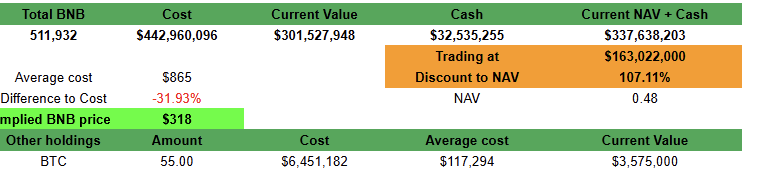
Let’s look at the numbers on $BNC. According to the latest official disclosures, they hold 511,932 BNB. At current prices ~$589, that is worth ~$301M. Keep in mind, their average cost is $865 per BNB. So they’re still materially underwater on the core position. They also still have about $32.5M in cash left. On top of that, they bought 55 BTC at an average price of $117K. I don’t get the BTC buy at 117k. If this is a BNB vehicle, why are we suddenly rotating into BTC at those levels? It feels random. And that just reinforces the idea that management is just random. Now let’s talk about valuation. BNB value (~$301M) Cash (~$32.5M) = ~$337M total NAV and Cash BNC is currently trading around $3.70, which puts the market cap at roughly $163M. So the stock is trading at 0.48 NAV. That means there’s roughly 107% upside just to reach just 1 NAV. If you look at it purely as BNB exposure, buying BNC here is like buying BNB at $318, while spot BNB is trading around $589. For BNC to simply trade at 1x NAV, the share price would need to be around $7.66.
Nas tweet media
English
4
1
6
594
Nas
Nas@ItsCryptoNas·
@VanessaGrellet_ Yea, they kept them, exactly why i am confused, why not Swap them into BNB as a BNB vehicle or even swap them into cash at the time of the PIPE, as a BNB vehicle you shouldn't be exposed to any other asset other than BNB
Nas tweet media
English
1
0
1
33
Nas
Nas@ItsCryptoNas·
i don't think they can just rotate to other assets, there are multiple shareholders and a lot of big names there including YZi labs, what YZi Labs and CZ is trying to do now is to make sure they can have more control over this vehicle, IMO that is the best outcome. Till they figure this out i think the NAV would stay compressed as people giving it a discount for the current management
English
1
0
0
49
Tomer Bariach
Tomer Bariach@TBariach·
@ItsCryptoNas It's like buying - but what promise me they won't rotate to other assets? make so weird leverage
English
1
0
0
32
Nas
Nas@ItsCryptoNas·
@VanessaGrellet_ Apparently they received those BTC in August 2025 in the PIPE they did, they received Cash, USDT, USDC and those BTC, they recorded the cost at market price at the time of the deal.
English
1
0
0
51