ทวีตที่ปักหมุด
Kevin
18.9K posts


Kevin
@KALAccountants
I'm a beancounter. I count other people's beans. KAL Accountants is a small practice that cares.
Blantyre เข้าร่วม Şubat 2012
1.4K กำลังติดตาม1.2K ผู้ติดตาม
Kevin รีทวีตแล้ว

The SFA enquiry into the Scottish Cup aftermath at Ibrox has released its suggested format for ingress and egress around the segregation area in the next game between the clubs on 10th May.
Poirot@Argenpoirot
Pakistán e India se odian, viven en guerra, tienen una carrera de arsenal nuclear. Sin embargo tienen la mejor ceremonia de apertura y cierre de frontera del mundo.
English
@scotlandscoeff1 The shout was always ‘head was low!’ and claim a foul if any player stooped in to a header.
He’s not entitled to go for the ball with his head in that position, it’s dangerous play. Unbelievably bad decision.
English

Having watched this again, the Hearts player actually headers the ball away from the Motherwell player.
IFAB describe "Playing in a dangerous manner is any action that, while trying to play the ball, threatens injury to someone (including the player themself)"
Fair argument to say it's dangerous play by the Hearts player as heading the ball while lying on the crowd opens you up to the chance of taking a boot to the head....
x.com/i/status/20430…
Scotland’s Coefficient@scotlandscoeff1
The penalty that turned the game in Hearts favour. Seeing a lot of complaints about this online. Personally can't see how they don't give it
English

Consistently the most informative, interesting and rational account regarding Scottish football that exists.
Scotland’s Coefficient@scotlandscoeff1
🆕🏴 Hearts Finishing At Home Was A Mathematical Impossibility There was literally no set of fixtures with Hearts home last AND - no derbies last day - all teams end H/A or A/H - max 2 in a row H or A - all games at same time match 37&38 @EwenDCameron scottishfootball.info/p/hearts-finis…
English
Kevin รีทวีตแล้ว

Jon Ossoff just OBLITERATED Tulsi Gabbard while grilling her on Trump's claims from June that Iran's nuclear program was obliterated.
Watch this. 🔥
English
Kevin รีทวีตแล้ว

@israel_ajoje FSR rule book
Work around
New rule to combat
Work around
New rule
Work around
New rule…
Repeat ad infinitum
That’s how tax law has worked for centuries. 🫣
English

@KALAccountants There probably already are smokes and mirrors even.
I'm sure clubs are already thinking of how to go about the impending squad cost ratio
English
This one is a football accounting gem. I promise you will love it.
In January 2023, Chelsea signed Mykhailo Mudryk from Shakhtar Donetsk for £88.5 million. The deal was jaw dropping on its own. But what really made the football world stop and stare was not the fee. It was the contract length. Eight and a half years. The longest contract in Premier League history at the time.
Journalists questioned it. Rival clubs complained about it. And most fans had absolutely no idea what Chelsea were actually doing.
But let me tell you. They were not being reckless. They were doing math. Very clever, very deliberate, very legal math. And the tool they were using is called amortisation.
This is part of what football insiders consider during transfers.
Are you with me? Good.
Here is the simplest way to understand amortization. When a club signs a player, they spread the accounting of the cost of the transfer fee over the period of the contract signed by the player.
So for example, when Harry Maguire signed for Manchester United in 2019 for £80 million on a six year deal, that did not show up as an £80 million expense in year one. It worked out as an annual amortisation cost of £13.3 million per year.
That is the entire concept.
Think of it the same way you think of a mortgage. You do not pay the full value of a house on the day you move in. You spread it. Football clubs do the exact same thing with players, and it is not a trick or a cheat. It is standard accounting practice used across every industry in the world. Check it. It's International Standard 38- used for accounting for intangible assets.
The reason it matters so much in football is because of Financial Fair Play and Profitability and Sustainability Rules, which regulate how much clubs can lose in any given period.
Amortisation costs are added to the profit and loss account each year, so the lower your annual amortisation figure, the healthier your books look. And here is where contract length becomes a weapon.
Now let us do the math together.
By using amortisation to complete Mudryk's transfer, Chelsea were able to record his £80 million fee as just £9.41 million per year for UEFA's FFP calculation. Had they signed Mudryk to a four year deal instead, his fee would have been recorded as £20 million per year. Same player. Same fee.
More than double the annual accounting cost just by changing the contract length. That is the power of what Chelsea figured out. They did the same with Enzo Fernandez, signed for a then-British record of £106.8 million on an eight and a half year deal, which translated to an annual amortisation expense of approximately £13.4 million.
And Moises Caicedo for £115 million on eight and a half years. And Wesley Fofana for £70 million on seven years. Repeat this across an entire squad and a billion pounds of spending starts to look manageable on paper.
Did you get that?
Now let's look at another part of amortization- the book value piece, because this changes how you think about every transfer you have ever watched.
Book value is the difference between the transfer fee spent on a player minus what has already been amortised.
For example, after two years, a £50 million player signed on a five year deal has a book value of £30 million. Any sale above £30 million is recorded as a profit. Anything below is a loss. This is why clubs can sell a player for what looks like a loss and still report a gain in their accounts.
Take this example: a player is signed for £40 million on a five year contract. He is not a success and is sold two years later for £26 million. At the point of sale, his book value is £24 million, meaning the club actually books a £2 million profit on the deal. Fans see terrible business. The accountants see a gain. Same transaction, completely different reality.
Manchester City lived this with Robinho. He was bought for £32.5 million on a four year deal in 2008, with annual amortisation of £8.1 million. He was sold after two years, leaving a book value of £16.3 million. City sold him for £18 million and claimed a £1.7 million profit on the sale. Supporters spent years calling it a disaster. The finance department called it a profit.
There is one more trick worth knowing: contract extensions. If a player signs a new contract during their existing deal, the remaining unamortised value is spread over the length of the new contract.
So if you bought a player for £60 million on a five year deal and after two years you extend his contract by three more years, the remaining £36 million book value is now spread across five new years instead of three.
That reduces the annual amortisation cost and can reduce FFP losses by millions per year. Extending a contract is not always about keeping a player happy. Sometimes it is purely a financial decision dressed up as a vote of confidence.
Back to Chelsea. Other clubs eventually complained loudly enough that UEFA had to act. UEFA amended its Financial Sustainability Regulations in July 2023, introducing a rule that limits the amortisation of player registrations to a maximum of five years, regardless of how long the contract actually runs.
The Premier League followed in December 2023, when shareholders voted to apply the same five year maximum to all new or extended player contracts going forward. The loophole was closed. But crucially, the rule could not be applied retrospectively, meaning every player Chelsea signed on those long contracts before December 2023 continues to be amortised over the full contract length.
Chelsea were already finished with their biggest spending windows by the time the door was shut. The timing was not a coincidence.
As I conclude, always remember this- the contract is never just a contract. It is an accounting instrument. And the clubs that understand that are always three moves ahead of the ones that do not.
I hope you enjoyed this.
Tomorrow, by 7AM WAT, We get into the wage bill, and why a £50 million transfer can quietly become a £150 million commitment before you have blinked.
Thanks for reading.
My name is Ajoje. I am a FIFA Licensed Agent and International Sports Lawyer. I write on the Law and Business of Football, a lot. Repost and Follow if you want to read more posts like this.

English
@Kepler_PhD @LordArche @20th_Centurygal Went to Dublin a few years ago for the anniversary tour. Croke Park. Awesome.
The wife and I now call ‘bullet the blue sky’ the toilet song. Absolute stampede! 🤣👍🏼
English

@LordArche @20th_Centurygal 'Bullet the Blue Sky' is the only loser. Otherwise, a near perfect album.
English


@tirnaog_09 Thats the worst list Ive ever seen, obviously fir all the reasons you have said but even the fact Andy Robertson is way above Willie Miller or Colin Hendry above the Maestro makes it immediately invalid without having to put an ounce of thought into it….
English

I know these lists are usually a bit or click bait but this one is particularly poor. I mean come on, not a single Lisbon Lion & Alan Hutton gets in, no Jim Baxter or Jimmy McGrory or either. I think somebody about 15 made this one up.

English
Kevin รีทวีตแล้ว

GLASGOW
3 WEEKS TONIGHT
Last night of my tour @GlasgowPavilion as part of @GlasgowComedy
One of the biggest gigs of my career. If you enjoy my stuff it would be class to have you there.
trafalgartickets.com/pavilion-theat…

English
@scotlandscoeff1 98/99 I worked with a boy who spread bet on the aggregate total of shirt numbers (it was the 2nd season of squad numbers I think) of goal scorers in Rangers 7-0 win at Perth. He made a fortune!! 🤣
Celtic’s 9-0 at tannadice was met with deafening boos on 90 cos no injury time 🤣
English
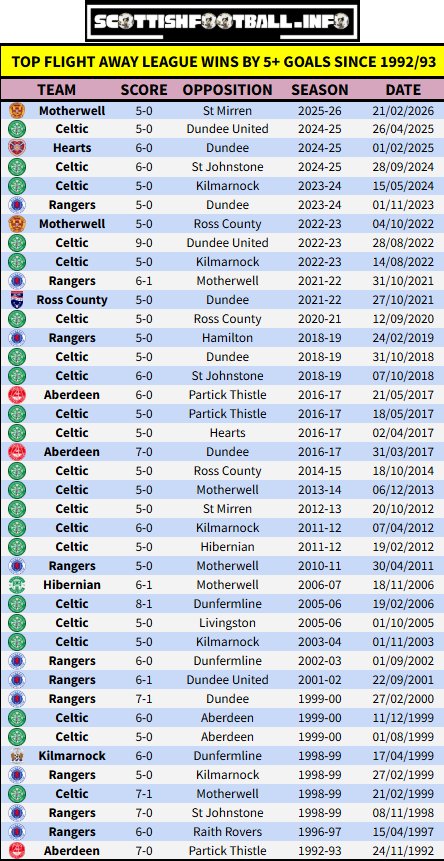
5️⃣ The 40 away wins in the top flight by 5+ goals since 1992/93
Celtic and Rangers account for 31 of the 40!
Rare achievement by Motherwell at the weekend 👏
Scotland’s Coefficient@scotlandscoeff1
🆕5⃣ Motherwell won by 5 goals away from home in the league The away team has done this just 145 times in past 22,500 Scottish matches! In the top flight, a non-Old Firm team has managed it just NINE times since 1992/93 ⤵️ 50p per week subscription scottishfootball.info/p/title-race-h…
English