ทวีตที่ปักหมุด

Verifiable Public Trigger & Motive Vector
Institute for Exotic Science as “Public-Facing Persona”
In December 2018, Amy Eskridge — alongside her father Richard H. Eskridge as CTO and co-founder — delivered a landmark 35-page presentation at HAL5 titled *“A Historical Perspective on Anti-Gravity Technology.”* This deck stands as the clear, documented public launch point for their work.
The structure was methodical:
• Gravity fundamentals (inverse-square law and graviton hypothesis)
• Historical experiments
• Modern research efforts
• Bold conclusions and recommendations
The team was framed as a “Huntsville-based father-daughter company with expertise in gravity modification research & development.” The Institute for Exotic Science was established as a Public Benefit Corporation focused on quantum computing, gravity modification, metamaterials, and communications — with international collaborators. It was explicitly their public-facing vehicle.
Key Technologies Highlighted
• Biefeld-Brown electrogravitics: Asymmetric capacitors creating high-voltage dielectric fields. Vacuum chamber tests were cited as evidence against simple ion wind effects (linked to a 1960 patent).
• Podkletnov’s experiments: Rotating YBCO superconductors claimed to produce “gravity shielding” with approximately 2% weight reduction. Supported by a 2001 patent and early 2000s NASA Marshall Space Flight Center collaboration.
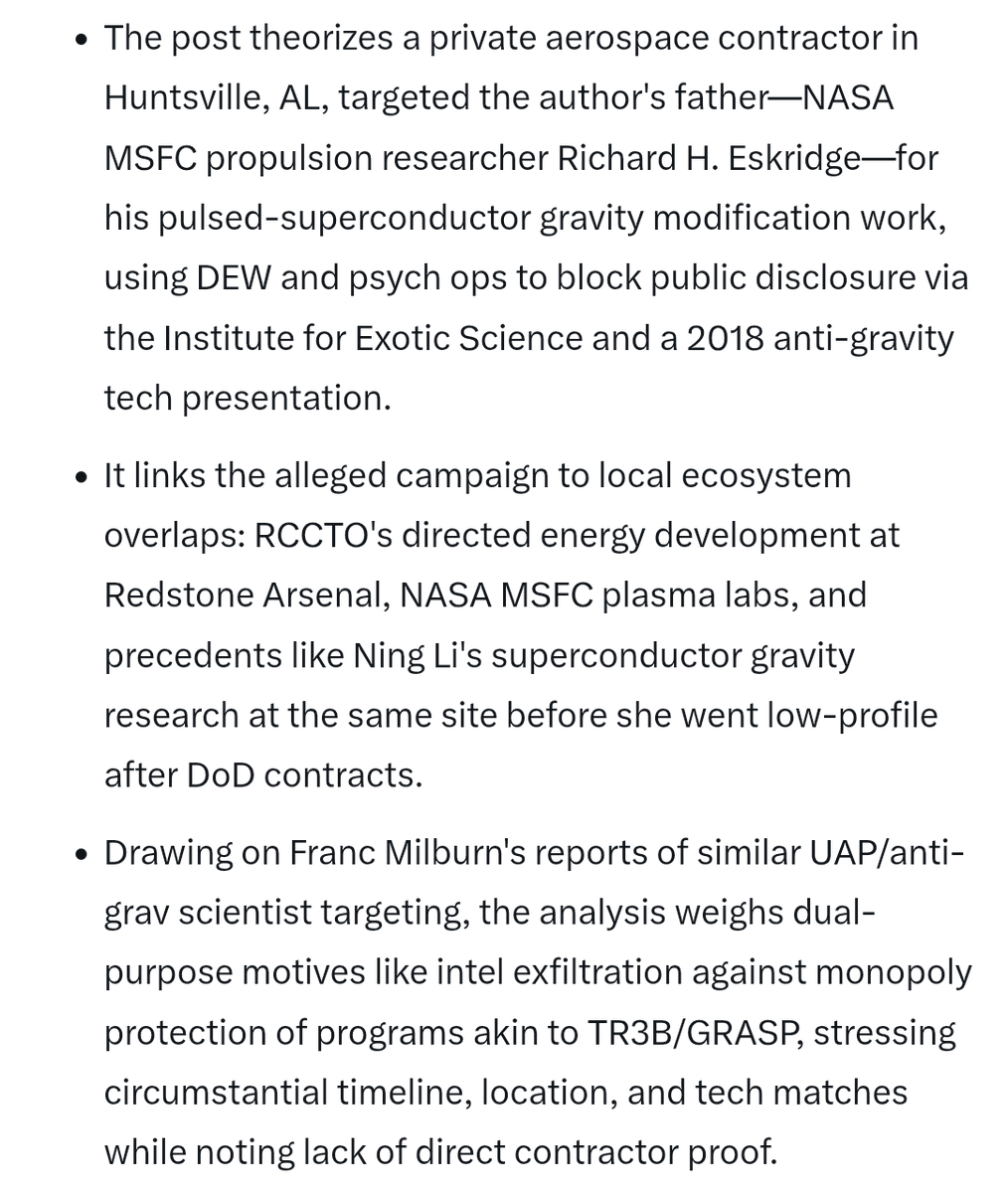
• Ning Li and AC Gravity: Work at UAH and NASA MSFC around 1996 involving magnetic fields on superconductors to align ion spins, potentially generating gravitomagnetic and gravitoelectric effects. Secured a $500k DoD contract in 2001 before the research reportedly “disappeared.”
• References to Boeing Phantom Works’ GRASP program and the TR3B “black triangle”/Alien Reproduction Vehicle concepts, with mechanisms compared to Biefeld-Brown generators.
The conclusion slide delivered the core motive in stark terms:
“Promising results always disappear into the classified realm — how do we fix this?”
Their proposed solution: Develop testable theories and pursue independently funded private research. This directly positioned the Institute as the mechanism to circumvent classification barriers and publicly release “novel foundational work,” including Richard Eskridge’s NASA-derived gravity modification research.
Public Disclosure Intent (2020 Podcasts with Jeremy Rys & Mark Sokol):
Amy was explicit about the Institute’s role in disclosure:
“If you stick your neck out in public, at least someone notices if your head gets chopped off. If you stick your neck out in private… they will bury you, they will burn down your house while you’re sleeping in your bed and it won’t even make the news. That’s why the institute exists.”
She spoke of planned NASA approval for the public release of “novel foundational work regarding antigravity.” This created a direct and verifiable threat vector to entrenched classified propulsion programs.
The NASA Connection — Richard H. Eskridge:
With decades at NASA Marshall Space Flight Center (1983–retirement) as Lead Technical Adviser in the Propulsion R&D Center, his background included pulsed plasma thrusters (PT-1 plasmoid thruster), electric guns, micro-meteoroid guns, combustion physics, and fusion concepts.
Most significantly, he conducted research into “anomalous gravitational effects of electrically pulsed superconductors” — placing him squarely in the same technical lineage as Podkletnov and Ning Li.
Further connections appear in the 2021 NASA Technical Memorandum on Pope-Osborne Angular Momentum Synthesis (POAMS), exploring links between angular momentum, nucleonic spin, and potential gravity modification (with reported positive results from bismuth spin experiments at MSFC).
Amy’s strategy centered on bringing this foundational, NASA-rooted work into the public domain."
English