ML in PL

826 posts

ML in PL banner
ML in PL

ML in PL

@MLinPL

ML in PL Association is a non-profit organization devoted to fostering the machine learning community in Poland and promoting a deep understanding of ML methods
Warsaw, Poland เข้าร่วม Nisan 2018
61 กำลังติดตาม1.6K ผู้ติดตาม
ML in PL
ML in PL@MLinPL·
It's a good reminder of how many Polish researchers are contributing to the field, often scattered across labs and teams around the world. Some of them are part of ML in PL, many aren't. This is based on public data and our best effort — not a definitive source.
English
1
0
0
44
ML in PL
ML in PL@MLinPL·
How many Polish researchers made it into #ICLR2026? We couldn't find a clear answer. So we made a list.
ML in PL tweet media
English
1
1
8
130
ML in PL
ML in PL@MLinPL·
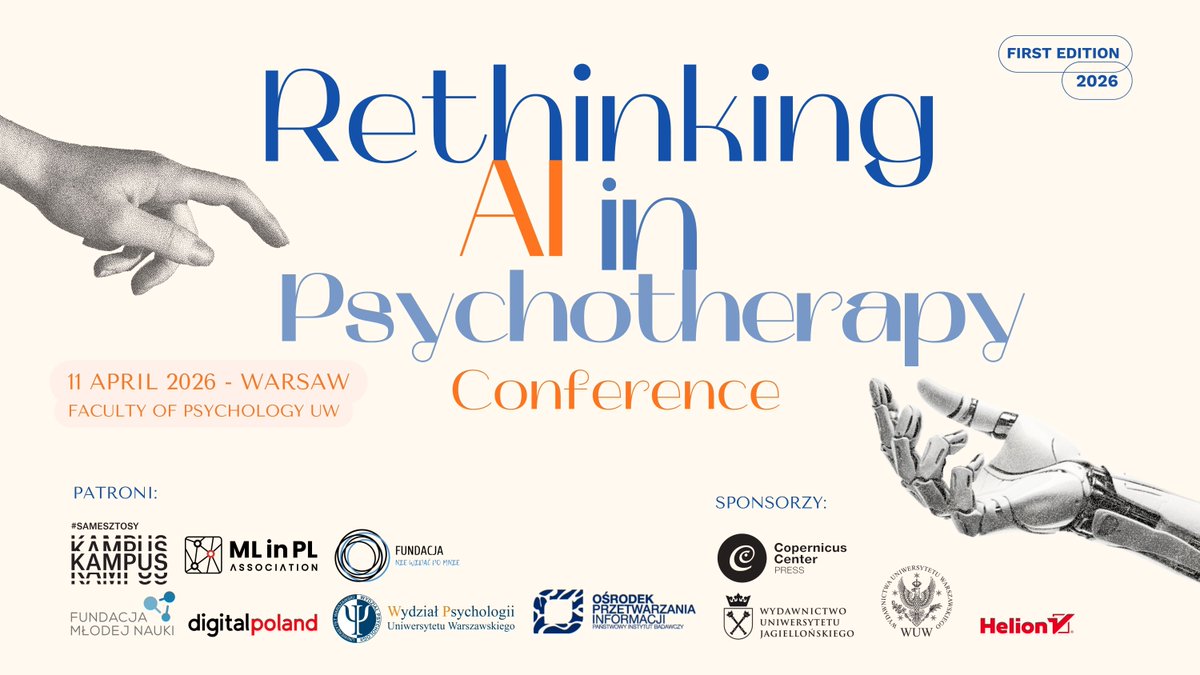
We are pleased to announce that ML in PL Association has become a media patron of the 1st National Conference “AI in the Study of Mind and Behavior”, organized by the Psychology & AI Research Lab (PAIR) at the Faculty of Psychology, University of Warsaw. The event will take place on April 11, 2026, from 10:00 a.m. to 5:00 p.m., at the new Faculty of Psychology building, located at 2D Banacha Street (Ochota Campus). The theme of this year’s edition is „Rethinking Psychotherapy”. The conference AI in the Study of Mind and Behavior aims to create an interdisciplinary space for the exchange of knowledge between the academic community, psychotherapists, and experts working on the development and applications of artificial intelligence. During the event, participants will discuss the possibilities of using AI in psychological research and psychotherapeutic practice, with particular attention to ethical issues and the impact of new technologies on mental health. This year’s speakers include: ● Artur Wiśniewski, MD, PhD, a psychiatrist and certified cognitive-behavioral therapist, who will discuss the ethics of implementing artificial intelligence in psychotherapy – from international standards to everyday clinical practice. ● Hubert Plisiecki, PhD, an AI researcher at the IDEAS Research Institute and psychologist, who will present an AI-based analysis of language as a tool for studying mental processes. ● Beata Rajba, PhD, a psychologist and philologist from Collegium Witelona State University, who will discuss the mechanisms that lead young people to form pseudo- therapeutic relationships with AI chatbots. ● Paweł Szczęsny, PhD, a psychologist, biologist, and bioinformatician, founder of the IMPERSONATO laboratory, who will present an analysis of typical “failure modes” in AI systems used in psychological support contexts. More information about the event and registration: Facebook: pair-conference.pl/index.html Registration: pair-conference.pl/register.html
ML in PL tweet media
English
0
0
0
135
ML in PL
ML in PL@MLinPL·
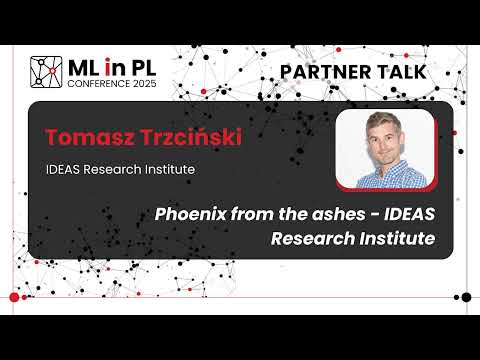
Time to check out a new batch of recordings! Tomasz Trzciński (IDEAS Research Institute) – Phoenix from the ashes – IDEAS Research Institute Does Poland deserve a full-fetched AI center focused on research excellence in artificial intelligence? If your answer is ‘yes’, welcome to the club. We think so too, and this talk will hipefully convince you we are all right. Get a short peek behind the scenes of the recently established publicly-funded IDEAS Research Institute, founded on the ashes of the sound-alike subsidiary of the National Research and Development Center. Maciej Zdanowicz, Mateusz Błajda (RTB House) – Sequential Representation Learning for Real-Time Bidding This talk presents ongoing work on integrating large-scale sequential user modeling into real-time bidding (RTB) systems — a domain where extreme latency constraints typically prevent the use of computationally intensive architectures. It begins with a short introduction to online advertising, outlining the key machine learning challenges that arise in high-throughput bidding environments. Aleksandra Chrabrowa, Mateusz Marzec (Allegro) – Evolving Search and Recommendations at a Leading E-commerce Platform Allegro stands as the largest e-commerce marketplace of European origin, with search and recommendation systems at its core. How do you inspire users or generate complementary recommendations within a single modeling paradigm? How do you cater to the long tail of search queries or incorporate multiple modalities within one model? In this talk, explore the challenges of training pipelines for coexisting models. Links in the thread ⬇️
ML in PL tweet media
English
1
0
2
174
ML in PL
ML in PL@MLinPL·
Research on AI safety and alignment will also be part of the programme at MLSS R&S 2026. 🎤 Anna Sztyber-Betley is an assistant professor at the Institute of Automatic Control and Robotics, Faculty of Mechatronics, WUT. She is an enthusiast of AI and ML education. Recently cooperates with Truthful AI (Berkeley) on AI Safety projects. 🎤 Jan Betley worked as a software developer for over a decade before shifting to AI safety in 2023. He is an ARENA and Astra Fellowship alumni, interested in anything related to out-of-context reasoning in LLMs. Currently works as an independent researcher with Truthful AI, Berkeley. 🎟 Regular registration for MLSS R&S 2026 is now open. Details in the first comment. 📍 Kraków, Poland 📅 June 29 – July 3, 2026 @GMUMJU @JagiellonskiUni @ELLISforEurope #MLSS #MLSS2025 #MLSS2026 #MLinPL
ML in PL tweet media
English
1
1
5
211
ML in PL
ML in PL@MLinPL·
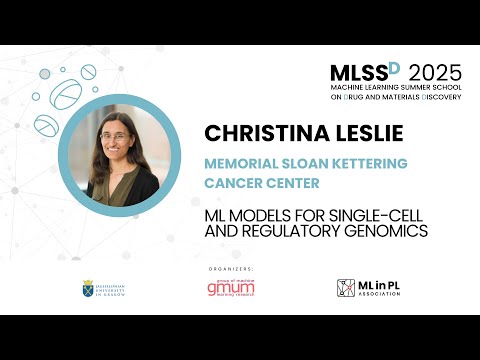
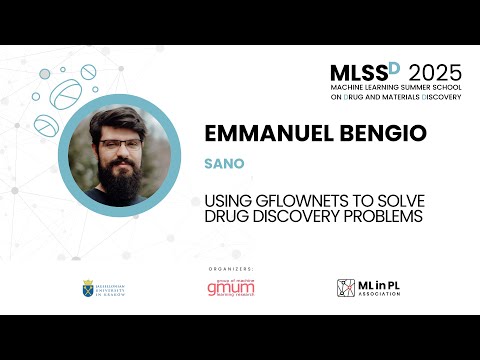
Machine learning in the life sciences spans everything from understanding gene regulation to designing entirely new molecules. Two more recordings from MLSS 2025 in Kraków are now available: Christina Leslie — ML Models for Single-Cell and Regulatory Genomics On machine learning methods for modelling gene regulation and single-cell data, and the challenge of extracting robust biological insight from complex, high-dimensional signals. 🎥 youtu.be/9_gNiRJX6kY Emmanuel Bengio — Using GFlowNets to Solve Drug Discovery Problems On generative flow networks as a principled framework for structured exploration in molecular discovery. 🎥 youtu.be/SMzgPjVkepk If you're interested in how machine learning methods are developed, evaluated and applied this year's edition will continue that conversation - with a focus on reliability and safety. 🎟 Regular registration for MLSS R&S 2026 is now open. Details: mlss2026.mlinpl.org #MLSS #MLSS2025 #MLSS2026 #MLinPL
YouTube video
YouTube
YouTube video
YouTube
ML in PL tweet media
English
0
0
1
79
ML in PL
ML in PL@MLinPL·
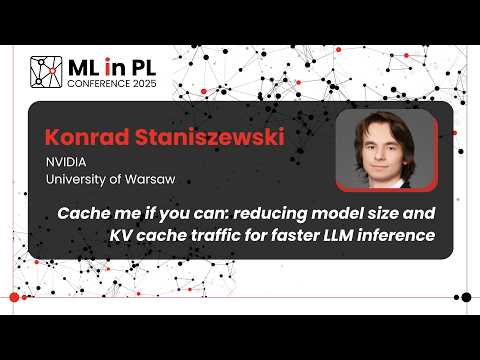
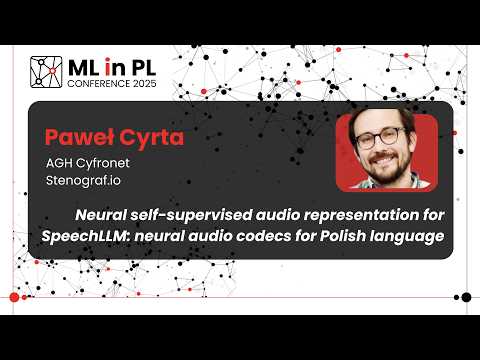
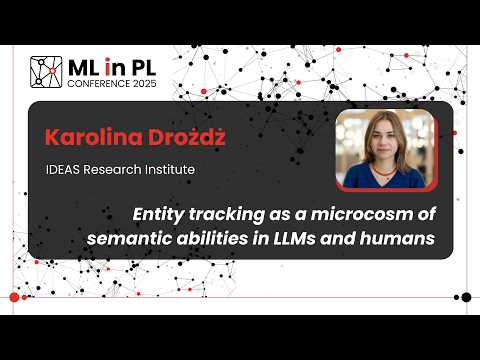
A new batch of recordings is now available! Konrad Staniszewski - Cache Me If You Can: Reducing Model Size and KV Cache Traffic for Faster LLM Inference How can we make LLM inference faster without sacrificing accuracy? This talk examines how to accelerate LLM inference by tackling the memory and bandwidth costs of the key–value cache. It presents compression and optimization techniques that reduce model size and KV-cache traffic, enabling faster and more efficient inference without sacrificing model performance. Paweł Cyrta – Neural Self-Supervised Audio Representation for SpeechLLM: Neural Audio Codecs for Polish Language This talk evaluates a wide range of self-supervised audio encoders and neural codecs for Polish speech, benchmarking them on the BIGOS dataset and proposing a Polish-optimized representation. The work also explores synthetic dialogue generation as a way to train high-quality speech models despite limited natural data. Karolina Drożdż – Entity Tracking as a Microcosm of Semantic Abilities in LLMs and Humans How well do language models understand and track entities across a narrative? This talk investigates entity tracking as a core semantic capability, comparing humans and a range of LLMs in tasks that require maintaining coherent representations of objects and their states in discourse. The results reveal that some modern instruction-tuned models can even surpass average human performance in certain conditions. Links are available below⬇️
ML in PL tweet media
English
1
0
1
90
ML in PL
ML in PL@MLinPL·
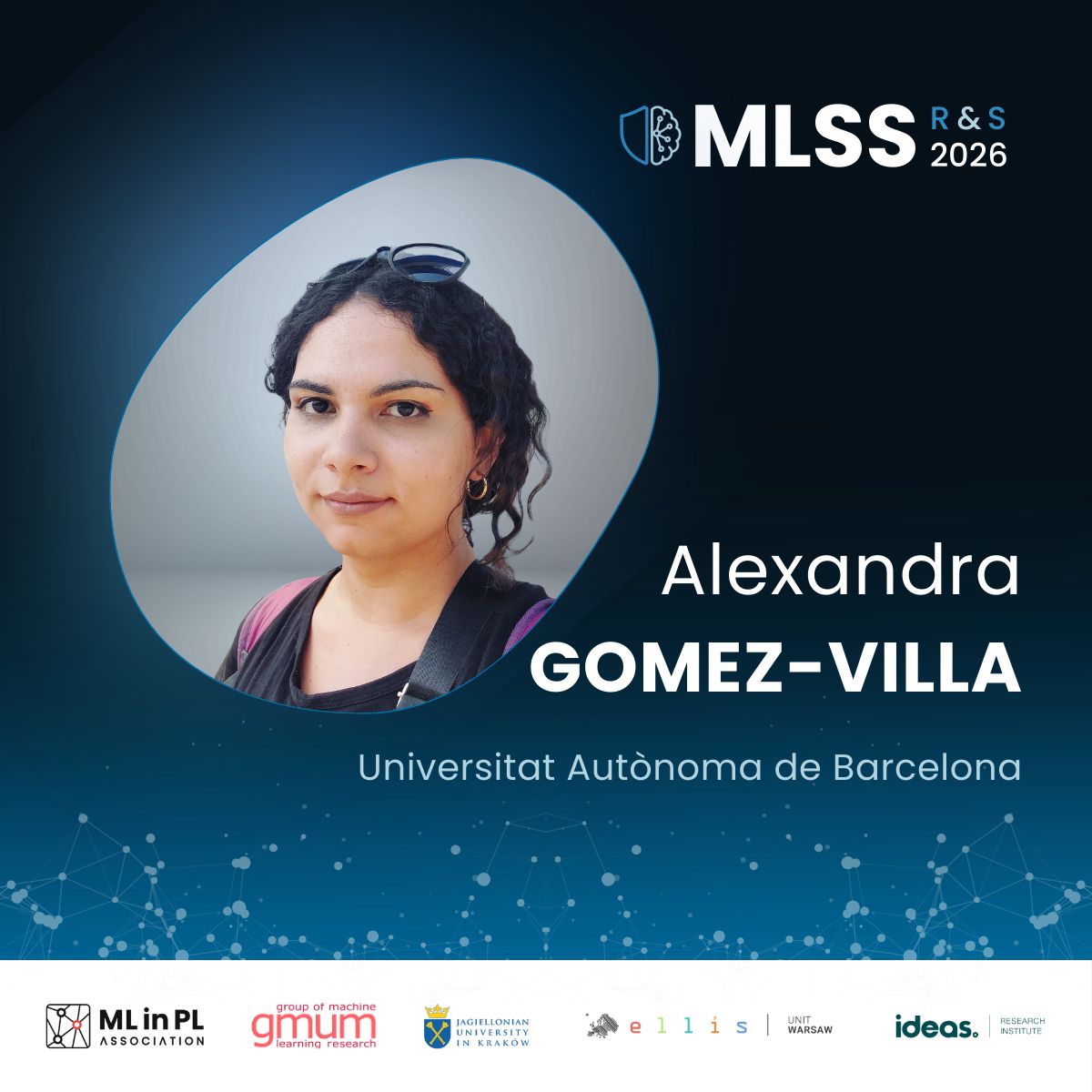
We’re pleased to introduce another researcher joining the MLSS R&S 2026 speaker lineup. 🎤 Alexandra Gomez-Villa is an Assistant Professor at the Universitat Autònoma de Barcelona, Spain, where she is a member of the Computer Vision Center. Her research focuses on emergent properties in foundation models, continual learning, and generative image models. She completed her PhD at the Computer Vision Center, with previous research positions at Universitat de València and Universitat Pompeu Fabra. She has published in leading venues including CVPR, NeurIPS, ICLR, and ECCV, with over 1140 citations. 🎟 Regular registration for MLSS R&S 2026 is now open. Details in the first comment. @GMUMJU @JagiellonskiUni @ELLISforEurope #MLSS #MLSS2025 #MLSS2026 #MLinPL
ML in PL tweet media
English
1
2
7
257
ML in PL
ML in PL@MLinPL·
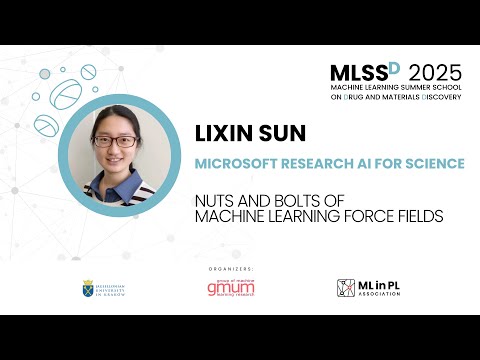
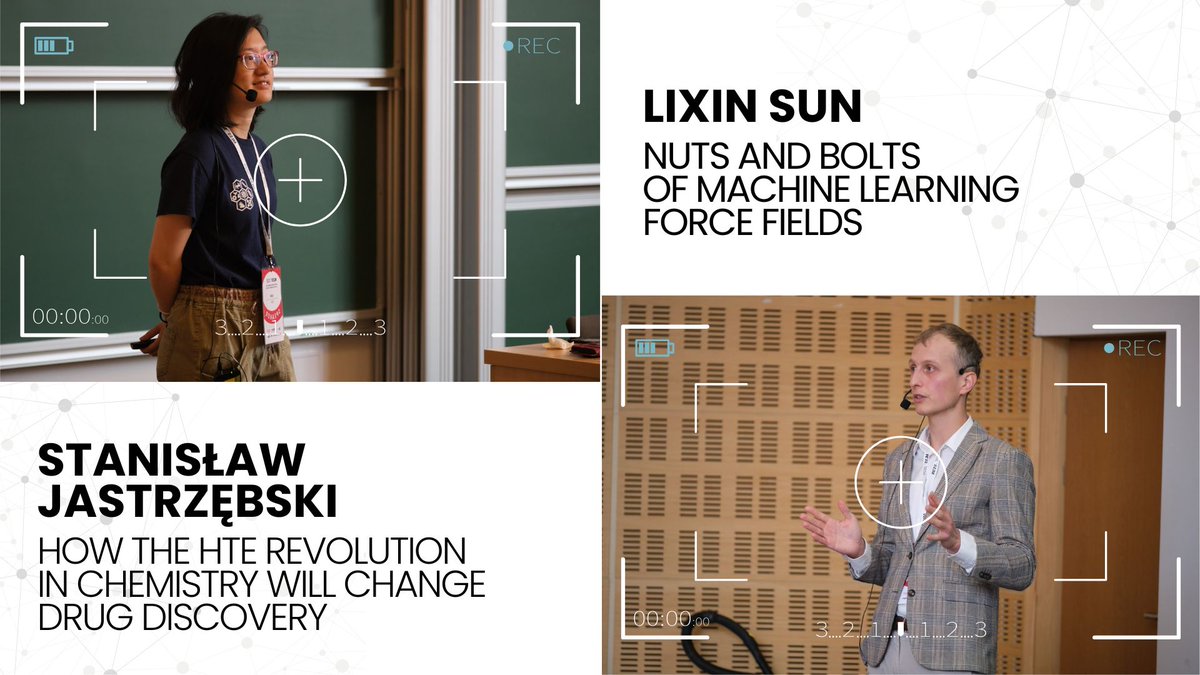
Two more lectures from MLSS 2025 just went live. If you’re considering joining us in Kraków this summer, Early Bird registration ends on March 8! Lixin Sun — Nuts and Bolts of Machine Learning Force Fields A technical overview of machine learning force fields, their practical implementation, and the computational considerations behind their performance in materials and molecular modelling. 🎥 youtu.be/RIi4vIkuKY4 Stanisław Jastrzębski — How the Quiet High-Throughput Revolution in Synthetic Chemistry Will Change Drug Discovery Forever On the evolving interface between synthetic chemistry and machine learning, and how large-scale experimentation reshapes modelling and discovery workflows. 🎥 youtu.be/8YbYX_duYxI 🎟 If you’re planning to join MLSS R&S 2026, now is the time to register: mlss2026.mlinpl.org #MLSS #MLSS2025 #MLSS2026 #MLinPL
YouTube video
YouTube
YouTube video
YouTube
ML in PL tweet media
English
1
0
4
141
ML in PL
ML in PL@MLinPL·
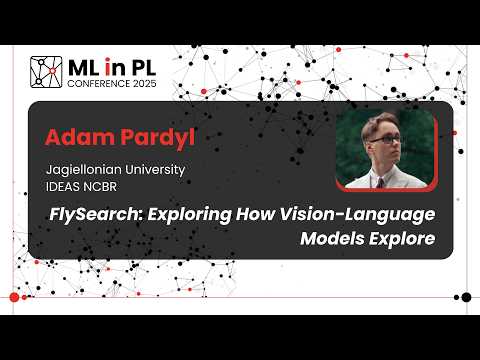
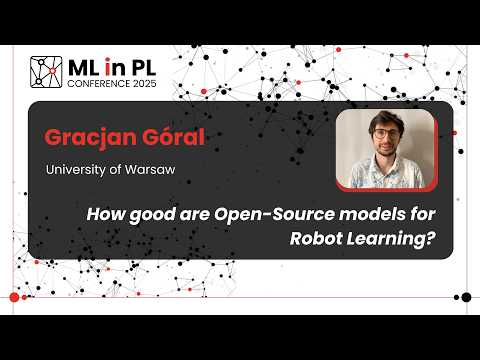
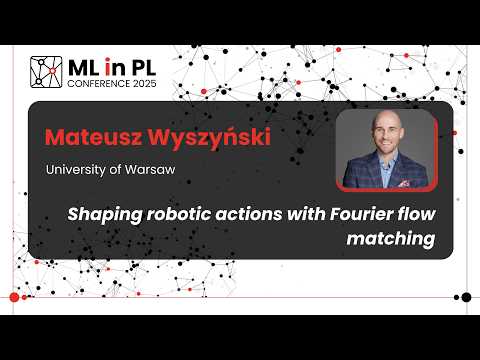
New recordings from ML in PL Conference 2025 are now online - you'll find the links in the comments below! Adam Pardyl - FlySearch: Exploring how vision-language models explore This talk introduces FlySearch, a 3D outdoor photorealistic benchmark for object search and navigation. State-of-the-art VLMs fail to reliably solve even the simplest exploration tasks, and the talk identifies key failure modes — from hallucination to planning failures — showing that some can be addressed through finetuning. Gracjan Góral - How Good Are Open-Source Models for Robot Learning? This talk investigates open-source VLMs as a foundation for Generative Value Learning (GVL) in robotics. While a performance gap to proprietary models exists, open-source alternatives show real promise — and the talk demonstrates that finetuning on the GVL task improves physical reasoning, alongside a new benchmark suite for standardized evaluation. Mateusz Wyszyński - Shaping Robotic Actions with Fourier Flow Matching - Best Contributed Talk of ML in PL Conference 2025 This talk introduces a Fourier-based flow matching approach for Vision–Language–Action models, representing action trajectories via Discrete Cosine Transform rather than predicting them directly in action space. An asynchronous plan–execute scheme lets the robot keep moving while the next action is being inferred, improving responsiveness.
ML in PL tweet media
English
1
0
4
125
ML in PL
ML in PL@MLinPL·
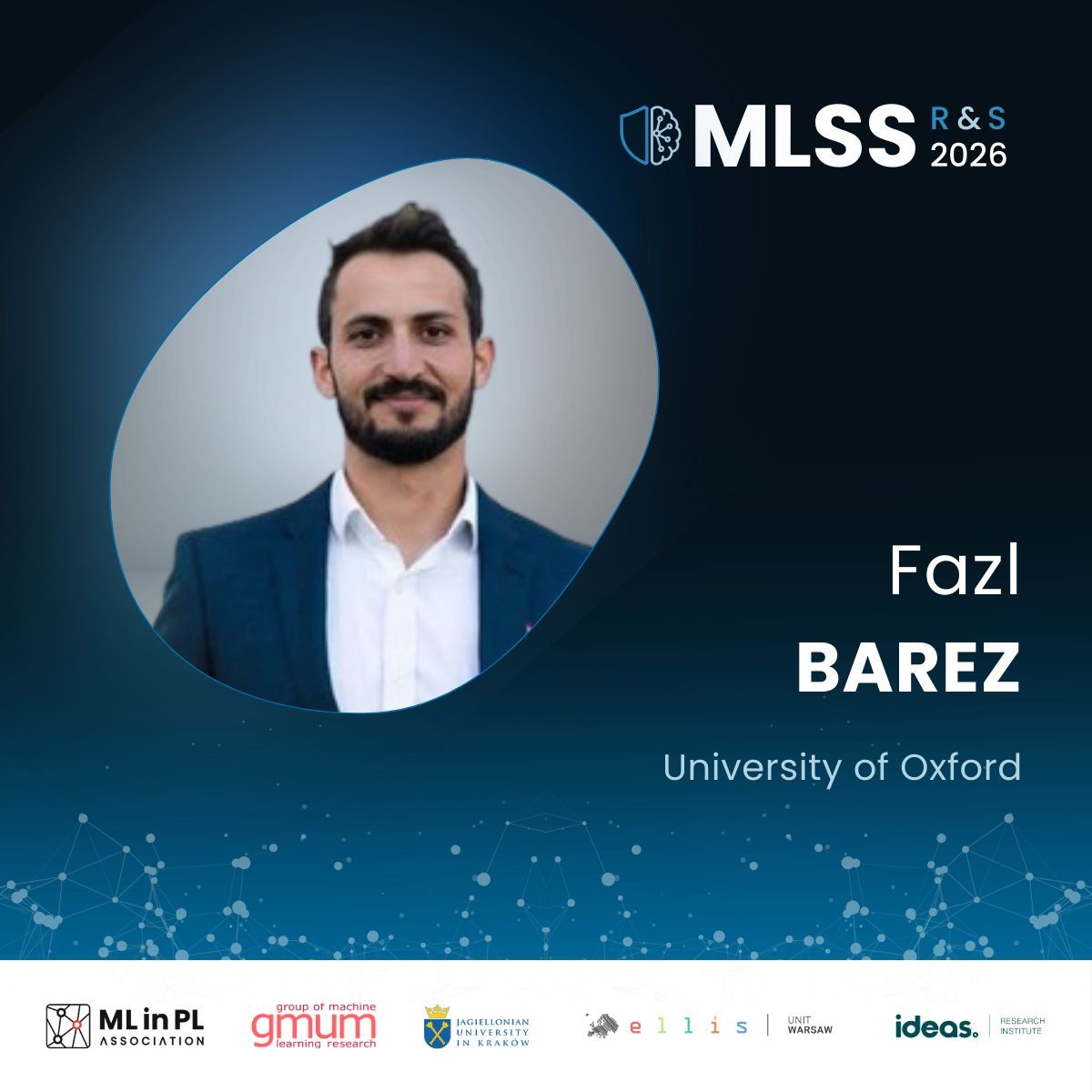
As we enter the final week of Early Bird registration for MLSS R&S 2026, we’re introducing another speaker joining this year’s programme on reliability and safety in machine learning. 🎤 Fazl Barez is a Senior Research Fellow at the University of Oxford's Martin AI Governance Initiative, where he serves as Principal Investigator leading research on AI safety, interpretability and governance. His work focuses on mechanistic interpretability of large models, safety evaluations, deceptive behaviours, and techniques such as model editing and machine unlearning. A central theme of his research is moving from observing model behaviour to understanding and systematically improving it. Alongside his academic work, Fazl is involved in Martian, an independent research group focused on understanding machine intelligence from first principles. The team brings together researchers with experience across major AI labs, including Anthropic, Google DeepMind, and Meta, combining frontier-model research with long-term safety perspectives. His broader experience spans academic research, frontier AI labs, and international initiatives on AI risk and reliability - a perspective closely aligned with this year’s focus on reliability and safety. 🎟 Early Bird registration closes on March 8. If you’re planning to join us in Kraków this summer, this is the moment to secure your place. Details in the first comment ⬇️ @GMUMJU @JagiellonskiUni @ELLISforEurope #MLSS #MLSS2025 #MLSS2026 #MLinPL
ML in PL tweet media
English
1
1
9
204
ML in PL
ML in PL@MLinPL·
Registration for GHOST Day: Applied Machine Learning Conference 2026 has just begun! 📅 8-9 May 2026 📍 Poznań University of Technology ️Tickets: #tickets" target="_blank" rel="nofollow noopener">ghostday.pl/#tickets ️Contributions: #cfc" target="_blank" rel="nofollow noopener">ghostday.pl/#cfc GHOST Day: AMLC provides a space for sharing knowledge and experience in machine learning, bringing together researchers, practitioners, and students. Every year, more than 500 participants gather in Poznań to see the world’s top researchers present in person, share their findings during the poster session, and socialize with other specialists during coffee and lunch breaks. Sign up now to participate in the limited Early Bird ticket offer or free registration for students, available until March 15th. There’s still a chance to apply for contributions until the end of February, which can also grant a free ticket.
ML in PL tweet media
English
0
0
2
110