Macrodamus

436 posts

Macrodamus banner
Macrodamus

Macrodamus

@Macrodamus

Analyzing macroeconomics and geopolitics.

เข้าร่วม Kasım 2022
38 กำลังติดตาม137 ผู้ติดตาม
ทวีตที่ปักหมุด
Macrodamus
Macrodamus@Macrodamus·
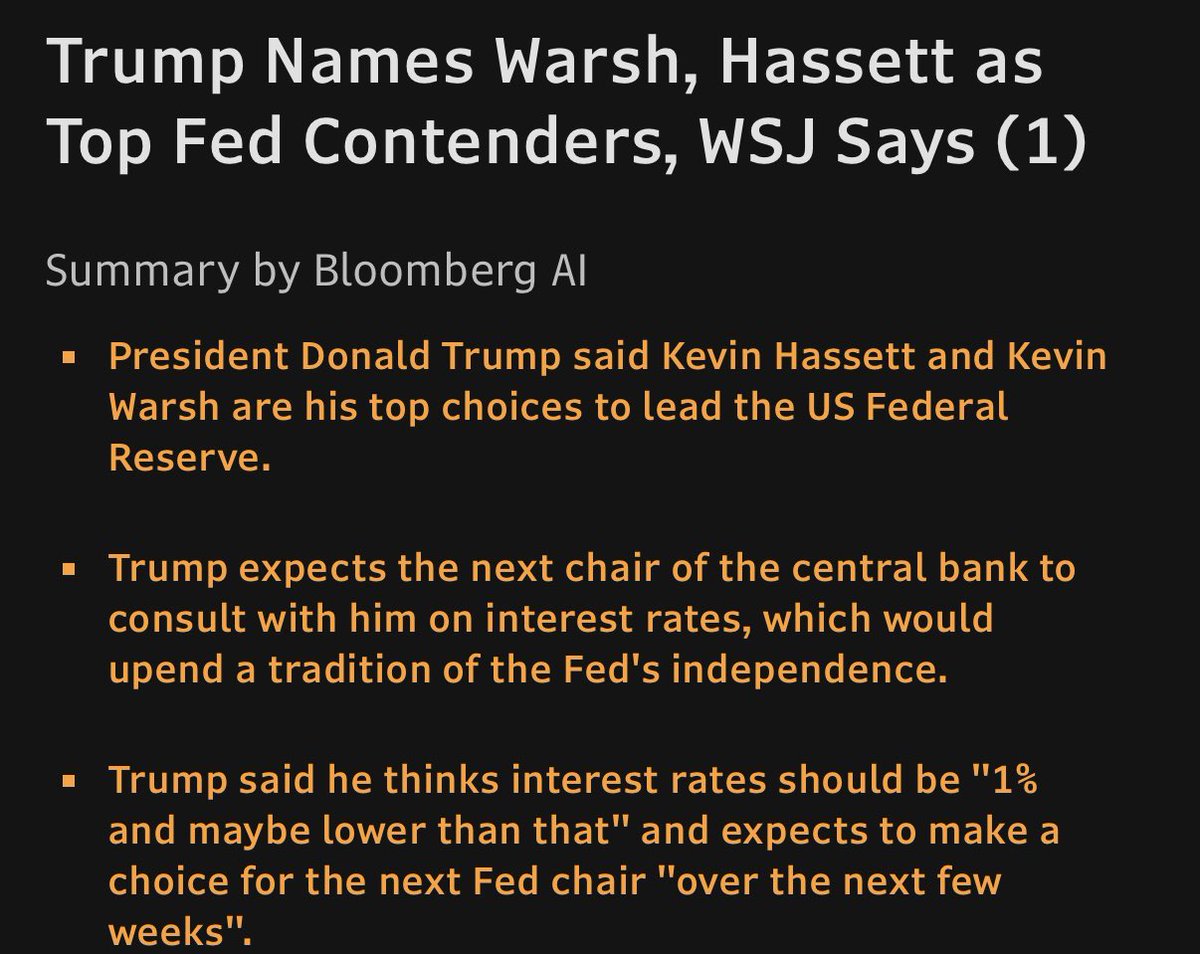
Warsh = credibility/anti inflation guy. Likely tighter policy, faster QT, less “Fed put” — good for anchoring inflation, tougher on markets/growth Hassett = more growth/dovish lean, his whole vibe is easier financial conditions. better for risk assets short term but higher inflation/term premium risk if it looks politically steered
Macrodamus tweet media
English
0
0
1
229
Macrodamus
Macrodamus@Macrodamus·
that 2015 table was a gross RMB figure converted at a much lower RMB per gram and mostly leasing flow, not a clean net long. what banks disclose now is “precious metals business scale” in RMB. at today’s ~1000 RMB per gram, even 1 trillion RMB is about 1k tons equivalent, not 12k. for context, BOC’s Q3 precious metals scale is 193.5B RMB which is roughly 200 tons equivalent and a lot of this sits against precious metals payables or derivatives So unless Beijing lets MTM gold gains flow into CET1, banks won’t run big net longs, so gold matters as collateral and leasing flow rather than as a balance sheet recap. Just food for thought, amigo
English
0
0
1
60
Luke Gromen
Luke Gromen@LukeGromen·
@Macrodamus Your math would imply they've net reduced gold exposures by ~600 tonnes since December 2015, which does not make sense intuitively or if we look at foreign gold shipment data....🤔
Luke Gromen tweet media
English
2
2
16
946
Luke Gromen
Luke Gromen@LukeGromen·
I've still never heard a western analyst discuss China's banking system holdings of gold, let alone consider whether gold rising sharply can re-collateralize Chinese bank balance sheets after property losses. For context, gold in CNY is up nearly 3x in just the past 4 years.
Bai, Xiaojun@oriental_ghost

CN banks hold over 12,000 T of gold! According to the profit reports of 42 listed banks in the 3rd quarter, the combined statistics show that CN banks hold a total of approximately 12,000 T of gold, worth over 1.2 trillion RMB.

English
59
79
635
109.6K
Macrodamus
Macrodamus@Macrodamus·
debasement and stimulus is the right pick but it’s honestly the plumbing. QT ended, fed’s doing bill RMPs, ON RRP is basically gone, SRF is the backstop. big deficit and heavy bill mix mean TGA swings drive reserves and beta. if TGA bleeds and bills stay chunky, risk up. if TGA rebuilds and coupons ramp, chop
English
0
0
1
162
Bob Elliott
Bob Elliott@BobEUnlimited·
Which will be the biggest driver of markets over the next 12m?
English
21
8
38
23.5K
Macrodamus
Macrodamus@Macrodamus·
Important events to keep an eye on this week: Monday – $69B US 2y auction (1:00pm ET). front-end check. Tue – the big one. Nov PCE Inflation + Durable Goods + Q3 GDP Final at 8:30am. 5Y Note auction at 1pm. plus bills/FRN/5y supply Wednesday – jobless claims (8:30). $44B US 7y auction (11:30). early close Thu/Fri – thin liquidity. japan tokyo CPI overnight (Fri) = JPY/rates watch
English
0
0
0
55
Macrodamus
Macrodamus@Macrodamus·
The sideways regime ends when either: - dealers stop being the shock absorber (gamma flips) or - spot demand becomes so one-way that the absorber saturates or - a jump move skips the range mechanics entirely
Bitcoin News@BitcoinNewsCom

OG whales are yield farming Bitcoin and capping the price? Jeff Park explains how large holders use the options market to sell covered calls, extracting income while BTC churns sideways. Video by @_Rob_Wallace Link to Jeff’s article below.

English
0
0
0
89
Macrodamus รีทวีตแล้ว
Conks
Conks@conksresearch·
・ *゚   ・ ゚* ・。 *・。 *.。 it's not QE 。・ °*. ゚ *・。
Conks tweet media
日本語
40
90
1.1K
106.9K
Macrodamus
Macrodamus@Macrodamus·
FOMC: FED WILL “INITIATE PURCHASES OF SHORTER-TERM TREASURY SECURITIES AS NEEDED TO MAINTAIN AN AMPLE SUPPLY OF RESERVES ON AN ONGOING BASIS” They’re not saying “we’re doing stimulus because the economy is weak.” They’re saying we’re doing technical operations in the Treasury market to make sure banks always have enough reserves so short-term interest rates stay under control and markets function smoothly This isn’t a “blast of new liquidity to goose assets” like classic QE but it supports and maintains a higher floor of liquidity than you’d otherwise have if they just let reserves keep drifting down
English
0
1
1
164
Macrodamus
Macrodamus@Macrodamus·
events this week (Dec 8–12): Tue – 10Y UST auction Wed – FOMC + SEP + Powell Wed – Q3 ECI Thu – 30Y UST reopening Thu – Fed H.4.1 balance sheet rates path, term premium and reserves all in play
English
0
0
2
43
Macrodamus
Macrodamus@Macrodamus·
BTC spent weeks rebuilding leverage into the “Fed ends QT / liquidity wave” narrative, exactly as ETF flows flipped negative and order books hollowed out from the October crash Zoomed out this is what a structural deleveraging looks like when you try to front run a policy pivot. the pain trade hits before the pivot actually adds liquidity The tell is that silver and other “funding eligible” assets ripped while btc tanked. Capital is rotating from digital high beta that doesn’t help your funding stack into assets you can actually post as collateral. That’s why these wipes feel worse than previous ones
The Kobeissi Letter@KobeissiLetter

BREAKING: Bitcoin falls -$4,000 in 2 hours as mass liquidations return. $400 million worth of levered longs have been liquidated over the last 60 minutes.

English
0
0
0
85
Macrodamus รีทวีตแล้ว
Adam Livingston
Adam Livingston@AdamBLiv·
Ben is highlighting the real significance of JPMorgan’s new Bitcoin structured note. It creates a direct financial incentive for JPM to prefer higher Bitcoin prices going into December 21, 2026. This note has an auto-call feature. If Bitcoin is above a certain price on Dec 21, 2026, JPM automatically closes the product and has no more upside liability. The risk disappears. The book is clean. Their exposure is dead. But if Bitcoin is below that price, the note keeps running until 2028. And in that scenario, investors get 1.5× leveraged upside on any Bitcoin rally. That is a huge convexity cost to JPM. So the bank has two outcomes: A) Bitcoin above strike in 2026 → they close the risk early. B) Bitcoin below strike → they remain exposed to leveraged BTC upside for 2 extra years. Banks always prefer the outcome where they eliminate tail risk early.
Ben Werkman@Werkman

Start preparing mentally for “unexplainable” Bitcoin price action leading into December 21, 2026. Incentives are always in the fine print, and in this case it comes from the auto-call feature that shuts off the tail risk for JPM.

English
40
103
744
93.7K
Macrodamus รีทวีตแล้ว
gamma_exposure🇩🇪🇬🇧
gamma_exposure🇩🇪🇬🇧@Tim10337907·
One of the most sophisticated expert i know will agree on this.
gamma_exposure🇩🇪🇬🇧 tweet media
English
2
4
21
817
Macrodamus
Macrodamus@Macrodamus·
bill buys help funding. duration still lives at the coupon calendar. QE-lite is mostly vibes until treasury cuts coupons or runs TGA lower. the real floor is ample reserves plus SRF. the real ceiling is how much duration the street has to swallow
English
0
0
0
38
Macrodamus
Macrodamus@Macrodamus·
fed is ending QT on dec 1. treasuries get rolled. MBS paydowns get recycled into bills. that’s reserves up on the margin, not 2020-style QE the punchline for risk isn’t the fed buy list, it’s treasury’s mix and the TGA. if coupons creep higher while the fed sticks to bills, you’re adding duration back faster than the fed can offset
Tomas@TomasOnMarkets

It’s official - the Fed is likely to begin expanding its balance sheet again soon. For the first time since 2022. Bad takes will likely abound on X. Is this "liquidity positive" on the margin? (yes) Is this "QE"? (no) So, what's going on? And, more importantly, what does it mean for risk asset markets? Warning - this is a LONG post The first step Recently the Fed announced that QT is coming to an end. The Fed has confirmed it will stop unwinding Treasury (Government bond) holdings off its balance sheet, but will continue to unwind its portfolio of MBS (Mortgage Backed Securities). As the MBS continue to mature and “roll off” the Fed’s balance sheet, the Fed will then reinvest the proceeds into Treasury bills. This would imply that the Fed balance sheet would remain roughly flat (essentially "liquidity neutral"). This process will start on December 1. The second step However, the Fed cannot just keep its balance sheet flat over the medium-term. This is because of bank reserves. Bank reserves cannot fall too low, relative to the size of the US economy - because if they do, the whole banking system starts to break (this happened in September 2019). As the US economy grows, the financial system needs more and more bank reserves to be able to function properly. So, at some point, the Fed will be forced to actually start expanding its balance sheet again (which will increase bank reserves). And this “second step” (balance sheet expansion) may arrive a lot sooner than many expect. Recently, Fed Chair Jerome Powell said: “At a certain point, you’ll want… reserves to start gradually growing to keep up with the size of the banking system and the size of the economy.” Also, New York Fed President John Williams made similar remarks last week. FED'S WILLIAMS: FED MAY SOON NEED TO EXPAND BALANCE SHEET FOR LIQUIDITY NEEDS A lot of analysts from across the banking world are now expecting this balance sheet expansion to come as early as Q1 2026 (this makes me think there’s been some “forward guidance whispers” behind closed doors). Marco Casiraghi, of Evercore, said: “We think the Fed will start buying enough Treasuries to grow the balance sheet again in the first quarter of next year.” Most analyst estimates put the expected pace of this balance sheet expansion at around $20bn per month, or around $240bn per year. To be honest - this is balance sheet expansion for ants. $20bn might seem like a big number - but in the grand scheme of things, it’s a tiny number. To put it in perspective - between March 2020 and June 2020, the Fed increased the balance sheet by more than $3 trillion - or more than $800bn per month. If the Fed were to continue to expand the balance sheet at a pace of $20bn per month - it would take roughly ten years just to return to the balance sheet highs of early 2022. These developments are not a surprise. Fed guidance has been laying this out for years. The plan has always been to grow the balance sheet slowly, at the same pace as GDP growth. This is not intended to stimulate the economy or asset markets - it’s to ensure that the banking system has enough reserves as the economy grows. Here’s a chart showing balance sheet projections from a Fed paper in early 2024. Bills, bills, bills Notice - the Fed has explicitly stated it is planning to purchase Treasury bills (short term - one year or less). This is a very important distinction in terms of any potential impact on risk asset markets. The Fed purchasing Treasury bills is somewhat liquidity positive, on the margin. But nowhere near as liquidity positive as if the Fed were to buy Treasury coupons (2-30 year). Technically, it’s not really “QE” unless the Fed is buying coupons. It’s more accurately described as "reserve management” - some people may label it as “QE-lite”, but I think even this is a stretch. In previous waves of “real QE” - like 2020 and 2021 - the Fed hoovered up huge amounts of Treasury coupons. So, the Fed was “removing duration risk” from the market. This is really the key asset price boosting power of “real QE” - this “removing of duration risk”. While the Fed buying bills is still liquidity positive on the margin - it is nowhere near as “potent” as previous “real QE” waves in terms of its impact on risk asset markets, because it doesn’t affect duration. So we have: 🔘 Balance sheet expansion for ants ($20bn per month) 🔘 “Less potent” balance sheet expansion (buying bills instead of coupons) In my view, this very slow buying of bills will have minimal direct positive impact on risk asset markets. But due to the avalanche of bad takes that will likely abound - the positive psychological impact may be larger. It's likely a bearish factor for the Dollar Index (DXY), on the margin. But wait a second... We can now get really nerdy. There is a plausible (and sneaky) way that this wave of balance sheet expansion could have similar effects to previous episodes of “real QE”. And that is all to do with what the Treasury is doing. The Treasury is constantly issuing new debt (Treasuries) to finance the Government’s ballooning debt pile. It can choose how much of this new debt is bills, and how much is coupons. In recent years, starting with previous Treasury Secretary Janet Yellen in 2023, the Treasury has heavily shifted issuance away from coupons and towards bills - so the “debt mix” has become much more “bill heavy”. This does have similar market effects to “real QE” - because it’s essentially “removing duration risk” from the market (“liquidity positive” overall). This tactic has been described as “Treasury QE”, “stealth QE” and “Yellen-omics” - and it has helped to power risk asset markets upwards in recent years. If, in the coming quarters, the Treasury decides to push overall debt issuance even further towards bills (thereby issuing less coupons) - essentially “removing more duration risk from the market” - while the Fed is also buying bills, this would technically have similar market effects to “real QE”: the Fed expanding its balance sheet and duration risk being removed from markets. So, to determine whether this might potentially happen - we need to watch the Treasury’s QRA (Quarterly Refunding Announcement). The latest QRA (released last week) signals that this further curbing of coupon issuance is not likely to happen - in fact, it hints at the opposite. Here’s the key line: “Treasury has begun to preliminarily consider future increases to nominal coupon auction sizes” This means the Treasury is considering increasing issuance of coupons - or “adding duration to the market” (“liquidity negative” overall). Now, Treasury officials may be “considering” increasing issuance of coupons and they might talk big - but whether they actually do or not is another question. If they do - this would not be good news for risk asset markets, all else being equal, and would likely completely counteract whatever the Fed is doing and then some. It could mark the end of the “Treasury QE” gravy train. Arguably, watching what the Treasury is doing is much more important than watching what the Fed is doing. Here’s what we know is likely to happen: 🔘 QT stops on December 1 🔘 The first step is to keep the balance sheet flat 🔘 Then, probably not long afterwards, the Fed will start to expand the balance sheet again 🔘 This will be achieved through buying bills (not coupons) and is therefore not technically “QE” and nowhere near as “potent” as “real QE” 🔘 It will also occur at an extremely slow pace ($20bn per month) 🔘 Arguably, the more important factor here is what the Treasury is doing

English
0
0
0
40
Macrodamus
Macrodamus@Macrodamus·
Just a thought: even when no bank is the named repo counterparty, the cash leg still settles as bank deposits and reserves through clearing banks and the fed, so the banking system is inherently involved and repo capacity conditions Treasury financing even though it does not create broad money
Andy Constan@dampedspring

Money creation and credit creation in the private sector 101 part 2. Role of Repo. In the prior thread I outline credit creation which can happen without banks and money creation which requires banks. I also hinted at bank reserves role as being one of grease to the

English
0
0
0
30
Macrodamus
Macrodamus@Macrodamus·
they’re losing their minds because they think a SOFR wiggle means credit event it’s just dispersion: repo prints not hugging the median when specials bite, quarter end balance sheet caps hit and TGA sloshes real stress is the median drifting off target or tails camping near SRF or volumes thinning or fails popping off none of that’s happening so we goodie
fejau@fejau_inc

I’m very confused why people are losing their minds suddenly about SOFR going down. The Fed cut rates to 3.75-4% recently, and so now SOFR is trading between 3.75-4%, just as it should after a rate cut. Why is this news and why are people falling over themselves about it?

English
0
0
0
46