Wharton’s latest AI study points to a hard truth: “AI writes, humans review” model is breaking down
Why "just review the AI output" doesn't work anymore, our brains literally give up.
We have started doing "Cognitive Surrender" to AI - Wharton’s latest AI study points to a hard truth: reviewing AI output is not a reliable safeguard when cognition itself starts to defer to the machine.when you stop verifying what the AI tells you, and you don't even realize you stopped. It's different from offloading, like using a calculator.
With offloading you know the tool did the work. With surrender, your brain recodes the AI's answer as YOUR judgment. You genuinely believe you thought it through yourself.
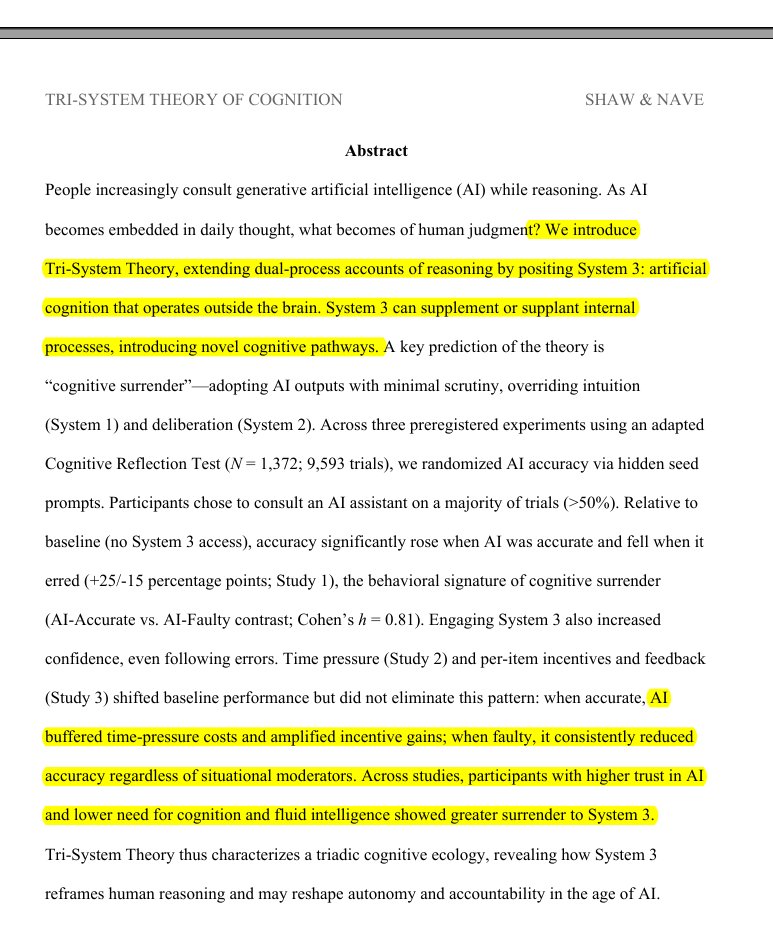
Says AI is becoming a 3rd thinking system, and people often trust it too easily.
You know Kahneman's System 1 (fast intuition) and System 2 (slow analysis)? They're saying AI is now System 3, an external cognitive system that operates outside your brain. And when you use it enough, something happens that they call Cognitive Surrender.
Cognitive surrender is trickier: AI gives an answer, you stop really questioning it, and your brain starts treating that output as your own conclusion. It does not feel outsourced. It feels self-generated.
The data makes it hard to brush off. Across 3 preregistered studies with 1,372 participants and 9,593 trials, people turned to AI on over 50% of questions.
In Study 1, when AI was correct, people followed it 92.7% of the time. When it was wrong, they still followed it 79.8% of the time.
Without AI, baseline accuracy was 45.8%. With correct AI, it jumped to 71.0%. With incorrect AI, it dropped to 31.5%, worse than having no AI. Access to AI also boosted confidence by 11.7 percentage points, even when the answers were wrong.
Human review is supposed to be the safety net. But this research suggests the safety net has a hole in it: people do not just miss bad AI output; they become more confident in it.
Time pressure did not eliminate the effect. Incentives and feedback reduced it but did not remove it. And the people most resistant tended to score higher on fluid intelligence and need for cognition. That makes this feel less like a laziness problem and more like a cognitive architecture problem.
The best essay written about AI this year just dropped and nobody in tech wants to hear it.
Manidis names something most of the industry is allergic to discussing: the majority of AI deployment today produces the sensation of work, not work itself. He calls these “tool-shaped objects.” You can hold them, use them, watch tokens stream across your screen, monitor chain-of-thought reasoning, swap models, add tools, build agents that call other agents that generate memos nobody reads. The number goes up. The output doesn’t.
He compares it to FarmVille. No matter where you click, your farm expands. The direction of your effort is irrelevant. The experience of productivity is the product. And the market for feeling productive is orders of magnitude larger than the market for being productive.
The data backs this up almost perfectly. McKinsey surveyed ~2,000 enterprises in 2025 and found 6% qualify as “AI high performers” with meaningful bottom-line impact. Six percent. Meanwhile enterprise AI spending went from $1.7B to $37B since 2023. A 22x increase in two years. Larridin found 89% of enterprises use AI but only 23% even measure ROI. Most organizations literally cannot tell whether they’re running a farm or running FarmVille.
But here’s where it gets interesting. That 6% who figured it out? They’re seeing 3-4x higher productivity gains than beginners, redesigning entire workflows, and pulling away at a rate that makes the spending rational for everyone else as a defensive bet. OpenAI’s enterprise data shows workers in properly deployed organizations saving 40-60 minutes daily. Wharton found AI deals convert to production at 47%, nearly double the 25% rate for traditional SaaS.
So the tool-shaped object problem isn’t that the tool is fake. The problem is that 77% of organizations never built the measurement framework to know which side of the gradient they’re on. They’re spending because spending feels like strategy, not because they can connect tokens consumed to value produced.
This is how every general-purpose technology diffuses. Factories installed electric motors and wired them to the same belt-drive layouts they used with steam engines. Productivity didn’t move for 30 years. It took managers who understood that electricity meant redesigning the factory floor before output followed. The AI adoption curve looks nearly identical, just compressed.
The Mac Mini agent setups, the orchestration layers, the billion-dollar frameworks: these are belt-driven electric factories. They will be replaced. But by the 6% who redesigned the floor, not by people who saw the belt-drive phase and concluded the motor was decorative.
In 1908, 253 American automobile manufacturers competed for the market. By 1929, just 44 remained. The assembly line didn’t just change how cars were made. It changed who got to make them.
Ford’s Highland Park plant, operational in 1913, slashed the time to build a Model T from 12 hours to 93 minutes. That 90% productivity gain restructured an entire industry. Manufacturers who couldn’t match Ford’s efficiency faced a simple choice : adapt or exit.
The consolidation was swift. Between 1908 & 1929, 83% of automakers vanished. Some merged. Most failed. The survivors shared a common trait : they adopted Ford’s methods. General Motors, Chrysler & the handful of remaining independents all built assembly lines.
An analogous revolution is happening in software, with important differences. AI coding assistants now reduce development time by 55-81%. The curve is familiar.
Ford took six years to achieve 90% time reduction. AI coding tools reached 81% in five. The slopes are nearly identical.
What happened to auto industry employment? It grew. Massively. In 1910, US auto plants employed 76,000 workers. By 1929, that number reached 471,0004. Mass production created mass consumption, & mass consumption demanded more workers.
The real explosion came from second-order effects. By 1929, for every one person building a car, seven others had a job because that car existed.
Dealerships, service stations, repair shops & supply chains employed nearly 4 million people. The industry didn’t just create more manufacturing jobs; it spawned an entirely new economy of “enablers” that was 8x larger than the core manufacturing base.
The software industry will follow a different pattern. In autos, capital intensity consolidated power. It’s the opposite in the world of AI.
AI data centers, the assembly lines of software, enable hundreds of millions of developers to build software as if they had the capabilities of an automobile behemoth. Any developer can access state-of-the-art models with a laptop & a credit card.
Easier software creation means more software. More software means more developers, not fewer. We should expect many thousands of new businesses each year as a result, & a similar explosion in second-order jobs.
tomtunguz.com/the-model-t-co…
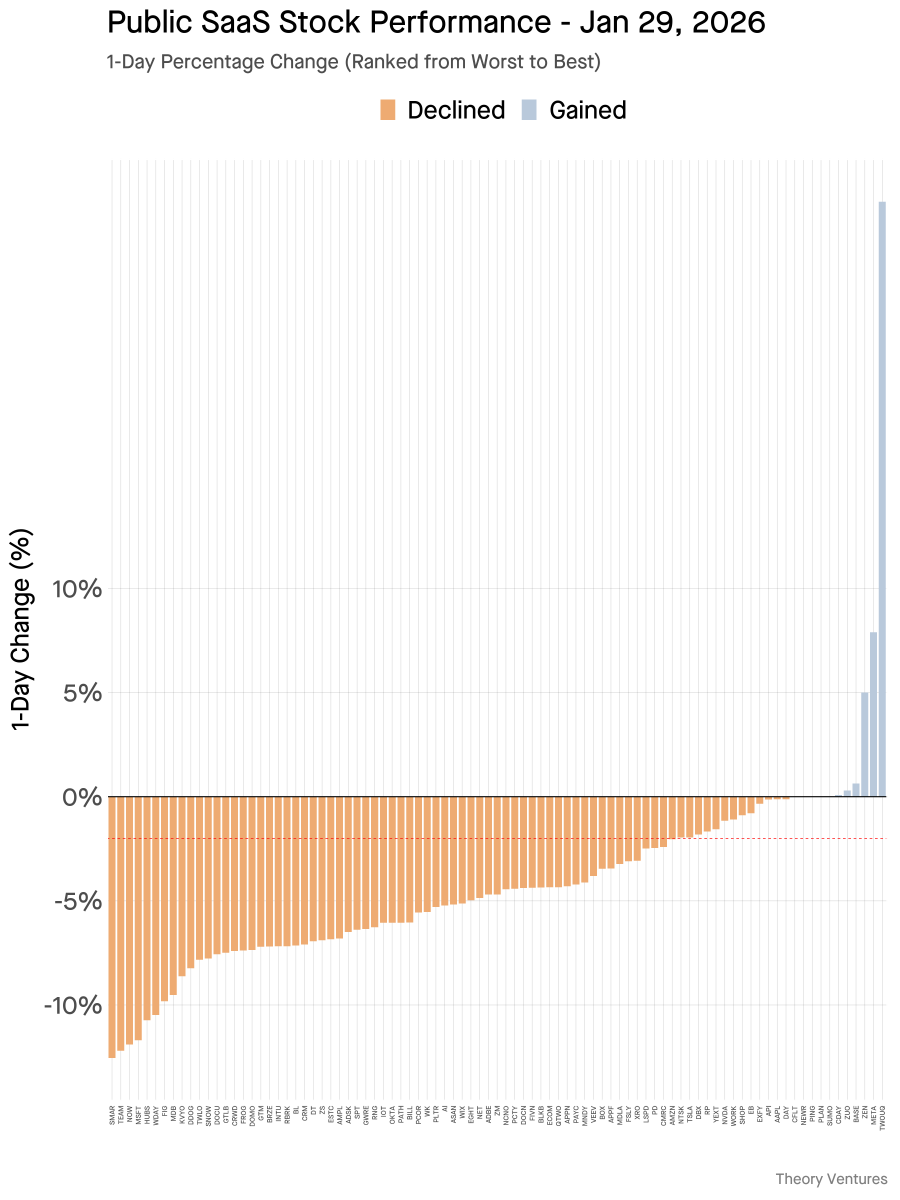
Is there a broad cycling out of software?
73% of public software companies fell today. Median decline: -4.7%.
Biggest drops:
- Smartsheet -12.6%
- Atlassian -12.2%
- ServiceNow -11.9%
- Microsoft -11.7%
- HubSpot -10.7%