Orson Scott Card

635 posts

Orson Scott Card banner
Orson Scott Card

Orson Scott Card

@orsonscottcard

The official account for OSC.

เข้าร่วม Haziran 2009
917 กำลังติดตาม31K ผู้ติดตาม
Orson Scott Card
Orson Scott Card@orsonscottcard·
MASTER ALVIN is the finale to a series that truly began forty-five years ago, in 1981, with a poem. This last & seventh volume contains “Prentice Alvin and the No-Good Plow” in its entirety (as well as the story of how it came to be). For fun, here’s the opening stanza: “Alvin, he was a blacksmith’s prentice boy, He pumped the bellows and he ground the knives, He chipped the nails, he het the charcoal fire, Nothing remarkable about the lad, Except for this: He saw the world askew, He saw the edge of light, the frozen liar There in the trees with a black smile shinin cold, Shiverin the corners of his eyes. Oh, he was wise.” a.co/d/026R50ZI
English

19
13
134
130.4K
Orson Scott Card
Orson Scott Card@orsonscottcard·
By sheer chance, Master Alvin (the Tales of Alvin Maker finale) and Writers of the Future volume 42 (with a new story by OSC) both launch today, 4/28. Writers of the Future 42 will, like its predecessors, be the best anthology of new fiction of its year. WoF is where the careers of great new SF and Fantasy writers begin, as the field of speculative fiction continues to reinvent itself. You can order the anthology here: a.co/d/00720kdB
English
4
10
112
3.1K
Orson Scott Card
Orson Scott Card@orsonscottcard·
Shirley MacLaine should be on every list of the great film actors. She has triumphed in every genre she’s tried, and as an accomplished dancer, she was just as deft with a laugh line and as delicate with heartache as she’d be with any choreography. And she’s still here! But are there any screenwriters creating Shirley MacLaine-worthy roles anymore? Please, get to work.
cinesthetic.@TheCinesthetic

Happy 92nd birthday to Shirley MacLaine!

English
16
18
202
8.7K
Orson Scott Card
Orson Scott Card@orsonscottcard·
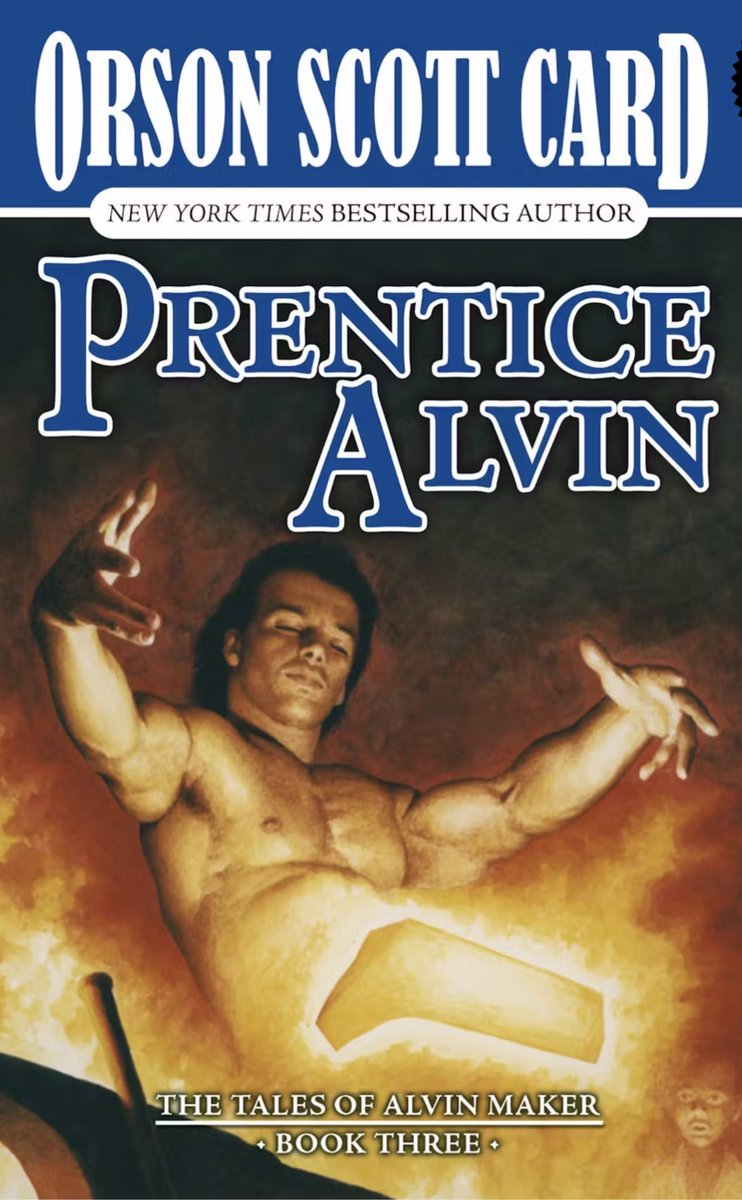
For completists (and those thinking of starting the series for the first time): MASTER ALVIN’s publication will be accompanied by a re-release, in trade paperback ONLY, of the earlier volumes in the series — and several will now incorporate the standalone Alvin Maker short stories that were published throughout the years. The bonus material will be included in Books 3-6 (Prentice Alvin, Alvin Journeyman, Heartfire, and Crystal City) and will appear in each book approximately where they occurred in the timeline of events in the saga. Below are the links which will take you to their Tor (Macmillan) pages, where you’ll find links to all booksellers where the reissued trade paperbacks (5” x 8” size) will be sold. (Heartfire is not quite ready to ship, but will be soon). us.macmillan.com/books/97812504… us.macmillan.com/books/97812504… us.macmillan.com/books/97812504… us.macmillan.com/books/97812504… us.macmillan.com/books/97812504…
Orson Scott Card tweet media
English
22
37
357
9.5K
Orson Scott Card
Orson Scott Card@orsonscottcard·
Ender’s Game is what I’m known for, and gratefully so. But it may be The Tales of Alvin Maker through which, if you tell me you’ve read them, I feel most known. Master Alvin, the final book of the series, will be out this Tuesday, April 28. Thank you to those who’ve patiently waited, and those who have eagerly prodded… and all who’ve taken these stories to heart and made them finer for being there. Preorder on Amazon: a.co/d/0iRYBxJ1 Preorder on Barnes and Noble: barnesandnoble.com/w/master-alvin… Preorder on IndieBound (bookshop.org): bookshop.org/p/books/master…
Orson Scott Card tweet media
English
162
107
1.6K
184.7K
Orson Scott Card
Orson Scott Card@orsonscottcard·
@bennash It would take the right ambitious someone. Very tough to make. Thank you for valuing it.
English
1
0
35
9.2K
Ben Nash
Ben Nash@bennash·
@orsonscottcard When might someone make a film of Pastwatch? That's my favorite book of yours and it's very relevant to today.
English
2
1
19
12.2K
Orson Scott Card
Orson Scott Card@orsonscottcard·
You don't need advice from editors on rejected manuscripts.  My short story “Ender's Game” was rejected by Ben Bova at Analog back when that was the top market for a sci-fi story. Ben gave me feedback. He thought the title should be “Professional Soldier” and he said to “cut it in half.” But I knew he was wrong on both points and submitted it to Jim Baen at Galaxy. He sat on it for a year, and responded to my query with a rejection. There was some kind of explanation, but I don't remember what it was. I concluded at the time that Baen's comments showed that he had barely glanced at the story. So … I got feedback both times, but it was not helpful. I looked at Ben's rejection again. What was it about the story that made him think it should, let alone COULD, be cut in half? Apparently it FELT long. What made it feel long? Now, post-Harry Potter, I would call it the quidditch problem. I had too many battles in which the details became tedious. So I cut two battles entirely, merely reporting the outcomes, and shortened another. In retyping the whole manuscript (pre-word-processor, that was the only way to get a clean manuscript), I added new point-of-view material to the point that I had cut only one page in length. So much for “in half.” But I already knew that my manuscripts did not need cutting — if it wasn't needed, it wouldn't be there in the first place. Even the battles were still there, but instead of showing them, I merely told what happened (so much for the usually asinine advice “show don't tell”), which kept the pace going. Those changes made, I sent it to Ben again. I did not remind him of what he had advised me to do. I merely told him I liked my title, and said, “I have addressed your other concerns,” which was true. I figured he wouldn't remember what his exact words had been. My answer was a check. That revised story was the basis for my winning the Campbell Award for best new writer. Did Ben's feedback help? Yes — but his specific advice was not right, and I knew it. On my next two submissions, Ben hated my endings, and I revised as suggested. The fourth submission he rejected outright, and the fifth, and I thought, Am I a one-story writer? I went back to Ender's Game and tried to analyze why it worked. Then, deliberately imitating myself, I wrote “Mikal's Songbird.” Ben bought it, and it received favorable mentions. I was afraid then that I had consigned myself to writing stories about children in jeopardy. But in fact I was writing character stories rather than idea stories. And THAT was how I built a career, not by self-imitation, and not by following editorial suggestions. I did get wise counsel from David Hartwell on my novel Wyrms, but that was on a book that was already under contract, and it was story feedback, not style. I got wise counsel from Beth Meacham, too, on various books over the years — but again, only on books that were under contract. I also received appallingly stupid advice from the editor of my novel Saints, which temporarily destroyed the book's marketability; after that, I was allowed to go back to my original structure and save the book — now it's one of my best. Editors don't know more than you about your story. They especially don't know why they decide to accept or reject stories. YOU have to know what your story needs to be, and take only advice that you believe in. Your best counselor on a story nobody bought is TIME. Let some time pass and then reread the story. Don't even think about why it Didn't Work. Instead, think about what DOES work, and then write it again, a complete rewrite, keeping nothing from the previous draft. Find the right protagonist and begin at the beginning — the point where the protagonist first gets involved with the events of the story. Be inventive — the failed first draft no longer exists, so you're not bound by any of your earlier decisions. THAT is how you resurrect a good idea you did not succeed with on your first try.
English
271
962
10.8K
1.4M
Daved Driscoll
Daved Driscoll@DriscollDaved·
@orsonscottcard Your analyses are the best writing analysis I ever see anywhere. So direct and simple and -- once you say them -- or, no -- the WAY you say them -- obvious. USABLE.
English
2
0
38
17.4K
Visam
Visam@visam22·
It's your fault I read books lol. I hated reading school books were so boring I could barely stay awake. My dad gave me a copy of Ender's Game for my birthday. I just tossed it on a shelf. But in the 7th grade they let me pick a book for a report, I read your book, and everything changed. It is still my favorite book (I think I've read all your books and many others). Thanks for making me enjoy reading!
English
3
1
274
28K
Orson Scott Card
Orson Scott Card@orsonscottcard·
“Is antiZionism related to antisemitism?” AntiZionism is the thin coat of shellac that Jew-haters use to pretend they're not antisemitic. Everybody sees through it. The only people who pretend that there's a difference are the antisemites. AntiZionism is to antisemitism as a square is to a rectangle. Not all rectangles fit the definition of squares, but all squares are rectangles. The United Nations gave legal existence to the state of Israel, and Israel then fought for and won the right to exist as the homeland of the Jewish people. Antisemites try to prove that not all Jews are descended from ancient Israelites, but it's a stupid argument. The Jewish people decide who counts as a Jew. Nobody else has a say in the matter. Jew-hating bigots who wish for the genocide of Jews accuse Israel of genocide. People who want to ghettoize Jews call Israel an apartheid state. BOTH charges are slanderous lies, antisemites accusing Israel of their own sins and desires. NonJews in Israel are freer and more prosperous than Muslims in any Muslim nation. Israel has never started a war with anybody, but they have fought preemptively to defeat nations and organizations that have committed acts of war and declared war against them. If Israel's neighbors had accepted the UN boundaries instead of attempting to slaughter Jews and wipe Israel off the map, there is no rational indication that Israel would not have remained within those borders. Jewish immigrants to Israel bought all the land they lived, farmed, or manufactured on — none of the land was stolen. Palestine was an impoverished backwater of the Ottoman Empire until Jewish settlers, farming with rifles strapped to their backs, subdued the bandits that had long terrorized the inhabitants of Canaan. Only when Canaan had been pacified and economically stimulated by Jewish immigrants did Palestine become a desirable place to live. Then Arabs immigrated to Palestine precisely because of what Jews had made of the place. Because newly arrived Jews were prosperous where Arabs had failed to thrive, they were resented … but if all Jews had been driven out then, there is no reason to believe that “Palestine” would not have immediately reverted to the lawless, feckless, impoverished, unproductive region it had been before. Whatever Canaan might have been when Moses arrived millennia ago (a land of “milk and honey”), it was an anarchic desert when the Zionists arrived to make it a fit homeland for the stateless Jews scattered through the world. Let no one be fooled by the lies of the Jew-hating antiZionists. They are murderous Hitlers and Himmlers in their hearts. They are all abetters of the monstrous crimes of October 7.
English
49
112
450
11.4K
Orson Scott Card รีทวีตแล้ว
Jenny Hautmann
Jenny Hautmann@JennyHPhoto·
The Artemis II crew named a lunar crater after Commander Reid Wiseman's late wife, Carroll. What a beautiful and touching moment. I'm not crying, you're crying 🤧
English
404
6.3K
42K
2.8M
Orson Scott Card
Orson Scott Card@orsonscottcard·
“Will Trump prevail in Iran or will this war be his downfall?” It could easily be both. Iran has been at war with the United States and all its neighbors since 1979. It has spawned murders and atrocities and its fanatical leadership has sought — and found — means of overwhelming the defenses of other nations. Not just nukes, but icbms and drones, which it aims at military and nonmilitary targets indiscriminately. The only way to find out a threat was imminent is to suffer the consequences of not acting preemptively. Somebody had to neutralize the Iranian threat, and the only nation with the power to do it is the US, and the only leader with the wisdom and the spine to do it is Trump. If Trump succeeds, his fanatical enemies in the US, who support causes every bit as insane as Iran's, will claim that the destruction of Iran's evil government was not “necessary,” because, see? They didn't have nukes. So just as the leaders of France and the UK would have been ousted if they had crushed Hitler back when it could have been done almost bloodlessly, and completely legally under the terms of the Versailles treaty, Trump will never be able to prove what “would have happened,” and his enemies, who have proven their contempt for law and their desire to create a permanent one-party state, will probably succeed in their aims. They will control the history-writing — they already control most of the press and universities — and so the fact that Trump preemptively saved the world from an evil warmongering state will be flipped on its head, and HE will be declared the evil warmonger. But if the attempt to suppress Iran fails, which will probably be the case if Trump does not deploy troops to break the back of the Iranian regime on the ground, the consequences will be so dire that again, Trump will be blamed for having “provoked” Iran with a “needless” war. So unless the American electorate behaves with unexpected wisdom, this attack is probably the most necessary and self-destructive act of Trump's administration. Necessary, because the fools who governed us from 2009-2017 and 2021-2025 did nothing but appease Iran's tyrants and enable them to oppress their own population while causing or abetting the worst state and nonstate actors in the world. Trump's successors, even if they have the will, will not have the power to destroy America's worst antagonists. The moment of possibility is now, Trump has taken it, and no matter how it turns out, it will be the weapon his fanatical, anti-democratic enemies use to destroy him.
English
62
83
541
32.3K
12345
12345@BilboParmesan·
@orsonscottcard Can I just say that I absolutely love Saints? Magnificently underrated piece of LDS historical fiction. It strengthened my faith.
English
1
0
1
155
Orson Scott Card
Orson Scott Card@orsonscottcard·
Addendum: How I did it -- once. My only start-quick novel was Ender's Game. I had had some traction with the novelet “Ender's Game,” and I had already committed to its main character as the protagonist of Speaker for the Dead. I needed a novel version of Ender's Game to properly set up Speaker, so readers of the EG novel would be prepared to pick up the story 3,000 years later. (Time dilation in lightspeed flight allowed frequent travelers to live through millennia.) I already knew, from expanding Mikal's Songbird into the novel Songmaster, that you don't novelize a short story by tacking twenty chapters onto the end. If the short story works, you start way earlier, developing characters and situations leading up to the same climax and resolution that worked so well in the short form. (If they did not work well, why are you novelizing it in the first place?) So to set up the story of EG, which began when Ender was given command of his own “army” in the orbiting Battle School, I went back to when he was chosen, and chose, to be taken out of his childhood home at around the age of six. Rigorous testing had led to Ender Wiggin being one of the most promising young recruits (draftees) to be trained to fight the invading hive queens. To show Ender's childhood family, I handled it quickly by putting Ender in my own family, back when there were only three of us kids. In my family, my sister was eldest, and a four-year gap between me and my older brother made us anything but close. So Ender grew up with a hostile older brother and a protective and kindly older sister — both of whom had come close to being drafted themselves. Every vile thing Peter did to Ender, my own brother had done to me. Every in-joke between Ender and Valentine was based on real memories shared with my sister. In this tiny cell, the parents seemed as distant as prison guards, quite unlike my own parents, who were in the main much more nurturing and involved. 1/3 🧵 ➡️
Orson Scott Card@orsonscottcard

“How can I get a quick start on writing a new book?” Embrace cliches. You don't have time to develop your characters or milieu, or set yourself any challenges as a writer. Getting crap on paper is your primary goal. Still, try to do a good job of writing — snappy dialogue, quirky minor characters, a compelling dilemma (to which you already know the solution). Writing better takes a little longer. Invent more deeply. Complicate your storyline. Disguise your use of commonplace tropes. Your goal was to start quickly — but that doesn't mean you shouldn't try to create a positive reading experience. As for the topic? Choose a character who suffers greatly, undergoes great challenges, and doesn't die. Set her in a milieu that you know well enough to write without much research. Create a few characters who do not just exist for your convenience, but have agendas of their own. Give your main character a reason to keep going despite all dangers and risks. Give your main character a job. Even if she hates her job, we need to see her working.

English
60
130
2.1K
355.7K
Orson Scott Card
Orson Scott Card@orsonscottcard·
By mining my own psyche and memories of experiences and readings, I was able to write the novel with NO additional research and development. I wrote the early chapters in a week, getting Ender into Battle School. Then my publisher sent me on a brief signing tour for my novel Saints (published incompetently under a stupid title with an appallingly bad cover). This being before the invention of the laptop computer, I wrote nothing that week. But unconsciously, I was developing Ender's story like mad. I got home and immediately got back to work. I wrote the rest of the novel, including Ender's post-war transformation into the original Speaker for the Dead, in just under three weeks. I printed it out on my NEC Spinwriter and mailed it off to my then-editor at TOR, Harriet McDougal (married to the soon-to-be-famous Robert Jordan).  Tom Doherty, the best publisher possible, would do a superb job of marketing the book, and it got some attention. But I have never spent so little time planning and developing a book as I did with Ender's Game. I'm not sure my haste was the key to its success. Rather, by mining my own life, lifelong study, and easy imagination, things came together to make it the easiest writing job of my life, which could not be repeated.  I have put a lot more preparation into almost every other book I've written. That preparation was never wasted, but neither did it have the strong results of EG. Speaker for the Dead shocked me by winning the same awards — but it never matched Ender's Game’s sales and staying power, and it certainly did not reach the YA audience the way EG did. It wasn't supposed to. It was the grownup book. Ender's Game was, conceptually, an elaborate standalone prologue. I raced through EG to get to Speaker, not realizing at the time that I had struck oil along the way. 3/3
English
28
15
854
18.6K
Orson Scott Card
Orson Scott Card@orsonscottcard·
Once Ender got to Battle School, he was placed in various armies led by somewhat older children. My most powerful understanding of military command came from reading Bruce Catton's brilliant trilogy about the Army of the Potomac in the American Civil War. Lincoln's frustrating search for an effective commander for the army that campaigned between Washington and Richmond became the semi-deliberate basis of all the bad-to-mediocre army commanders Ender came across. So apart from trying to invent tactics for combat in a cubic enclosed space in zero-G (Shuttle astronauts confirmed for me that their own experiments in the cargo bay showed that I did OK with my thought experiments), I was relying on either my own life or powerfully-remembered history for my characters and their actions. Soon Ender took on a life of his own. I freely invented his responses and solutions, making no effort to base him on me once he left home — I'm not as smart or as brave as Ender Wiggin, so I was not a good model for him. Instead I “invented” his reasons and motives, unconsciously drawing on principles of leadership I had learned along the way. In my life I had never been a leader, as far as I was aware. But I had always been impervious to peer pressure, never aspiring to “coolness” and never achieving it, but always deciding what I wanted to do and then doing it. I always considered my actions in childhood and adolescence to be real — when I wrote, produced, and/or directed plays in college, often against faculty opposition, I regarded my plays as actual productions, fictional in content but real in the execution. When Ender never loses sight of the goal of Battle School, which was to win the war against the Hive Queens, it does echo my constant attitude that my scripts and productions were never “student work,” but real dramas and comedies for real audiences; my competition was not other students or even the variably talented faculty — my competition was Shakespeare and Oscar Wilde. I never came close to winning that competition, but in my mind, that was my playing field and my aspiration. I gave Ender that kind of ambition — he didn't care about being top student, he cared about preparing himself and his best colleagues to face the Hive Queens in combat and destroy them, thereby saving the human race once and for all. 2/3
English
6
12
649
26.5K