TS

4.4K posts

TS banner
TS

TS

@PelionCap

Crypto Vol | Founder Pelion Capital (FO) | Deribit Forensics | AD Advisor. 30+yr Options | Ex-MS-Head of Trading desk. Tweets my opinion not financial advice.

Inside the Simulation เข้าร่วม Nisan 2018
924 กำลังติดตาม22.5K ผู้ติดตาม
ทวีตที่ปักหมุด
TS
TS@PelionCap·
1) My threads are written with options specialists in mind. However, I also appreciate and am humbled by the large number of followers that are interested in the commentary as a process to learn about and interpret option market activity. This thread will hopefully help a little.
English
51
238
1K
0
TS รีทวีตแล้ว
Kris Sidial🇺🇸
I think this is a useful teaching moment, so I’ll try to expand on it a bit. Over the last few weeks, I’ve heard a lot of statements like “most participants are short,” “everyone is hedged,” and “the pain trade is up.” But when you hear things like that, you really have to step back and ask: who exactly is doing what, and what evidence do I actually have to support it? At a high level, markets can be broken down into a few key groups of participants: Large tactical end users; These are primarily hedge funds and active managers. They are trading to generate returns, and their flows are large, fast-moving, and opportunistic. Like the hedge funds listed in the original post below. Small tactical end users; This includes smaller RIAs and retail traders. The flows are smaller, but still active and reactive, often moving quickly in and out of positions. Large passive end users; These are large RIAs, retirement programs, insurance-linked mandates, and ETF issuers. They represent massive pools of capital, but their activity is slower and typically rules-based. Small passive end users; Your typical buy-and-hold retail accounts. Smaller in size individually, but collectively meaningful. Their behavior is generally steady and long-term oriented. Non-tactical end users; Sovereign wealth funds and very slow-moving pension or retirement programs that require 5 year long approval cycles. These are enormous in size but extremely slow to adjust positioning. Now, if you think about how markets actually move, most short-term price action is driven by large and small tactical players, along with large passive flows. That is where the velocity comes from. So if “everyone is short” and “the pain trade is up,” you have to reconcile that with reality. If that were true, why did so many of those players (like the hedge funds in the original post) lose money during a market decline? Why did large RIAs wealth programs lose money? Why did a broad set of passive products also take losses? Once you look at actual performance across the street, the list of possible explanations narrows quickly. Are pensions broadly positioned for equities to fall? No. Are sovereign wealth funds leaning short equities? Also no. Are buy-and-hold retail investors positioned for downside? Definitely not. What people usually mean when they say “the pain trade” is that large and small tactical players are positioned in a way that would lose money if a certain outcome occurs. But when data objectively shows us the opposite, we have to accept that information. It might sound elegant to frame things as some kind of 4D chess, but in reality, markets are often much simpler. Most of the time, when it comes to U.S. equities and larger drawdowns, the real pain trade is lower. It continues to seem like that is the case at this moment.
Nishant Kumar@nishantkumar07

March was BRUTAL: Some of the world’s biggest hedge funds known for delivering steady returns lost money as the war in the Middle East roiled markets across energy, bonds and equities and forced traders to unwind crowded positions. Here are some confirmed initial estimates:

English
40
50
487
87.4K
TS
TS@PelionCap·
@Dogetoshi Cringe lol, but too early?
English
0
0
2
301
Steven
Steven@Dogetoshi·
Can we keep all future exploits on Ethereum so it's easier to track tyvm
English
3
0
28
2.6K
TS รีทวีตแล้ว
Jason Choi
Jason Choi@mrjasonchoi·
Edge + no aggression = win small No edge + aggression = blow up Edge + aggression = dynastic wealth No edge + no aggression = consultants
English
6
11
109
8.3K
TS
TS@PelionCap·
@saliencexbt Could be...but.. Spot balloons on a resolution, or Vol surge on further escalation. Wait and see, or predict/delve into the mind of Trump.
English
1
0
5
359
TS
TS@PelionCap·
Not surprisingly, BTC option flows represent the tension in the market, with Puts+Put spreads bought, protecting AUM or playing for a further downside shock. Put Skew is now at its most elevated during March. Implied vol levels holding firm even when realized is underperforming.
Deribit Insights@DeribitInsights

2) More complex than the usual big picture, to slice out Mar27 expiry. What can be observed is some rotation out to April, and that the rotation still heavily favors Puts. April 60-64k Puts and 64/62k-55k Put spreads bought. Some outright, and some funded by Apr+May ~80k Calls.

English
3
4
42
10.7K
TS รีทวีตแล้ว
huf.hl
huf.hl@hufhaus9·
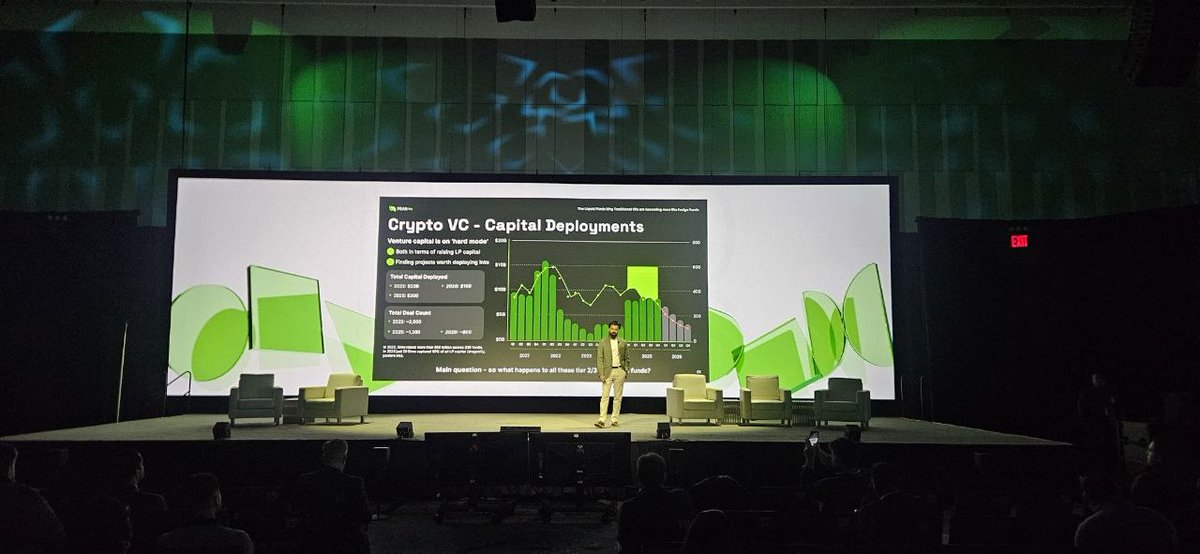
Crypto VC has an existential problem The old model of invest early, and wait for TGE is DEAD So where might this money go next? Here's the notes from my Keynote @blockworksDAS 👇
huf.hl tweet media
English
21
28
161
13.8K
TS รีทวีตแล้ว
Kris Sidial🇺🇸
Kris Sidial🇺🇸@Ksidiii·
Ty, my friend 🙏🏾. I say this quite a bit. You can generate over 9 figures in P&L, have a net worth of 8 figures strictly from trading volatility, be one of the best performers in the space for the last 5 years (with a real audited track record), manage close to a yard in a vol book……. And still have some person on Fin-twit claim you have no idea what you are talking about 😂 It’s a very odd place at times, with a ton of grifters and keyboard warriors that have very large egos lol. Best rule of thumb for people on Fin-twit, is if the person posting doesn’t have a real audited track record with outperformance, it’s best to ignore any strong opinions.
English
10
2
128
10.2K
TS
TS@PelionCap·
I admit I only skim-read this options primer, but if I can capture one quote: 'In my trading, I refuse to acknowledge things such as parmicharma, which sounds like Italian ham, or speed, that is solely reserved for 3am on a weekend when you want the night to keep going.' lmao. 🫡
English
0
0
6
1.1K
TS
TS@PelionCap·
Long Option Gamma continues to perform as the simplest way to manifest profits from Trump's erratic behavior.
English
0
1
27
4.6K
TS
TS@PelionCap·
Trump's wildly erratic messaging and attempts to save face are nothing but the toxic brew of his monstrous ego slammed against the brutal pressures crushing him—from upcoming midterms, internal party division, and his legacy obsessions to threats from foreign leaders who poured money into the US and are now salivating to humiliate and yank their cash from this rapidly weakening president. Art of the deal? - No.
English
4
4
61
4.1K
TS
TS@PelionCap·
@0xcarlosg Excellent and thorough. Accounting for revenue rebates is honest work. The structures could be insto driven as you/WM suggest, or considering the type of structures (specifically BTC) could be related to exchange risk or 'mutually aligned' growth.
English
0
0
5
264
TS รีทวีตแล้ว
Deribit Insights
Deribit Insights@DeribitInsights·
1) STRC assisted BTC to 76k and last report's 75k Calls to a 4x, but there was no sign of profit taking as Spot retraced hard. Instead, buying of 50-60k Puts, +Mar Put spreads. When Israel hit energy infra yesterday and PPI came in hot, Puts lifted via April+Dec risk reversals.
Deribit Insights tweet media
English
4
4
24
3.6K
TS
TS@PelionCap·
@0x_tiago Compare discord activity to X shills for your answer.
English
1
0
1
292
Tiago
Tiago@0x_tiago·
This framing is the reason I didn't buy $DRV last week. I could see traction picking up, but it wasn't enough for me to justify a short-term trade betting on it being undervalued in this market environment. The market sure didn't care and I missed a 3x in a week, but it is what it is (I am coping) I've been using the platform daily for a month now, and everything has improved so much. My only concern now is how long it will take for on-chain options to really take off Derive has been all over my feed recently, but with the new algo, it's hard to be sure if there are many people talking about it, or if I'm in an echo chamber because I liked some related posts
harsha@Harsha2077

you've probably seen screenshots of $DRV OI next to Hyperliquid and Aster from ppl shilling it as "undervalued" i dug into the numbers. here's what's actually going on first, that $1.3B OI is almost entirely options notional. Derive's own dashboard breaks it down: BTC: $528M total OI • $507M options • $21M perps ETH: $97M total OI • $94M options • $3.4M perps so actual perp OI is only ~$24M. the "$1.3B" figure comes from options notional value (which makes sense because Derive is an options protocol). but options notional and perp OI are completely different things. in perps, $70k notional = a real $70k position with collateral and liquidation risk. yes leverage inflates it, but typically by ~5–10x. in options, $70k notional just means the contract references $70k of the underlying. the premium paid might only be $200–$400. the inflation vs real capital can easily be 100x+. this is why TradFi doesn't report options OI in notional. CME and CBOE report contract count. Deribit (the largest crypto options exchange) does the same: • 483,124 contracts headline • $33.7B notional shown separately clear and transparent. Derive only shows notional OI as the headline, with no contract count on the trading UI. so i went to their stats page. Derive has roughly ~8,000 BTC options contracts across all strikes. Deribit has ~483,000. that puts Derive at ~1.7% of Deribit's size. to be clear, i actually like Derive as a project. the team is solid. but when someone puts Derive's "$1.3B OI" next to Hyperliquid and Aster and says "look how undervalued", they're comparing options notional to perp OI. it's apples to oranges. also worth noting: Derive's OI is concentrated in just two expiries (March 27 and June 26), suggesting a small number of large positions. so the real picture is: • ~8,000 options contracts • mostly one-sided call selling • concentrated in two expiries • ~1.7% of Deribit's size if someone's selling you $DRV based on "$1.3B OI at $76M mcap", they probably don't understand options. also @DefiLlama can do better here. options protocols like Derive shouldn't be ranked by notional OI alongside perp protocols. either show contract count for options or at least separate the categories. the current setup is misleading

English
4
0
12
2.2K
TS
TS@PelionCap·
@Harsha2077 At that point, like with all protocols, Defillama/one has to debate the actual fees (after discounts+mm kickbacks/token incentives etc). For another time.
English
0
0
3
210
harsha
harsha@Harsha2077·
fair point. delta-adjusted still overcounts for multi-leg strats. but it’s better than raw notional but not perfect. agree that fees are probably the cleanest comparison, which is why i included that in the post. $5.28M annualized fees on the reported OI tells you more than any OI metric can
English
1
0
2
411
harsha
harsha@Harsha2077·
in my last post i broke down why Derive’s "$1.3B OI" isn’t comparable to perp OI. the Derive team suggested delta-adjusted OI as a fairer metric. i agreed, so i pulled their public API and calculated it. but first, what does delta-adjusted actually mean? simple example: someone buys a BTC $100K call when BTC is at $70K. that contract adds $70K to headline OI. but the option has a 0.13 delta, meaning for every $1 BTC moves, the option moves $0.13. so it behaves like a $9.1K position, not a $70K one. the other $60.9K is just inflating the headline. delta-adjusted OI removes that inflation and shows how much real exposure actually exists. this is standard in TradFi and what the Derive team themselves suggested. so i pulled every active option from Derive’s API across all four assets: BTC, ETH, HYPE, SOL. grabbed each contract’s OI, delta, and price. here’s what the data shows: 1. BTC - 6,895 contracts - $486M notional - $119M real exposure (24.4%) 2. ETH - 46,781 contracts - $97M notional - $21M real exposure (21.9%) 3. HYPE - 1,598,215 contracts - $59M notional - $24M real exposure (40.3%) 4. SOL - 3,593 contracts - $312K notional - $68K real exposure (21.8%) combined: $642M notional $164M real exposure so for every $1 of headline OI, only about $0.25 is actual exposure. the other ~$0.75 comes from out-of-the-money contracts that inflate the number without much real economic weight behind them. the fees tell the same story. Derive generates about $5.28M annualized fees on its reported OI. if this OI represented the same activity as perp OI, fee generation would likely be multiples higher. you can inflate notional. you can’t inflate fees. one more thing i found while digging through the API: Derive’s stats page shows $1.34B OI, but summing every individual instrument from the API gives about $642M. the global number is exactly 2× for every asset. meaning the headline likely counts both the buyer and seller of each contract separately. for context, Deribit and CME report options OI single-sided (one contract = one count). that’s the industry standard. @DeriveXYZ is the two-sided reporting intentional? genuine question, not an accusation. note: this is a snapshot at a single point in time. deltas change as prices move. but the ~25% ratio held independently across BTC, ETH, and SOL, suggesting it’s structural rather than a one-off. i like what Derive is building. onchain options are a real and growing market. but if someone uses Derive's "$1.3B OI" to compare it with perp protocols, it's worth understanding what that number actually represents. all data pulled from Derive’s public API. script is open source if anyone wants to verify.
harsha@Harsha2077

you've probably seen screenshots of $DRV OI next to Hyperliquid and Aster from ppl shilling it as "undervalued" i dug into the numbers. here's what's actually going on first, that $1.3B OI is almost entirely options notional. Derive's own dashboard breaks it down: BTC: $528M total OI • $507M options • $21M perps ETH: $97M total OI • $94M options • $3.4M perps so actual perp OI is only ~$24M. the "$1.3B" figure comes from options notional value (which makes sense because Derive is an options protocol). but options notional and perp OI are completely different things. in perps, $70k notional = a real $70k position with collateral and liquidation risk. yes leverage inflates it, but typically by ~5–10x. in options, $70k notional just means the contract references $70k of the underlying. the premium paid might only be $200–$400. the inflation vs real capital can easily be 100x+. this is why TradFi doesn't report options OI in notional. CME and CBOE report contract count. Deribit (the largest crypto options exchange) does the same: • 483,124 contracts headline • $33.7B notional shown separately clear and transparent. Derive only shows notional OI as the headline, with no contract count on the trading UI. so i went to their stats page. Derive has roughly ~8,000 BTC options contracts across all strikes. Deribit has ~483,000. that puts Derive at ~1.7% of Deribit's size. to be clear, i actually like Derive as a project. the team is solid. but when someone puts Derive's "$1.3B OI" next to Hyperliquid and Aster and says "look how undervalued", they're comparing options notional to perp OI. it's apples to oranges. also worth noting: Derive's OI is concentrated in just two expiries (March 27 and June 26), suggesting a small number of large positions. so the real picture is: • ~8,000 options contracts • mostly one-sided call selling • concentrated in two expiries • ~1.7% of Deribit's size if someone's selling you $DRV based on "$1.3B OI at $76M mcap", they probably don't understand options. also @DefiLlama can do better here. options protocols like Derive shouldn't be ranked by notional OI alongside perp protocols. either show contract count for options or at least separate the categories. the current setup is misleading

English
5
3
70
36.2K