Peter Cunningham 🇨🇦

2K posts

Peter Cunningham 🇨🇦 banner
Peter Cunningham 🇨🇦

Peter Cunningham 🇨🇦

@PeterCunningham

Curious centre-right Albertan | Proud #ForeverCanadian 🇨🇦 Learning from those who think differently Argue. Err. Get smarter. #NAFO Fella 🐶🇨🇦🇺🇦

Canada เข้าร่วม Mart 2009
3.3K กำลังติดตาม2.5K ผู้ติดตาม
Peter Cunningham 🇨🇦
Peter Cunningham 🇨🇦@PeterCunningham·
💯 C-226 creates zero civil service jobs. Price transparency isn't government running grocery stores — it's a label on a shelf. The government announced a plan to trim 40,000 public-sector jobs — about 10% of the workforce — with up to 15% reductions across ministries, targeting $44B in savings. Agree, that should be more like 33%.
English
0
0
0
4
Jen (ESC) 🇨🇦❤️🦋
Poilievre complains almost daily about the Liberals raising prices on groceries. However, yesterday, he voted no on Bill-C226 to improve food price transparency. Conservatives are lying to you 😒
English
187
607
1.9K
17.7K
Peter Cunningham 🇨🇦
Peter Cunningham 🇨🇦@PeterCunningham·
The veto point misunderstands the mechanics. Section 122 tariffs expire automatically in 150 days unless Congress votes to extend them. Trump can't veto inaction. He needs Congress to act — not the other way around. Meanwhile Canada's effective US tariff rate is ~2.4%, with USMCA goods still duty-free. Compare that to Japan ($550B tribute for 15%), Korea ($450B for 15%), or the EU ($750B for 15%). "Canada doesn't have time" to do what, exactly — pay $500B in tribute to get a worse deal than we already have? Section 122 tariffs took effect February 24, 2026. 150 days later is July 24, 2026. The midterms are November 3, 2026 — meaning the Section 122 expiry comes 3.5 months before election day. Congress would have to vote to extend tariffs in late July, in the middle of primary season, with the election 14 weeks out.
English
0
0
0
10
Rick Pereria
Rick Pereria@RickPereria·
@PeterCunningham @BBCWorld The president can use his veto power. It’s going to be two plus years at the very least. Canada doesn’t have that kind of time.
English
1
0
0
9
Peter Cunningham 🇨🇦
Peter Cunningham 🇨🇦@PeterCunningham·
@ShaMustard @Smil3yAngel Disagree. Transparency is the precondition for accountability. The people who benefit most from opacity in grocery pricing are the grocers. If they hate this bill, that’s a pretty good sign it’s not nothing. More floor crossings to come.
English
0
0
0
7
Shawn Dejong
Shawn Dejong@ShaMustard·
@PeterCunningham @Smil3yAngel "This bill won’t cap prices" So it's a bullshit bill that does nothing. A waste of time and taxpayer dollars. Cheering it on and then complaining about theatre is beyond peak irony.
English
1
0
1
12
Peter Cunningham 🇨🇦 รีทวีตแล้ว
Scott Robertson
Scott Robertson@sarobertsonca·
PM Carney on the Americans calling the alcohol ban an irritant: "You know what's an irritant? 50% tariffs on steel. 50% tariffs on aluminum. 25% tariffs on automobiles. All the tariffs on forest products. Those are more than irritants, those are violations of our trade deal."
English
474
5.4K
24.5K
581.3K
Peter Cunningham 🇨🇦
Peter Cunningham 🇨🇦@PeterCunningham·
Here’s what I know about it. What are your concerns? Bill C-226 passed second reading 168–150 yesterday. The National Framework for Food Price Transparency Act isn’t flashy — it directs the Minister of Industry to work with provinces on national unit pricing standards and grocery price disclosure practices. That’s actually worth doing. Right now, unit pricing in Canada is inconsistent, poorly displayed, and varies wildly by retailer. Consumers trying to compare a 340g vs 500g vs 1.2kg product shouldn’t need a calculator. Standardized, accurate shelf-level unit pricing is basic consumer infrastructure that most of Europe figured out decades ago. This bill won’t cap prices. But transparency is how you build the evidentiary foundation for what comes next — and for the Competition Bureau to do its job. Small bill. Legitimate purpose. I voted Conservative. My Conservative MP voted against it with the Opposition. He’s already heard from me
English
1
0
0
23
Peter Cunningham 🇨🇦
Peter Cunningham 🇨🇦@PeterCunningham·
Time will tell on steel and aluminum. The US Federal Reserve said this: "We estimate that the tariffs implemented through November of 2025 have raised core goods PCE prices by 3.1 percent through February 2026" Source: Federal Reserve Board, Detecting Tariff Effects on Consumer Prices in Real Time – Part II (April 8, 2026). federalreserve.gov/econres/notes/… The effect has been to raise costs for U.S. manufacturers and push some of that through to American consumers as higher prices, especially for goods that use a lot of steel or aluminum, directly or indirectly. Federal Reserve researchers said the 2025 tariff waves raised consumer goods prices measurably, while the Fed’s Beige Book reported rising metal prices from tariffs, including steel and aluminum. On aluminum specifically, U.S. buyers were paying sharply more for physical metal in early 2026, and Reuters reported that Canada had been the largest supplier to the U.S. market while U.S. stocks were shrinking. Reuters also noted the metal is used in automotive, aerospace, construction, and packaging, which is how those higher input costs end up filtering into retail prices. Statistics Canada says that in 2025, Canadian aluminum exports to countries other than the U.S. increased, with shipments to the Netherlands up 74.3%, to Italy nearly doubling, and to Poland increasing fourfold. It also reported that exports of aluminum products rose from $738 million in 2024 to $2.1 billion in 2025, led by higher shipments to the Netherlands and Italy
English
0
0
0
8
Cesar A. Guilarte M.
Cesar A. Guilarte M.@cguilarte·
@PeterCunningham @BBCWorld Keep dreaming, Peter. We have no leverage with the US (tariffs or not), and the people whose livelihoods depend on USMCA-protected probably feel differently about the need to rush.
English
2
0
0
24
Peter Cunningham 🇨🇦
Peter Cunningham 🇨🇦@PeterCunningham·
Thanks Scott. I've no idea why this performative stuff works in the US; it sure works against PP in Canada outside of his tiny base. We all know the "rupture" Carney was talking about was not about pulling out of CUSMA. Manufactured BS. What Carney actually said, repeatedly, is that the world is in a broader “rupture, not a transition” and that the old rules-based order and Canada’s old reliance on close U.S. ties are no longer safe assumptions. In Davos on January 20, he said: “We are in the midst of a rupture, not a transition,” then described tariffs, financial infrastructure, and supply chains being used as coercive tools. (Canada's Prime Minister) He used the same framing again on February 10, saying “the world is in the midst of a rupture” and that Canada should respond by strengthening defence at home and diversifying economic and security partnerships abroad. (Canada's Prime Minister) More recently, on April 16, Carney said that “many of our former strengths – based on close ties with the U.S. – have become vulnerabilities,” and that Canada should not wait for the old relationship to come back. That is a warning about dependence on the U.S., not an announcement that Canada should quit CUSMA. (Liberal Party of Canada) In fact, current reporting points the other way: Carney’s government has set up a new advisory committee specifically ahead of the CUSMA review, and Reuters reports the agreement is still viewed as important because roughly 85% of Canadian exports to the U.S. are tariff-exempt under it. (Reuters) So Poilievre’s line is a political extrapolation, not what Carney literally said. “Rupture” in Carney’s usage means a breakdown in the old international and Canada-U.S. strategic environment, not a stated plan to withdraw from CUSMA.
English
0
1
11
142
Scott Robertson
Scott Robertson@sarobertsonca·
Pierre Poilievre: "He says he wants this rupture with the U.S. Does that mean he wants to pull out of the CUSMA? Because that's what a rupture would mean. Unless the word was just a meaningless sensationalist slogan."
English
150
41
167
66.4K
Peter Cunningham 🇨🇦
Peter Cunningham 🇨🇦@PeterCunningham·
This is boilerplate anti-government fluff. C-226 does not set up an expensive new bureaucracy. It tells the Industry Minister to work with provinces on a framework for unit pricing and price transparency. Why? Because the Competition Bureau has already said accessible, harmonized unit pricing helps consumers compare prices and improves competition. So the real position here is: “I support competition, but I oppose one of the basic transparency tools that helps competition work.” That is not serious.
English
0
0
0
4
AnotherOne
AnotherOne@AnotherOne92155·
@PeterCunningham @Smil3yAngel I’m against anything that unnecessarily increases prices and especially Taxes. To believe additional bureaucracy whether Federal or Provincial is IMO naive. Worse if it’s Provincial as it will require double staff etc. who pays for the reports? Only consumers and taxpayers 😊
English
1
0
0
5
Peter Cunningham 🇨🇦
Peter Cunningham 🇨🇦@PeterCunningham·
C-226 does not set up some giant new agency. Read the bill: it requires the Minister of Industry to work with provinces on a framework for unit pricing and price transparency, then table a report and publish it. The Competition Bureau has already said harmonized unit pricing helps consumers compare prices and improves competition. In plain English: competition is weaker when grocers make it harder to see who is actually cheaper. So this “bureaucracy” talking point is mostly a dodge. Conservatives say they want more grocery competition, then sneer at one of the exact transparency measures the Competition Bureau recommended to make competition work better. canada.ca/en/competition…
English
1
0
0
10
AnotherOne
AnotherOne@AnotherOne92155·
@PeterCunningham @Smil3yAngel Maybe you can explain how adding another government agency, staff, bureaucracy required as well as all the daily expenses to the retailers who will undoubtedly pass them on to us consumers is going to make stores of all sizes more competitive. It’ll raise prices, not lower them.
English
1
0
0
9
Peter Cunningham 🇨🇦
Peter Cunningham 🇨🇦@PeterCunningham·
True, our only "leverage" is American voters, our patience, and our willingness to trade with others. In the meantime, Canada has the LOWEST effective US tariff rate of any major trading partner — about 2.4–2.9%. ~90% of Canadian goods enter duty-free under USMCA. On industries like auto, the US administration is openly frustrated that reshoring hasn't happened fast enough and is actively considering tightening the rules — subjecting even USMCA-compliant vehicles to an effective 10% tariff. Trump's stated goal, in his own words, is "poaching key industries" from Canada and Mexico. That is not a negotiating position. That IS the policy. No Canadian PM — Liberal, Conservative, or otherwise — can negotiate away the core industrial strategy of a US President. This is what Carney means when he says we need to stop reminiscing. Others have rushed to a d eal. Japan paid $550B in US investment for a 15% tariff. Korea paid $350B plus $100B in forced energy purchases for 15%. The EU committed $750B for 15%. Canada is at 2.4% with zero tribute. Meanwhile, $166B in tariffs paid by US consumers — now $166B to be paid out in refunds by taxpayers. They pay twice because consumers won't see that refund. Trump's latest tariffs have to be ratified by Congress within 150 days. The midterms will change the house and limit what Trump can do going forward.
English
0
0
0
26
Peter Cunningham 🇨🇦
Peter Cunningham 🇨🇦@PeterCunningham·
This is a dodge. C-226 does not claim grocers are the only reason food is expensive. The Bank of Canada says grocery prices are affected by energy, labour, transportation, exchange rates and harvests too. What C-226 does is much narrower: clearer unit pricing, better transparency on price changes, and consumer education. In other words, basic rules so people can compare what they’re actually being charged. Related example, beef +12.7% — four packers controlling most processing. Prices for Canadian beef are cheaper in the USA after the White House put the hammer down. Why wouldn't we? The Competition Bureau explicitly recommended harmonized unit pricing because competition fails when consumers can’t easily see the best deal. It also says grocery concentration is part of the problem, even if not the whole problem. So the Conservative line is: “We support competition” right up until there’s an actual transparency measure that might make competition work a little better. parl.ca/DocumentViewer…
English
2
2
4
87
Kevin̊ ⤵️🐰🕳
@Smil3yAngel C-226 adds bureaucracy, compliance costs for grocers, and federal overreach that get passed to consumers, while ignoring root drivers of food inflation like deficits, taxes, and supply chain regulations. It will increase food costs to Canadians. Would you vote for that?
English
4
4
72
565
Peter Cunningham 🇨🇦
Peter Cunningham 🇨🇦@PeterCunningham·
Ford ran the ad that blew up the trade talks, so naturally the solution is to call him a Liberal. Solid framework. The Ontario Conservative government ran the ad, Carney is on-record saying he didn't approve. Trump punished Canada for it. Carney is now blamed for not fixing it?
English
0
0
1
27
Marc Nixon
Marc Nixon@MarcNixon24·
Trump TERMINATED all Canada-US trade talks Oct 2025 after Liberals got caught running a fraudulent Reagan ad exposed by the Reagan Foundation itself. Six months later: Carney’s team hasn’t even picked up the phone. Zero outreach. Why? They’re deliberately torching our #1 trading relationship to keep the “Orange Man Bad” boogeyman alive and prop up Carney’s support. Sabotaging Canada’s economy for Liberal poll numbers. Insane. Suicidal.
English
190
555
2.5K
89.3K
Peter Cunningham 🇨🇦
Peter Cunningham 🇨🇦@PeterCunningham·
Important point, and I think we're aligned on almost everything. But a security clearance does not mean automatic access to everything. Dissemination of classified information is still controlled on a strict need-to-know basis. Clearance makes a briefing possible; it does not create a right to sources, methods, or operational details. For the Opposition Leader the benefit is that they can receive appropriately scoped classified briefings when needed — enough to scrutinize government decisions, understand real threats, and act responsibly in a crisis. Clearance enables access. Need-to-know still limits it.
English
0
0
0
19
Dimitris Soudas 🇨🇦⚜️🇬🇷☦️ 13.12.1943
The MP calling for all party leaders to receive security clearance isn’t just foolish, it’s reckless. And it exposes a fundamental lack of understanding about national security. Here’s what people don’t understand: the government CAN already brief the Leader of the Opposition on classified information. That mechanism exists. It works. What it cannot reveal are sources and methods. And that distinction matters more than anything. Knowing what we know is one thing. Knowing how we know it and who told us is something else entirely. Expose that, and you don’t just compromise one operation. You burn networks. You endanger lives. Handing that to every party leader in Westminster isn’t transparency. It’s a gift to every foreign intelligence service watching. This isn’t a bold democratic move. It’s a security disaster waiting to happen.
English
7
3
24
1K
Marc Nixon
Marc Nixon@MarcNixon24·
Bruce Fanjoy reads petition requiring all MP to have their security clearance. 42,300 signatures. This is a NATIONAL SECURITY RISK
English
229
59
249
25.6K
Peter Cunningham 🇨🇦
Peter Cunningham 🇨🇦@PeterCunningham·
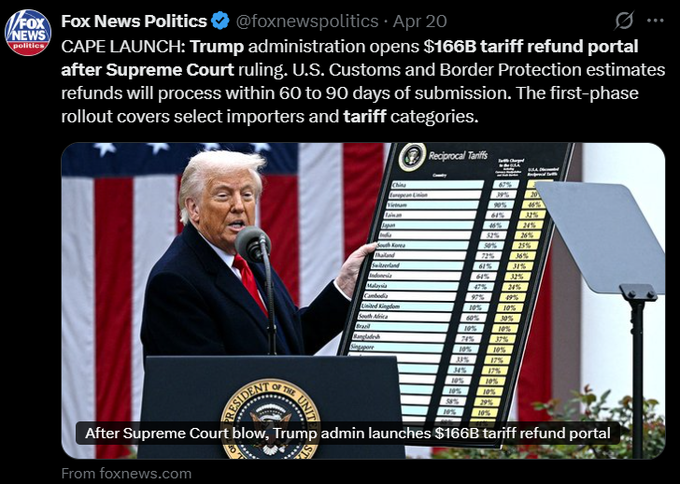
$166B in tariffs paid by US consumers, now $166B to be paid out in refunds by taxpayers. Y'all paid twice. Canada has the LOWEST effective US tariff rate of any major trading partner — about 2.4-2.9%. ~90% of Canadian goods enter duty-free under USMCA. Carney himself said it: "Canada currently has the best trade deal with the United States... better than that of any other country. If there's a loser here, it's not Canada.
Peter Cunningham 🇨🇦 tweet media
English
0
0
1
14
Peter Cunningham 🇨🇦 รีทวีตแล้ว
Gandalv
Gandalv@Microinteracti1·
Tariff refunds will total billions of dollars. Now, you might reasonably ask who looked at all this and cheered. Good question. Allow me to introduce you to them. Two thirds of Trump’s voters in 2024 did not have a college degree. That is not an insult. That is a Pew Research finding. The gap between college graduates and non-graduates voting Republican was 13 points in 2024, wider than in 2020, and wider again than in 2016. It is a chasm that keeps getting bigger.  These are the people who watched a man promise that China would pay America’s bills, nodded thoughtfully, and voted for him anyway. Twice. In some cases three times, if you count the primaries. States where fewer adults hold a college degree are almost all reliably red. States above that threshold are almost all reliably blue. It is, at this point, the single most reliable predictor of how a county votes. More reliable than income. More reliable than religion. More reliable, frankly, than common sense. And when the bill arrived, when $166 billion turned out to have been paid by American businesses and passed directly onto American families through higher prices on strollers, brake pads, and olive oil, these same voters did not pause for reflection. They went on social media and explained that actually, the deep state had rigged the Supreme Court. One in four Trump voters agreed that God had personally ordained his election victory.  Not metaphorically. Literally divinely appointed. This is the electorate that was asked to evaluate a 50-page trade policy and determine whether tariffs are paid by the exporter or the importer. They got it wrong, obviously. But here is the thing about Trump’s genius, and I use the word with the generosity I normally reserve for describing a broken lawnmower as “retro.” He did not need them to understand the policy. He needed them to feel it. And what they felt was that someone, finally, was sticking it to the foreigners. The details were irrelevant. The foreigners were laughing. He was going to make them stop. The foreigners are still laughing. The Americans paid $166 billion to fund that particular fantasy, and are now watching Walmart collect the refund. You really cannot make this up. Though apparently, you can make them vote for it. Gandalv / @Microinteracti1
English
39
268
824
23.7K
Peter Cunningham 🇨🇦
Peter Cunningham 🇨🇦@PeterCunningham·
Pierre says he wants to “take taxes off groceries.” Here’s the problem: the supply of basic groceries, including most food marketed for human consumption, is already zero-rated — GST/HST is applied at 0%. Meat — including beef, poultry, pork, and lamb — is explicitly listed as zero-rated. The federal “grocery tax” Poilievre is campaigning on removing does not exist. It is currently zero. It has been zero since GST was introduced in 1991. The consumer carbon tax — which did apply indirectly through fuel and heating costs at the farm and processing level — was repealed in March 2025. Beef is up 13–14% since then. The policy he blamed is gone. The prices aren’t. So why is Canadian beef expensive while cheaper abroad? Despite being a major beef-producing nation, Canada consistently pays more than the United States. The reasons are structural: smaller market scale, higher transportation costs, and a retail landscape dominated by a few powerful grocers. Two companies — JBS and Cargill — dominate beef processing across North America, are both privately owned, and under no obligation to publish detailed financial results. That opacity leaves consumers, producers, and policymakers guessing at how much profit is being extracted from the system. The White House sued them for price-fixing. They settled quietly. Draw your own conclusions. Should Canada take similar action? Ranchers now receive less than 30 cents of every retail beef dollar — a historic low. Meanwhile packer profits have soared. The farmer isn’t getting rich. You’re getting gouged. The money is in the middle. Canadian beef is cheaper in the US because CAD trades at ~0.72 USD — that 28% discount is doing the work. Premium cuts ship to South Korea and Japan because foreign buyers outbid Canadians. Retail beef in Canada averages $25–26/kg. Imported beef entering Canada runs ~$15/kg. Export prices from Brazil and Argentina range $4–6 USD/kg. That gap is not a tax gap. It’s a structural concentration gap. “Take taxes off groceries” is a slogan targeting a tax that doesn’t exist, to solve a problem caused by entities named JBS, Cargill, Loblaw, Sobeys, and Metro. Sources: Canada Revenue Agency (Basic Groceries zero-rating policy) · Revenu Québec · Canadian Grocer/Charlebois, Dalhousie · Retail Insider/Agri-Food Analytics Lab Apr 2026 · Farm Action/USDA Packers & Stockyards Report
English
0
0
0
14
Peter Cunningham 🇨🇦
Peter Cunningham 🇨🇦@PeterCunningham·
Poilievre’s grocery-affordability politics are a con. He talks like a populist enemy of concentrated corporate power, but when Parliament gets a chance to do anything concrete about concentrated grocery power, he votes the other way. He backed a vague motion about boosting grocery competition, then opposed real competition tools in Bill C-56 and opposed price-transparency and unit-pricing rules in Bill C-226 that the Competition Bureau itself says would help consumers and improve competition. That is not principle. That is theatre. He wants the anger of people at the checkout counter without supporting the rules that make dominant grocers compete harder for their business.
Pierre Poilievre@PierrePoilievre

For 4 months in a row, Prime Minister Carney has given Canadians the worst food inflation among G7 countries. Liberal grocery taxes and doubled deficits have pushed a record number of Canadians to food banks and 1 in 4 people into food insecurity. Take all taxes off groceries to deliver affordable food now: conservative.ca/cpc/make-food-…

English
1
0
0
24