What is fascinating about yesterday's event is how Cardano recovered from a minority chain and got rid of the symptom while preserving most of the history and progress since the incident. 🧵
Power2theEdge🛡️ ₳D₳
15.5K posts

@Power2theEdge
Advocate 4 common sense, less government, open free markets, personal accountability, consequences for bad actors; Not a fan of broad generalizations, tribalism

What is fascinating about yesterday's event is how Cardano recovered from a minority chain and got rid of the symptom while preserving most of the history and progress since the incident. 🧵

First finding was a vulnerability that allowed programmable tokens to exist outside the mini-ledger (ie. not be subject to any programmable logic and just live in your wallet). The problem was that you could mint a programmable token without first registering it, and then you could later register it at which point it is subject to the programmable logic. The second finding was that the Aiken implementation for transfers of programmable tokens was just broken, it didn't handle minting / burning correctly. Specifically, it couldn't handle transactions where you burn all the programmable tokens you are sending so if you wanted to burn tokens you would always have to leave at-least one token, you could never burn the total amount.

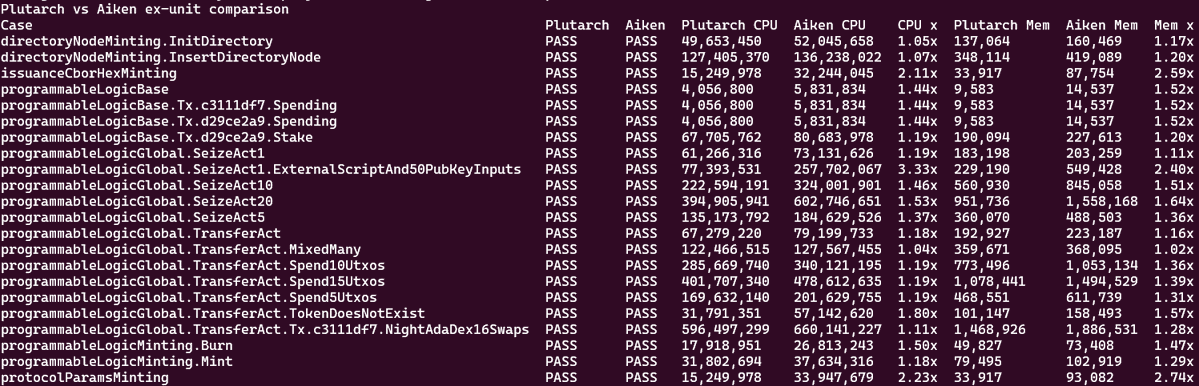
No. 1. None of the reported numbers on the Aiken version reflects the current implementation. E.g. - The transfer simple is currently at [cpu: 68.97M, mem: 193.70K], so about on-par - The mixed many transfer sits at [cpu: 107.93M, mem: 307.89K], well below the Plutarch's implementation - etc... 2. The difference IS about micro-optimisations. We are talking couple of % in the 100M cpu and 100K mem range. So 1% difference is about 0.01% of the overall transaction max budget. Said differently, a difference of 1% roughly translates to 200 lovelaces of execution cost; that's about $0.00005. 3. The size of the Plutarch scripts is 4522 bytes. Aiken's latest scripts weight 2787 bytes. Each byte costs *at least* (if reference inputs, and in the lowest price tier) 15 lovelace. So that's currently a difference 26,025 lovelace. So even if the Aiken version was 130% more costly; it would still be balanced by the script size. For the complete analysis / rationale, please read: github.com/cardano-founda…

Comprehensive benchmarks of Plutarch implementation of programmable tokens against the Aiken implementation (on average the Plutarch implementation is 39.6% more efficient) This benchmark covers real use-case scenarios pulled from actual DeFi transactions from the ledger history. For a practical example, a DEX transaction which processes 16 swap requests when converted to the equivalent transaction on the programmable tokens mini-ledger is 28% more expensive in the Aiken implementation. In every single case, the Plutarch implementation is more efficient. In the largest observed difference, the Aiken implementation consumed 3.33x more CPU and 2.4x more memory than the Plutarch equivalent. The difference here is not micro-optimization, it is an entirely separate class of efficiency. We are not talking about a 5% difference; we are talking about an average difference in efficiency of 39.6% across benchmarks produced from real world use-cases randomly sampled from mainnet DeFi protocols.


In December, President Trump signed an Executive Order tasking us with the development of a national framework for AI, what he called “One Rulebook.” This was in response to a growing patchwork of 50 different state regulatory regimes that threaten to stifle innovation and jeopardize America’s lead in the AI race. Today we are releasing that framework. It will help parents safeguard their children from online harm, shield communities from higher electric bills, protect our First Amendment rights from AI censorship, and ensure that all Americans benefit from this transformative technology. We look forward to working with our colleagues in Congress to turn the principles we are announcing today into legislation. whitehouse.gov/articles/2026/…


SENATOR CYNTHIA LUMMIS SAYS CRYPTO YIELD NEGOTIATIONS MAKING PROGRESS BUT REMAIN IN A DELICATE STATE


This is patently incorrect. The benchmarks I posted above are all correct and reflect the current Aiken and Plutarch contracts. All claims made in my OP are correct, Aiken is worse across all test vectors. All benchmarks posted above are reproducible, and I hope that you take the 5 minutes required to do so yourself and retract the false claims above. Go to the repo, checkout the branch you are basing the port on, run `nix develop` and run: `cabal run benchmark-onchain-aiken-scripts` `cabal run benchmark-onchain-scripts` or you can just run ./benchmark-onchain-compare.sh and it will output the ex-unit difference across all the benchmarks above.


Donald Trump was overwhelmingly elected by the American people to be our President and Commander in Chief. As our Commander in Chief, he is responsible for determining what is and is not an imminent threat, and whether or not to take action he deems necessary to protect the safety and security of our troops, the American people and our country. The Office of the Director of National Intelligence is responsible for helping coordinate and integrate all intelligence to provide the President and Commander in Chief with the best information available to inform his decisions. After carefully reviewing all the information before him, President Trump concluded that the terrorist Islamist regime in Iran posed an imminent threat and he took action based on that conclusion.