Alexsandro Soares รีทวีตแล้ว
Alexsandro Soares
22 posts

Ele é do time #braziliansnow
Time Brasil@timebrasil
É OUROOOOO! É A PRIMEIRA MEDALHA OLÍMPICA DE INVERNO DO #TIMEBRASIL!!! 🇧🇷❄️ Lucas Pinheiro Braathen faz história no slalom gigante de #MilanoCortina2026 e coloca o Brasil no pódio dos Jogos Olímpicos de Inverno pela primeira vez! O sonho se tornou realidade! Você é gigante, Lucas! 🌟 #InvernoTimeBrasil #EsquiAlpino #Loterias #Caixa
Português
Alexsandro Soares รีทวีตแล้ว

Alexsandro Soares รีทวีตแล้ว

@predict_addict Could you provide a list of books for beginners in data science or machine learning that have strong scientific evidence?
English
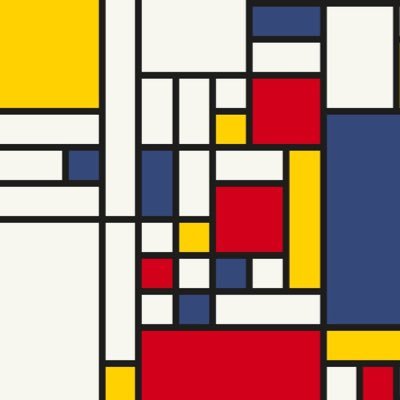
Data science books and other resources that people pay quite a lot of money for often contain inaccuracies and wildly incorrect claims.
Here is one example of one book containing grossly incorrect claims about classifier calibration.
The book claims, inter alia, that Naive Bayes and Artificial Neural Networks “provide calibrated probabilities.” A manifestly untrue claim that contradicts scientific evidence.
Naive Bayes is very miscalibrated, which was known for decades and is explicitly stated in Caruana and Niculescu Mizil paper cs.cornell.edu/~alexn/papers/…
Neural Networks are severely miscalibrated especially the deep learning kind which was known since 2017 (see for example Guo (2017) arxiv.org/abs/1706.04599) but also many other papers.
And shallow neural networks are miscalibrated as well as shown in more recent papers. See for example Johansson Are Traditional Neural Networks Well-Calibrated? ieeexplore.ieee.org/document/88519…
Unlike other sciences like math, physics etc beginners in data sciences who are not following formal route to data science education are often are brought up on cocktail of junk materials containing lots of errors and ridiculous claims and are acquiring “skills“ based on incorrect information.
Think authors of such books have any responsibility to ensure correctness of the claims?
Think again and read small font in disclaimer (in comments). The responsibility to acquire correct information is on you data scientists. The disclaimer says so.
#books #calibration
English
Awesome Conformal Prediction has a small but growing section referencing @Kaggle materials.
And yes conformal prediction often improves even ROC AUC and other non probabilistic metrics.
Submit a quality notebook and get it featured on the repo!
#kaggle #conformalprediction
github.com/valeman/awesom…

English
Alexsandro Soares รีทวีตแล้ว

There is an ongoing discussion involving Harvard and MIT, two institutions where I spent plenty of time during the past 20 years. I first came to Harvard as a visiting PhD student in 2005, then joined the Kennedy School as a postdoc in 2008, and in 2010 I joined the MIT faculty, where I was until 2019. Personally, I don’t have much to add to the current discussion (eg about DEI, plagiarism, etc.) except some notes on the social context of Cambridge, Massachusetts. Because like all drama, what we are seeing today is unfolding on a social backdrop that may be difficult to understand. After all, I know for a fact that most Americans do not know how society works in and around these institutions. For most, even people from the north and south shores of Massachusetts, Harvard and MIT are mythical places that we hear mentioned in sitcoms and movies. And while the reality is different, it is still interesting. They are a reflection of a segment of society, not only of the United States but of the world, as these institutions are effective at attracting global elites.
I will first start with a few positive notes from the 2000s. I remember vividly being thrown head-first into a tough-love environment. If you brought a half-baked idea to a professor or colleague they would destroy it, and kick you while you are down. You had to learn to change your mind, defend yourself, or go home crying. At that time I hated it, but in hindsight, I’ve come to appreciate it. That’s how I learned to think and write, and also, came to understand that the best you can get as a junior scholar from a senior scholar is unvarnished feedback because the other option is for them to simply ignore you.
You need to keep in mind that academia is a game of social acceptance since all hiring, funding, and publication decisions come from secret peer recommendations. In many institutions, what that leads to is not excellence, but clubbiness. People form implicit support groups with others with whom they agree to approve each other’s work. These challenge-free environments lead to a lot of half-baked work that is usually ignored by the larger academic community. That was not how these institutions were in the mid-2000s. They were tough pressure cookers that did not care about you or your feelings. They cared about whether you really had something important to say, and could figure out how to say it and show it. It was tough, but the focus was on the quality of the work. And that is why their prestige is well deserved. There is a lot of great work and great people in them. Brilliant people pushing themselves and their teams to the limit, and in the process, generating new knowledge, technologies, and scientific leaders.
But there is also an underbelly to this society. A society that is not immune to prestige and its addiction. People always went to these institutions looking for prestige. But over the last few decades, the prestige machine was supercharged with social media, displacing in part the culture of excellence. And this brings me to some of the saddest stories.
I remember a colleague and friend who joined the MIT faculty in the mid-2010s. He came from abroad with his wife who had to quit her job to move there. And he was killing it in academic terms. But still, he was not happy. During a Saturday lunch, he explained to me why. He told me that when they socialized people would turn around and start talking to someone else as soon as his wife told them that she was in between jobs. That behavior was wearing them out. People in Cambridge were not there to make friends. I know this is a cliché, but I remember being told those same exact words by a senior colleague who made a habit of walking past me without acknowledging me every morning after I said hello, even though his office was a few doors away. My friend eventually left Cambridge as well.
I also remember one of the most bizarre parties I’ve ever attended. I don’t know how else to call it other than a well-organized “braggathon.” About 200 people were invited to the house of a person who had made a fortune in finance. After everyone arrived, we were brought to a large library where one of the hosts got the party going. He started calling people, who would respond with their prepared pitches. “Hey Jennifer, I know you are revolutionizing the cancer industry..” and Jennifer would deliver her pitch. “And that reminds me of Brandon, who is doing amazing work on aerospace,” and Brandon would jump into action. That went on for about 2 hours. It is a strange prestige-driven society that is hard to fathom from the outside.
And eventually, you get used to it. Because prestige is a powerful drug, a master of puppets that can take over your life. When you are affiliated to those institutions you get treated like royalty around the world. Saying you are a professor there provides a strong 'in' with the elites of the world. Many people don’t know how to evaluate ideas, so they rely on where these ideas come from. Prestige shapes the world. But there is another side to that coin. The crudest example of prestige addiction is the blighted and chronically addicted, those who at MIT are called lifers. These are people who joined the institute as an undergraduate, and 30 years later, continue doing odd jobs for a big professor because they understand that being low in the ranks of the castle is better than trying to survive outside its walls. They are in some ways, the most loyal members of the institutions, knowing that there is a parade of visitors that will give them for ten minutes the respect they otherwise never get inside.
The north bank of the river Charles is a peculiar place. A place with many stories, that because of this prestige addiction, will never see the light of day. Today I can talk because I have been sober for a few years, after not being granted tenure at MIT (link to this story below). I uprooted my life and moved to Europe during covid, where I have been playing a different game: helping build research institutions instead of climbing them. And I do appreciate my time in Cambridge. It helped me become a better thinker, writer, and scientist. It also opened my eyes to the world. But I know many colleagues who will never share their stories as long as they keep a weak link to these institutions. Quitting the prestige drug is difficult. Still, slowly but surely, the drama will keep on trickling as the cracks in the levy continue to spread. There is certainly a Morning Show-type drama series or movie waiting to be made about Cambridge MA, if only screenwriters were not so focused on New York and California.
x.com/cesifoti/statu…
English
Alexsandro Soares รีทวีตแล้ว
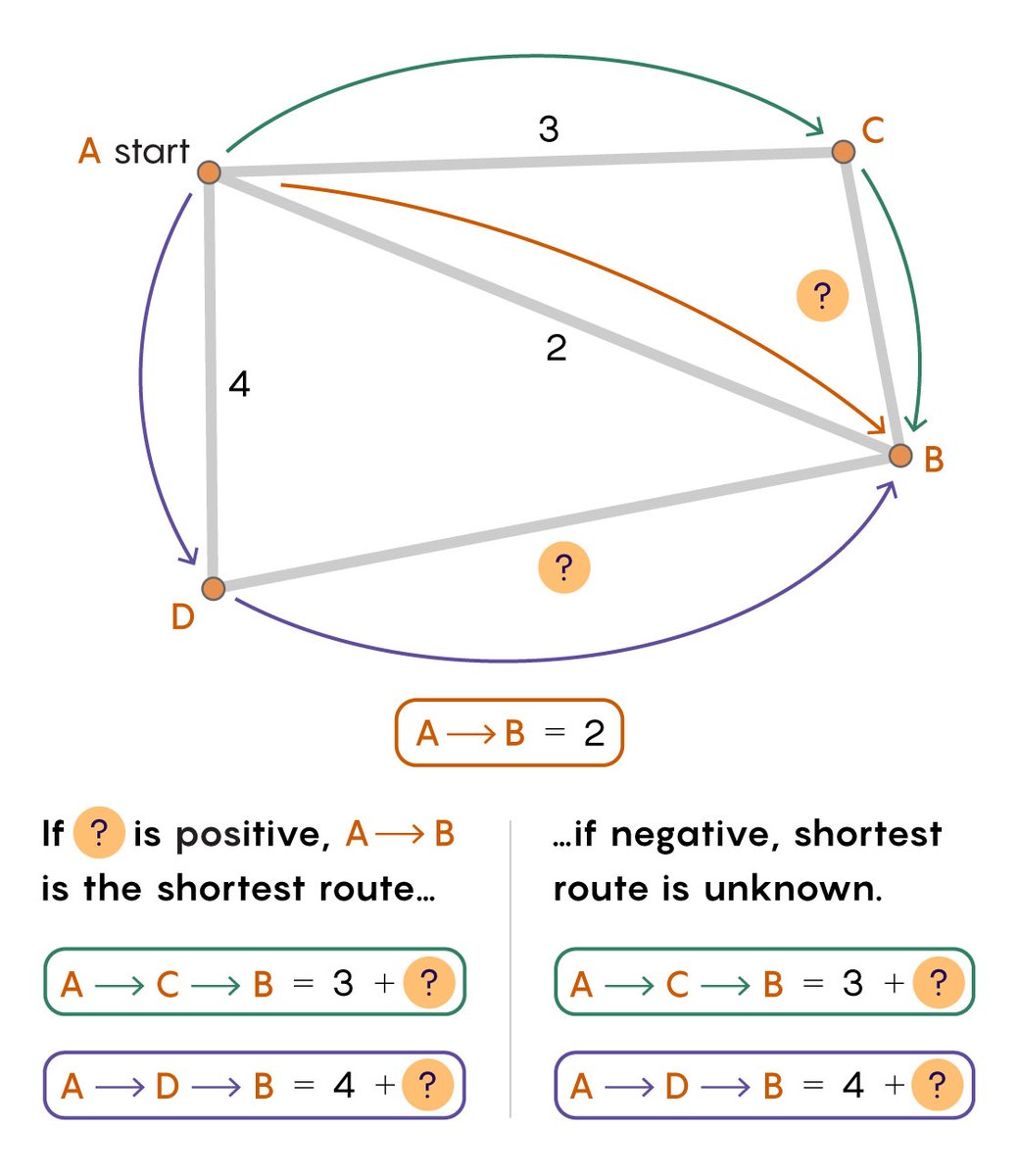
Decades ago, the Dutch computer scientist Edsger Dijkstra developed a greedy algorithm that finds shortest paths between points on a graph with positive weights. But if the weights are negative, the algorithm fumbles. quantamagazine.org/finally-a-fast…
English
Alexsandro Soares รีทวีตแล้ว

“While the problem we address is not new, our approach to solving it is completely novel”
English
Alexsandro Soares รีทวีตแล้ว

Veja como o incrível #E2ProfitHunter permite que as companhias aéreas aproveitem novas oportunidades de forma sustentável, lucrativa e rápida.
#AccelerateOpportunity #E2ProfitHunter #Embraer #WeAreEmbraer #EmbraerStories #E195E2 #ProfitHunter #TechEagle
Português
Alexsandro Soares รีทวีตแล้ว
Alexsandro Soares รีทวีตแล้ว

Daniel entrou na faculdade de Medicina aos 17 anos, em sua cidade natal, no interior do país, num campus recém inaugurado.
Durante o curso, teve que decorar rodapés e picuinhas de prova, mas o que nunca lhe ensinaram foi a raciocinar. Daniel é agora um médico leigo.
Segue o fio
Português
Alexsandro Soares รีทวีตแล้ว

“NO WOMAN SHOULD BE FORCED TO COVER HER HEAD.” 💪
🇧🇷’s Team touches down at the World Cup on a plane paying tribute to Mahsa Amini, the 22-year-old Iranian woman who died in police custody after being arrested for “improperly” wearing her hijab. (1/2)
English
@marciofrayze Talvez este artigo do Peter Norvig o ajude a responder: norvig.com/21-days.html
Português
Às vezes tenho receio de falar sobre isso e parecer muito elitista.
Mas nem sei direito como responder essa afirmação.
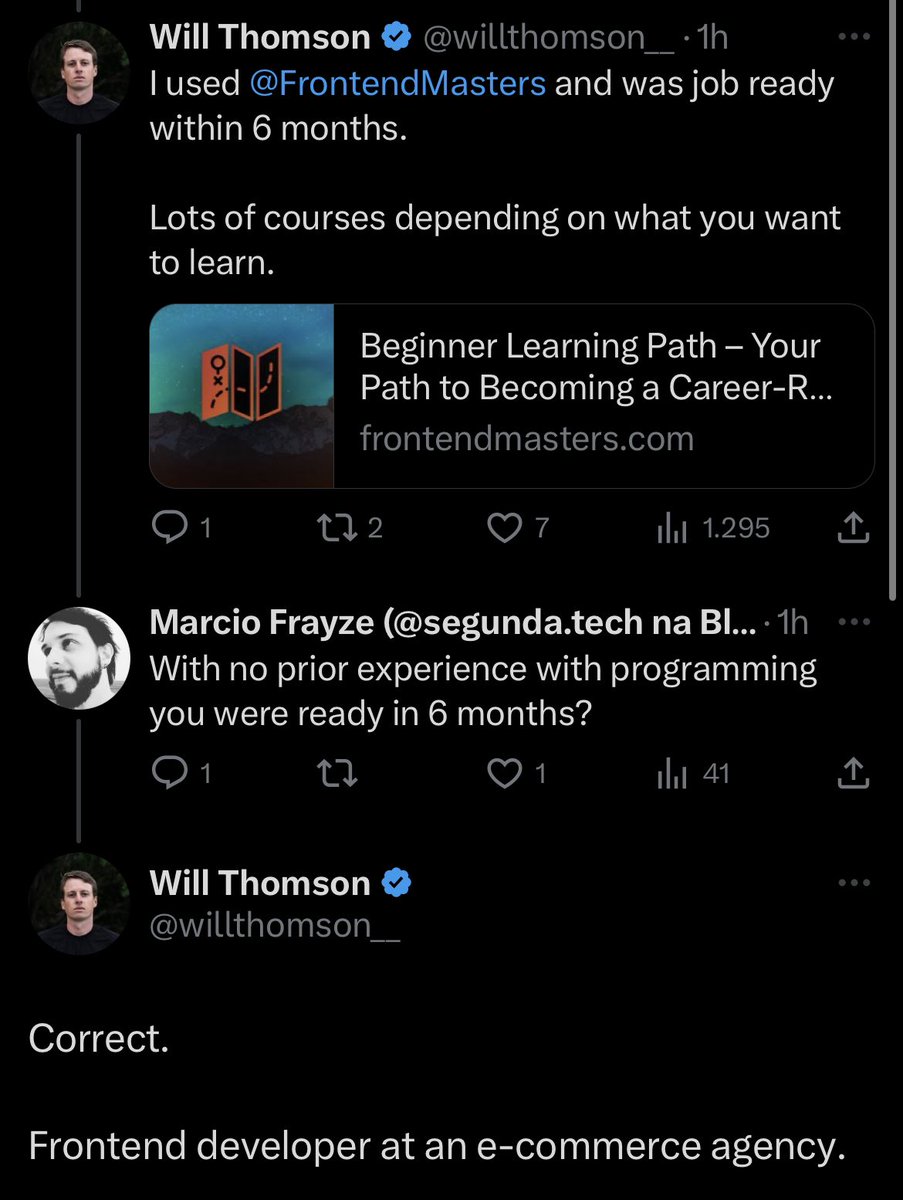
Português
Alexsandro Soares รีทวีตแล้ว

How to create a mesmerizing (and scary) well in your living room table using the infinity mirror principle.
[what's an infinity mirror: buff.ly/3VErviX]
[source: buff.ly/3B0ucU4]
English
Alexsandro Soares รีทวีตแล้ว

Viralata caramelo obrigado a ir a ato golpista evita ser identificado

Português
@andretrig o artigo da Nature trata sobre a experiência indiana de décadas sobre reflorestamento.
Forrest Fleischman@ForrestFleisch1
India has attempted large scale forest restoration for decades. We have just published one of the first systematic evaluations of these efforts. We find that decades of tree planting have had almost no impact on forest canopy cover or rural livelihoods. A Thread.
Português
Alexsandro Soares รีทวีตแล้ว