ทวีตที่ปักหมุด
RYT Chain
1.3K posts

RYT Chain
@RYTchain
Sovereign-scale blockchain infrastructure. Architecturally gas-free rails for mass adoption. Quietly shipping in Pakistan and LATAM. https://t.co/cEQK2WQVhT
California, USA เข้าร่วม Aralık 2024
143 กำลังติดตาม1.4K ผู้ติดตาม

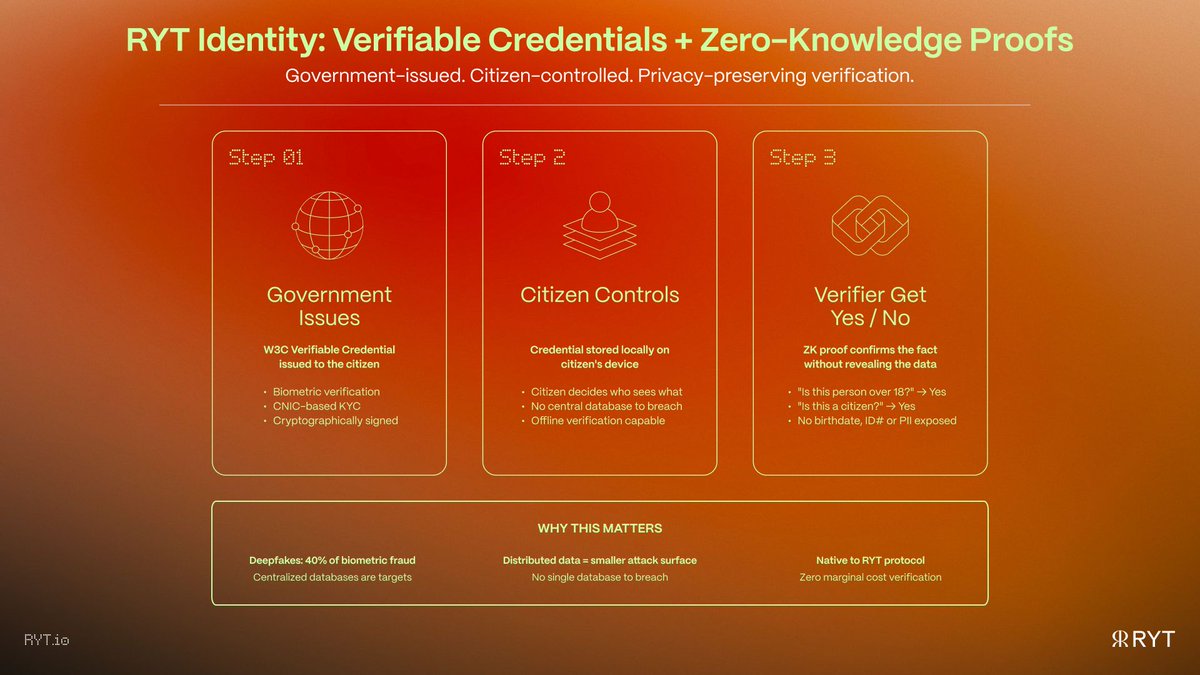
RYT builds this at the protocol level.
DID hooks and ZK verification are native to the chain, not a third-party integration.
For a government issuing credentials to 260M people the infrastructure needs to handle verification at zero marginal cost with offline capability for rural areas.
That's the architecture we've built.

English

Why this matters at population scale:
Centralized identity databases are massive targets.
Deepfakes now account for 40% of biometric fraud attempts globally with injection attacks up 9x in the last year.
A system where personal data is distributed across holders rather than concentrated in one database fundamentally changes the attack surface.
English

Pakistan stepping into a diplomatic role at this moment says a lot about where the country is headed, it’s a trajectory that deserves more attention than it gets.
Bilal bin Saqib MBE@Bilalbinsaqib
For a country often discussed in the context of its challenges, this is a reminder: Pakistan has 250 million people. A nuclear-capable military. Deep relationships across the Gulf, Central Asia, and the West. And when it chooses to deploy its diplomatic weight, the world notices.
English

How does our system compare?
Correspondent banks charges 6-7% on a $200 transfer. Crypto rails cut that, however the protocol layer also matters in ways that aren't obvious.
Users don't need native tokens to send, receive or transfer funds on RYT. The blockchain doesn't add gas costs on top of RYT's service fees. And deterministic settlement means what you send arrives, no failed transactions or mempool uncertainty.
For someone sending $200 to family, that combination of low fees, token-free access and guaranteed delivery is the product.

English

The key piece most remittance startups can't replicate:
Access to informal channels like Hawala netowrks.
Hawala networks move roughly half of Pakistan's remittance volume. Those operators aren't criminals. They're small businesses serving communities. But they can't navigate the compliance process to become official.
RYT gives them a path to get compliant and keep operating rather than competing against them.
English

Something we think about a lot internally:
Studies consistently show the majority of digital government projects fail to meet their goals.
Across all digital government projects, not just blockchain. The baseline failure rate is significant.
The reasons are predictable:
✖ Scope creep
✖ Vendor lock-in
✖ Infrastructure designs that don't account for the populations actual connectivity that is mobile and may be intermittent access at best.
RYT is building for governments. That means we're building into that failure rate. The only way to beat it is to design for the constraints that cause failure, not for a demo environment where everything works perfectly.
✔ Mobile-compatible nodes
✔ Offline functionality
✔ Predictable costs that don't change when the network gets congested.
Common-sense attributes that determines whether the thing actually works.
English

A securities depository in MENA or a central bank in LATAM operates under constraints that look nothing like London or New York.
✖ Regulatory frameworks don't mirror US or EU structures
✖ Market sizes and investor profiles are different
✖ Cost parameters for multi-year infrastructure contracts are tighter.
The platforms LSEG and DTCC are building won't be designed for those environments.
English

They're not alone...
➔ DTCC got SEC approval to tokenize DTC-custodied assets including stocks and US Treasuries.
➔ NYSE is building an onchain trading platform.
➔ Nasdaq filed for tokenized equity trading.
Leading Western exchanges are moving forward on blockchain settlement capability simultaneously.
English