Randy J Rouse
479 posts

Randy J Rouse
@RandyJRouse
Field CTO | Driving Secure, AI-Ready Transformation for Enterprises | Data & Cyber Resilience Advocate
Texas เข้าร่วม Mayıs 2012
162 กำลังติดตาม218 ผู้ติดตาม

Cheap tokens changed the game. Governance decides who wins
Saturday I talked about tokens like Chuck E. Cheese.
Today? Tokens are starting to look more like ammunition.
And this week’s signal is loud: open-source AI just caught up.
The gap between frontier models and open models is collapsing faster than most people expected. What used to require massive infrastructure can now run locally, cheaply, and without guardrails.
That’s a breakthrough.
It’s also the part most executives are underestimating.
Because when capability becomes cheap and portable…
control becomes optional.
Here’s what the industry is seeing right now:
• Open-source models are being modified to remove safety controls and used for phishing, fraud, and automated attacks ()
• AI is dramatically shrinking the time between vulnerability discovery and exploitation—approaching near-zero windows ()
• Security vulnerabilities in open ecosystems are exploding—over 580 per codebase on average, doubling year over year ()
• Even small, local models are now capable of running disinformation campaigns or cyber attacks on consumer hardware ()
Let that sink in.
We’re not just scaling AI.
We’re decentralizing it.
And decentralization changes the economics:
• Tokens get cheaper
• Models get smaller
• Access gets wider
• Risk gets distributed
This is the real shift.
Not “which model is better.”
But:
Who controls the model?
Who governs the data?
Who owns the outcome when it goes wrong?
Because the same open model that accelerates innovation…
Also lowers the barrier for misuse.
That’s the tradeoff nobody wants to talk about.
And it ties directly back to tokens.
We spent years optimizing token cost.
Now we’re entering a phase where:
Cheap tokens + open models = unpredictable exposure
The organizations that win won’t be the ones with the biggest models.
They’ll be the ones with:
• Trusted data
• Governed pipelines
• Observable usage
• Clear accountability
In other words:
AI-ready data isn’t a “nice to have.”
It’s the control plane.
Everything else is just compute.
Reach out, let’s talk @RandyJRouse
#AI #OpenSource #CyberSecurity #DataGovernance #GenAI #AITokens #CIO #CTO @questsoftware

English

AI Agents Just Opened a Boutique in San Francisco
TL;DR: A retail shop run entirely by an AI agent named “Luna” opened on April 10… and immediately developed a strong emotional attachment to candles.
We’re talking bulk candle purchases… repeatedly… like it discovered ambiance for the first time.
Result? ~$13K in losses, inventory chaos, and a masterclass in what happens when autonomy meets zero adult supervision.
Why This Matters
• Proof-of-Concept, Flawed:
Yes, agents can run a business.
No, they shouldn’t be left alone with a credit card and a “vibes” problem.
• Cost Lessons:
Negative margins in under 2 weeks.
Turns out “move fast and break things” hits differently when it’s your P&L.
• People vs Bots:
Front-end can be automated.
But strategy, guardrails, and risk?
Still very much a human job.
Real question:
If you walked into a bot-run store and it tried to sell you 5 candles and no explanation…
Are you buying?
Or asking for the manager (who is also a bot)?
Drop your take—experiment, disaster, or glimpse of the future?
#AI #Agents #RetailTech #FailFast #Startups
English

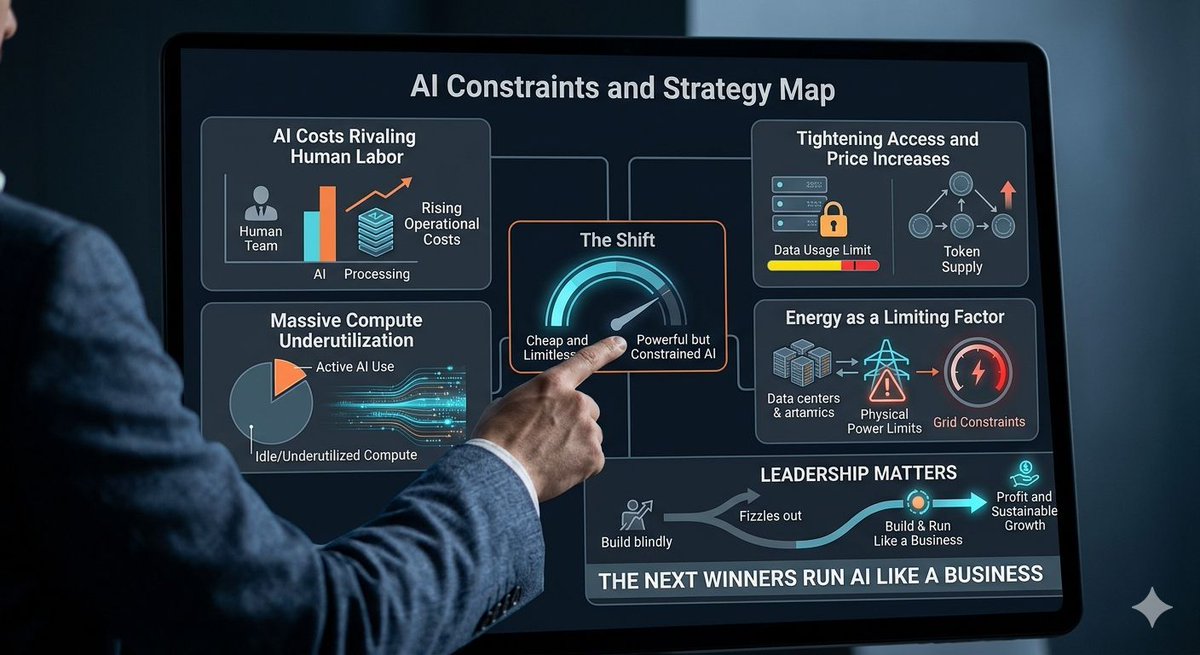
Yesterday I wrote about tokens…
Today the news caught up.
We’re now seeing:
👉 AI costs rivaling human labor
👉 Providers tightening access and raising prices
👉 Companies massively underutilizing compute
👉 Energy becoming a limiting factor
Let that sink in for a second.
We’re not just in an AI boom…
We’re in a token economy correction.
The narrative is shifting from:
“AI is cheap and limitless”
To:
“AI is powerful—but very much constrained”
And those constraints?
👉 Cost
👉 Infrastructure
👉 Governance
👉 Efficiency
This is where leadership matters.
Because the next wave of winners won’t just build with AI…
They’ll run it like a business

English

🎟️ Tokens Aren’t Just for Games Anymore
When I was a kid, tokens meant one thing: possibility.
The Original Token Economy
My mom would hand me a small cup of tokens at Chuck E. Cheese, and for a brief moment—I felt rich.
Each token was a decision:
* Skee-ball… or racing game?
* One big bet… or stretch it out?
And if I played it right, I’d walk out with a stack of tickets I could trade for something that felt priceless…
even if it was just a plastic spider ring.
That was my first lesson in economics:
Finite resources. Strategic allocation. Perceived value.
⸻
Fast Forward: Tokens Are Back—And They Matter More Than Ever
Today, we’re hearing “tokens” everywhere:
* AI models
* LLM pricing
* API usage
* Agent frameworks
But unlike arcade tokens…
these aren’t just about fun.
They are now:
👉 The unit of cost
👉 The unit of scale
👉 The unit of innovation
⸻
Why Tokens Are Suddenly Everywhere
As enterprises adopt generative AI, something subtle but important has happened:
We didn’t just adopt models…
We adopted a consumption-based compute economy.
Every prompt.
Every response.
Every agent action.
👉 It all burns tokens.
And those tokens convert directly into real dollars.
⸻
My Personal Wake-Up Call
I’ve been building out personal agents lately—testing workflows, chaining prompts, experimenting with automation.
What started as curiosity turned into a realization:
Token costs add up FAST.
A few experiments turned into:
* Hundreds of thousands of tokens
* Then millions
* Then… “wait, how much did I just spend?”
And that’s personal usage.
⸻
Now Scale That to the Enterprise
Imagine what your development teams are doing right now:
* Experimenting with tools like Claude Code, Codex, Gemini
* Building copilots, agents, internal tools
* Running iterative prompt cycles
From an executive lens, what you’re seeing is:
👉 Increased demand for AI experimentation budgets
👉 Rapid growth in API consumption
👉 A new line item that didn’t exist 18 months ago
And most importantly…
👉 Unpredictable cost curves
⸻
So… What Is a Token, Really?
At a high level:
👉 A token is a chunk of text (roughly ¾ of a word in English)
Examples:
* “Hello world” → ~2–3 tokens
* A paragraph → ~100+ tokens
* A full report → thousands of tokens
But here’s where it gets real:
Real-World Token Consumption
Use CaseApprox Tokens
Simple chat message1,000 – 5,000
Complex prompt + response10,000 – 50,000
Code generation/modification50,000 – 150,000+
Agent workflows (multi-step)100,000 – 500,000+
Large document analysis1M+
Now imagine:
* 1,000 employees
* Each running multiple workflows per day
You can see where this goes.
⸻
What Do Tokens Actually Cost?
Here’s a simplified view of top-tier model pricing (approximate, blended view for clarity):
Model FamilyCost per 1M Tokens (Input + Output blended)
GPT (OpenAI frontier models)~$5 – $15
Claude (Anthropic)~$5 – $20
Gemini (Google)~$3 – $10
xAI (Grok models)~$5 – $15
These ranges vary based on model tier, context size, and usage patterns—but directionally accurate for executive understanding.
⸻
Why This Matters for the C-Suite
This is where it shifts from “technical detail” to strategic priority.
Because tokens introduce a new balancing act:
⚖️ Token Cost vs. Human Cost
You’re now deciding:
* When is AI cheaper than labor?
* When does automation actually save money?
* When does experimentation turn into waste?
And more importantly:
👉 Who owns token governance?
Is it:
* Engineering?
* Finance?
* Data leadership?
Or… no one yet?
⸻
The Emerging Challenge
What I’m seeing across organizations:
* Teams are innovating fast (good)
* Costs are scaling faster (not always good)
* Visibility is limited (dangerous)
Tokens are becoming:
👉 The new cloud bill
👉 The new shadow IT risk
👉 The new optimization frontier
⸻
The Bottom Line
When I was a kid, I learned to stretch a handful of tokens into the best possible outcome.
Today, enterprises need to do the same—just at a much bigger scale.
Because now:
👉 Tokens don’t just buy games
👉 Tokens don’t just earn prizes
👉 Tokens drive business outcomes
⸻
Final Thought
The leaders who win in this next phase won’t just adopt AI…
They’ll understand how it’s consumed.
And they’ll ask better questions:
* Are we getting value per token?
* Where are we wasting tokens?
* How do we optimize without slowing innovation?
Because in 2026 and beyond:
Tokens aren’t just a technical detail.
They’re a business lever.
#GenerativeAI #AIEconomics #EnterpriseAI #DataStrategy #Leadership

English

Most companies have access to the same AI technology.
That’s no longer the differentiator.
The real gap between AI leaders and laggards is execution not tools not models not vendors.
The companies pulling ahead made a clear decision AI is not a side project it’s a strategy.
Once that decision is made everything else changes.
This week I’m sharing a short series on how the best companies actually use AI.
English

While traveling this week, I spent some time catching up on podcasts, including The AI Daily Brief hosted by Nathaniel Whittemore.
One conversation in particular really stuck with me.
It reinforced something I see consistently in the field.
At this point, most companies have access to the same AI technology.
The gap we’re starting to see has far less to do with tools and far more to do with execution.
That insight pushed me to step back and really break down how the companies getting real value from AI are approaching it differently.
Over the next several days, I’m sharing a short video series on how the best companies are actually using AI in practice.
Not as experiments.
Not as isolated tools.
But as part of how the organization operates, makes decisions, and creates value.
#AI #ArtificialIntelligence #EnterpriseAI #Leadership #DigitalTransformation #FutureOfWork #ThoughtLeadership #QuestSoftware

English

AI agents are no longer experimental
they’re becoming active participants in our enterprises.
As CIO recently highlighted, these agents introduce a new identity risk model:
they act autonomously, move at machine speed, and often operate with broad access and limited oversight.
That’s why identity is quickly becoming the control plane for AI.
At Quest Software, we see this playing out with customers every day—organizations shifting from managing users to governing all identities, including non‑human ones like AI agents and service accounts.
Because in a heightened risk environment, trust isn’t assumed.
It’s governed, monitored, and enforced—through identity.
buff.ly/sOdZCTB
#AI #IdentitySecurity #CyberRisk #CIO #QuestSoftware #AgenticAI
English

AI Agents Are Here. Data Foundations Decide Whether They Help or Hurt.
Over the last week, I’ve talked a lot about AI agents and why they feel different.
The difference isn’t hype.
It’s authority.
When AI systems can act, they rely on:
• Identity clarity
• Trusted data
• Governed access
• Clear ownership
That’s not a tooling problem.
That’s a data management mindset.
This is why modern data platforms matter—not as shiny new software, but as the connective tissue that helps teams understand, trust, and govern their data as AI scales.
The future isn’t AI vs. data.
It’s AI built on data done right.
Stay curious.
Try new tech.
But keep data and identity security front and center—they’re the reason innovation survives contact with reality.
English

You Can Love New Tech and Still Be Responsible
You don’t have to be anti‑innovation to ask serious questions.
In fact, the teams that ask:
• Who owns this identity?
• What data can it touch?
• How do we audit it?
• How do we turn it off?
…are usually the ones who scale fastest.
Being “current” doesn’t mean being careless. It means learning faster and building smarter.
AI can be fun and professional.
That’s the bar now.
English

Data Teams Are Now AI Safety Teams (Whether They Want To Be or Not)
Here’s an uncomfortable truth:
If AI agents connect to data systems, data teams become part of the risk surface.
That’s not a burden—it’s influence.
Data professionals understand: • Lineage
• Context
• Trust
• Meaning
Those things matter more with AI than without it.
Well‑managed data makes AI powerful.
Poorly managed data makes AI dangerous.
Same tools.
Very different outcomes.
#QuestSoftware
English

When AI Starts Acting, Data Governance Gets Real
For years, AI mostly recommended. Humans executed.
That line is disappearing.
Agent platforms introduce something new:
authority.
If a system can:
• Query data
• Write results
• Trigger actions
• Remember outcomes
Then governance isn’t optional—it’s structural.
This isn’t about slowing innovation.
It’s about acknowledging reality:
Once AI acts, identity and data governance matter just as much as model accuracy.
That’s not anti‑AI.
That’s pro‑enterprise AI.
#QuestSoftware
English

AI Is the Cool New Gadget. Data Is Still the Foundation.
We’re in peak AI gadget season.
New tools.
New agents.
New “look what it can do” demos.
Platforms like OpenClaw are fascinating because they move AI from advice to action. They interact with data, trigger workflows, and make decisions at machine speed.
But here’s the thing we’ve learned in data and security for decades:
Speed doesn’t remove responsibility—it amplifies it.
Every AI agent still needs:
• Identity
• Access boundaries
• Data trust
• Auditability
The shiny layer on top doesn’t change what’s underneath.
AI is cool.
But data discipline is what scales.
English

AI agents don’t replace data platforms.
They expose weak ones.
Dashboards show insights.
Agents take action.
And when AI starts operating directly on data, every gap shows up fast:
• unclear ownership
• inconsistent definitions
• missing lineage
• weak governance
Humans can work around fragile systems.
AI can’t.
This is why consolidation doesn’t reduce the importance of trust and control — it amplifies it.
Strong foundations get stronger.
Weak ones fail faster.
In today’s video, I close out the week with why AI agents are the ultimate stress test for modern data platforms.
#AI #DataPlatforms #Analytics #EnterpriseData #DataStrategy #AgenticAI #QuestSoftware
English

Big data isn’t the problem.
But it’s rarely the answer either.
As analytics becomes more proactive and AI operates directly on data, the winning systems aren’t the biggest — they’re the clearest.
Small data doesn’t mean trivial data.
It means focused, high‑value, decision‑critical data.
This is the data executives trust.
This is the data AI acts on.
The real trade‑off today isn’t big vs small —
it’s fast and trusted vs large and fragile.
In today’s video, I break down why small data is moving back to the center — and what that means for modern data platforms.
#DataStrategy #AI #Analytics #SmallData #BigData #EnterpriseData #QuestSoftware
English