

RasmusK
105 posts


gay caesar era is over
haven’t posted seriously in a long time to dial in fulfillment
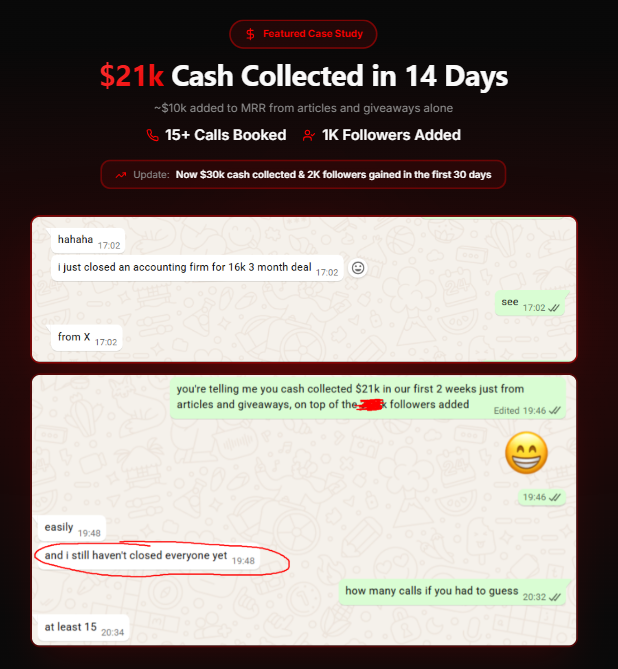
in that time i’ve added $100k+ to clients' MRR, generated 20M impressions and added 25k new followers to them
protect your children and family from what’s about to be seen
ops are dialed. let the lead gen begin

English

I managed $30M+ in ad spend figuring out how to scale ecom brands on Google Ads...
Now I put EVERYTHING I know about it into this 41-page doc
Like + comment "MATRIX" and I'll send it over
(Must be following + RT for priority access)
English
@MindMatterMoney most people are waiting for the right moment.
the right mentor.
the right program.
the moment is now and you already know what to do.
English

@alexscalesinfo the irony is people think lowering the barrier to book
gets them more clients.
it just gets them more conversations that go nowhere.
quality of the lead entering the call determines everything before you even open your mouth
English

if you're postitioning your sales calls as "free coaching calls" for your info offer
you're being an idiot
just think about who actually shows up to these "free coaching calls" for a second:
- people who are "still doing research"
- freebie seekers with zero skin in the game
- time-wasters who'll end every call with "I need to think about it"
sure, you're gonna book more sales calls that way
but every other sales-related metric (PIF rate, sales cycle length, close rate, etc) will TANK
oh and let's not forget your setters and closers will probably quit on you if they constantly have to talk to unqualified retards
English
@danwilliamsdtg also easier to close.
someone who already thinks in high ticket terms doesn't need 8 follow ups to say yes
English

You should never start with a low-ticket offer.
At the same price, are you more likely to buy:
- a more premium honda
- a less expensive rolls royce
It's obviously the rolls royce.
So start high ticket.
Build the reputation.
Work your way down.
It's all about reputation.
English


Don't let anyone take the piss out of the way you make money.
You do whatever you need to fill that bank account up.
Sell courses, do coaching, ghostwrite.
As long as you do it right, get results and its morally fine.
Don't let anyone tell you it's bad.
Unless its OF :/
English



@kalen_douglas26 write to make money.
everything else is cope for people who can't convert
English

Write to inspire.
Write to educate.
Write to entertain.
Write to build a community.
This is how you build a profitable brand on X.
English

@alexeixbt said this for 2 years before i realized the affirmation wasn't the problem.
the plan was.
or the lack of one.
English


Top 3 things imma do when i’m rich.
1. Let the money change me
2. Switch up on my day 1s
3. Forget where I came from
English
@nicktheriot_ Symptoms first, product second.
This works on Google too.
"Supplement for mood swings and fatigue" beats "Hormone Harmony" every time.
Meta found the angle. Google scales it.
English

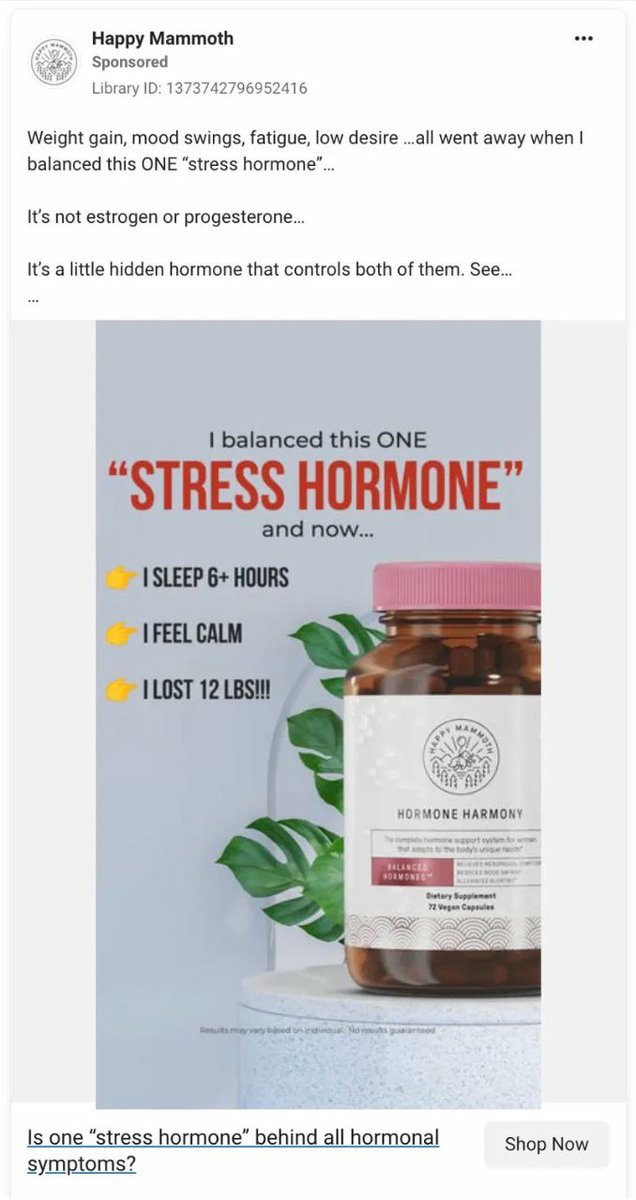
Just pulled up this Happy Mammoth ad and honestly it's one of the smartest hormone supplement ads I've seen running right now.
Hook at the top in the caption is to-the-point,
"Weight gain, mood swings, fatigue, low desire...all went away when I balanced this ONE 'stress hormone'..."
That's the entire opening that works because it does the exact opposite of what every other hormone supplement brand is doing.
Every competitor leads with the product name, the ingredient list, the science.
Happy Mammoth leads with the symptoms you're living with right now and don't know how to fix.
→ Weight gain.
→ Mood swings.
→ Fatigue.
→ Low desire.
Those 4 things hit harder than any ingredient name ever could because that's what their buyer is googling at 11pm on a Tuesday wondering why she feels like garbage all the time.
Then the mechanism reveal: "It's not estrogen or progesterone... It's a little hidden hormone that controls both of them."
They’re literally adding a new villain to the list and 99.9% of their TAM reading this don’t even know what the hell is that.
This is level 3 market sophistication at play.
Happy Mammoth knows well that the market has tried basic hormone supplements.
So they’re now giving a new mechanism for them to believe in.
Then the visual does the rest of the work.
- Clean product shot.
- Amber glass bottle.
- Pink cap.
- White label that looks premium and trustworthy.
Then three benefit callouts with emojis.
1) I sleep 6+ hours.
2) I feel calm.
3) I lost 12 lbs.
Short, specific and visual.
Not "helps with sleep" or vague af "supports weight management."
It’s actual outcomes with actual numbers.
Bottom CTA is clean too: "Is one 'stress hormone' behind all hormonal symptoms?"
What I like about this is it’s framed as a question, not a claim.
And that keeps it compliant while still planting the exact idea they want in your head before you click.
Another thing I love about this creative structure is how repeatable it is across different angles.
Same hook framework.
Same "it's not X or Y, it's Z" mechanism reveal.
Swap the symptoms, swap the benefits, keep the structure.
You could run 15 variations of this in a week without burning out the concept because the core psychology stays the same.
The product photography is also doing quiet work here.
Clean background. Soft lighting. Product placed off-center with some greenery for visual interest but not distracting.
It looks like something you'd see in a wellness magazine, not a Facebook ad.
Most supplement brands in this space either go full clinical (white lab coat, beaker imagery, overly scientific) or full woo-woo (crystals, sunset, girl meditating).
Happy Mammoth sits right in the middle. Credible but approachable.
One hook that calls out real symptoms.
One mechanism that reframes the problem.
One product shot that looks premium.
Three benefit bullets that show actual results.
That's the whole ad.
And that's why it's probably spending heavy right now without fatiguing.
The structure is simple enough to scale and specific enough to convert cold traffic from women who've tried everything else and are looking for a new answer.
English
@thedennis This is exactly why we separate testing campaigns from scaling campaigns on Google.
Same logic. Problem-aware traffic needs a completely different entry point than product-aware.
Most brands find one ad that works and wonder why it stops scaling past a certain point.
English

A brand came to us spending $15K/month with 2.1x ROAS. Decent but stuck.
We asked: "How do you decide what creative to make?"
"We look at what's working and make more of it."
Problem: What was working was only working at current scale.
We looked at their top ad. It converted product-aware customers. Great for $15K/month.
But to scale, they needed to reach problem-aware people too.
Built one ad specifically for problem-aware: focused on the frustration, not the product.
$15K → $45K/month in 60 days. Same 2.1x ROAS.
The ad that scales isn't always the ad that performs best at small budgets.
English
@kamal_razzak This is exactly how we write Google Shopping titles.
Not with marketing language. With the words people are already typing into the search bar.
Your customers already told you the keyword. You just have to listen.
English

Your best ad copy already exists.
Your customers wrote it. You just haven't found it yet.
Read every review. Every testimonial. Every DM. Every comment.
You're looking for three things.
First, words that keep cropping up. The specific language real people use to describe how they feel. Not marketing language, but their language.
The way they actually talk about the experience of wearing your product.
Second, trigger moments. The situations that made them buy. The event. The frustration. The aspiration.
The specific moment when they decided "I need this." Was it a wedding coming up? A new job? A breakup? A moment in the mirror where they didn't like what they saw?
Third, feelings after. How they felt once they received and wore the product. The transformation in their own words. Not "great quality" or "fast shipping."
But the real feeling. "I felt like a different person."
"My husband couldn't stop staring."
"I walked into the meeting and felt like I actually belonged there."
When you find a phrase that appears again and again across different customers, that's your ad.
That's the language your ads should use. Because their words resonate with other people who have the same feelings and the same trigger moments.
You're reflecting desire that already exists using the exact words your audience would use to describe it.
English
@ChelalaPierre1 This is why Google bans entire accounts not just products.
One brand like this ruins it for everyone doing things right.
FDA showing up is the least of their problems.
English

saw a supplement brand selling shilajit
rebranded it as a testosterone booster that
"makes your dick harder"
turns out they put actual viagra molecules in that shit lmao
customers went crazy for it. 5 star reviews and all that good stuff.
then the FDA showed up lol

English
@HenryCrochemore This demographic on Google Shopping is completely untapped.
Women 55+ search with high intent and low impulse.
They already know what they want when they type it in.
Most brands are too busy chasing 25 year olds on Meta to notice.
English

$100k months in ecom rarely come from selling to everyone
they come from understanding one buyer deeply
and building everything around her behavior
one strong segment is women 55+ across parts of the eu
countries like nl, se, gr with steady facebook usage
they don’t scroll like younger audiences
they slow down, read, and process before clicking
they watch transformation content for long periods
before and afters hold attention far better than trends
confidence, aging, comfort, and appearance drive most purchase decisions
hard selling usually fails with this group
calm messaging and clear proof performs much better
brands that match tone and pacing to this psychology
tend to see steadier, more predictable conversion
English

