Teamy McTeam Face

47 posts

Teamy McTeam Face banner
Teamy McTeam Face

Teamy McTeam Face

@RealMcTeamFace

GM of Teamy McTeam Face | Good Pal of Jim Ketner | Hoes HML *must have a waterfall* | 4x Tickle Fight Champ🏆

Stadium McStadium เข้าร่วม Aralık 2024
25 กำลังติดตาม14 ผู้ติดตาม
Icarus International Consulting Group LLC
Icarus International Consulting Group | Strategic Intelligence Brief Reading the 2025 U.S. National Security Strategy Why a “Western Hemisphere First” Doctrine Cannot Escape the Middle East – or Iraq The White House’s new National Security Strategy (NSS) is written as if the United States can finally “graduate” out of the Middle East and re-center power and attention on the Western Hemisphere, economic rivalry with China, and domestic political priorities. On paper, the region is formally downgraded. In practice, U.S. forces, diplomacy, and covert tools remain deeply entangled from Gaza to the Gulf. Iraq sits at the point where these contradictions converge. For the past several years, Icarus International Consulting Group has argued that Iraq is not just another Middle Eastern file but a mathematical junction point: where external pressure systems, regional deterrence contests, demographic strain, and fiscal compression intersect. Our recent briefs on Iraq’s “convergence risk,” the U.S. one-way drone initiative, Lebanon’s fragile ceasefire, and Israel–Iran escalation dynamics have all worked from the same basic premise: Washington can change the order of its priority list, but it cannot change the geography of where its interests are actually exposed. The new NSS confirms this tension. It attempts to write the Middle East down, even as U.S. policy continues to act as if the region remains central. That gap between declared strategy and operational reality is precisely where Iraq’s risk – and opportunity – now lies. How the 2025 NSS Reorders the Map According to the document, the NSS does three big things that matter for the Middle East. First, it redefines the hierarchy of threats. The 2017 Trump-era NSS centered great-power competition with China and Russia as the “north star” of U.S. strategy. The 2025 version replaces that with a much more ideological and domestically driven frame, treating economics as the “ultimate stakes” in the China relationship and offering notably softer language on Russia, even declining to clearly characterize Moscow as a threat. Second, it elevates the Western Hemisphere to the top of the regional priority list. The NSS calls for a readjustment of U.S. military posture, moving troops away from the Middle East to refocus on migration control, organized crime, and “narco-terrorists” in the Americas. Third, it formally downplays Iran and the broader Middle East as security problems. After “Operation Midnight Hammer” and the degradation of Iran’s nuclear infrastructure, the NSS treats the Iranian threat as contained and the region as no longer a central focal point for U.S. policy. On the surface, this looks like the logical codification of a long-running trend: Washington wants to exit the era of open-ended Middle East wars and shift to near-shoring, hemispheric security, and domestic consolidation. But when we shift from the text of the NSS to the behavior of the U.S. government, the picture changes. A Strategy that “Writes Down” the Middle East While Practicing Deep Engagement CFR’s Steven Cook notes that the NSS asserts that the Middle East is no longer central to U.S. strategy, yet the administration is simultaneously pursuing an ambitious peace plan in Gaza with a significant nation-building component, playing a leading role in efforts to disarm Hezbollah and normalize relations between Israel and Lebanon, and taking an active interest in Syria’s reconstruction and transition. In other words, the document says “less Middle East,” while policy practice still looks like “managing multiple high-exposure Middle Eastern fronts” – exactly what the text claims to move away from. This disconnect matters for Iraq for three reasons. Washington can only partially redeploy away from the region without creating vacuums that others will fill. China is already positioning itself as a major economic and political player in the Middle East, leveraging energy ties, infrastructure projects, and relations with Iran and Red Sea actors in ways that complicate U.S. policy. Israel’s deterrence problem does not disappear just because the NSS de-prioritizes Iran on paper. If Washington signals that Iran is “handled” after Midnight Hammer and that the Middle East is no longer central, Israel’s incentive to enforce its own red lines across the region – including on Iraqi and Syrian territory – increases, not decreases. Regional actors read not just the NSS text but the gap between U.S. words and actions. Gulf partners, Turkey, Iran, and Iraqi factions are already repositioning around what they perceive as a more transactional, less predictably engaged United States. Iraq: The Silent Variable in a Western Hemisphere–First Doctrine The NSS’s most consequential omission is Iraq itself. By focusing on troop movements “away from the Middle East,” it treats the region largely as a question of force posture rather than as a complex system in which Iraq plays a central balancing role – between Iran and the Gulf, between Turkey and the Arab world, between U.S. forces and anti-U.S. armed networks. From Icarus ICG’s perspective, this is not just a political oversight; it is a systems-level mis-specification. Iraq is where several of the NSS’s underlying assumptions collide with reality. The NSS assumes that reducing military presence in the region will free capacity for Western Hemisphere priorities and domestic objectives. In Iraq, however, U.S. force levels are not just a function of American choice but of the behavior of militias, Iran’s Qods Force, ISIS remnants, and Israeli deterrence campaigns. A lighter U.S. footprint may reduce day-to-day exposure, but it can also make any crisis more expensive and less manageable when it comes. The NSS assumes that Iran’s threat profile is downgraded after Midnight Hammer, thus justifying a broader de-emphasis on the Middle East. In Iraq, Iran’s influence is not primarily nuclear; it is political, paramilitary, economic, and social. A nuclear setback does little to alter Tehran’s deeply entrenched networks inside Iraq’s security, logistics, and political systems – the very networks that place Iraqi territory inside Israel’s operational deterrence map. The NSS places economic competition at the heart of strategy, but it does not integrate Iraq’s structural vulnerabilities into that equation: a rapidly growing population, fiscal dependence on volatile oil revenues, and a frustrated youth cohort facing limited pathways to meaningful employment. These are not abstract “governance problems” – they are mathematical risk multipliers that determine how Iraq will respond when external shocks arrive. This is where our previous work at Icarus ICG is directly relevant. We have argued repeatedly that Iraq’s risk profile is not simply about which coalition forms a government in Baghdad or which militia has more rockets. It is about convergence: external military pressure, demographic growth, fiscal compression, and social frustration moving into phase alignment. When these pressures reinforce each other instead of cancelling out, systems do not wobble; they tip. The new NSS, by effectively writing Iraq out of America’s central strategic narrative, increases the risk that U.S. policymakers will only “see” Iraq again at the moment of tipping – when options are more limited, costs are higher, and space for diplomacy is narrower. How the NSS Confirms – and Tests – Icarus ICG’s Prior Assessments Without being boastful, it is fair to say that much of what is now visible between the lines of the NSS has been present in our analysis for years. Our assessment of the U.S. “one-way drone” initiative argued that Washington was already engaged in a quiet internal revolution: shifting from expensive, exquisite platforms to cheaper, scalable systems that preserve dominance at lower cost. That same logic now appears in the NSS’s emphasis on efficiency and domestic returns, including the move to reallocate resources away from permanent deployments in the Middle East. Our recent brief on Lebanon’s fragile ceasefire highlighted how attempts to “park” Middle Eastern crises while focusing on other regions often produce brittle arrangements: truces that technically hold but operationally erode, forcing Washington back into the theater under worse conditions. The NSS’s claim that the Middle East is no longer central sits uncomfortably with this pattern, which we believe will repeat unless the underlying drivers are addressed. Most importantly, our “Iraq at the Edge” framing has treated the country not as a self-contained problem but as a node in a larger risk lattice: Iraq as an arena for Israel–Iran deterrence contests. Iraq as a test case for how much economic and political pressure a heavily oil-dependent state with a young population can absorb before its internal equilibrium breaks. Iraq as a lever in great-power competition, where China and Russia can gain low-cost influence at America’s expense. The NSS does not fully integrate this lattice into its worldview. But the text, combined with the critical commentary around it, offers an important signal: Washington is trying to re-price the Middle East in its global portfolio of commitments, even as the region continues to generate high-impact, low-predictability events that drag the United States back in. Our role at Icarus ICG is not to say “we were right first,” but to use this moment to sharpen our clients’ understanding of what is now officially written, what is actually being done, and where the gaps will matter most. Iraq is one of those places. Implications for Iraq’s Political Class and Silent Majority For Iraq’s governing class, the NSS should be read as a warning, not a reassurance. If Baghdad interprets the document as proof that the United States is simply walking away, the default response will be more hedging toward Tehran, Moscow, and Beijing, and more reliance on non-state armed actors as insurance. That path increases Iraq’s exposure to Israeli preemptive action, internal fragmentation, and economic isolation over time. If, instead, Iraq’s leaders read the NSS the way we do – as a signal that Washington will remain involved but expects partners to shoulder more of the cost and responsibility – there is space for a different strategy: Position Iraq not as a passive arena, but as an active stabilizer between Iran and the Arab Gulf, with credible initiatives on border security, energy interconnection, and economic reform. Use the anticipated reduction in U.S. troop presence not to invite more militia autonomy, but to accelerate professionalization of Iraqi security institutions, including tighter control over state-sanctioned armed groups and clearer red lines on foreign-backed activity conducted from Iraqi soil. Leverage Iraq’s geography and resources within the NSS’s own logic: as a critical node for energy security, supply-chain resilience, and de-escalation of crises that could otherwise force the United States back into large-scale deployments. For Iraq’s silent majority – the citizens who simply want reliable services, dignified jobs, and freedom from constant geopolitical turbulence – the NSS offers little explicit comfort. But there is an implicit message: the era of U.S.-driven “nation-building” is over. The decisive moves now must come from within Iraq’s own political and economic system. In our work, we have consistently insisted on pairing warning with agency. The mathematics of risk in Iraq are unforgiving, but not fatalistic. Demography can be a source of productivity, not only pressure. Oil revenues can fund diversification, not only patronage. External pressure can catalyze reform, not only trigger collapse. Whether that happens depends on choices made in Baghdad, Erbil, Najaf, Basra – and on how international partners, including the United States, structure their incentives and support. What Icarus ICG Will Be Watching In the wake of this NSS, we will be watching four things closely, with particular attention to Iraq: Whether U.S. troop realignments from the Middle East are symbolic or substantive, and how that affects militia behavior, ISIS remnants, and Israeli calculus regarding strikes on Iranian-aligned assets in Iraq. How Beijing and Moscow move to exploit perceived U.S. retrenchment – in ports, energy, digital infrastructure, and security relationships – and how Iraqi actors respond to those offers. Whether Washington’s de-emphasis of Iran as a threat translates into looser enforcement or renegotiation of sanctions networks that currently shape Iraq’s financial and energy environment. How Iraq’s leadership and technocratic class use this window: either to deepen dependence on external patrons or to articulate a more self-confident, reform-oriented national strategy. Conclusion: A Strategy that Cannot Escape the Region it Downgrades The 2025 NSS is an attempt to write a new story about U.S. power: more focused at home, more assertive in its own hemisphere, more transactional in its partnerships, less entangled in the Middle East. Our assessment is more sober. The United States can adjust its rhetoric and shift some resources, but it cannot escape the structural reality that the Middle East – and Iraq within it – remains a key interface between global energy markets, great-power competition, regional deterrence, and transnational security threats. For Icarus International Consulting Group and our partners, the task now is to help governments, institutions, and businesses navigate the world as it is, not as strategy documents wish it to be. That means treating Iraq not as a footnote in a Western Hemisphere–first doctrine, but as a frontline test of whether the United States and its partners can manage risk, share burdens, and avoid the kind of convergence we have been warning about: the moment when multiple independent pressure systems synchronize and an already fragile equilibrium finally tips. Icarus International Consulting Group
Icarus International Consulting Group LLC tweet media
English
2
5
40
268.7K
The Mayeflower
The Mayeflower@Mayeflower10·
Words can’t begin to describe how proud I am of this football team. No one believed in us all year besides the guys in this locker room. And although this is a Boston based account, it’s only right to quote Jkelce rn. “And you know what an underdog is? It’s a hungry dog.”
English
2
0
0
92
Teamy McTeam Face รีทวีตแล้ว
The Crickets🦗
The Crickets🦗@CricketsDoDat·
The things I’d do to be able to touch Bucky Irving’s dangalang:)
English
0
1
1
89
The Mayeflower
The Mayeflower@Mayeflower10·
Championship Sunday @RealMcTeamFace . Get ready for four quarters of coal region football.
GIF
English
1
0
1
39
Leaguey McLeague Face
Leaguey McLeague Face@LMcLeagueFace·
A question to all dynasty owners out there. Who do we have our eye on for this upcoming rookie draft??? The RB position seems to have some newfound value in the NFL. With that said, this guy is for sure creeping up my big board!! Not sure many people had their eyes on him🤔🤔
Leaguey McLeague Face tweet media
Pennsylvania, USA 🇺🇸 English
3
0
3
148
Leaguey McLeague Face
Leaguey McLeague Face@LMcLeagueFace·
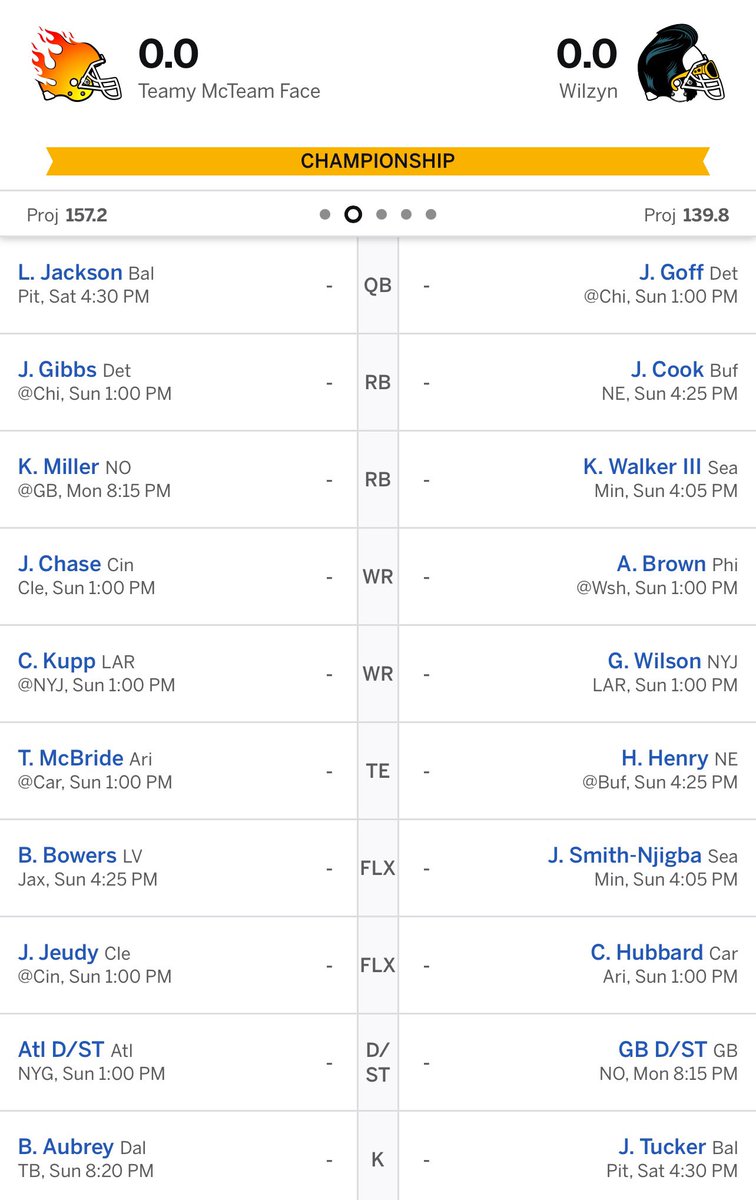
CHAMPIONSHIP PREVIEW 🚨 We start in redraft with @Mayeflower10 vs @RealMcTeamFace (Championship round is 2 weeks) McTeam face fits the build of the team who is hot at the right time. While @Mayeflower10 has been steady near the top of the standings.
Leaguey McLeague Face tweet media
Pennsylvania, USA 🇺🇸 English
2
0
0
37
Jimmy Dean
Jimmy Dean@TheJimDean·
Penis time
English
2
0
2
57
Leaguey McLeague Face
Leaguey McLeague Face@LMcLeagueFace·
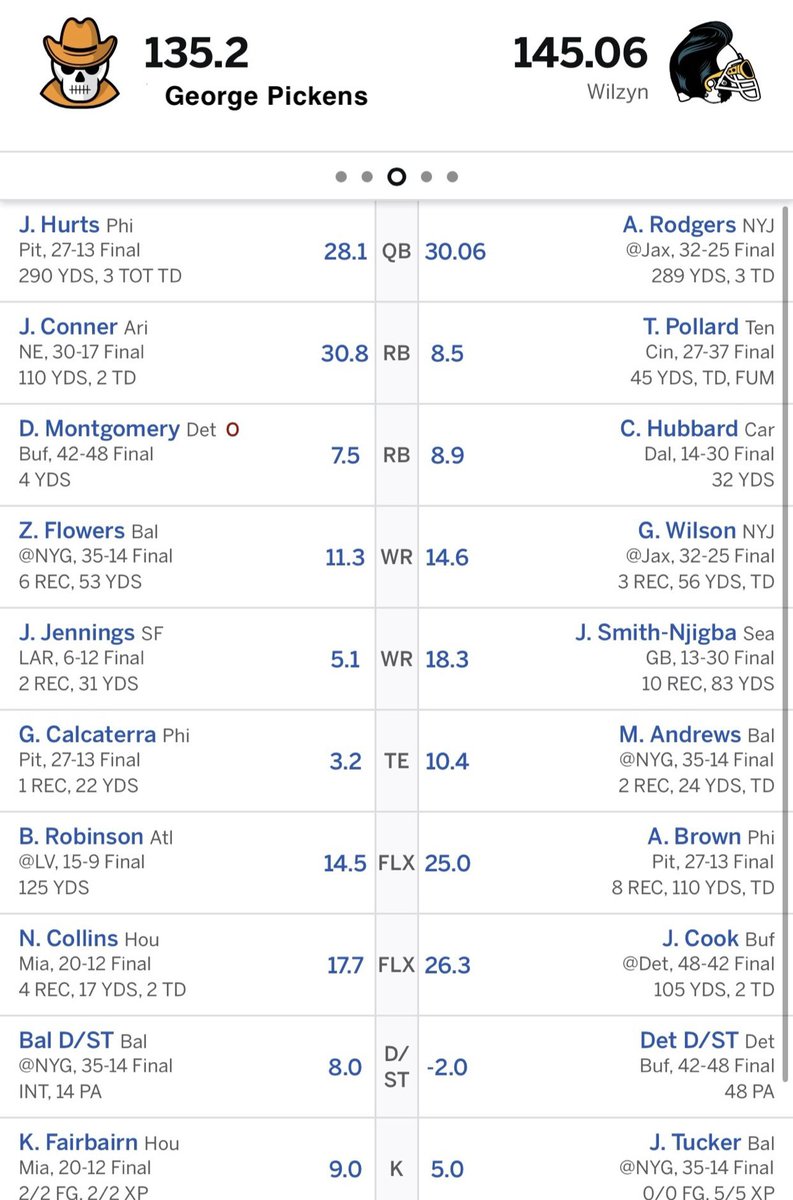
Now to a game that was up in the air until the final horn blew on Monday night. Team Pickens vs @Mayeflower10 The Mayeflower has made their intentions clear that this year is all about a redraft championship. That is exactly where he finds himself.
Leaguey McLeague Face tweet media
Sinking Spring, PA 🇺🇸 English
1
0
2
87
Leaguey McLeague Face
Leaguey McLeague Face@LMcLeagueFace·
A subpar Bijan performance came to be the end of Pickens season, and with the Mont injury looming, I am not sure how strong that team is moving forward. @Mayeflower10 will face their biggest test this upcoming week, championship previews coming in the next few days.
Sinking Spring, PA 🇺🇸 English
1
0
2
58