Robert Klitgaard

5K posts

Robert Klitgaard banner
Robert Klitgaard

Robert Klitgaard

@RobertKlitgaard

University Professor, Claremont Graduate University. Books include “Policy Analysis for Big Issues: Confronting Corruption, Elitism, Inequality, and Despair”

Claremont, CA เข้าร่วม Aralık 2011
1.2K กำลังติดตาม2K ผู้ติดตาม
ทวีตที่ปักหมุด
Robert Klitgaard
Robert Klitgaard@RobertKlitgaard·
How This Started How It's Going
Robert Klitgaard tweet mediaRobert Klitgaard tweet media
English
1
0
21
701
Robert Klitgaard
Robert Klitgaard@RobertKlitgaard·
Almost a syndrome now
Jesús Fernández-Villaverde@JesusFerna7026

A couple of days ago, Megan McArdle (@asymmetricinfo) posted about how she uses LLMs in her journalism: research, transcription, fact-checking, sharpening questions, compressing ancillary tasks, etc. The reaction from some quarters included calls for her dismissal, accusations of fraud, and moral outrage galore. This is a good reminder of why Karl Marx is useful: “It is not the consciousness of men that determines their being, but, on the contrary, their social being that determines their consciousness.” People’s moral positions on LLMs track their position in the relations of production with remarkable precision. A senior journalist who can use LLMs to become more productive is harder to replace. But a junior journalist or an adjunct professor whose work is now much easier to replace has every incentive to find moral arguments against LLMs or to exaggerate their flaws. Narratives follow economics, not the other way around. The calls for McArdle’s removal aren’t about journalistic integrity; they’re about defending a labor market position that’s becoming hard to justify. And framing that defense as a moral stance is just shifting the argument into a territory where the author feels more comfortable: moral judgments. Oldest trick in the book. Bourdieu would call it a field strategy: when you cannot win on competence, you redefine the game so that the relevant capital is moral authority rather than productivity. The people loudest about the ethics of LLMs are, not coincidentally, the people with the most to lose from them.

English
0
0
2
115
Robert Klitgaard รีทวีตแล้ว
Chubby♨️
Chubby♨️@kimmonismus·
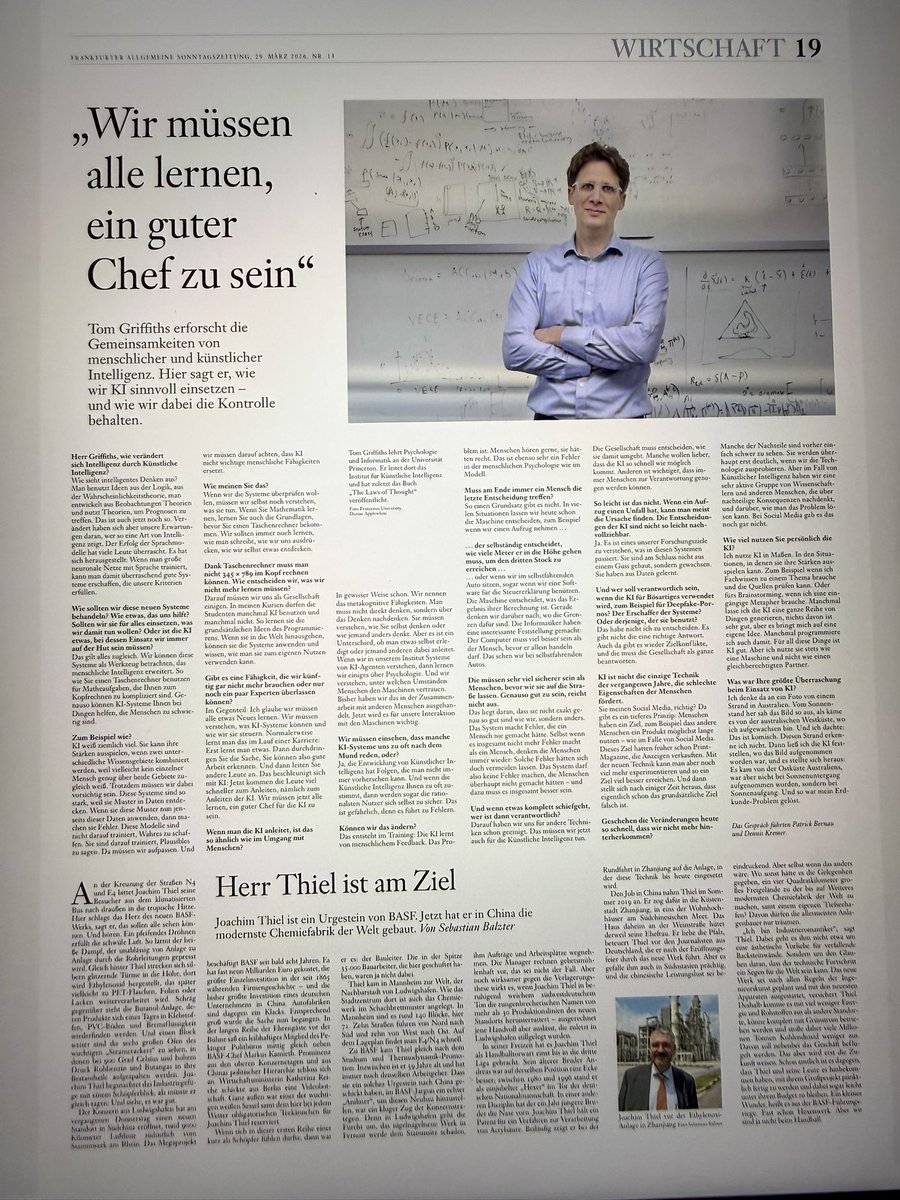
Reading the Saturday edition of Frankfurter Allgemeine Zeitung (my daily newspaper). There’s an interview between a journalist and an AI expert, and something struck me. In Germany, the conversation around AI is almost entirely framed through fear. Should we “consume” AI in moderation, like a good beer? Who is responsible when it makes mistakes? Does it make us less intelligent if we use it too much? And so on. Not a single question focuses on the upside. Not one tries to explore what AI could actually do for humanity. Instead, the underlying question always seems to be: How much suffering will AI bring? This is absurd.
Chubby♨️ tweet media
English
103
43
617
38.1K
RAND
RAND@RANDCorporation·
More and more young people are turning to AI when they feel anxious, stressed, or alone. What happens when a chatbot becomes a de-facto therapist? New episode of Policy Minded: bit.ly/3Pe6cH9
English
2
2
5
1.5K
Robert Klitgaard
Robert Klitgaard@RobertKlitgaard·
.@tylercowen has a new book with an intriguing tab: "What's the Straussian take? Discover messages that might be hiding between the lines." Intrigued, I tried out that prompt on a few of my books. Amazing. And here's how ChatGPT responded regarding robertklitgaard.com/grad-school-%2…: "Here is a Straussian reading in the mild, useful sense: not a hunt for secret codes, but a search for the book’s quieter quarrels, its deeper loyalties, and the argument it is really making beneath its announced topic. On the surface, 'Graduate School Meets Generative AI' is a practical guide to a fast-moving technology; underneath, it is a book about what graduate education has forgotten about itself. ""The first hidden argument is this: GenAI is not the real crisis. It is the revealer of a prior crisis. The book opens with the shock of ChatGPT doing very well on graduate exams and then asks, in effect, what professors have really been measuring all along. If polished essays, solved problem sets, and even dissertations can be imitated by a machine, then the machine has not merely changed education; it has exposed how much of education had come to rest on outputs that were already too shallow, too proxy-like, too easy to fake. The hidden message is harsh but bracing: if AI can counterfeit the signs of mastery, perhaps we had confused the signs with the thing itself. A second hidden argument is aimed at credentialism. Chapter 3 keeps distinguishing human capital from signals and suggests that employers may increasingly assess competence directly rather than rely on degrees as passports. Read Straussianly, this is more than labor-market analysis. It is an accusation. Universities have long survived partly by selling signals—grades, degrees, prestige markers—not only by cultivating deep competence. GenAI threatens that old bargain. So the book is quietly saying: the age of educational rent-seeking may be ending. If universities want to live, they will have to deserve to live. "Third, the “Anti-Preface” matters more than it first seems. The imaginary skeptic is not a straw man. The voice is cultured, morally serious, aesthetically alert, suspicious of capitalism, wary of standardization, offended by fake art, and allergic to being preached at. The reply does not crush this figure; it honors the figure’s conscience while refusing the conclusion. That suggests a deeper point: the real obstacle to GenAI in higher education is not ignorance of the tools. It is a moral and aesthetic revulsion among serious academics who fear not merely error, but degradation. The book knows this. It stages that fear from the inside. It wants conversion, but without humiliation. "Fourth, the book’s deepest loyalty is not to innovation but to calling. After all the talk of disruption, substitution, and augmentation, it turns toward mastery, integrity, collaboration, communication, lifelong learning, and then further toward the intrinsic goods of study—what is “true, beautiful, and good,” what Schlick called activities valued for their own sake. That turn is decisive. The hidden argument is that GenAI may force graduate education to remember its soul. If routine intellectual production can be mechanized, then graduate education must justify itself not by its outputs alone but by the kind of people and communities it forms. The university must become again a place for judgment, discipline, delight, courage, and craft. "Fifth, co-intelligence is not just a teaching technique here. It is an anthropology. The book keeps insisting that GenAI can both substitute for learning and augment learning; both are possible, and “it depends on what we do.” Beneath that practical line sits a larger claim about human beings. We are not, at our best, mere producers of text. We are askers of questions, judges of claims, framers of problems, bearers of responsibility, makers of meaning in company with others. GenAI becomes useful precisely insofar as it throws those more human powers into relief. The machine is the foil that helps the book redraw the human. "Sixth, the two 2030 scenarios are not really forecasts. They are moral fables. The collapse scenario says: if universities cling to lectures, signals, routine assessment, and inherited prestige, they may become relics. The flourishing scenario says: if they embrace GenAI while doubling down on mentorship, community, judgment, and rich conversation, they may become “uniquely humanizing” institutions. This is not just scenario planning. It is a choice between two visions of the university—one already half-dead, one still worth defending. Hidden beneath the futurism is a very old claim: institutions survive not by preserving their forms, but by recovering their ends. "Seventh, the book is also quietly arguing that integrity is a design problem, not just a virtue problem. It says plainly that bans are not enough and that good assessment design—AI-traceable drafts, disclosure, oral defenses, redesigned assignments—can make plagiarism less profitable and learning more visible. In Chapter 3 it broadens this into incentives, equilibria, and collective-action problems. The hidden message is broader than education. Good institutions do not depend on exhortation alone. They shape conduct. In that sense, this is a governance book in academic dress. "Eighth, there is a quiet democratic streak in the book. The example of opening cost-benefit analysis to students beyond economics, the praise for personalized tutoring, and the student and TA reflections all suggest that GenAI can widen entry into forms of learning once guarded by guilds, prerequisites, or professor time. The hidden message is not that standards should fall. Quite the reverse. Standards may finally be extended more broadly because support can now be individualized. The book is therefore not only pro-technology and pro-university; it is, quietly, anti-needless exclusion. "Ninth, and maybe most Straussian of all, the book performs its thesis. It announces itself as a product of co-intelligence. It includes the unedited little self-description from ChatGPT. It offers prompts, a syllabus, a teaching note, student voices. In other words, it does not merely argue that human-AI collaboration can be serious, candid, and fruitful. It enacts that claim in front of the reader. The medium is part of the proof. A book like this could not finally persuade by abstraction alone; it has to show its work. "So my one-sentence Straussian reading would be this: the surface argument is that graduate schools should learn to use GenAI wisely, but the hidden argument is that GenAI has exposed how much of graduate education had become theater—credential, routine, proxy—and that only a recovered culture of calling, judgment, design, and human community can save the university from becoming a very expensive ghost."
English
0
0
1
59
Jesús Fernández-Villaverde
Jesús Fernández-Villaverde@JesusFerna7026·
My previous post on LLMs for self-study has sparked considerable debate about the role of “traditional” higher education. In response to some of the comments, I want to enumerate the arguments supporting the survival of “traditional” higher education. In my next post, I will assess how each might be affected by AI. Think of today's post as a taxonomy of arguments that I will review tomorrow in terms of their strength and robustness. I count twelve. First, signaling. The value of, let’s say, a degree from MIT is that you were smart enough to get into MIT and survive the grueling workload. The best example of signaling was the old way the British civil service selected its high-flyers: students with a first from Oxford in Literae Humaniores, not because they learned anything particularly useful there, but because it was hard to get in and hard to master all the Greek and Latin. Second, credentialing. Societies, for a variety of reasons (some justified, some not), have decided that a degree is required to perform certain tasks. Sometimes, the requirement is statutory. For example, I cannot teach economics in a high school in Pennsylvania because I do not have a teacher’s certificate. Sometimes, the requirement is a social norm. Many firms insist that their recruits for many positions have a B.A. Third, networking. The friendships, relationships, and (often) sentimental partnerships formed at a university are very valuable, as they occur at a key moment in life when students transition from adolescence to adulthood. Personally, networking was the most valuable component of my undergraduate education. Fourth, peer effects in learning. This is distinct from networking. Being in a room with other smart students who challenge your thinking in real time, study groups, and classroom debate: the value is in the interaction during the learning process, not in the connections formed afterward. This was the most valuable aspect of my graduate education. Fifth, commitment. Most students suffer from some form of time-inconsistency, and, in the absence of a formal degree, they would not complete more than a small fraction of the required work. Abysmal completion rates at Coursera courses illustrate the importance of this channel. Sixth, curation of topics. Universities curate the topics and content that a well-balanced degree requires. Seventh, skill acquisition. Students learn accounting, marketing, or biochemistry, and these skills are valued by the market. Eighth, cultural capital. Students learn social norms and preferences that are valuable for positioning games in society and might have value in themselves (for example, university graduates tend to exhibit healthier behavior, even after controlling for selection and higher lifetime income). Ninth, a “hold-out” period. Students are parked at universities while they mature, break links with their parents, and figure out what to do with their lives. Tenth, proximity to the research frontier. The professor who teaches you monetary economics is also producing monetary economics. There is something qualitatively different about learning from someone working at the boundary of knowledge versus learning from someone, or something, that transmits existing knowledge well. This is not skill acquisition. It is exposure to how knowledge gets made. Eleventh, assessment and feedback. The structured loop of writing, receiving criticism, and revising is a distinct mechanism from the discipline of showing up or the curation of content. Twelfth, physical infrastructure. For many fields (chemistry, biology, engineering, medicine), the university provides labs, equipment, and supervised access to materials that cannot be replicated at home. Some of these arguments are strong. Some of them are weaker than universities would like to believe. And some of them are about to be tested in ways they have never been tested before. Next time, I will go through each one.
Jesús Fernández-Villaverde tweet media
English
13
134
499
40.9K
Robert Klitgaard
Robert Klitgaard@RobertKlitgaard·
It's the people. A new RCT finds that attaining citizenship had "no measurable impact on economic outcomes, financial well-being, or broader integration indicators . . . These findings challenge prevailing assumptions about the transformative power of citizenship over permanent residency." pnas.org/doi/abs/10.107…
English
2
0
2
66
Robert Klitgaard
Robert Klitgaard@RobertKlitgaard·
@RANDCorporation The very same tool can help fake learning AND help profound learning. It depends on us.
English
0
0
2
25
RAND
RAND@RANDCorporation·
67% of students believe that the more they use AI for schoolwork, the more it will hurt their critical thinking skills. New survey results: bit.ly/4rzKRFu
English
1
5
6
1.7K
Robert Klitgaard รีทวีตแล้ว
DataRepublican (small r)
DataRepublican (small r)@DataRepublican·
🧵 THREAD: Democrats TEACH voter identification and election integrity ... just not in America The Democratic Party has an international arm called the National Democratic Institute (NDI). It's funded by $181M/year in US tax dollars. Its board includes Stacey Abrams, Donna Brazile, and Tom Daschle. But in regards to today's SAVE America Act debate... did you know that the NDI has taught and supervised election processes all over the world? For 40 years, NDI has told every developing country on earth that voter ID is essential for election integrity. They've recommended biometric systems... yes, that's right, NDI recommended biometric systems, which goes way beyond SAVE America Act! They praised fingerprint verification. Tracked ID card issuance rates. Meanwhile, Democrats call the SAVE Act "Jim Crow 2.0." Same party. Same people. Opposite positions. As always, patience as I pull together the thread 👇
DataRepublican (small r) tweet media
English
1.4K
13.1K
29.8K
11.8M
Robert Klitgaard รีทวีตแล้ว
stepfanie tyler
stepfanie tyler@stepfanie·
If an alien civilization ever shows up, the thing they will be most confused about is why Elon is not universally revered for moving humanity forward. He has and will do so much. MASS DRIVERS ON THE MOON. SUSTAINABLE ABUNDANCE. I will never understand the hate. I literally cannot fathom it. Can anyone actually explain why people hate him other than RiCh mAN bAd?
SpaceX@SpaceX

Announcing TERAFAB: the next step towards becoming a galactic civilization twitter.com/i/broadcasts/1…
English
250
66
1.2K
48K
Robert Klitgaard รีทวีตแล้ว
Alexandria Ocasio-Cortez
This is sad. I know as a politician these companies are going to spend a billion dollars against me for saying it but 🤷🏽‍♀️ Pervasive gambling is not good for society. It turns life into a casino, traps people in addiction & debt, surges domestic violence, and fosters manipulation.
Polymarket@Polymarket

We’re honored to announce MLB has named Polymarket as their Exclusive Prediction Market Exchange Partner. Polymarket 🤝 MLB

English
9K
11.3K
116.6K
10.7M
Robert Klitgaard รีทวีตแล้ว
Mario Nawfal
Mario Nawfal@MarioNawfal·
In January, I was the loudest voice on X criticizing the Iranian regime. Result? All regime supporters flooded my comments calling me a ‘zionist’ and an ‘Israeli asset’ Now, as I criticize this war (I’ve always been anti-war), some pro Israeli hawks voices are labeling me a ‘regime sympathizer’ The same happened during the Gaza war: I got called both a zionist and an anti semite, and received death threats from both sides Here’s my stance so you don’t have to guess: - Very critical of the Iranian regime. What they did in January was horrific - The current war is a mistake, and if the objective is regime change, then I am very worried about Iran’s future as risks of civil war increase - I am very critical of what Israel did in Gaza and the West Bank, and more nuanced on their attacks on Hezbollah and Iran - I believe Hezbollah should be disarmed - The U.S. objective in this war is control of the Strait of Hormuz, to beat China in the AI race. I’ve always said I want the U.S. to win the AI arms race, as I do not want to live in a world where AI is controlled by an autocracy - As an Australian citizen, I am a believer in our democratic way of life and have always been critical of anyone threatening democracies (EU, Brazil, Pakistan). But this does not mean I support the various interest groups pushing our world into endless wars - As the son of a religious Christian family, I respect all religions, but don’t think religion should ever justify wars Did I miss anything?
Mario Nawfal@MarioNawfal

Why am I against this war? As someone who's been EXTREMELY critical of the Iranian regime, so much so I was labeled 'zio' by many, I've always advocated AGAINST regime change through military means The reason is simple: In over 100 years, there's been ZERO successful regime change operations without boots on the ground And we're seeing this play out right now: The Iranian regime's grip on power has strengthened under bombardment, and they've become even more brutal in suppressing dissent If the U.S. conducted a very limited military operation to give Iranians the chance to bring down the regime, then maybe I would have been supportive (assuming the country does not descend into civil war) But seeing Iran get bombed daily, Israel and the region get attacked, U.S. troops die, and the global economy cater... this is not what I envisaged for 2026. I want the U.S. to win against China I want the regime to fall I want Iran to be a democracy I want Hezbollah's military arm gone I want Lebanon and Iran to normalize with Israel But a prolonged war with Iran is NOT the way to achieve any of these goals


English
577
134
1.2K
700.2K
The Best
The Best@Thebestfigen·
The medieval town of San Gimignano, Siena, Italy.
The Best tweet media
English
64
677
6.7K
91.4K
ThinkingWest
ThinkingWest@thinkingwest·
There’s probably no cooler street view than this
ThinkingWest tweet media
English
116
305
5.3K
594.5K
Robert Klitgaard
Robert Klitgaard@RobertKlitgaard·
@cremieuxrecueil 25 years back, the best explanation was divergent trends in relative prices of fruits and vegetables (up) vs. fats and sugars (down)
English
0
0
0
6
Crémieux
Crémieux@cremieuxrecueil·
You know what actually predicts rising obesity? The introduction of television. Increased food availability. Aging. The wealth of society! Increasing wealth has been a thing for a while now, so we should not be surprised to learn people have been getting fatter all the while.
English
24
69
672
39.7K
Crémieux
Crémieux@cremieuxrecueil·
There is a widespread myth that the obesity epidemic started in or around 1980. This is based on a misunderstanding of the relationship between body fat percentage and BMI, which is used to classify someone as "obese". 🧵
Crémieux tweet media
English
66
204
1.4K
524.3K
Robert Klitgaard
Robert Klitgaard@RobertKlitgaard·
@emollick When GenAI first appeared, you argued that we couldn’t tell AI-generated writing from writing by real people. Has that changed?
English
0
0
0
59
Ethan Mollick
Ethan Mollick@emollick·
I know I go on about this, but comments to all of my posts, both here and on LinkedIn, are no longer worth reading at all due to AI bots. That was not the case a few months ago. (Or rather, bad/crypto comments were obvious, but now it is only meaning-shaped attention vampires)
English
150
43
958
115.3K