Raghu Reddy Suram

4.7K posts

Raghu Reddy Suram banner
Raghu Reddy Suram

Raghu Reddy Suram

@RvrSuram

CEO & Head of AI at EB1A Experts. EB1A-approved founder using AI to help tech professionals navigate and simplify the EB1A immigration journey.

Greater Seattle, Washington เข้าร่วม Ekim 2021
55 กำลังติดตาม149 ผู้ติดตาม
ทวีตที่ปักหมุด
Raghu Reddy Suram
Raghu Reddy Suram@RvrSuram·
🚀 24 EB-1A approvals in a single month. Our best month ever. December is usually considered a slow and challenging month in immigration. Fewer filings, holidays, and year-end slowdowns. But this December tells a very different story. ✅ 24 approvals in one month 📈 Our strongest performance so far 🔥 Clear momentum going into the new year Over the last few months, we’ve made some deliberate strategy shifts. From how we evaluate profiles, to how we build evidence, to how we work with attorneys and clients. The result. Those changes are now showing up in outcomes. This isn’t luck. It’s the compounding effect of better processes, better execution, and a team that’s constantly improving. Grateful to our clients for trusting us, and to the EB1A Experts team for pushing the bar higher every single month. Onwards and upwards. 🚀 Disclaimer: Content and any other data shared are for informational purposes only and do not constitute legal advice.
Raghu Reddy Suram tweet media
English
0
0
2
301
Raghu Reddy Suram
Raghu Reddy Suram@RvrSuram·
2 years ago, he was a senior software engineer who didn’t think he qualified for EB1A. Today, he has his green card. And he just accepted a VP of Engineering role at a startup. The secret? He started preparing before he felt ready. When he first came to us, his self-assessment was: “I’m just a regular engineer. I don’t have any awards. I have a couple of papers but nothing special. I don’t think this is for me.” Here’s what we found during his profile evaluation: → His “couple of papers” had 180+ citations — top 8% in his subfield → He was listed as inventor on 2 patents he’d forgotten about (employer-filed) → He’d reviewed papers for a top IEEE journal — and never thought to mention it → His “regular engineering” had been featured in his company’s engineering blog, which had 100K+ monthly readers → His compensation was in the 92nd percentile He didn’t lack qualifications. He lacked perspective. Within 6 months, we built a case around criteria he didn’t even know he met. 12 months later: approved. And the moment his green card arrived, he finally felt free to make the career moves he’d been postponing for years. That VP role? He’d been offered it twice before but declined because of H-1B transfer anxiety. Not anymore. Disclaimer: This post is for informational purposes only and does not constitute legal advice. For guidance specific to your situation, consult a qualified immigration attorney.
Raghu Reddy Suram tweet media
English
0
0
0
24
Raghu Reddy Suram
Raghu Reddy Suram@RvrSuram·
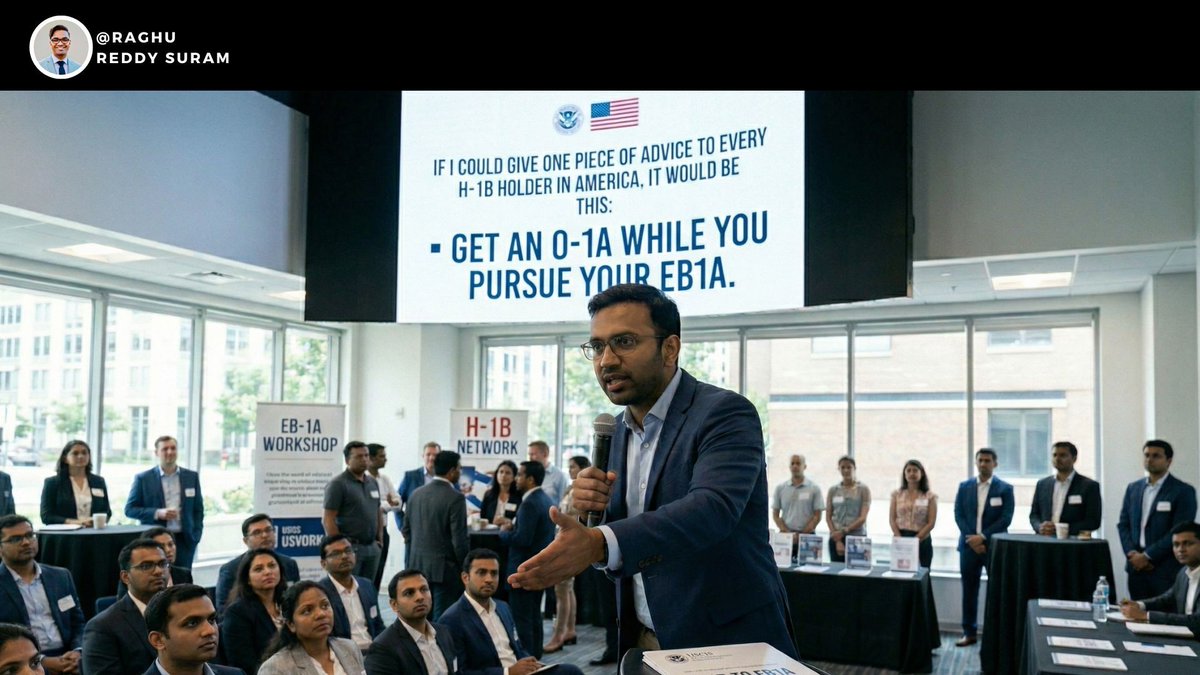
If I could give ONE piece of advice to every H-1B holder in America, it would be this: Get an O-1A while you pursue your EB1A. Let me explain why this dual strategy is the smartest move in 2026. The O-1A visa: → Doesn’t have a lottery — your employer petitions directly → Has a lower evidence bar than EB1A → Can be approved in 15 days with premium processing → Gives you 3-year work authorization, renewable indefinitely → Allows dual intent — you CAN pursue a green card simultaneously Here’s the strategic play: Step 1: Apply for O-1A now (lower bar, faster processing) Step 2: While on O-1A, build your EB1A profile for 12-18 months Step 3: File EB1A when your case is at maximum strength Why this works: → O-1A removes lottery risk immediately → O-1A evidence overlaps significantly with EB1A (same criteria framework) → Time on O-1A lets you strategically strengthen your weakest EB1A criteria → You’re never dependent on H-1B renewal or transfer With the $100K H-1B fee making new sponsorship prohibitively expensive for many employers, O-1A is becoming the go-to bridge visa for top talent. Don’t wait for the perfect EB1A case. Build a bridge with O-1A, then walk across it. Disclaimer: This post is for informational purposes only and does not constitute legal advice. For guidance specific to your situation, consult a qualified immigration attorney.
Raghu Reddy Suram tweet media
English
0
0
0
68
Raghu Reddy Suram
Raghu Reddy Suram@RvrSuram·
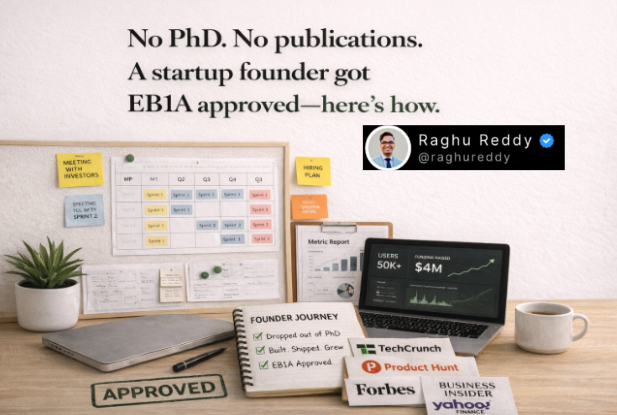
A founder DM’d me saying, “I dropped out of my PhD to build a startup. I have no publications. Am I disqualified from EB1A?” Here’s what I told them: You might be one of the strongest candidates I’ve talked to this month. Let me explain. USCIS doesn’t care about your degree. They care about extraordinary ability in your field. And founders, especially technical founders, often have evidence that employees never accumulate: → You BUILT something. If your product has users, revenue, or industry recognition — that’s an original contribution of major significance. → You’ve been COVERED by media. Startup press coverage counts. TechCrunch, Product Hunt features, and podcast interviews — all valid evidence. → You command HIGH compensation. Founder equity, salary, and total compensation often place you in the top percentile. → You JUDGE others’ work. If you’ve been on a pitch panel, mentored at an accelerator, or served as a startup advisor, that qualifies under the “judging” criterion. → You hold a CRITICAL role. As founder/CEO, you hold a leading or critical role in a distinguished organization. This particular founder had raised $4M in VC funding, had 50K+ users, and had been featured in 5 tech publications. We filed his EB1A 4 months later. Approved. No publications. No PhD. No problem. Disclaimer: This post is for informational purposes only and does not constitute legal advice. For guidance specific to your situation, consult a qualified immigration attorney.
Raghu Reddy Suram tweet media
English
0
0
0
23
Raghu Reddy Suram
Raghu Reddy Suram@RvrSuram·
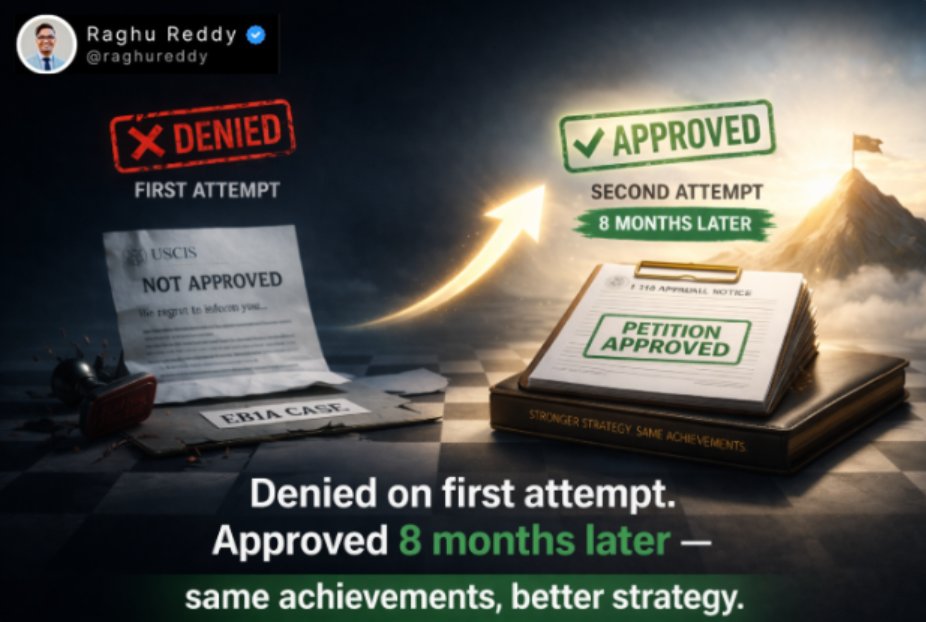
She got denied. Then she hired us. 8 months later, she was approved. Our client, a senior research scientist at a biotech company, came to us devastated. Her first EB1A petition had been denied. Not RFE’d. Denied outright. The denial letter said: “The petitioner has not established that she meets at least three of the ten criteria.” But when we reviewed her profile, she clearly met five. Here’s what went wrong with her first petition: ❌ Her publications were listed, but their citation impact wasn’t contextualized ❌ Her peer review work was mentioned but not documented with journal confirmation letters ❌ Her awards were included but described as “internal company recognitions” — which USCIS doesn’t count ❌ No salary benchmarking data was provided ❌ Recommendation letters were all from colleagues at her own company Here’s what we did differently: ✅ Reframed her citations with field-specific percentile analysis (top 5% in her subfield) ✅ Obtained official confirmation letters from 3 journals where she’d served as a reviewer ✅ Identified 2 legitimate external awards she’d forgotten about — a conference best paper award and a government research grant ✅ Added Bureau of Labor Statistics salary data showing her compensation in the top 3% ✅ Secured 6 new recommendation letters from independent researchers at rival institutions Same person. Same achievements. Completely different outcome. Her approval came back without an RFE. A denial is not the end. It’s information about what needs to change. Disclaimer: This post is for informational purposes only and does not constitute legal advice. For guidance specific to your situation, consult a qualified immigration attorney.
Raghu Reddy Suram tweet media
English
0
0
1
29
Raghu Reddy Suram
Raghu Reddy Suram@RvrSuram·
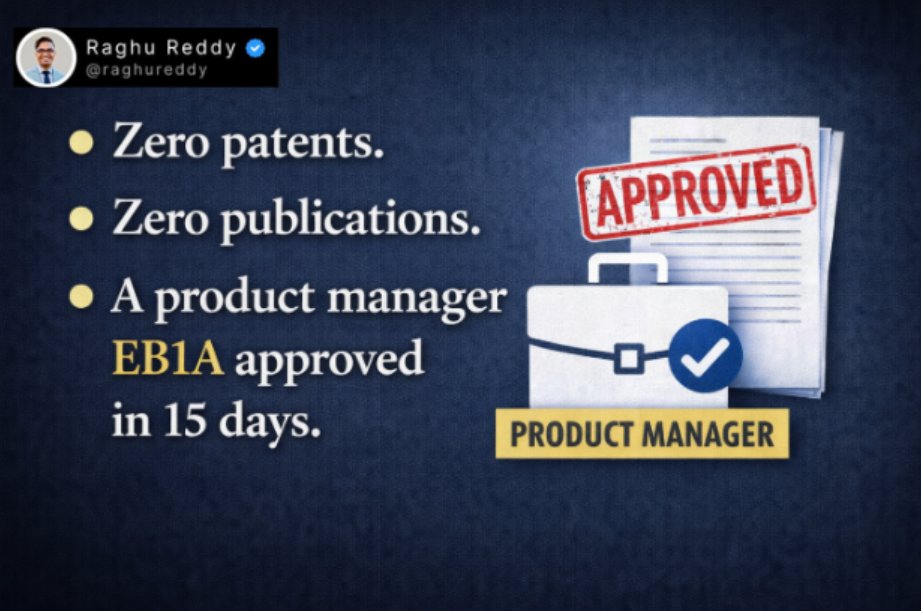
He was a product manager. Everyone said PMs can’t get EB1A. He proved them wrong. One of the most persistent myths in EB1A: you need to be a researcher or engineer with publications and patents. Our client was a Group Product Manager at a well-known SaaS company. Zero publications. Zero patents. Zero academic citations. Here’s what he DID have: → Led the product strategy for a platform serving 5M+ enterprise users → Designed a pricing model that generated $200M+ in annual revenue → Featured in 3 major tech publications for his product-led growth approach → Invited to keynote at 2 SaaS industry conferences → Salary in the 99th percentile for product management We built his case around the “original contributions of major significance” and “high salary” criteria, supplemented by media coverage and conference invitations. His recommendation letters came from founders and VPs at competing companies who could testify to how his work influenced the broader SaaS industry. Result? Approved on the first attempt. Premium processing. 15 business days. EB1A isn’t just for engineers and researchers. It’s for anyone who has moved the needle in their field. If that’s you — regardless of your title — let’s talk. Disclaimer: This post is for informational purposes only and does not constitute legal advice. For guidance specific to your situation, consult a qualified immigration attorney.
Raghu Reddy Suram tweet media
English
0
0
0
20
Raghu Reddy Suram
Raghu Reddy Suram@RvrSuram·
Hot take: AI matters more than attorneys for EB1A preparation in 2026. Before the lawyers come for me — let me explain. I’m not saying you don’t need legal counsel. You absolutely do for filing. But here’s what AI can do that most attorneys can’t: • Analyze 10,000+ approved EB1A petitions to identify winning patterns • Benchmark your profile against similar approved candidates in your specific field • Identify which criteria combinations have the highest approval rates for your profile type • Flag potential RFE triggers before you file • Generate data-driven evidence gap analyses in minutes, not weeks At EB1A Experts, we combine AI-driven insights with deep human expertise. The AI identifies patterns and optimizes strategy. The humans provide judgment, nuance, and the kind of storytelling that moves USCIS officers. This is the future of immigration consulting. Not AI replacing humans. Not humans ignoring AI. AI amplifying human expertise. And the firms that don’t adopt this approach? They’ll keep producing cookie-cutter petitions in a world that demands precision. Disclaimer: This post is for informational purposes only and does not constitute legal advice. For guidance specific to your situation, consult a qualified immigration attorney.
Raghu Reddy Suram tweet media
English
0
0
0
14
Raghu Reddy Suram
Raghu Reddy Suram@RvrSuram·
I spent last Tuesday on a 90-minute call with a client’s recommender, a professor at MIT who’d never written an EB1A letter before. It changed how I think about the gap between talent and documentation. This professor had collaborated with our client on a groundbreaking ML project. He knew the work was exceptional. He didn’t know how to say it in a way USCIS would understand. His first draft read like a LinkedIn endorsement: “She is a talented researcher whom I enjoyed working with.” Nice. Useless for EB1A. After our 90-minute conversation, here’s what the letter became: → A detailed analysis of how our client’s specific algorithmic contribution solved a problem that had stumped the field for a decade → Concrete metrics: her method reduced error rates by 37% and was adopted by 4 independent research groups within 18 months → A comparison to the broader landscape: “In my 25 years in this field, I have encountered fewer than 5 researchers who have achieved this level of impact at her career stage.” → Specific examples of downstream applications — including one that led to a published follow-up study Same recommender. Same admiration. Completely different letter. This is the work that most people never see. The hours spent coaching recommenders, extracting specifics, and turning genuine admiration into legally persuasive evidence. Great recommendation letters don’t happen naturally. They’re engineered. Disclaimer: This post is for informational purposes only and does not constitute legal advice. For guidance specific to your situation, consult a qualified immigration attorney.
Raghu Reddy Suram tweet media
English
1
0
0
28
Raghu Reddy Suram
Raghu Reddy Suram@RvrSuram·
IIT-Guwahati taught me something that no Silicon Valley job ever could: How to solve problems with zero resources. At IIT, we didn’t have the latest software. We didn’t have industry mentors. We had textbooks, each other, and a relentless drive to figure things out. That same mindset is what got me through months of EB1A self-study. And it’s the same mindset I bring to every client case at EB1A Experts. Here’s what I mean: Every EB1A case is a resource-constrained problem. You have a fixed set of career achievements. You can’t manufacture new evidence overnight. You need to maximize the impact of what you already have. That’s a product problem. And as a product manager, that’s how I’ve always thought. → How do you structure the narrative for maximum clarity? → Which 3-4 criteria give you the strongest case? → What evidence combinations tell the most compelling story? → Where are the gaps, and can they be filled in 3-6 months? This is why we built AI into our process at EB1A Experts. We analyze patterns across hundreds of approved cases. We identify optimal evidence strategies. We treat each petition like a product optimization problem. Because that’s exactly what it is. Tech professionals make the best EB1A candidates — because they already think in systems. Disclaimer: This post is for informational purposes only and does not constitute legal advice. For guidance specific to your situation, consult a qualified immigration attorney.
Raghu Reddy Suram tweet media
English
0
0
1
33
Raghu Reddy Suram
Raghu Reddy Suram@RvrSuram·
The hardest conversation I’ve ever had was about leaving Salesforce. Not with my manager. Not with HR. It was with my mother. I called her in Hyderabad and said: “I’m quitting my job at one of the best tech companies in the world to start an immigration consulting company.” Silence. My family had sacrificed so much to get me here. IIT Guwahati. USC. The Salesforce offer was the payoff. The validation that it had all been worth it. And I was walking away from it. My mother asked, “Are you sure this will work?” I said, “No. But I’m sure I need to try.” That was the truth. I had navigated my own EB1A case from scratch — every guideline, every AAO decision, every piece of evidence. I had watched brilliant colleagues live in fear of layoffs because of visa dependency. I knew I could help. But could I build a business? I had no idea. Three years later, EB1A Experts has helped hundreds of professionals secure green cards. My mother is proud. And I know this leap honored every sacrifice my family made to get me here. The hardest conversations aren’t about risk. They’re about being honest with the people who sacrificed the most for you. Disclaimer: This post is for informational purposes only and does not constitute legal advice. For guidance specific to your situation, consult a qualified immigration attorney.
Raghu Reddy Suram tweet media
English
0
0
0
30
Raghu Reddy Suram
Raghu Reddy Suram@RvrSuram·
I came to America with an F-1 visa and a belief that hard work would be enough. It wasn’t. Hard work got me into IIT Guwahati. It got me a Master’s from USC. It got me a job at Salesforce. But hard work alone could not get me a green card. The immigration system does not reward hard work. It rewards strategy, documentation, and knowing the rules of the game. I learned that the hard way. Over 1,800 hours, I studied every USCIS guideline, every AAO decision, and every successful EB1A case I could find. And when I finally got approved, I made a promise: I would make sure no other tech professional had to spend 1,800 hours figuring out what I figured out. Today, EB1A Experts has helped hundreds of engineers, researchers, and founders secure their permanent residency. With a 90%+ success rate. With AI-powered insights. With a team that treats every case like it’s their own. Because it once was mine. If you’re an immigrant in tech working toward your American dream, know that you do not have to do it alone. We’ve been where you are. And we’re here to help you get where you’re going. Disclaimer: This content is for informational purposes only and does not constitute legal advice.
Raghu Reddy Suram tweet media
English
0
1
1
40
Raghu Reddy Suram
Raghu Reddy Suram@RvrSuram·
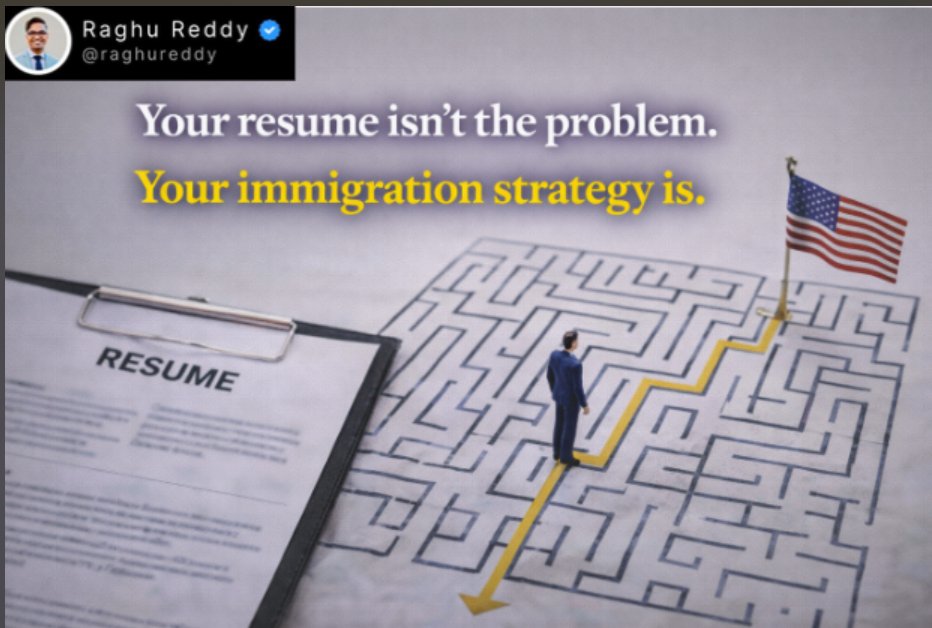
Your resume is not the problem. Your immigration strategy is. I talk to engineers every week who say: “I’ve been at Google for 7 years. I have 4 patents. I’ve published 8 papers. But I’m still waiting on my EB2 green card.” And I ask: “Have you looked at EB1A?” The answer is almost always: “I didn’t think I qualified.” Let me be direct: If you have 4 patents and 8 papers after 7 years at a top tech company, you almost certainly qualify for EB1A. The problem isn’t your profile. The problem is that nobody told you about this path. Or worse, someone told you it was “only for professors” or “too risky.” Here’s the truth: • EB1A doesn’t require employer sponsorship • EB1A doesn’t have the 10+ year backlog • EB1A has premium processing (15 days) • EB1A lets YOU control your immigration future The best strategy isn’t always the most obvious one. Sometimes the best strategy is the one nobody told you about. Disclaimer: This content is for informational purposes only and does not constitute legal advice.
Raghu Reddy Suram tweet media
English
0
0
0
23
Raghu Reddy Suram
Raghu Reddy Suram@RvrSuram·
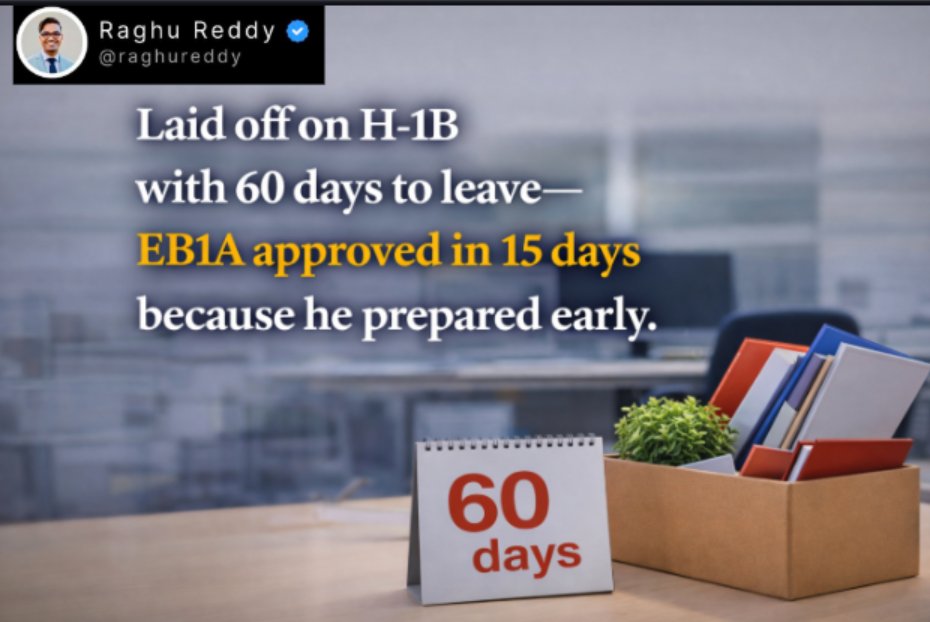
He had 48 hours to make a decision that would change his family’s life. One of our clients, a principal engineer at a major cloud company, got laid off on a Tuesday. On H-1B, he had 60 days to find a new employer or leave the country. His wife. Two kids in school. A mortgage. Fifteen years of building a life in America. But here’s what he didn’t know when the layoff happened: We had been quietly building his EB1A case for the past 8 months. Here’s what was already in place: • 5 patents granted • Key architect of a platform used by 50,000+ enterprise customers • Recommendation letters from 7 independent experts, already drafted and signed • Complete petition, 90% ready to file Within 48 hours of his layoff, we filed his EB1A petition with premium processing. 15 days later: approved. No RFE. He went from “I might have to leave the country.” to “I have a green card” in two weeks. His only regret? Not starting the process sooner. This is why I always tell people: start your EB1A preparation while things are good. Because when things change, and they always can, having your case ready isn’t just a strategy. It’s a safety net. Disclaimer: This content is for informational purposes only and does not constitute legal advice.
Raghu Reddy Suram tweet media
English
0
0
0
29
Raghu Reddy Suram
Raghu Reddy Suram@RvrSuram·
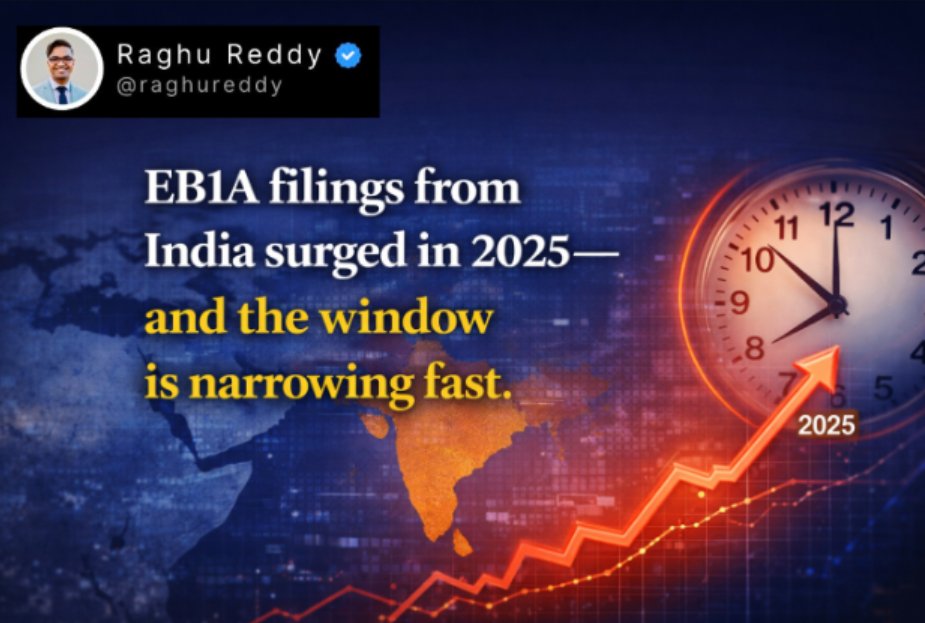
A surprising statistic about EB1A: EB1A filings from India increased sharply in 2025, while filings from China dropped by 40%. So what’s driving this shift? For Indian tech professionals, the math has become undeniable: • EB2/EB3 backlog: 10–15+ years, and growing • H-1B uncertainty: $100K fee + lottery unpredictability • EB1A timeline: 4–8 months to approval • EB1A backlog for India: Currently manageable, but getting tighter More Indian professionals are realizing that EB1A is not just a “nice to have.” It is the most practical path to permanent residency. And here’s what concerns me: As filings surge, the EB-1 category hit its annual limit in FY 2025 for the first time. Priority dates for India are starting to fluctuate and retrogress. This means the window is narrowing. If you’re an Indian tech professional on H-1B or L-1, and you haven’t seriously explored EB1A, the data is telling you something important: The best time to file was last year. The second-best time is now. Disclaimer: This content is for informational purposes only and does not constitute legal advice.
Raghu Reddy Suram tweet media
English
0
0
0
166
Raghu Reddy Suram
Raghu Reddy Suram@RvrSuram·
The real reason your EB1A case isn’t as strong as it could be? You’re thinking like an employee. Not like an expert. Let me explain the difference. Employee mindset: “I built a feature that shipped to production.” “I managed a team of 5 engineers.” “I got promoted to a senior level.” Expert mindset: “I designed a novel architecture that reduced latency by 40%, now adopted as the standard approach across the industry.” “I led a cross-functional initiative that resulted in 3 patents and influenced the product roadmap for a $2B business line.” “My research on X was cited by 15 independent teams and formed the basis for the Y open-source framework.” Same person. Same career. Completely different narrative. The shift from employee to expert isn’t about doing different work. It’s about recognizing and articulating the extraordinary impact of the work you’re already doing. This is the transformation we help our clients make at EB1A Experts. And it changes everything. Disclaimer: This content is for informational purposes only and does not constitute legal advice.
Raghu Reddy Suram tweet media
English
0
0
0
16
Raghu Reddy Suram
Raghu Reddy Suram@RvrSuram·
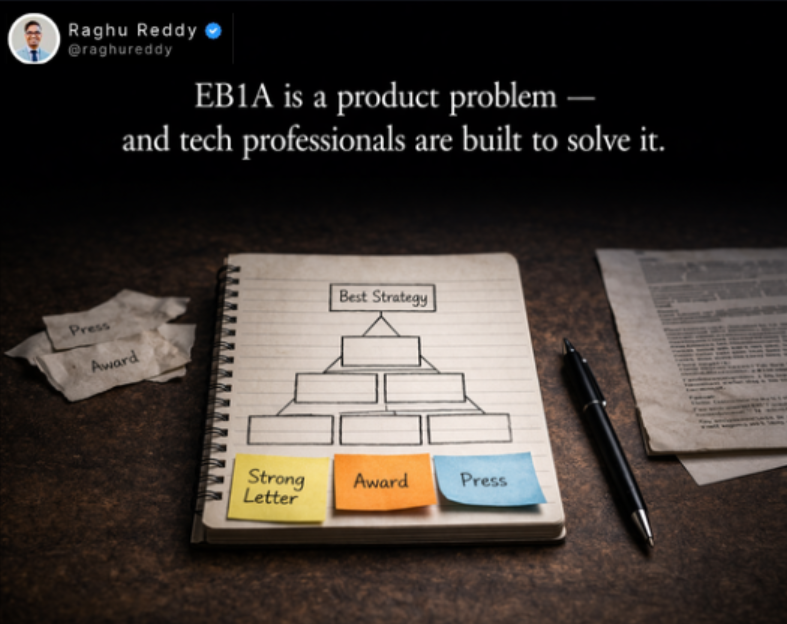
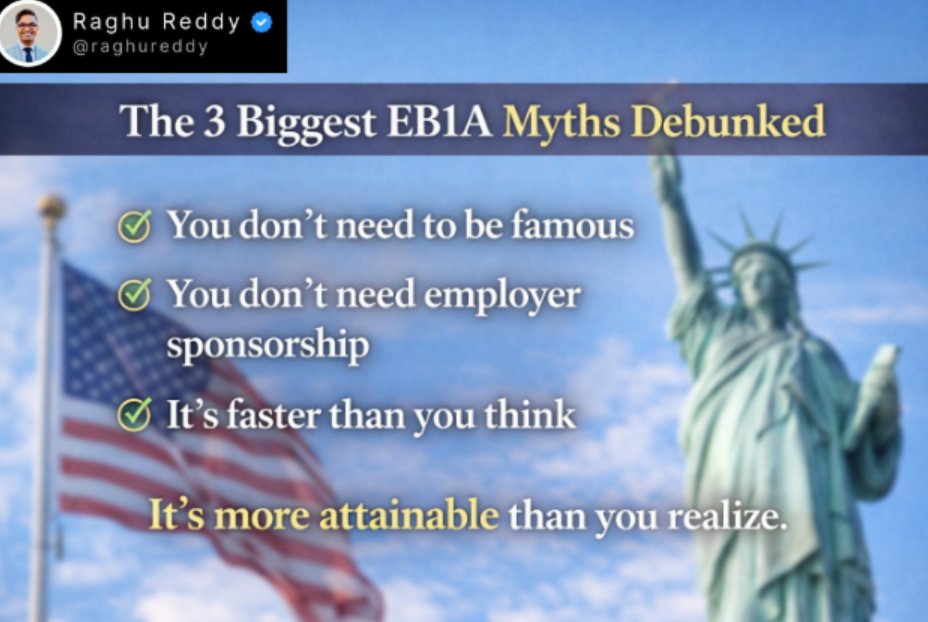
If you’re thinking about EB1A, read this first. I speak with 50+ tech professionals every month about their immigration options. And 90% of them have the same three concerns. Concern 1: “I don’t think I’m extraordinary enough.” Reality: USCIS defines “extraordinary ability” as being at the top of your field. If you’re a senior engineer at a major tech company, you’re likely already there. It’s about how you present it. Concern 2: “My employer won’t support it.” Reality: EB1A is a self-petition. You do not need your employer’s permission, sponsorship, or even knowledge. You file it yourself, with proper legal support. Concern 3: “It takes too long and costs too much.” Reality: EB1A processing can take 4–8 months, or as little as 15 days with premium processing. Compare that to 10+ year EB2/EB3 backlogs for Indian nationals. The ROI is massive. The biggest barrier to EB1A isn’t eligibility. It’s information. Most qualified professionals simply do not know this path exists. Or they have been told myths that scared them away. Now you know. What will you do with it? Disclaimer: This content is for informational purposes only and does not constitute legal advice.
Raghu Reddy Suram tweet media
English
0
0
0
15
Raghu Reddy Suram
Raghu Reddy Suram@RvrSuram·
I made this mistake so you don’t have to: I treated recommendation letters as an afterthought. When I was building my own EB1A case, all 1,800 hours of it, I spent 80% of my time on documentation and evidence gathering. And then, two weeks before filing, I rushed the recommendation letters. Big mistake. My first round of letters was basically LinkedIn recommendations on steroids. Nice things from nice people. USCIS wasn’t impressed. What actually works: • Letters from independent experts — not your boss or colleagues • Specific descriptions of your contributions and their field-wide impact • Technical depth that shows the letter writer truly understands your work • Comparison to the broader landscape in your specialty • 6–8 letters minimum, with at least half from people outside your organization Your recommendation letters aren’t supporting documents. They are the case. Treat them accordingly. Disclaimer: This content is for informational purposes only and does not constitute legal advice.
Raghu Reddy Suram tweet media
English
0
0
0
15
Raghu Reddy Suram
Raghu Reddy Suram@RvrSuram·
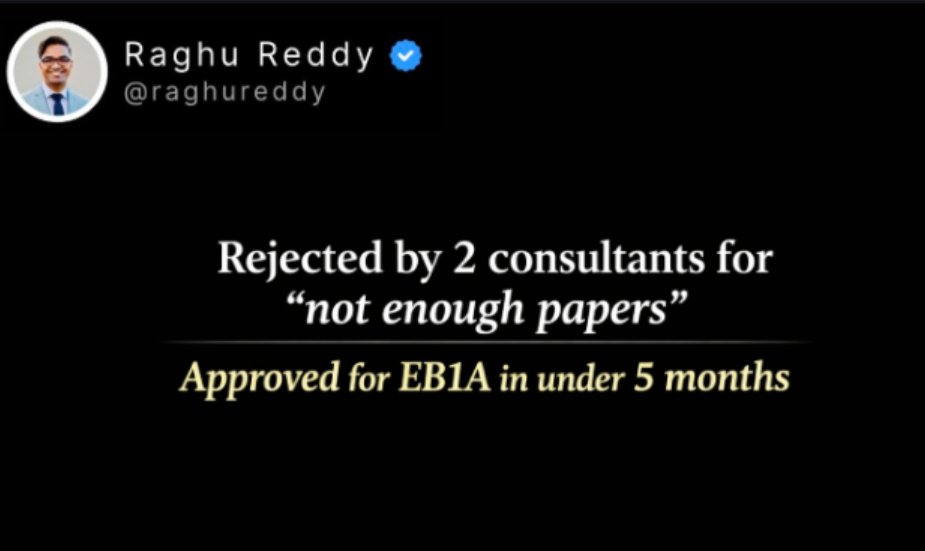
She was told she’d never qualify for EB1A. 6 months later, she got approved. One of our clients, a senior data scientist at a Fortune 500 company, came to us after being turned away by two immigration consultants. Their reasoning? “You don’t have enough publications. You need at least 15.” She had 4 papers. But here’s what those consultants missed: • Her papers had 300+ combined citations • Her ML model was running in production, serving 20M+ users daily • She’d been invited to review papers for two top-tier AI conferences • Her open-source toolkit had been adopted by 3 other Fortune 500 companies • Her salary was in the top 5% nationally for her role We built her case around impact, not volume. Every piece of evidence was framed to show how her work pushed the boundaries of her field — not just how many papers she had. Result? Approved. No RFE. Under 5 months total. The consultants who rejected her were counting papers. We measured impact. That’s the difference. Disclaimer: This content is for informational purposes only and does not constitute legal advice.
Raghu Reddy Suram tweet media
English
0
0
0
20
Raghu Reddy Suram
Raghu Reddy Suram@RvrSuram·
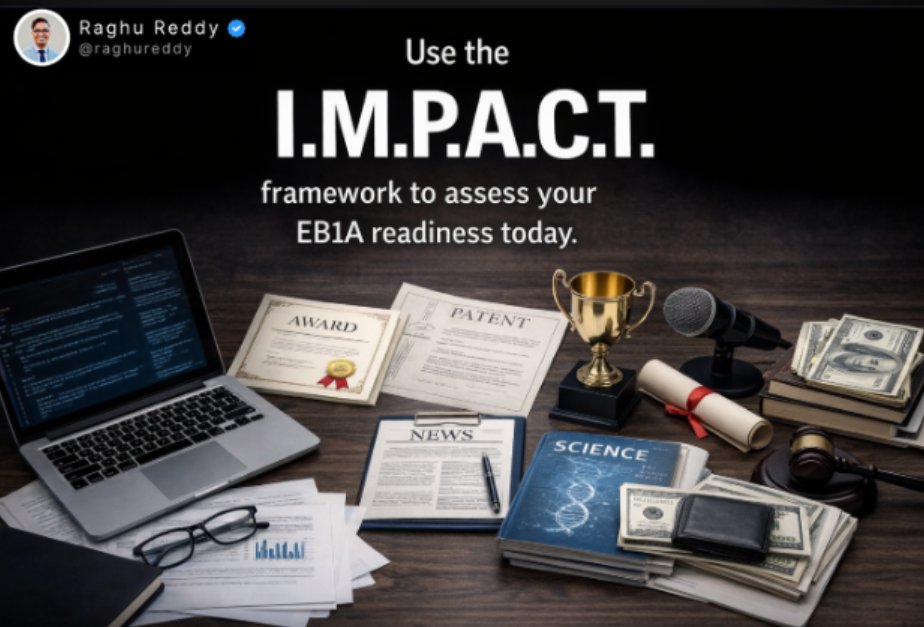
Here’s a framework I use to evaluate EB1A readiness for tech professionals. I call it the I.M.P.A.C.T. framework: I = Independent Recognition Have you received awards, grants, or recognition from organizations outside your employer? M = Media & Mentions Has your work been featured in trade publications, tech blogs, or mainstream media? P = Publications & Patents Do you have papers, patents, or technical contributions that are documented and citable? A = Authority in the Field Have you served as a reviewer, judge, or evaluator for others in your domain? C = Contributions of Significance Can you point to specific products, tools, or research that meaningfully advanced your field? T = Top Compensation Is your salary in the top tier for your role and geography? You don’t need all six. But you do need at least three, with strong, documented evidence for each. If you score 3+ on this framework, it’s time to start building your case. If you score 2, you’re likely 6–12 months of strategic work away from being ready. Save this. Share it with someone who needs it. Here is a slightly more impactful version with stronger LinkedIn flow: Tech professionals often ask me how to know whether they’re truly ready for EB1A. Disclaimer: This content is for informational purposes only and does not constitute legal advice.
Raghu Reddy Suram tweet media
English
0
0
0
24
Raghu Reddy Suram
Raghu Reddy Suram@RvrSuram·
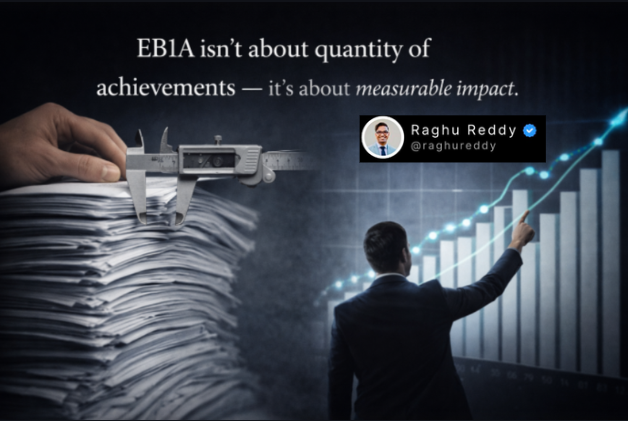
You don’t need 100 publications to get an EB1A. You need 5 that demonstrate real impact. This is the myth that holds back more tech professionals than any other. I’ve worked with clients who had: → 3 papers with 200+ combined citations — APPROVED → 1 patent used in a product serving 10M users — APPROVED → 0 publications but 5 major open-source contributions — APPROVED And I’ve seen clients with 50+ publications get denied because none showed meaningful impact. USCIS cares about quality over quantity. Every single time. The question isn’t: “How many things have I done?” It’s: “What impact have my contributions had on the field?” If your code is running in production at scale, If your research has been cited by others building on your work, If your designs influenced industry standards - That’s an extraordinary ability. Stop counting. Start measuring impact. Disclaimer: This content is for informational purposes only and does not constitute legal advice.
Raghu Reddy Suram tweet media
English
0
0
0
23
Raghu Reddy Suram
Raghu Reddy Suram@RvrSuram·
Nobody talks about the mental health toll of immigration uncertainty. But it changed how I build my company. When I was on an H-1B, I experienced something millions of immigrants know — but rarely discuss: The constant, low-grade anxiety of knowing your entire life in this country depends on your employer’s sponsorship. → Can’t start a side project (visa restrictions) → Can’t easily switch jobs (transfer anxiety) → Can’t plan more than 3 years ahead → Every news headline about immigration policy feels personal I’ve had clients break down on calls. Not because their case was weak — but because years of visa stress had convinced them they’d never be free of it. That’s why at EB1A Experts, we don’t just build cases. We build confidence. Every client gets a clear roadmap. A realistic timeline. Honest assessments. Because the worst part of immigration isn’t the paperwork. It’s the uncertainty. And the best thing we can do is replace uncertainty with clarity. Disclaimer: Content and any other data shared are for informational purposes only and do not constitute legal advice.
Raghu Reddy Suram tweet media
English
0
0
0
18