
ทวีตที่ปักหมุด
SMR
15.4K posts


SMR
@SMR_VISION
Exploring the future of #ADAS #LIDAR #AR #AI #Mobility #Robotics #Drones 🚗🤖 | Long $MVIS @MicroVision | Not a financial advisor, DYOR!
Earth เข้าร่วม Aralık 2019
2.9K กำลังติดตาม1.7K ผู้ติดตาม

Appreciate the clear phased breakdown scaling mature L2/L2+ first, then controlled-domain ops, and finally sensor simplification once the AI is battle-proven makes a lot of sense for long-term cost + scalability discipline.
Quick question on the early phases: what specific role / specs are you targeting for LiDAR in those initial robotaxi / controlled-domain units (e.g. range class, placement, expected contribution to perception safety before the big camera-heavy maturity step)?
Curious to hear more details as the roadmap progresses! 🚗🤖
English

Important nuance here:
Step 1: mature L2/L2+ at scale.
Step 2: controlled-domain autonomy.
Step 3: simplify sensor stack as software confidence grows.
Cost structure + architecture discipline matter long term. $VFS
SMR@SMR_VISION
$MVIS @VinFastofficial #AD roadmap: from L2 to #LiDAR-less robotaxis. VinFast is pursuing autonomous solutions that are both cutting-edge and widely accessible. Leapfrogging LiDAR? VinFast’s long-term vision for the Robo-Car entails a unique AI architecture that reportedly eliminates the need for expensive LiDAR, radar arrays, or high-definition maps. These are currently regarded as the fundamentals for autonomous driving by most developers, with a handful of notable exceptions. Instead, VinFast and Autobrains believe they can leverage seven standard cameras and a compact, high-performance computing chip capable of processing approximately 20 trillion operations per second. The promise: advanced autonomous functionality at a fraction of the cost and complexity of traditional systems. However, this may take time, and Van Duong explains that the company will take a step by step approach towards robotaxis. The initial units will still feature #LiDAR, radar, cameras, and ultrasonic sensors. “Only later will we remove some of the sensors, after reaching a good maturity level for camera and radar-based systems. Camera-based technology is advancing daily, which enables many new areas and applications including autonomous driving. By observing our in-house AI technology progress, in addition to Autobrain’ agentic AI, we are confident in this path.” automotiveworld.com/articles/vinfa…
English
SMR รีทวีตแล้ว


$MVIS Microvision Q4 2025 Financial and Operating Results Call youtu.be/_SbvGeDrOS4?si… via @YouTube

YouTube
English
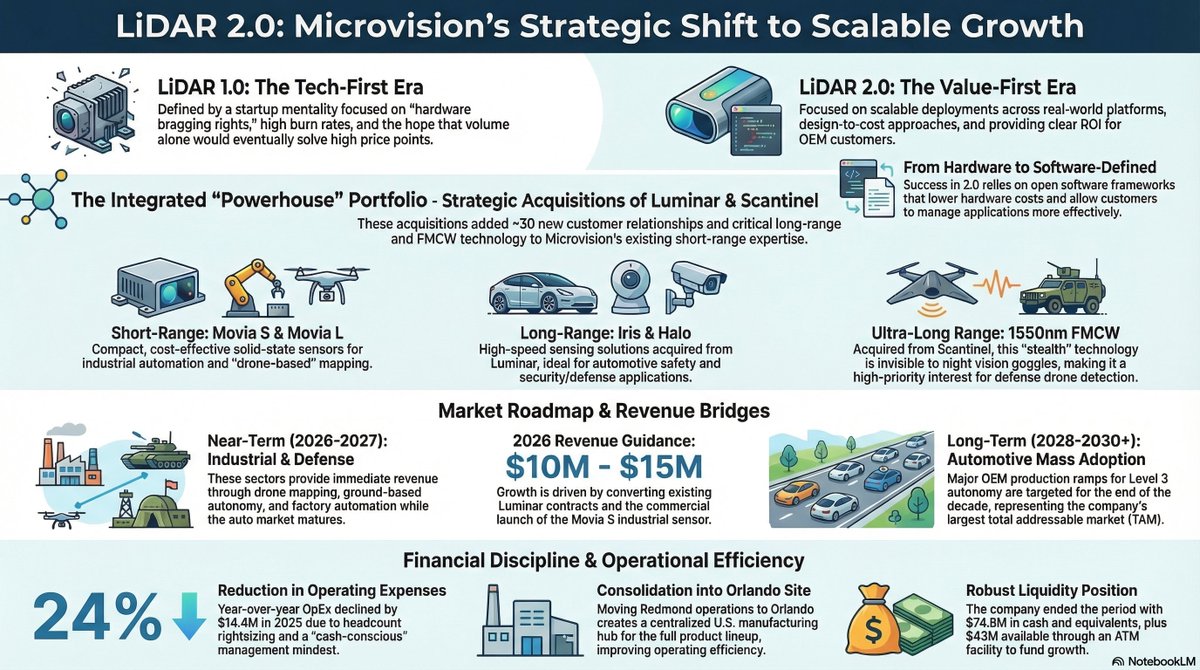
$MVIS is entering the #LiDAR 2.0 era, shifting its focus from a hardware technology race to a model centered on software value, scalability, and affordability. The company has issued 2026 revenue guidance of 10M–15M, a significant projected increase driven by industrial sales and legacy Luminar contracts.
Through the acquisitions of Luminar and Scantinel, MicroVision has added approximately 30 new customer relationships and expanded its portfolio to include 905nm and 1550nm sensors.
Engineering and manufacturing operations are being consolidated in Orlando to realize synergies and provide a U.S. hub for the growing security and defense sector. While near-term growth is expected from industrial and defense markets, management anticipates the automotive segment will begin scaling meaningfully between 2029 and 2031.
#MVIS #LiDAR #Earnings #TechNews

English
$MVIS @MicroVision : Navigating the Shift to LiDAR 2.0 !!
The earnings call highlights Microvision's transition into the "#LiDAR 2.0" era, characterized by a shift from a hardware-first "Silicon Valley mindset" to a strategy focused on scalable deployments, OEM value, and software-defined capabilities.
Strategic Strategy and Acquisitions :
The company has transformed its business through the acquisitions of Luminar and Scantinel, which provided what management describes as the industry's most robust technology portfolio,. This portfolio now includes:
Movia sensors: Compact, cost-effective short-range sensing for industrial and automotive use,.
Iris and Halo sensors: Long-range sensing for high-speed automotive, security, and defense applications.
FMCW sensors: Ultra-long-range sensing (1550 nanometer) acquired from Scantinel, particularly attractive for drone detection and night operations due to its invisibility to night-vision equipment,.
Software: The Mosaic and Sentinel products provide end-to-end perception and AI-based features through an "open software" framework designed to lower hardware costs.
Market Verticals and Commercial Traction :
Microvision is targeting three primary verticals: Automotive, Industrial, and Security/Defense.
Bridges to Revenue: While large-scale automotive volumes are expected later in the decade (2028–2030), the industrial and security/defense sectors serve as immediate "bridges",.
Security and Defense: Management is optimistic about this "nascent" market, citing demand for drone-based mapping and ground-based autonomy,.
Customer Expansion: The Luminar acquisition added approximately 30 new customer relationships, and the company has already begun shipping Iris and Movia L units to resume those commercial programs
Operational Execution :
To improve efficiency and support its defense sector ambitions, Microvision is consolidating its Redmond operations into its Orlando, Florida facility,. This move is expected to incur $8 million to $12 million in asset impairment charges but will establish Orlando as the primary U.S. manufacturing site for its full product lineup,. Management also noted an ongoing search for a permanent CFO, with a target hire date in the second quarter of 2026.
Microvision is transitioning into a new strategic phase termed LiDAR 2.0, moving away from a technology-only focus toward a value-driven model for #automotive, industrial, and #defense customers.
By acquiring companies like @luminartech and #Scantinel, the firm has expanded its hardware and software portfolio to include versatile short-range and long-range sensors. This consolidation aims to accelerate revenue streams and achieve better economics through high-volume, scalable production.
Management highlights a shift toward open software frameworks to lower costs and enable easier integration for original equipment manufacturers.
Financially, the company is focused on disciplined cash management and operational efficiency as it integrates new teams and facilities. Ultimately, Microvision seeks to lead the market by providing affordable, high-performance sensing solutions across multiple global sectors. DYOR. NFA!!
ir.microvision.com/news/press-rel…
English

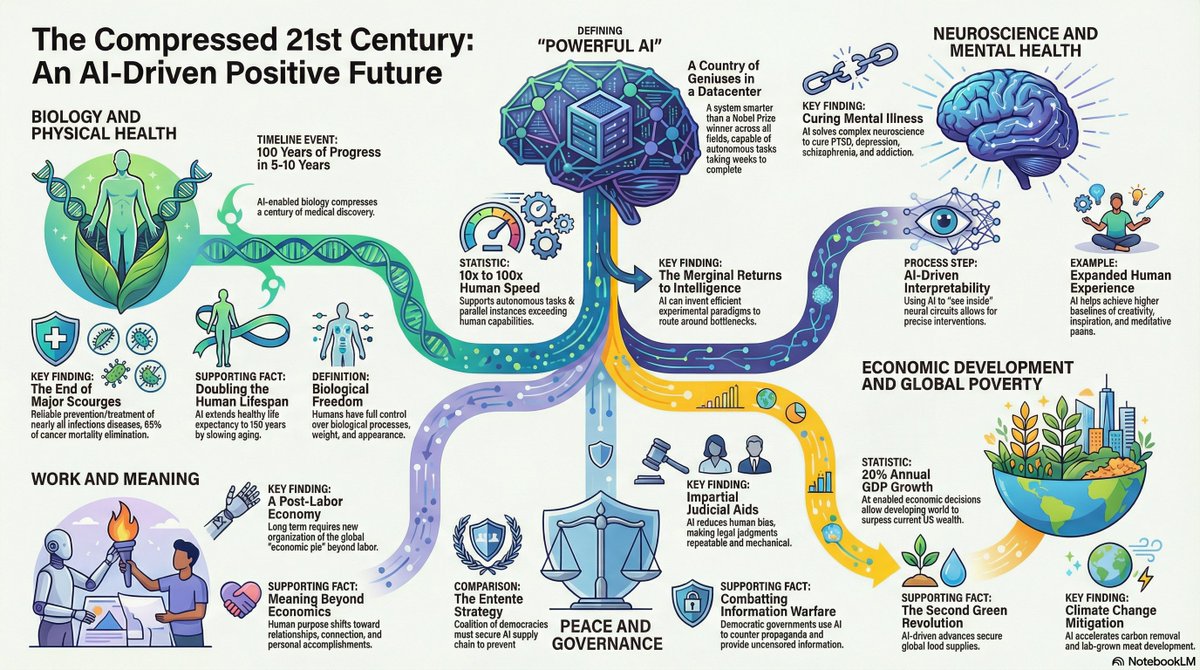
An article by @DarioAmodei : Machines of Loving Grace - How AI Could Transform the World for the Better. The Compressed 21st Century. darioamodei.com/essay/machines…
English
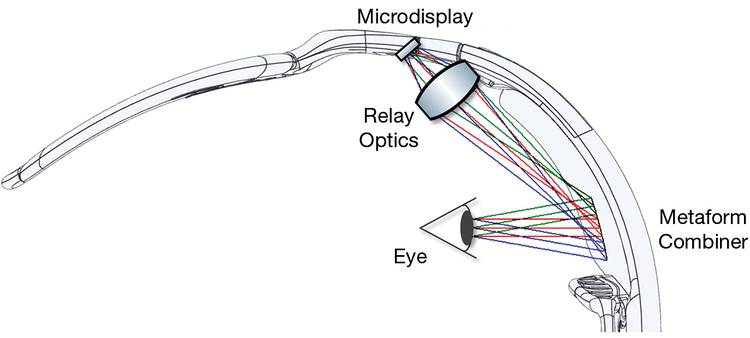
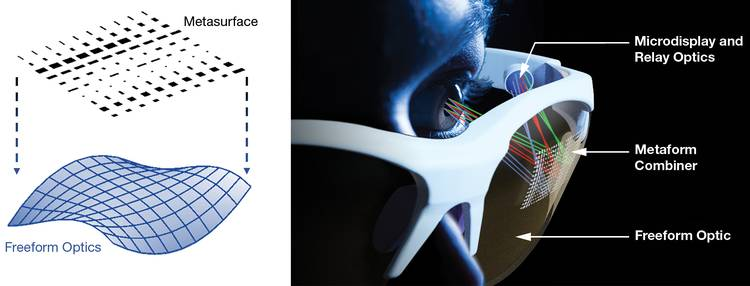
$MVIS Barry Silverstein - Laser Displays: The Next Leap for XR and the AR Alliance’s LDAR Initiative !!
Laser displays represent a pivotal advancement, addressing many limitations of current architectures and opening new possibilities for efficiency, image quality, and user experience. photonics.com/Articles/Laser…
English
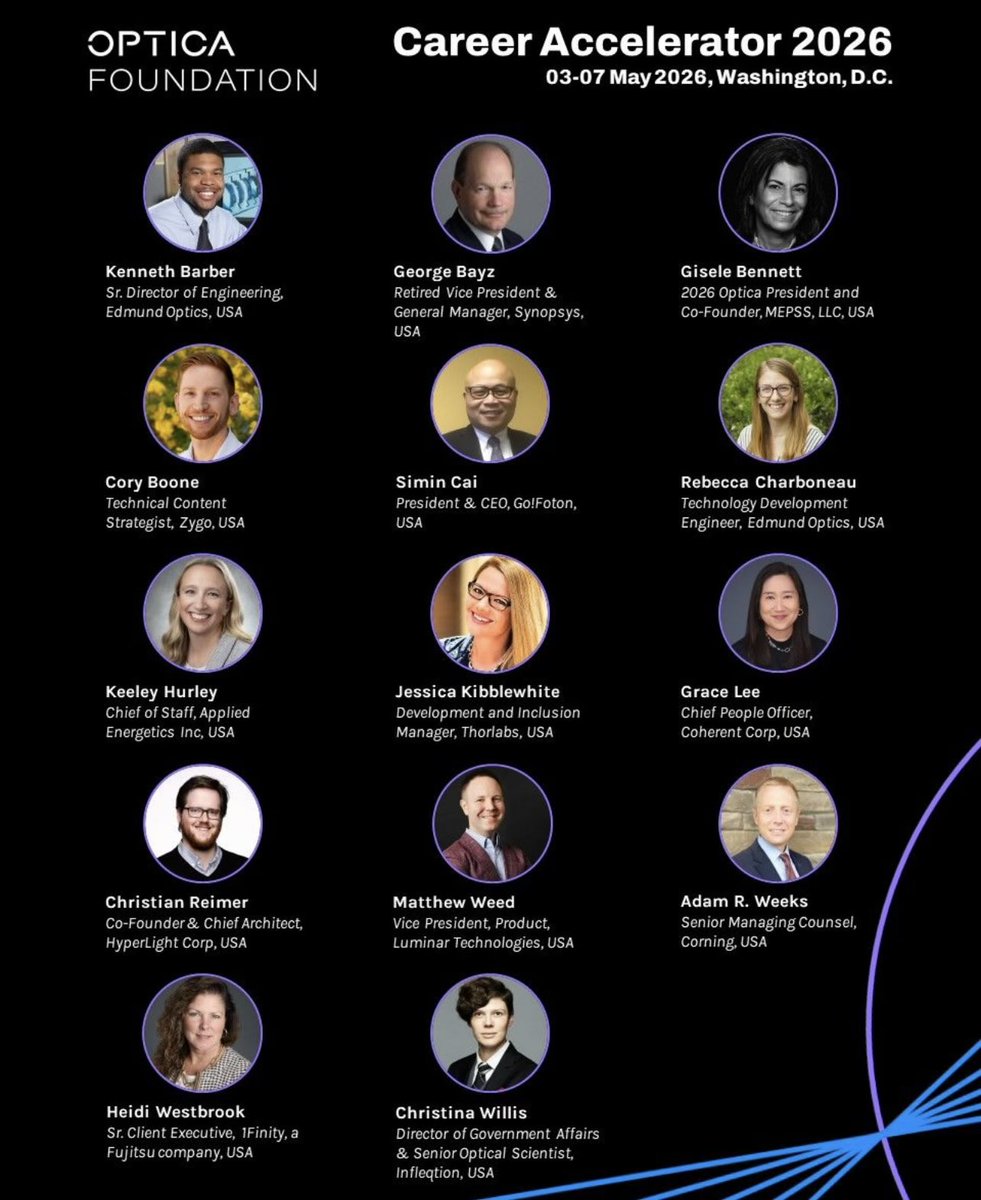
$MVIS Matthew Weed from @luminartech is in the list of Career Accelerator speakers !! @MicroVision @OpticaWorldwide
English
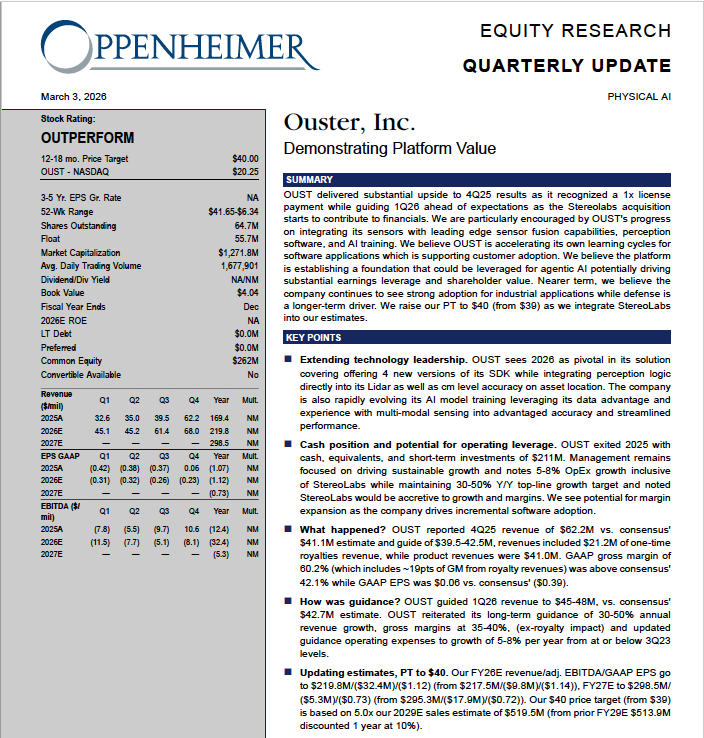
$MVIS $QCOM @Qualcomm : Real-time #LiDAR object detection is computationally expensive. Running it locally on the edge without latency spikes is even harder.
CenterPoint is now available and optimized on Qualcomm AI Hub.
This 3D object detection model predicts object centers and regresses other attributes specifically for autonomous driving scenarios. It's engineered for high accuracy and real-time performance on the road.
The Specs:
• Checkpoint: PointPillars
• Parameters: 21.8M
• Footprint: 83.3 MB
You can run this locally across a wide range of hardware, from Snapdragon Automotive platforms (like the Snapdragon 8 Elite Gen 5 QRD) to the Snapdragon X Elite and Snapdragon 8 Gen 3.
No cloud dependency required.
Grab the optimized model and test it on your target hardware today: buff.ly/exm2uEu
#EdgeAI #ComputerVision #AutonomousDriving #QualcommAIHub #MachineLearning

English
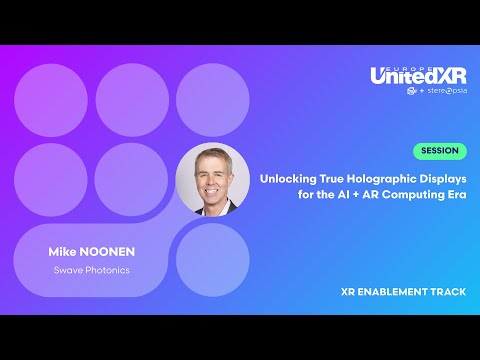
$MVIS Unlocking True Holographic Displays for the AI + AR Computing Era | Mike NOONEN, Swave Photonics !
This video will describe the requirements for consumer augmented reality (AR) displays, and describe how a laser illuminated holographic display technology could satisfy them.
youtu.be/aGxriXNX6a4?si…
YouTube
English
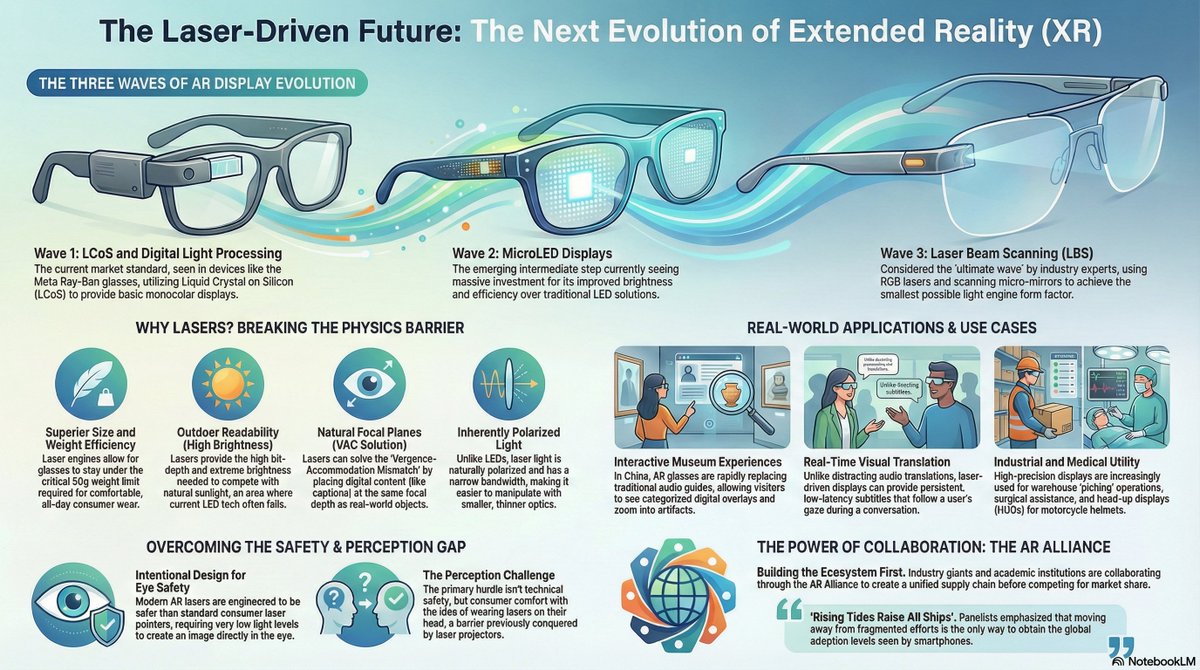
$MVIS Laser-Driven Extended Reality Evolution !!
While the "best" display depends on current market readiness versus long-term potential, the experts in the sources identify laser-driven displays as the "third and ultimate wave" of AR technology. Currently, the market is navigating through three distinct technological generations:
Wave 1: Liquid Crystal on Silicon (LCOS): These are the current "productizable solutions" used in devices like the Ray-Ban Meta glasses. They provide a quality experience today but are often limited by a smaller field of view and the bulkiness of the illumination systems.
Wave 2: MicroLED: This emerging technology is seen as the next step, with many groups currently shifting their focus toward MicroLED imagers.
Wave 3: Laser Displays: Panelists believe lasers will "inevitably lead to the best AR display systems" because they break the physical barriers inherent in other technologies.
Why Laser Displays are Considered Superior :
According to the sources, laser technology offers several critical advantages that make it the preferred choice for the future of AR:
Form Factor and Weight: To be successful, glasses must be fashionable, lightweight (ideally under 50g), and compatible with prescriptions. Lasers allow for smaller projection engines compared to LED-based systems, enabling the sleek design required for all-day wear.
Brightness and Efficiency: Lasers provide the high brightness necessary to compete with outdoor environments while maintaining the battery life needed for all-day use.
Depth Perception (Vergence-Accommodation Mismatch): A unique advantage of certain laser-based displays, such as holographic or specific scanning systems, is the ability to place digital objects at the correct focal depth. This solves the "vergence-accommodation mismatch," allowing users to look at digital subtitles or objects at the same focal plane as the person they are speaking to, which is not something the human brain manages well with standard displays.
Computational Display: Experts suggest that lasers allow for "computational displays" that replace heavy, bulky optics with dynamic, light-weight systems.
The Role of Application :
Despite the push toward lasers, some experts note that it may be "pretentious" to name a single "best" technology, as different approaches (such as Laser Beam Scanning or Holography) have different pros and cons. Different technologies will likely coexist to provide differentiation in the market, as some users may prioritize field of view while others prioritize size or color performance.
English
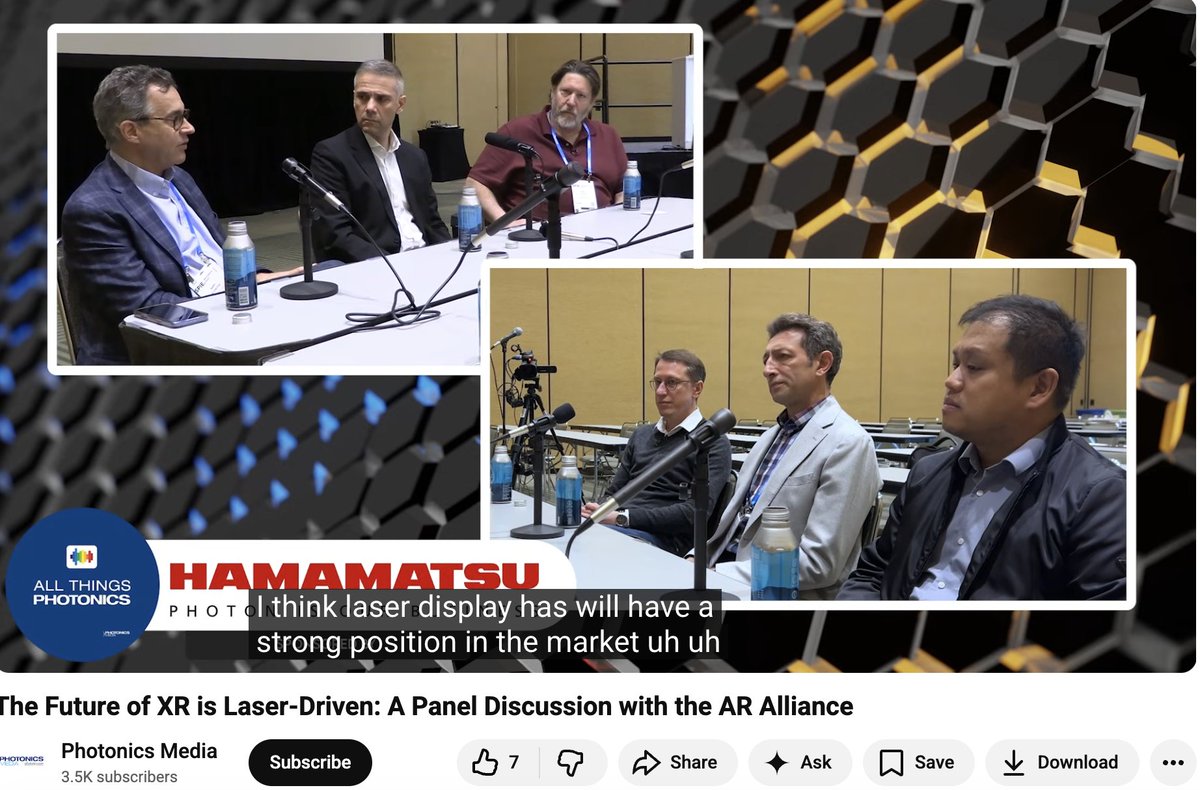
$MVIS Barry : Laser display will have a strong position in the market and it is inevitable that it will become best AR display systems !!
SMR@SMR_VISION
$MVIS The Future of XR is Laser-Driven: A Panel Discussion with the AR Alliance youtu.be/vg8f7DBjTsQ?si…
English
$MVIS The Future of XR is Laser-Driven: A Panel Discussion with the AR Alliance youtu.be/vg8f7DBjTsQ?si…
YouTube
English
$MVIS @MicroVision is currently executing a "Pivot to Profit" strategy led by their relatively new CEO, Glen DeVos. Over the last 60 days, the company has undergone a radical transformation:
Asset Consolidation: In February 2026, MicroVision completed a $33 million acquisition of Luminar Technologies' core lidar assets (Iris and Halo sensors) following Luminar's bankruptcy.
Debt Refinancing: Just last week (Feb 24), they secured $43 million in new capital. This wasn't just for survival; it was specifically earmarked to integrate the @luminartech and Scantinel acquisitions.
The Redmond Layoffs: The 49 layoffs in Redmond are the direct result of this. MicroVision is moving away from its legacy R&D structure and "relocating" those operations to the specialized teams they just acquired in Germany and potentially Florida.
The Bottom Line: MicroVision is cutting the "old" Redmond guard to make room for a "new" global structure fueled by their recent acquisitions. They are betting everything that a leaner, more specialized team can finally land the major automotive OEM contract that has eluded them for years.
DYOR. NFA !!!
English
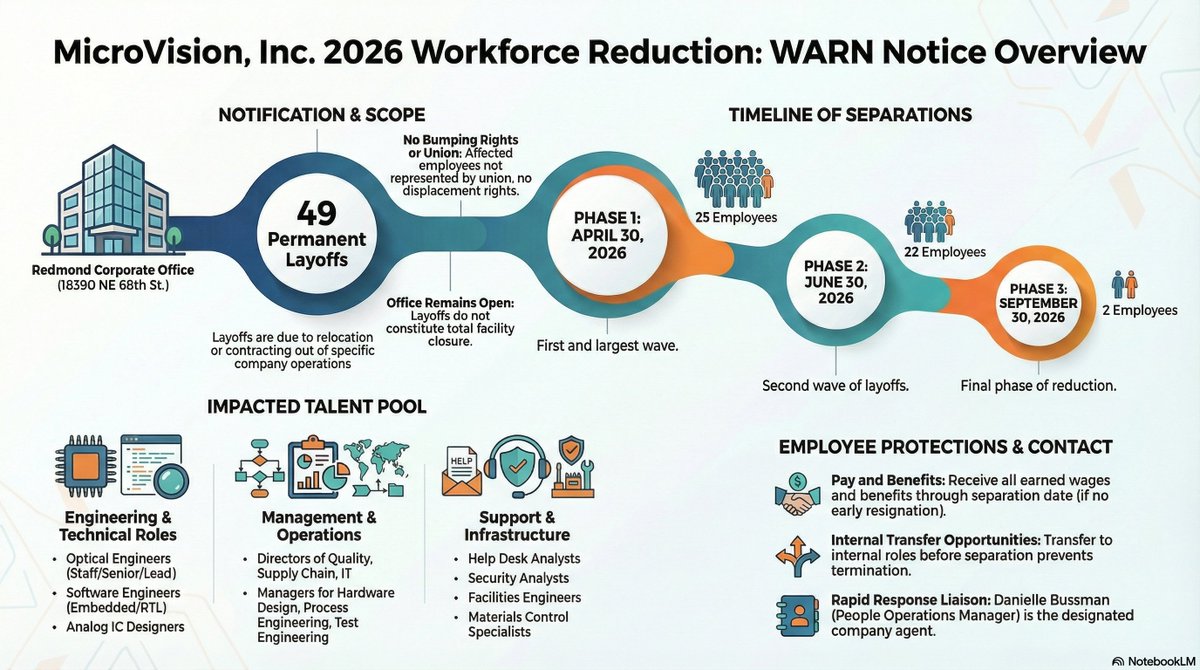
$MVIS MicroVision, Inc. has issued a Worker Adjustment and Retraining Notification (WARN Notice) announcing the permanent layoff of 49 employees at its corporate office in Redmond, Washington.
The layoffs are scheduled to occur in three phases during 2026:
April 30, 2026: 25 employees
June 30, 2026: 22 employees
September 30, 2026: 2 employees
While the Redmond Office will not be closed in its entirety, the company stated that these terminations are due to the relocation or contracting out of specific operations or positions. Affected employees are not represented by a union, and no bumping rights exist. Those who accept internal transfers before their separation date will not be terminated.
The layoffs impact a wide range of highly technical and managerial roles, including:
Engineering: Optical, Software, Hardware Design, Systems, MEMS, and Control Systems Engineers.
Leadership: Directors of Quality, Manufacturing Engineering, Operations, Supply Chain, and Information Technology.
Operations & Support: Managers for Test and Process Engineering, Materials Control Specialists, and Help Desk Analysts.
@MicroVision has requested that the Employment Security Department and the Redmond Mayor’s Office protect the privacy of the affected employees by redacting personal information from public records.
English
$MVIS @MicroVision : 𝗗𝗼𝗻´𝘁 𝗺𝗶𝘀𝘀: MVIS will host its Q4 and full year ’25 financial and operating results webcast on Wednesday, March 4, at 4:30 PM PT ET.
More information at lnkd.in/eE3QiTwq.
The webcast can be accessed at lnkd.in/g5BDrtk5.

English
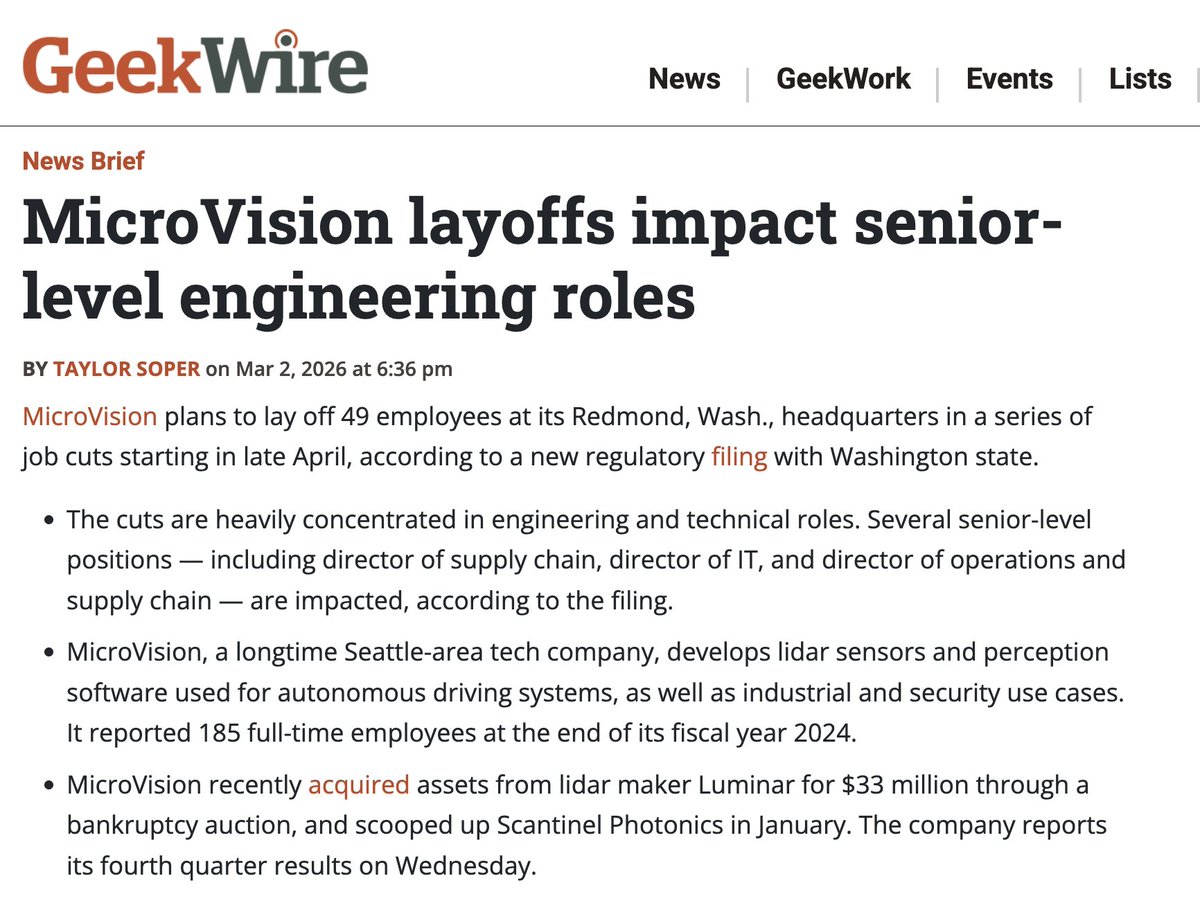
$MVIS @MicroVision plans to lay off 49 employees at its Redmond, Wash., headquarters in a series of job cuts starting in late April, according to a new regulatory filing with Washington state.
The cuts are heavily concentrated in engineering and technical roles. Several senior-level positions — including director of supply chain, director of IT, and director of operations and supply chain — are impacted, according to the filing.
MicroVision, a longtime Seattle-area tech company, develops lidar sensors and perception software used for autonomous driving systems, as well as industrial and security use cases. It reported 185 full-time employees at the end of its fiscal year 2024.
MicroVision recently acquired assets from lidar maker Luminar for $33 million through a bankruptcy auction, and scooped up Scantinel Photonics in January. The company reports its fourth quarter results on Wednesday. geekwire.com/2026/microvisi…
English
$MVIS Interesting take from Hyundai. No #LIDAR .
Can a camera-first, software-defined approach change how autonomous vehicles are built and deployed? 42dot’s Richard Chelminski breaks down what it really takes to build an end-to-end Level 4 autonomous driving system. Richard shares how 42dot’s Atria AI platform uses cameras and radar instead of LiDAR, why software architecture now defines vehicle capability, and how these technical choices enable scalable Transportation as a Service.
Join us as we sit down with Richard Chelminski (  / richard-chelminski-b71... ) , Senior Vice President, Head of SDV Platform, at 42dot (https://www.hyundaimot..., an autonomous driving software and mobility platform development startup from Hyundai Motor Group. We discuss how the company is pushing boundaries with its end-to-end autonomous driving system, Atria AI, which is focused on Level 4
autonomy and designed for seamless integration into consumer vehicles — no LIDAR required!
You’ll also learn why camera-first and radar technologies are reshaping the industry, how software is now at the heart of vehicle development, and what the future holds for Transportation as a Service (TaaS). If you’re curious about the next wave of smart, software-defined vehicles and autonomous driving innovation, this episode is a must-listen.
youtu.be/ZJ1FCnKjftg?t=…

YouTube
English