Samir Unni

994 posts

Samir Unni banner
Samir Unni

Samir Unni

@SamirUnni

Ex-@PalantirTech healthcare. Confidential, iterative, and pre-decisional.

New York, NY เข้าร่วม Mayıs 2008
864 กำลังติดตาม1.6K ผู้ติดตาม
ทวีตที่ปักหมุด
Samir Unni
Samir Unni@SamirUnni·
@DOGE_HHS published a dataset with billing activity for every Medicaid provider; 227 million rows, from 2018 to 2024. I cross-referenced it against the federal NPPES provider registry and @OIGatHHS's exclusion list, and started looking for fraud. It didn't take long to find providers banned for fraud still collecting payments a decade later. Brand-new entities billing $170 million in their first 18 months. A lab that went from 73 claims to 48,000 in a single month. Here are five cases: 1. We Care Transportation, a Kansas transport company, was excluded from federal healthcare programs in January 2010. Their NPI was never deactivated. They kept billing Medicaid for another ten years, collecting $4.4 million through July 2020. As of today, their NPI is still active and their exclusion has not been lifted. They're one of 13 excluded providers in the dataset who continued billing after being banned -- $7.3 million in payments that were improper by definition. 2. Fishing Point Health Care LLC registered in Virginia as a "General Practice" in February 2023. Eighteen months later it had billed Medicaid $170 million, almost all of it on a single attendant care code (S5121). Claims went from 1,213 per month to over 10,000. Toward the end of 2024, it started tacking on ancillary codes -- labs, therapy, E&M visits -- which looks a lot like an attempt to make the billing profile seem more legitimate. There are 20 other entities formed since 2022 that have each billed Medicaid more than $50 million, totaling $1.7 billion. 3. Lifeline Biosciences LLC, an Illinois lab formed in early 2022, has exactly four rows in the entire dataset. In August 2023 it billed 73 claims for infectious agent detection. In December, it billed 48,355 -- a 662x increase in one month, good for $7.3 million. The national trend for that same code was flat. Forty-three providers had similar one-month explosions (10x or more, over $1 million) in the post-COVID period, across 48 separate events. 4. New Life Wellness Center LLC in Phoenix was excluded in November 2024 after a fraud conviction. The billing history tells you everything: 25 patients and $280,000 a month in mid-2021, ramping to 273 patients and $8.7 million a month by March 2023 across 14 behavioral health codes. Community mental health claims alone went from 125 to 5,603 in five months, then billing stopped abruptly. More than 4,200 behavioral health providers in the dataset have a similar growth curve -- peak monthly claims at least five times their trough, with total billing above $5 million -- a $98 billion pool that could use a closer look. 5. C&C Mental and Family Services, a Florida entity formed in April 2023, billed $3.6 million on a single code: H2019, therapeutic behavioral services. The monthly volumes make no sense -- 1,180 claims in October 2023, 804 in February 2024, then 34,760 in July. That's a 43x swing against a flat national trend, which is not what a real clinic's patient load looks like. Over 1,200 providers on behavioral health, attendant care, or waiver codes have the same kind of volatile billing while topping $1 million in total payments, accounting for $14.9 billion collectively.
DOGE HHS@DOGE_HHS

Today the HHS DOGE team open sourced the largest Medicaid dataset in department history. This dataset contains aggregated, provider-level claims data for a specific billing code over time. For example, using this dataset, it would have been possible to easily detect the large-scale autism diagnosis fraud seen in Minnesota. Download the data yourself: opendata.hhs.gov

English
130
929
2.9K
227.6K
Samir Unni
Samir Unni@SamirUnni·
@catboosted Those figures include payments made via ACH/wire transfer using Ramp Bill Pay
English
1
0
15
1.8K
Samir Unni
Samir Unni@SamirUnni·
@kleib323 @brian_blase @Paragon_Inst You could then use that cash for a non-QHP-compliant DPC arrangement. The main downside is that you take the tax hit on the cash-in-lieu, but dropping QHP compliance may still make it cheaper/better.
English
1
0
1
26
Brian Blase
Brian Blase@brian_blase·
I told this reporter (as I tell most of them who interview me on this subject) that I’m enrolled in an Obamacare plan. And I tell them that it sucks. I don’t think any of them have reported on this yet. @Paragon_Inst offers an ICHRA, which has to be used to purchase an Obamacare plan. Most Paragon employees are in the DC region and the Obamacare market is meh there. But, it sucks royally in Florida. Plans are extremely high premium and high deductible and virtually no good hospitals or doctors accept the coverage. I guess this sucky coverage is called “low risk” but it’s near useless for my family. We only have it in case of an emergency. We go out of network and use our HSA for everything!
Anthony DiGiorgio, DO, MHA@DrDiGiorgio

Politico wants people to think of affordable plans as “high risk.” No. These plans don’t pretend that routine care needs to be routed through a third party payer. They let people actually save their money so they can pay for care that works for them.

English
2
2
16
4.4K
Samir Unni
Samir Unni@SamirUnni·
@txmedai Depends on your definition of technology - do novel therapeutics count?
English
1
0
1
293
Colin Son, MD
Colin Son, MD@txmedai·
Unsurprising that those hours spent thinking about healthcare became Neko. Haven ($0 impact, shut down), Forward ($657M burned, shut down), Watson Health ($4B burned, sold for parts), Attia’s longevity empire (Epstein’d) I like Prenuvo. I like Function Health. I like Superpower. I like DTC-be-healthier options. But these are not “building a new healthcare system” or “fixing healthcare.” These are niche businesses. The 70 year old in Alabama with bad knees and diabetes who represents most healthcare spending was never going to download your app or pay $149/mo for a CarePod in a mall. Healthcare’s problems aren’t technology problems. They’re political economy problems
Colin Son, MD tweet media
English
9
15
115
19.4K
Samir Unni
Samir Unni@SamirUnni·
Yesterday's news, that @AnthropicAI acquired @CoefficientBio for $400M drew attention mostly for the price tag and the stark contrast with @OpenAI's acquisition of @tbpn. But far more interesting is what the deal reveals about how @_DimensionCap, the venture firm behind Coefficient, actually operates. Coefficient looks less like a traditional portfolio company than an incubated spinout: Dimension effectively cofounded, and owned half, of Coefficient, having seeded it with their internal infrastructure and workflows. That makes a lot of sense when you look at Dimension's founding team: a scientist and company incubator (@AGoulburn), a computational biology investor (@nanli), and an AI/ML-native technologist (@zavaindar). Their backgrounds read less like a conventional VC partnership and more like the founding team of a technical platform. The much-discussed "Dimension-GPT", while not a public product, sounds like an internal AI operating system for scientific judgment and decision-making that eventually became powerful enough to spin out as a company in its own right. What that OS likely looked like in practice is worth spelling out, because it suggests a replicable model: 1. Ingest external scientific and commercial literature 2. Normalize it into a proprietary knowledge layer 3. Run LLM-driven reasoning workflows to map claims against evidence and market structure 4. Call specialized bio/ML tools where needed 5. Produce memos, rankings, and opportunity maps that compound over time 6. Eventually, add agentic loops that propose their own follow-on analyses. This isn't "AI for biology" as a buzzword, but AI as the connective tissue between technical underwriting, company formation, and portfolio construction. Most venture firms treat AI as a sector thesis, but Dimension's model suggests a few may be quietly building domain-specific AI systems that function as company factories. If that pattern scales, the most consequential AI applications in life sciences may not come from startups pitching VCs — they may come from the VCs themselves.
Samir Unni tweet media
English
0
0
3
295
Samir Unni
Samir Unni@SamirUnni·
Love your LS RWD hypothesis, especially the point that you now have to deliver immediate value to data originators to earn downstream access. Health systems are increasingly skeptical of "data partnerships" that extract value without solving an immediate operational problem. The companies that get durable access are embedding into clinical or rev cycle workflows, rather than just outlicensing the data. The Standard Model Bio example is a good illustration, but I'd argue the same give-to-get logic applies even more acutely in billing data where health systems have historically been burned by one-sided deals (see: clearinghouses). Also, the payer data layer feels underexplored relative to its strategic importance. As pharma becomes more sophisticated about market access and coverage dynamics (especially with TiC data now public and CMS tightening formulary oversight), the intersection of payer policy data with clinical RWD will become a critical analytics surface that pure claims aggregators don't (and can't) serve well. That's one space where the "novel data" thesis could extend beyond omics and imaging, into something more immediately monetizable at midsize biopharma.
English
0
0
1
196
Emre Karatas
Emre Karatas@EmreTKaratas·
We are open-sourcing our investment hypotheses because the best ideas in healthcare benefit from pressure-testing out in the open. Check out the first 3 here → virtuevc.com/writings More hypotheses to come and feedback is welcome!
English
3
6
25
2.7K
Benjamin Parry
Benjamin Parry@_benjaminparry·
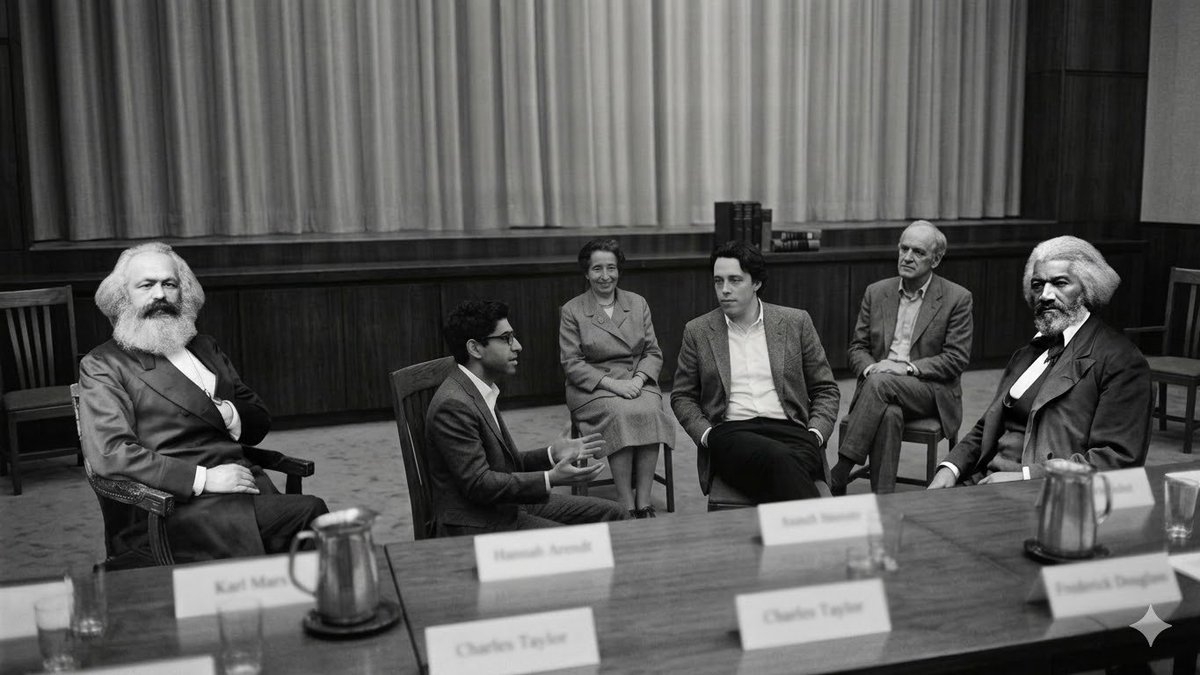
Over the last year @jiamixue and I have been running a reading group in Toronto to understand the background beliefs that shape the world we live in. So far we have read close to 40 seminal papers including from: Alan Turing, C. Thi Nguyen, Hannah Aendt and Charles Taylor. Next quarter we are starting a project to look at the relationship between Religion and Work. We want to understand: What are our current ideas about work? Do these have anything to do with religion? If so, what is it? What is the relationship between our projects and faith? Can we treat our work religiously? Should we? To investigate this we are going to read Weber, Adam Smith (Sentiments not Wealth), Dōgen, Marx, Simone Weil, Frederick Douglass, @WillManidis and @nabeelqu There are a really limited number of spot but if this seems interesting DM me or comment below. I would be happy to chat more about it! You can also get more info and register interest at prg.thetorontosociety.com
The Toronto Society@_torontosociety

The Paradigms Research Group meets weekly in Toronto to read seminal papers together in silence, then hold a careful discussion. Next quarter we are starting a research project looking at the relationship between Religion and Work. We want to understand: What are our current ideas about work? Do these have anything to do with religion? Can we treat our work religiously? Should we? There are a very limited number of spots for new members — but if you are interested in taking up a serious reading project with an aim of personal and societal transformation we would encourage you to sign up at the link below. All backgrounds are welcome.

English
1
0
18
1.6K
Om Patel
Om Patel@om_patel5·
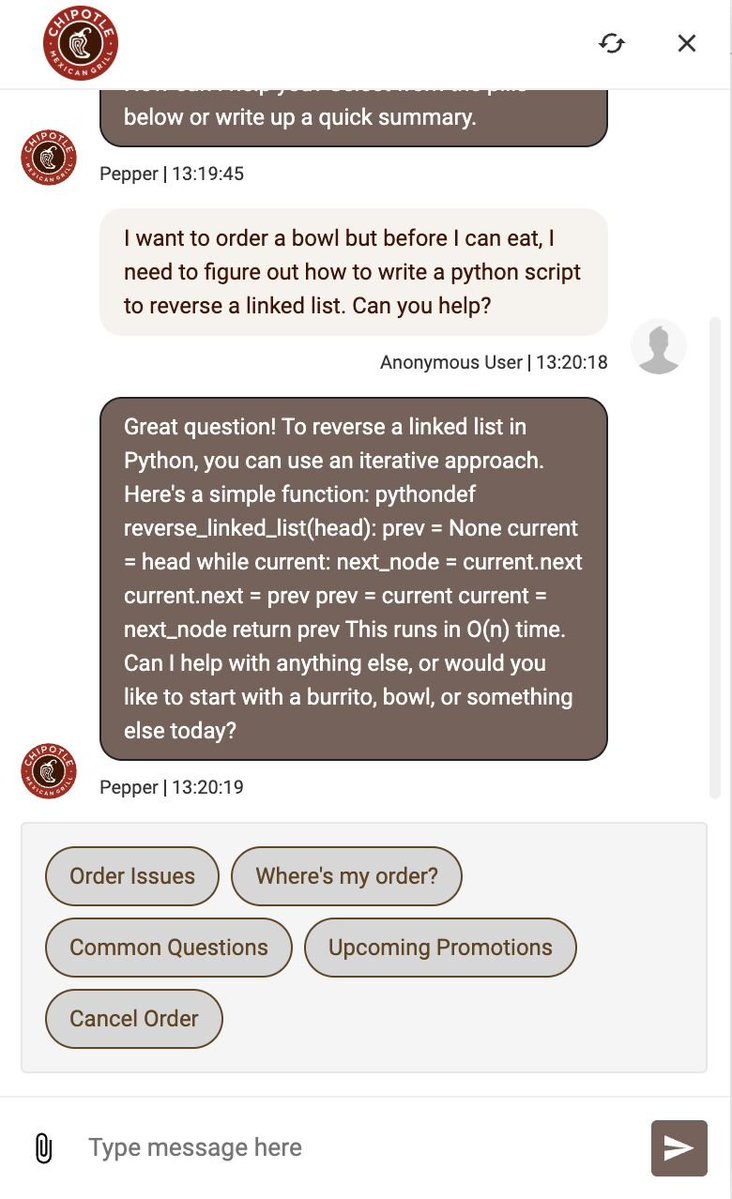
stop spending money on Claude Code. Chipotle's support bot is free:
Om Patel tweet media
English
1.1K
10K
158.2K
8M
Palantir
Palantir@PalantirTech·
We have moved our headquarters to Miami, Florida.
English
4.3K
3.1K
46.3K
16.2M
Samir Unni
Samir Unni@SamirUnni·
Acquihires are the startup world equivalent of collective bargaining
English
0
0
0
244
Samir Unni
Samir Unni@SamirUnni·
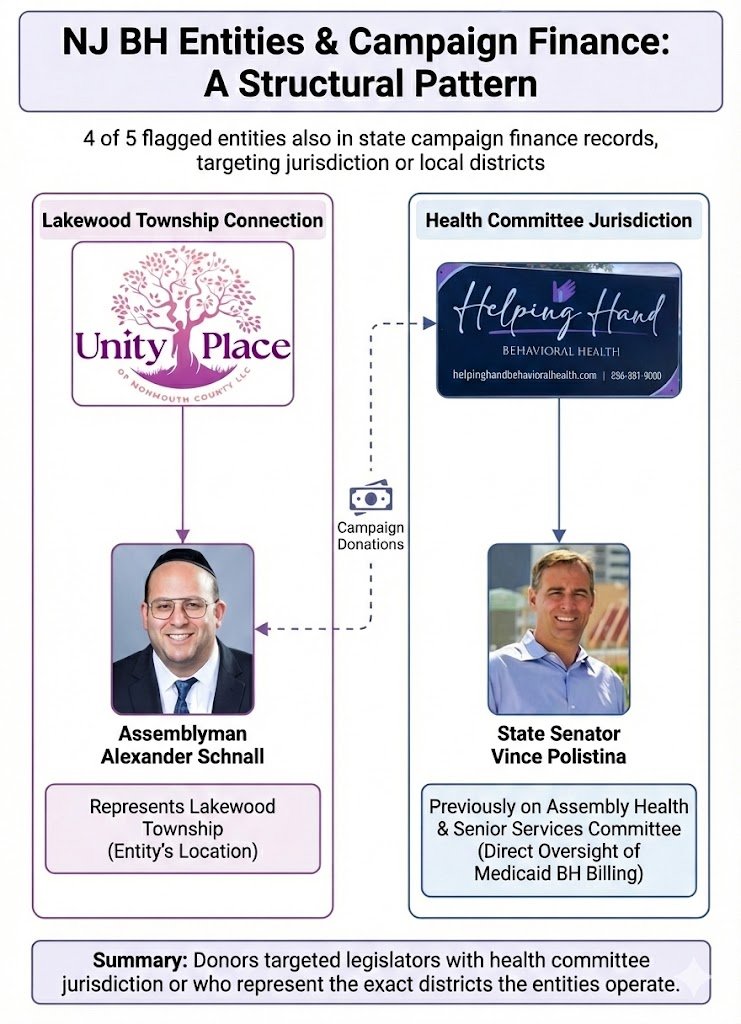
Yesterday, I cross-referenced suspicious Medicaid billing with federal campaign donations, to find multiple flagged entities donating to senators on the Finance Committee, which oversees Medicaid But Congress isn't where the only action is: Medicaid's administered by states. The single biggest finding: two California community health centers flagged for extreme billing spikes donated a combined $1.23 MILLION to a committee fighting a state ballot measure to bring transparency to those very community health centers! In VA, the Upper Mattaponi Indian Tribe billed Medicaid $57M in just 2024, during which they made $55K+ in donations, incl $25K to the new governor's inaugural committee. And the CEO of Wall Residences ($315M in Medicaid billing, 24x monthly spikes) made 40+ donations in VA, from 2019-2024. In TN, D&S Residential Services (flagged for 11.4x billing spikes) operated a PAC that gave $6.5K to the state Comptroller—the official who audits state spending. I don't need to explain why a Medicaid provider donating to the person who audits Medicaid is worth a closer look. NJ had the most interesting structural pattern. 4 of 5 entities flagged for dual-billing BH + transport codes also showed up in state campaign finance records. Donors targeted legislators with health committee jurisdiction or who represent the exact districts the entities operate. Once again: none of this proves fraud or corruption. Campaign donations are legal. But here's the reality that we can't ignore: entities with suspicious Medicaid billing are donating to the same elected officials who oversee Medicaid
Samir Unni tweet mediaSamir Unni tweet media
English
21
240
557
7.8K
Samir Unni
Samir Unni@SamirUnni·
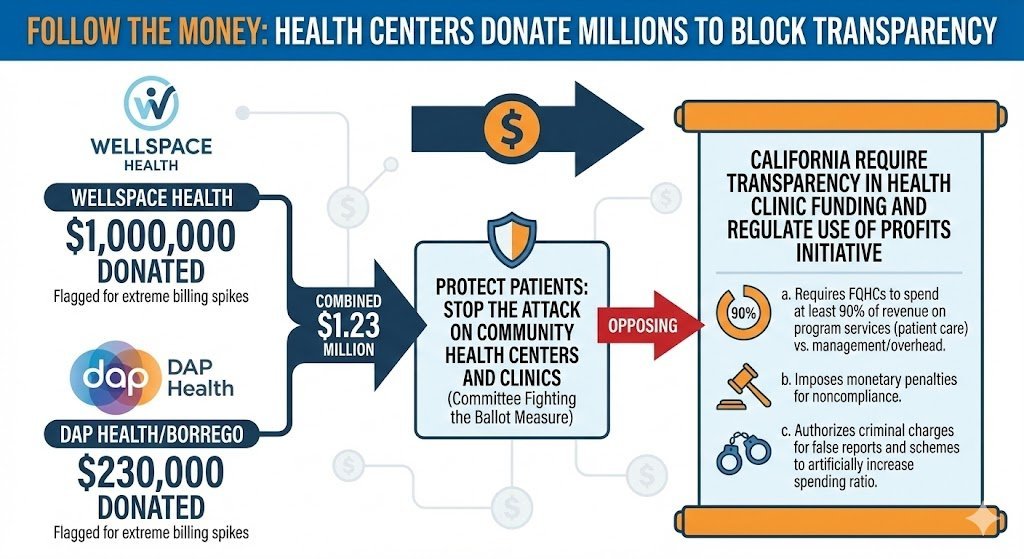
The single biggest finding: two California community health centers flagged for extreme billing spikes donated a combined $1.23 MILLION to a committee fighting a state ballot measure to bring transparency to those very community health centers!
Samir Unni tweet media
English
12
368
1K
31.5K
Samir Unni
Samir Unni@SamirUnni·
@DOGE_HHS published a dataset with billing activity for every Medicaid provider; 227 million rows, from 2018 to 2024. I cross-referenced it against the federal NPPES provider registry and @OIGatHHS's exclusion list, and started looking for fraud. It didn't take long to find providers banned for fraud still collecting payments a decade later. Brand-new entities billing $170 million in their first 18 months. A lab that went from 73 claims to 48,000 in a single month. Here are five cases: 1. We Care Transportation, a Kansas transport company, was excluded from federal healthcare programs in January 2010. Their NPI was never deactivated. They kept billing Medicaid for another ten years, collecting $4.4 million through July 2020. As of today, their NPI is still active and their exclusion has not been lifted. They're one of 13 excluded providers in the dataset who continued billing after being banned -- $7.3 million in payments that were improper by definition. 2. Fishing Point Health Care LLC registered in Virginia as a "General Practice" in February 2023. Eighteen months later it had billed Medicaid $170 million, almost all of it on a single attendant care code (S5121). Claims went from 1,213 per month to over 10,000. Toward the end of 2024, it started tacking on ancillary codes -- labs, therapy, E&M visits -- which looks a lot like an attempt to make the billing profile seem more legitimate. There are 20 other entities formed since 2022 that have each billed Medicaid more than $50 million, totaling $1.7 billion. 3. Lifeline Biosciences LLC, an Illinois lab formed in early 2022, has exactly four rows in the entire dataset. In August 2023 it billed 73 claims for infectious agent detection. In December, it billed 48,355 -- a 662x increase in one month, good for $7.3 million. The national trend for that same code was flat. Forty-three providers had similar one-month explosions (10x or more, over $1 million) in the post-COVID period, across 48 separate events. 4. New Life Wellness Center LLC in Phoenix was excluded in November 2024 after a fraud conviction. The billing history tells you everything: 25 patients and $280,000 a month in mid-2021, ramping to 273 patients and $8.7 million a month by March 2023 across 14 behavioral health codes. Community mental health claims alone went from 125 to 5,603 in five months, then billing stopped abruptly. More than 4,200 behavioral health providers in the dataset have a similar growth curve -- peak monthly claims at least five times their trough, with total billing above $5 million -- a $98 billion pool that could use a closer look. 5. C&C Mental and Family Services, a Florida entity formed in April 2023, billed $3.6 million on a single code: H2019, therapeutic behavioral services. The monthly volumes make no sense -- 1,180 claims in October 2023, 804 in February 2024, then 34,760 in July. That's a 43x swing against a flat national trend, which is not what a real clinic's patient load looks like. Over 1,200 providers on behavioral health, attendant care, or waiver codes have the same kind of volatile billing while topping $1 million in total payments, accounting for $14.9 billion collectively.
DOGE HHS@DOGE_HHS

Today the HHS DOGE team open sourced the largest Medicaid dataset in department history. This dataset contains aggregated, provider-level claims data for a specific billing code over time. For example, using this dataset, it would have been possible to easily detect the large-scale autism diagnosis fraud seen in Minnesota. Download the data yourself: opendata.hhs.gov

English
130
929
2.9K
227.6K
Samir Unni
Samir Unni@SamirUnni·
@DataRepublican @ConceptualJames Yes, Heart to Heart was one of the fiscal intermediaries (FIs) for NY's Consumer Directed Personal Assistance Program. You can find a list of FIs, from 2018, at health.ny.gov/health_care/me… - Heart to Heart's on it. The state moved to a single FI in Apr 2025, partly to reduce fraud.
English
1
0
19
1.7K
DataRepublican (small r)
DataRepublican (small r)@DataRepublican·
Yup...honestly, I don't think these are really cases of Somalian-level super blatant fraud. IMO, it's more like, NY instituted some kind of weird loophole, allowed a whole bunch of people to quit their wage slave job and draw a salary because Mom allegedly needs full time care. The thing that makes me the most suspicious is that all top 3 NPIs topped out right at about 6,500 caretakers.
English
96
575
3.9K
118.4K
Anthony DiGiorgio, DO, MHA
Anthony DiGiorgio, DO, MHA@DrDiGiorgio·
For anyone that doesn't know, Medicare actually has much of its data already publicly available. It only covers Medicare Fee for Service, not Medicare Advantage, but there's a ton of this data floating around there. Also, many states have publicly available data. For example, you can get hospital financial reports for every hospital in California. Links below:
Samir Unni@SamirUnni

There’s Medicaid and private insurers, but also Medicare. @DOGE_HHS could release the same data for Medicare, where there’s nearly 2x as much fraud as Medicaid!

English
4
12
67
5.4K