
samzabey
146 posts


samzabey
@Samzabey
Adventurer, bibliophile, and caffeine addict. Lover of tech and AI. Always on the lookout for the next big challenge. Let's connect and share.
เข้าร่วม Aralık 2016
669 กำลังติดตาม61 ผู้ติดตาม

Orchids is rebranding to Bud: the first agent with a full computer.
Since our launch in September of last year, we’ve grown to well over 7 figures ARR in record time.
We’ve simultaneously come to realize that an agent that builds apps is just the first step in a future where an agent does the majority of human work.
Comment below to get early access or go to bud [dot] app.
English

Every operations role being cut in 2026 maps to a workflow category.
I've built in most of them. Here's the full breakdown:
→ Email routing and triage: 3-5 nodes. avg build time 4 hrs
→ Invoice processing and matching: 8-12 nodes. avg build time 7 hrs
→ Lead assignment and CRM updates: 4-6 nodes. avg build time 3 hrs
→ Status update aggregation: 3-4 nodes. avg build time 2 hrs
→ Onboarding checklist management: 6-9 nodes. avg build time 5 hrs
→ Report generation and distribution: 5-8 nodes. avg build time 4 hrs
Every one of those is a client conversation.
Every one of those is a workflow that pays for itself in week one.
The full playbook - node breakdown, pricing guidance, client conversation script, and what to charge - is in the PDF.
Comment OPSMAP and I'll DM it to you.
(must be following for DM)
English

I mapped every AI automation opportunity across 25 industries.
10-15 pain points each. With the exact positioning, pricing range, and who to sell to.
This took me 4 years and 80+ client engagements to figure out.
A lot of AI agencies pick a niche and pray.
They don't know the actual pain points.
They don't know who the buyer is.
They don't know what these companies are already paying for broken solutions.
They don't know what the realistic project size is.
So they end up competing on price for generic "AI automation" gigs.
I've worked with marketing agencies, recruiting firms, e-commerce brands, law firms, real estate companies, healthcare practices, financial services, SaaS companies, manufacturing, construction, logistics, and more.
Every single one has 10-15 processes that are bleeding money because they're still done manually.
Here's what the guide covers for each industry:
→ The top 10-15 automation pain points (ranked by ROI)
→ Who the actual buyer is (CEO, COO, ops manager, etc.)
→ What they're currently paying for manual labor or broken SaaS
→ Realistic project pricing ($5K-$60K+ depending on scope)
→ The discovery questions that unlock the deal
→ How to position yourself as the expert even if you've never worked in that industry
→ Red flags to avoid (industries and company sizes that aren't worth it)
25 industries and 300+ specific automation opportunities.
This is the cheat code for picking your niche and knowing exactly what to sell before you ever get on a call.
Like + RT + reply "NICHE" and I'll send you the full guide (Must be following so I can DM)

English
i just retained a $200K/year consulting client.
not by building 8 workflows.
by building 8 workflows before lunch.
here's what i shipped and how long each took using synta:
→ new client onboarding: 8 min
→ meeting scheduler: 6 min
→ weekly performance digest: 7 min
→ monthly exec report: 9 min
→ lead routing: 11 min
→ renewal date alert: 6 min
→ quarterly biz review prep: 7 min
→ support ticket classification: 7 min
total: 61 minutes. all production-ready.
consultants charge $3K-$15K per workflow minimum.
8 workflows: $24K-$120K at standard rates.
the math: $216K/year in consulting value. 61 min of build time.
agencies spend 3-6 weeks on discovery + requirements docs. this entire system ships in one afternoon.
comment BLAZE and i'll send you the full breakdown + template prompts.
(following required for DM)
English
claude can already write the workflow.
the new bottleneck is getting it live.
that's why the biggest shift in automation right now isn't "better prompts."
it's this:
you can now describe a production n8n workflow from your phone and have the full thing built, tested, and ready to run.
the stack:
→ dispatch keeps the thread alive on mobile
→ claude handles the reasoning
→ synta(.)io handles the n8n build layer
→ the self-healing loop catches the obvious breakpoints before they become downtime
that's the part most people still miss.
generic ai can describe the logic.
it usually can't get you all the way to a dependable workflow.
i put together a short playbook with:
→ the 5 workflows i'd build first
→ the 5 prompt templates worth stealing
→ the deployment checklist that stops dumb failures
comment PHONE and i'll send it over.
(must be following for DM)
English

We're launching a new Skool Community.
Teaching you how to go from $0 to $10K/month as a digital creator.
It’s going to cost $50/m in the future.
But for the next 48 hours, it’s FREE to join.
To gain access, simply:
1. Like this
2. Reply "Skool"
3. Follow us (to receive DM)

English

If you want to take cold email seriously you cannot be doing Apollo searches manually.
I created a custom Claude lead list builder.
Like + comment "claude" - I'll send you the link to use it - fully free + my full lead list building SOP.

English
I built 31 automations for clients last year.
Every single business needed some version of the same ones.
So I put them all in one playbook:
✅ 31 workflows organized by department
✅ The exact prompt to build each one
✅ Which 3 to start with (save 10+ hrs/week)
✅ From "I should automate" to running in minutes
Comment "PLAYBOOK" and I'll DM it to you.
English
I built 31 automations for clients last year.
Every single business - from solo founders to 50-person teams - needed some version of the same workflows.
So I documented all of them. Every workflow. Every department. And the exact plain-English prompt that builds each one in minutes.
Sales & CRM: lead capture, follow-up sequences, deal tracking, proposal generation, pipeline alerts
Marketing: social scheduling, email sequences, content repurposing, UTM tracking, review requests
Operations: invoice generation, payment reminders, inventory alerts, automated reporting
Customer Success: onboarding emails, NPS surveys, churn detection, support routing
Admin: meeting scheduling, expense tracking, document generation, approval workflows
Each one includes the specific prompt I use to build it - not vague instructions, the actual sentence I type.
Plus which 3 to start with if you want to save 10+ hours/week immediately.
Comment "PLAYBOOK" and I'll DM you the full PDF for free.
English
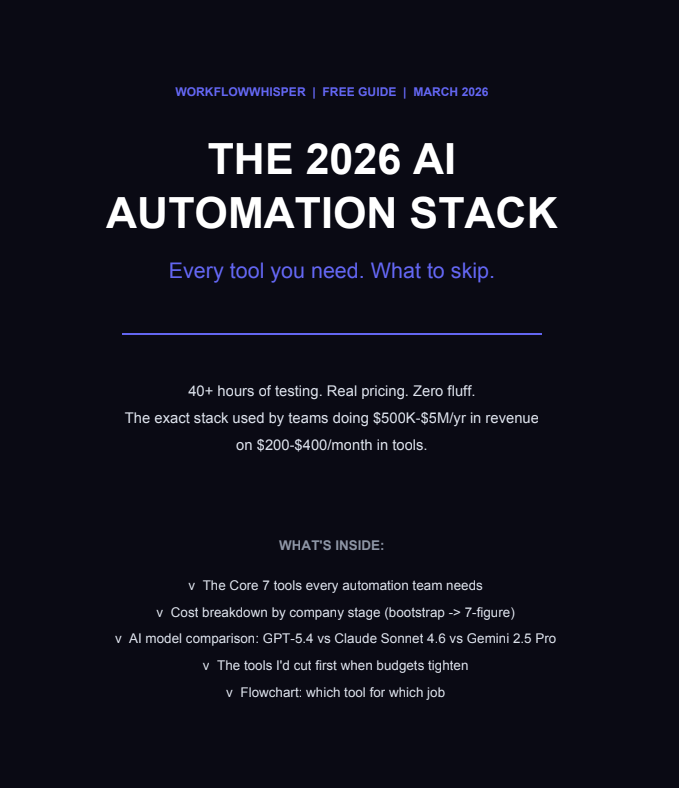
I spent 40+ hours testing every AI automation tool in 2026.
Put everything into a free guide:
> The exact stack running 6-figure businesses
> Cost breakdown (most spend 10x too much)
> What to use when - flowchart included
> The 3 tools I'd never give up
Comment "STACK" and I'll DM it to you.
English


50 spots left for our group chat for AI developers!
Learners are welcome!
We’re building cool stuff.
Join 👇
English
atlassian just cut 1,600 people.
block cut 4,000 the week before.
45,000 tech workers gone in march alone.
both CEOs said the same thing:
"AI changes the skills we need."
here's what nobody's saying out loud:
the people who got cut weren't bad at their jobs.
they were good at jobs that AI made unnecessary.
the people who survived?
they're the ones who already automated their own work
before the layoff memo landed.
a claims adjuster in chicago saw the writing on the wall
6 months ago. built a triage workflow that processes
3x the volume of her old team. promoted twice.
an office manager in phoenix automated lease renewals
the week her company announced restructuring.
she got a $22K raise and a title change.
a bookkeeper in atlanta automated invoice reconciliation
for 11 clients. added $5,800/month in recurring revenue
while her colleagues were updating resumes.
none of them wrote code.
all of them described what they needed in plain english
and had it running the same day using synta(.)io
i put together a free PDF with the full framework:
→ 5 highest-ROI workflows by industry (with exact prompts)
→ the "make yourself unfireable" conversation script
→ how to pitch automation to your boss without sounding like a threat
→ pricing guide if you want to sell these as side income
→ MCP + synta self-healing setup walkthrough
comment "LAYOFFS" and i'll send it.
45,000 people lost their jobs this month.
the next round is coming.
the question is which side you're on.
(must be following for DM)
English

most outbound teams are talking to a fraction of their real market.
they've got a list of 500 companies they cycle through every 3 months.
there are 30,000 decision makers in their space who've never heard their name.
the math on full market coverage:
30,000 decision makers x contacted every 45 days = familiar before you even ask for a meeting.
by the 3rd touch, reply rates double.
by the 6th, you're the default option when the pain gets bad enough.
the teams winning aren't writing better emails.
they're covering more ground, more consistently.
most of your market hasn't heard from you this quarter.
that's the problem.
comment ICP and i'll DM you the full market coverage framework (must be following)
English

your offer matters WAY more than your script in outreach
i've seen shit scripts with great offers get 2.5% reply rates
i've seen perfect scripts with weak offers get 0.3%
took me 3 hours to put together 23 pages on how to craft offers that PRINT replies
- the irresistible offer formula
- good vs bad offers (side by side)
- offers for 10+ different niches
- risk reversal structures that work
- how to test and find your winner
after sending 1,000,000+ emails and generating $480k last year i'm giving away everything i know about offers
like + comment "OFFER" and i'll send it over
(must follow + RT for priority access)
English
most people think cold email is about the email.
it's not.
it's about whether the email reaches the inbox.
your deliverability setup determines whether 80% of what you send gets read or goes to spam.
the complete cold email infrastructure playbook covers every layer:
-> domain setup: age, naming, configuration
-> DNS: the exact records in the exact format
-> warmup: the 21-day protocol before your first send
-> sending limits: per inbox, per domain, per day
-> the 2-email sequence and why you stop there
-> what to do when a domain starts burning
comment COLD and i'll send it over.
(must be following)
English
a property manager in phoenix saved her entire department
by building one automation last month.
her company announced layoffs - 45,000 tech workers cut in march alone.
52% directly because of AI.
she wasn't a developer. she managed lease renewals and tenant communications
for a 200-unit apartment complex.
when the restructuring memo went out she didn't update her resume.
she described her entire workflow in plain english:
"when a lease is 90 days from expiring, pull the tenant's payment history,
generate a renewal offer based on market rate, send personalized email,
schedule follow-up if no response in 7 days, update the CRM."
working automation in 14 minutes.
her boss saw it. asked her to build three more.
now she runs automation for the entire portfolio - 1,400 units.
got a title change and a $22K raise.
she's not the only one.
→ HVAC dispatcher in dallas automated emergency call routing - went from answering phones to managing a team of 12
→ insurance adjuster in chicago built a claims triage workflow - processes 3x the volume, promoted twice in 8 months
→ bookkeeper in atlanta automated invoice reconciliation for 11 clients - added $5,800/mo in recurring revenue
none of them wrote code. all of them described what they needed and had it running the same day.
i put together a free PDF with the full framework:
→ the 5 highest-ROI workflows to build by industry (with exact prompts)
→ the "make yourself unfireable" conversation script
→ how to pitch automation to your boss without sounding like a threat
→ pricing guide if you want to sell these as a side income
→ MCP + synta setup walkthrough for self-healing workflows
comment "BUILDER" and i'll send it.
45,000 people got cut this month.
the ones who survive aren't job hunting.
they're building.
(must be following for DM)
English
my entire automation backend is being run by openclaw.
not a piece of it. the whole thing.
here's what happens when a client gets on a call with us:
→ meeting is transcribed live
→ transcription gets pushed into an openclaw chat
→ openclaw analyzes it using my best practices and workflow frameworks
→ pushes the brief to a builder chat where it starts constructing the full n8n automation
→ it decides whether each task should be handled by claude or built as an n8n workflow
→ within an hour we have a fully working automation
→ we demo it to the client the same afternoon
sub one hour from "nice to meet you" to "here's your automation running live."
the reason this is possible: synta just dropped openclaw integration.
your openclaw agent now gets full access to your n8n instance. it can build workflows. trigger them. see errors in real time. fix those errors itself. and keep going until every node passes.
no more cron jobs hosted on your desktop.
no more "my automation stopped because my macbook went to sleep."
workflows run on n8n - not your laptop.
i still have devs. business is a people thing.
but the entire automation layer? openclaw + synta.
i put together a free guide on exactly how to set this up:
→ the full client call → transcription → openclaw → n8n pipeline
→ how to structure your openclaw builder chats
→ when to use claude vs n8n for each task
→ the self-healing setup that catches and fixes errors automatically
→ pricing guide for selling same-day automation demos to clients
comment "OPENCLAW" and i'll send it.
or skip straight to the install - copy the link in the comments directly into your openclaw setup and follow the steps:
2 minutes. one skill install. your openclaw agent becomes an n8n expert.
synta(.)io
(must be following for DM)
English
i built 31 n8n workflows this month that replace
the most overpriced saas tools businesses pay for.
→ $299/mo email marketing platform — replaced
→ $199/mo social scheduling tool — replaced
→ $149/mo lead scoring software — replaced
→ $99/mo form + crm connector — replaced
→ $249/mo client onboarding system — replaced
total saas spend eliminated: $11,388/year
total time to build all 31: one weekend
i documented every single one in a free pdf.
reply "WORKFLOWS" + repost and i'll send it to you
(must be following so i can dm)
English
openclaw just hit 157,000 github stars. openai bought the creator.
but nobody's packaging what actually makes claws useful for business.
i've been connecting openclaw to synta through n8n for 2 weeks. here's what's selling:
→ claw-triggered client intake + CRM sync ($2K-4K)
build time: 6 min. zero manual data entry.
→ agent-to-workflow pipeline with rollback ($1,800-3,500)
one message triggers 6 business actions in 90 seconds.
→ self-healing review + reputation engine ($1,500-3,000)
google reviews triple in 30 days. negative ones get intercepted.
→ multi-agent orchestration hub ($3K-6K)
replaces 2-3 employees. 24/7 coverage. agents share context through n8n.
→ claw monitoring + client dashboard ($800-1,500)
anomaly detection. ROI tracking. the upsell machine.
average build time: 7.2 minutes through synta.
average close rate when you demo live: 65%.
margin on every workflow: 95%+.
every single one self-heals through synta's MCP. no debugging. no 11pm client calls.
i put together a free PDF with:
→ all 5 copy-paste synta prompts (word for word)
→ pricing calculator by vertical (law, real estate, medical, etc)
→ the live demo pitch script that closes 7 out of 10
→ openclaw → synta → n8n connection walkthrough (5 min)
comment "CLAW" and i'll send it.
synta(.)io - describe the workflow in plain english. it builds, deploys, and fixes itself.
(must be following for DM)
English