ScienceFocus

433 posts

ScienceFocus banner
ScienceFocus

ScienceFocus

@ScienceFocusonX

ScienceFocus

เข้าร่วม Kasım 2019
0 กำลังติดตาม3.5K ผู้ติดตาม
ScienceFocus
ScienceFocus@ScienceFocusonX·
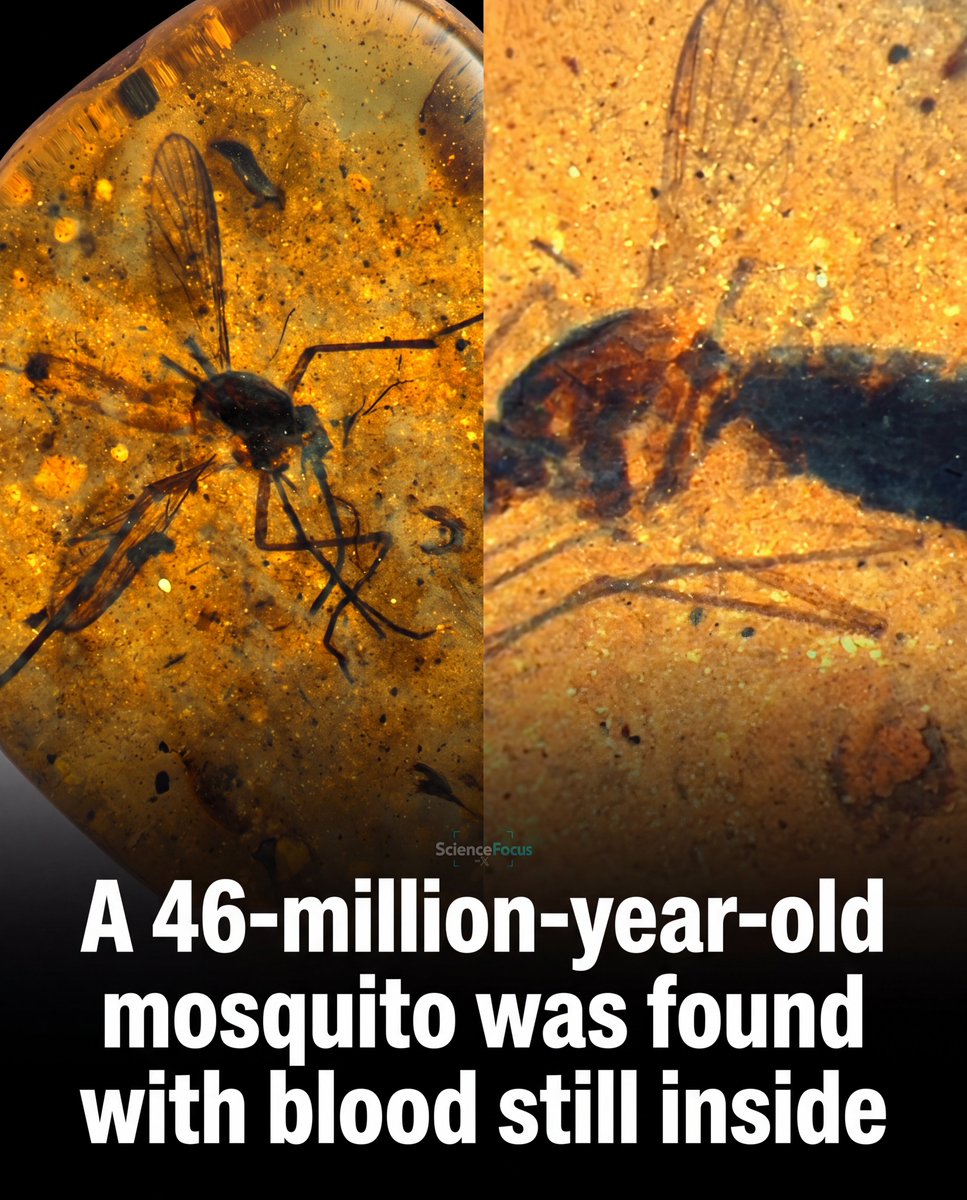
Jurassic Park almost got it right. A mosquito frozen in time for 46 million years has been found with blood still locked inside its tiny body. Not amber. Shale. The fossil was pulled from oil shale beds in northwestern Montana, near Glacier National Park. Inside its swollen abdomen, scientists detected heme and porphyrin molecules. The exact chemical fingerprints of blood. This is the first fossilized mosquito ever discovered with a blood meal preserved inside it. The odds? Researcher Dale Greenwalt of the Smithsonian called it a one-in-a-billion shot. The insect had to suck blood, fall into a lake at the perfect moment, sink without bursting, and stay sealed in sediment for tens of millions of years. It pulled it off. Before sinking, this female mosquito likely fed on a bird or a small mammal during the Eocene epoch, around 19 million years after the dinosaurs vanished. Now here's where Hollywood gets crushed. DNA breaks down fast. Half-life of about 521 years. Completely unreadable after roughly 1.5 million. So even with blood inside, no Tyrannosaurus is getting cloned. Ever. But the chemistry survived. Iron. Porphyrins. The molecular ghost of a meal eaten before humans, before primates, before most modern mammals even existed. A bug took one bite, made one mistake, and accidentally became immortal. Source: Proceedings of the National Academy of Sciences (Greenwalt et al., 2013), Smithsonian National Museum of Natural History
ScienceFocus tweet media
English
1
0
8
470
ScienceFocus
ScienceFocus@ScienceFocusonX·
The cat is alive. AND dead. For 23 minutes straight. Schrödinger would lose his mind. Chinese physicists just did something the quantum world said was nearly impossible. They kept a "Schrödinger's cat" state breathing for a full 1,400 seconds — that's 23 minutes and 20 seconds of pure quantum weirdness holding itself together. For context, these states usually collapse in milliseconds. Blink and they're gone. The team at the University of Science and Technology of China pulled it off by chilling 10,000 ytterbium atoms down to a hair above absolute zero, then trapping them with light. Each atom got locked into a superposition of two opposite spin states — alive and dead, simultaneously, on the smallest scale imaginable. Then they just… let it sit there. For 23 minutes. Why does this matter? Because long-lasting quantum states are the holy grail. They unlock insanely precise measurements, sharper quantum computers, and possibly clues about physics beyond the Standard Model — the stuff that might finally explain dark matter and dark energy. Barry Sanders from the University of Calgary called it a "big deal" and a "beautiful cat state" that's actually stable. A thought experiment from 1935. A box. A cat. A paradox that haunted physicists for nearly a century. And now, in a lab in China, that paradox just lived for 23 minutes in real life. Source: Nature Photonics / University of Science and Technology of China
ScienceFocus tweet media
English
0
1
6
284
ScienceFocus
ScienceFocus@ScienceFocusonX·
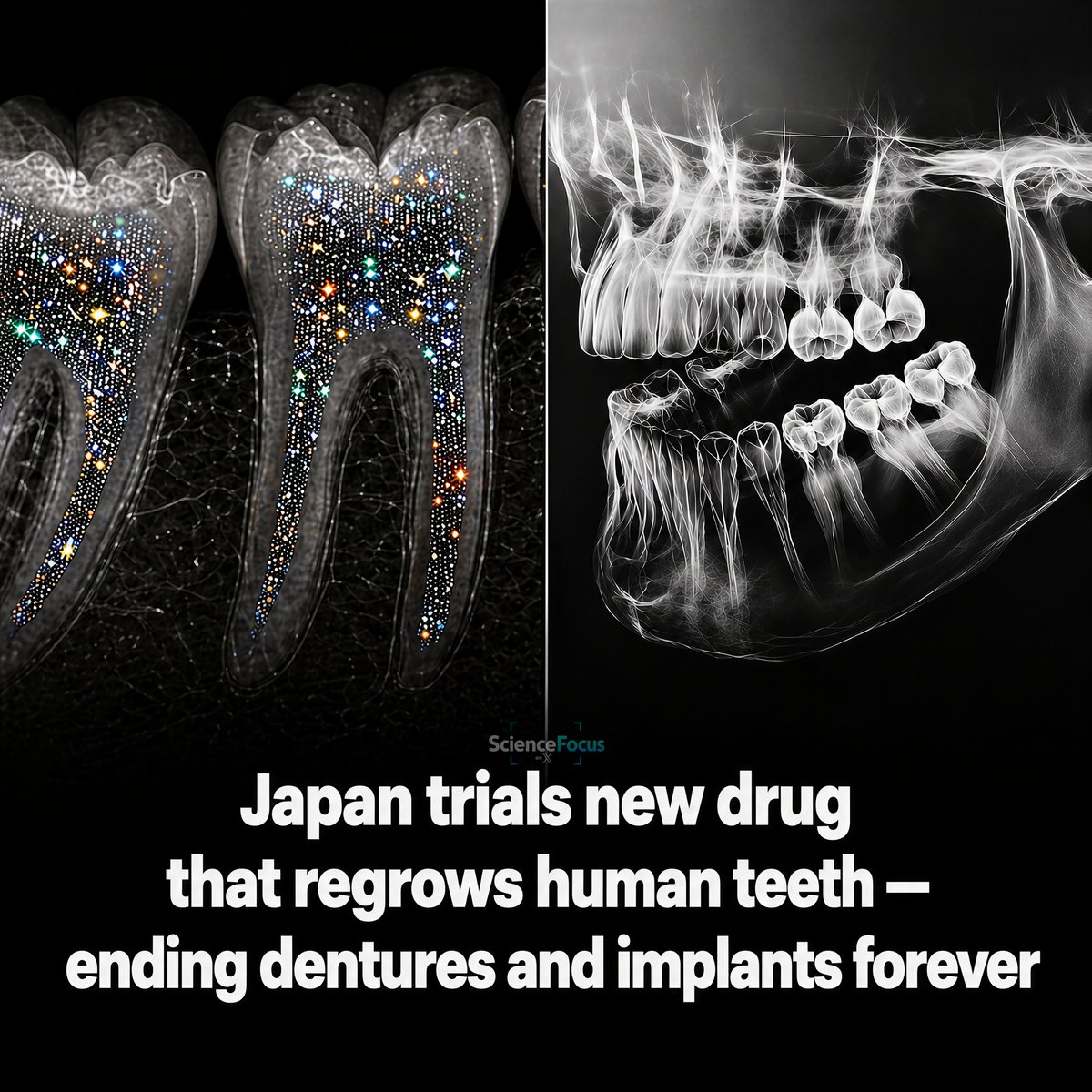
Dentures could become extinct. Japan just hit a milestone that sounds ripped straight out of a sci-fi novel. At Kyoto University Hospital, scientists have started dosing humans with a drug that could trigger the body to grow brand new teeth from scratch. No drilling. No implants. No fake plastic plates floating in a glass beside your bed. The trial kicked off in October 2024 with 30 men, ages 30 to 64, each missing at least one tooth. Phase one is purely about safety and dosage. Here's the wild part. Humans actually have a hidden, dormant third set of tooth buds buried inside the jaw. We just never grow them. A protein called USAG-1 keeps them switched off for life. The drug shuts that protein down. Turn off the off-switch, and the buds wake up. It already worked in mice and ferrets, which grew fresh teeth in lab studies led by Dr. Katsu Takahashi at the Medical Research Institute Kitano Hospital in Osaka. If the human trials hold up, phase two will move on to children born with congenital anodontia, a condition where kids never grow a full set of teeth. The team is aiming for public release around 2030. That's not decades away. That's the next election cycle. In Japan, where over 90% of people aged 75 and up are missing at least one tooth, this isn't just dental progress. It's a rewrite of what aging looks like. The dentist of the future might not pull. They might plant a seed. Source: Kyoto University Hospital / Medical Research Institute Kitano Hospital, Osaka — research led by Dr. Katsu Takahashi
ScienceFocus tweet media
English
1
1
10
323
ScienceFocus
ScienceFocus@ScienceFocusonX·
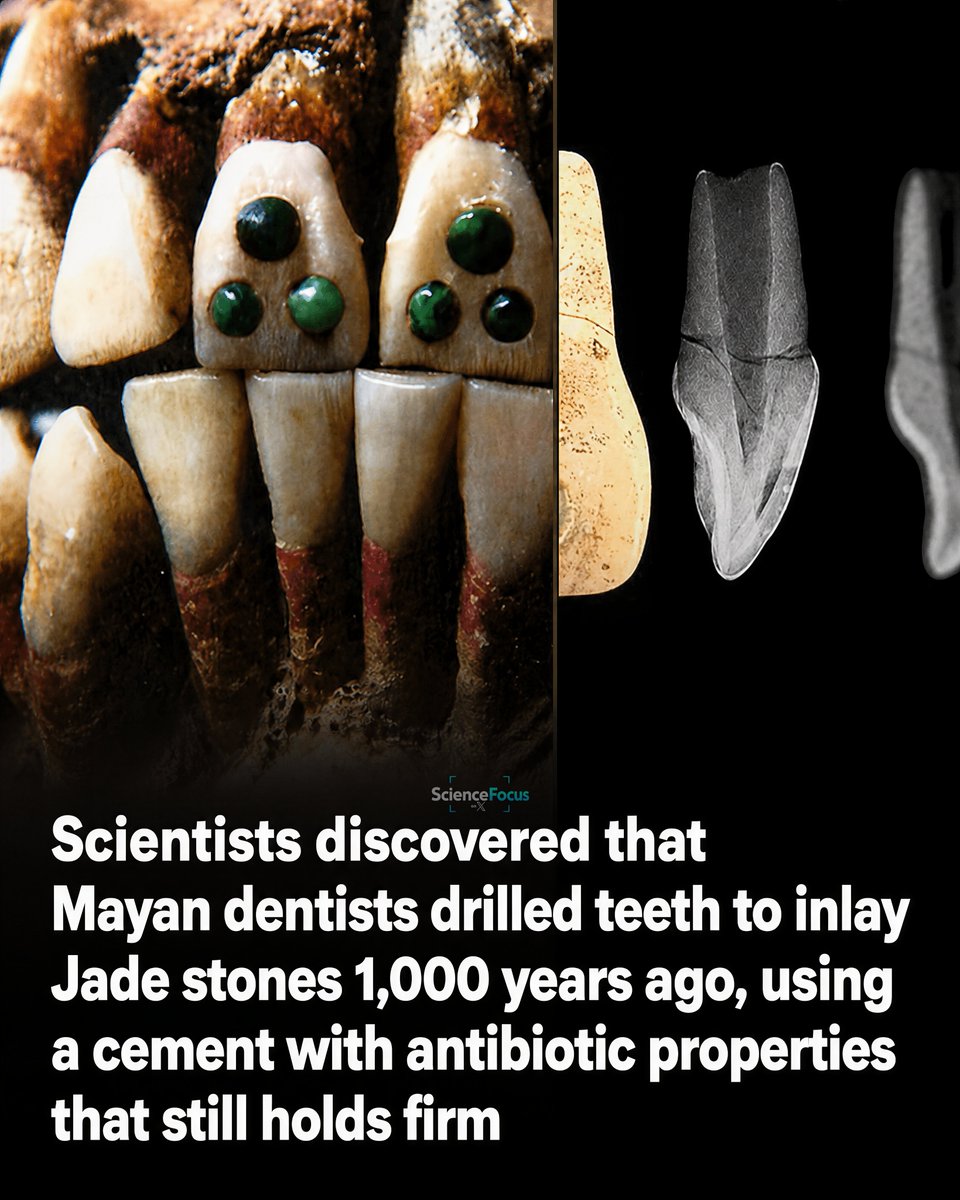
Forget your dentist. The Maya were drilling teeth and embedding jade gems over 1,000 years ago, and somehow their work is still holding. Picture this. A Mayan craftsman, no electric drill, no novocaine, carefully boring a perfect circle into someone's front tooth. Then sliding in a polished disc of green jade. And here's the part that breaks your brain: those gems are still locked in place today. The cement they used wasn't just sticky. Researchers found it had antibiotic properties, packed with plant resins and compounds that actively fought infection in the mouth. Modern dental cement only dreams of that kind of resume. This wasn't crude body modification either. It was status. It was art. It was a flex. Skulls pulled from ancient burial sites still flash those tiny green stones like the wearer just walked out of the appointment. A thousand years later, the seal hasn't cracked. Makes you wonder what else we've forgotten that they already figured out.
ScienceFocus tweet media
English
9
40
206
24.3K
ScienceFocus
ScienceFocus@ScienceFocusonX·
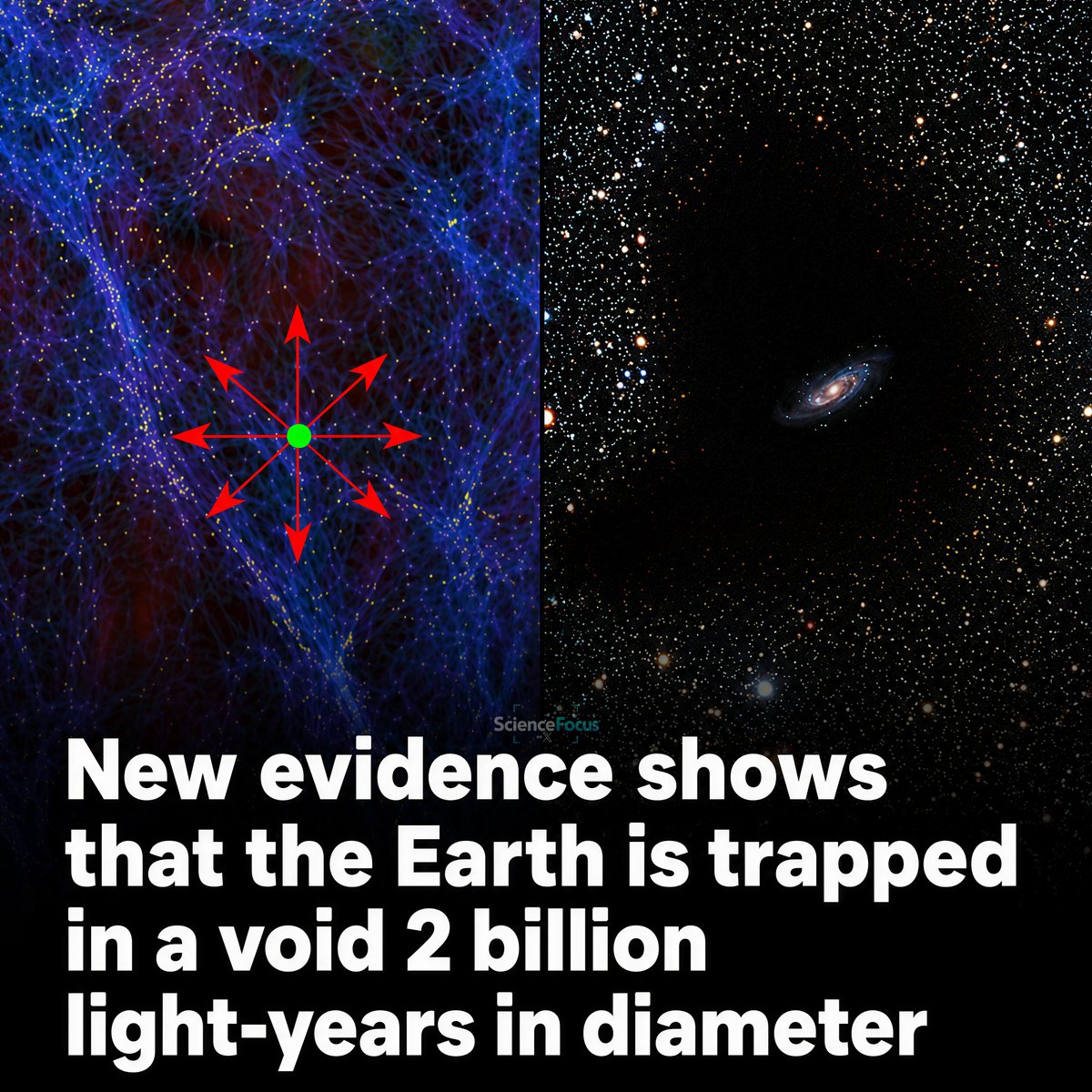
Forget everything you thought you knew about your place in the universe. Astronomers just dropped a bombshell. Earth — along with our entire Milky Way — might be floating inside a colossal cosmic emptiness stretching nearly 2 billion light-years across. Yes. Two. Billion. The region we call home appears to be roughly 20% less dense than the rest of the universe. A giant bubble of "nothing" that we never knew we were inside. Here's where it gets wild. Scientists figured this out by listening to the leftover echoes of the Big Bang itself — ancient soundwaves called baryon acoustic oscillations. Those ripples don't lie. And they're pointing to one strange conclusion: we live in a hole. This isn't just cosmic trivia. It could finally crack one of the biggest mysteries in modern science — the Hubble tension. For years, astronomers couldn't agree on how fast the universe is expanding because the math kept giving two different answers depending on where they looked. A massive local void would explain everything. Space stretches faster inside the bubble than outside it, throwing off our measurements like a funhouse mirror warping reality. According to one team, the void model is around one hundred million times more likely than the standard picture of a smooth, uniform universe. That's not a small claim. That's a rewrite of the cosmological textbook. If confirmed, it changes the true age of the universe, our understanding of cosmic expansion, and humanity's literal address in the cosmos. We're not at the center of everything. We're at the center of nothing. Source: Royal Astronomical Society / Live Science / Space.com
ScienceFocus tweet media
English
59
99
580
45.6K
ScienceFocus
ScienceFocus@ScienceFocusonX·
Mercury just got its closeup. And it's not what you'd expect. Forget the dull grey rock you pictured in school. This swirling masterpiece of blue, gold, and copper is actually the planet sitting closest to our Sun, captured in stunning detail by NASA's MESSENGER spacecraft. The colors aren't a filter trick. They're real data. MESSENGER's Wide Angle Camera shoots through 11 different filters, picking up wavelengths far beyond what human eyes can detect. Combine them, and Mercury's hidden chemistry suddenly bursts into view. Those electric blue streaks? Fresh material blasted out from recent impacts. The golden-tan plains? Ancient volcanic terrain shaped billions of years ago. The dark patches? Low-reflectance rock that's been baked by sunlight 11 times stronger than what we feel on Earth. And here's the wildest part. Mercury races around the Sun at 46.6 kilometers per second, completing an entire year in just 88 Earth days. Surface temperatures swing up to 450°C. Yet MESSENGER, hiding behind a heat-resistant ceramic shield, became the first spacecraft ever to orbit it back in 2011. It mapped the whole planet for four years before crashing into the surface in 2015, sending back postcards like this until its very last breath. A small, scorched world. Painted in colors no eye was ever meant to see. Source: NASA/Johns Hopkins University Applied Physics Laboratory/Carnegie Institution of Washington (MESSENGER mission)
ScienceFocus tweet media
English
12
61
393
17.9K
ScienceFocus
ScienceFocus@ScienceFocusonX·
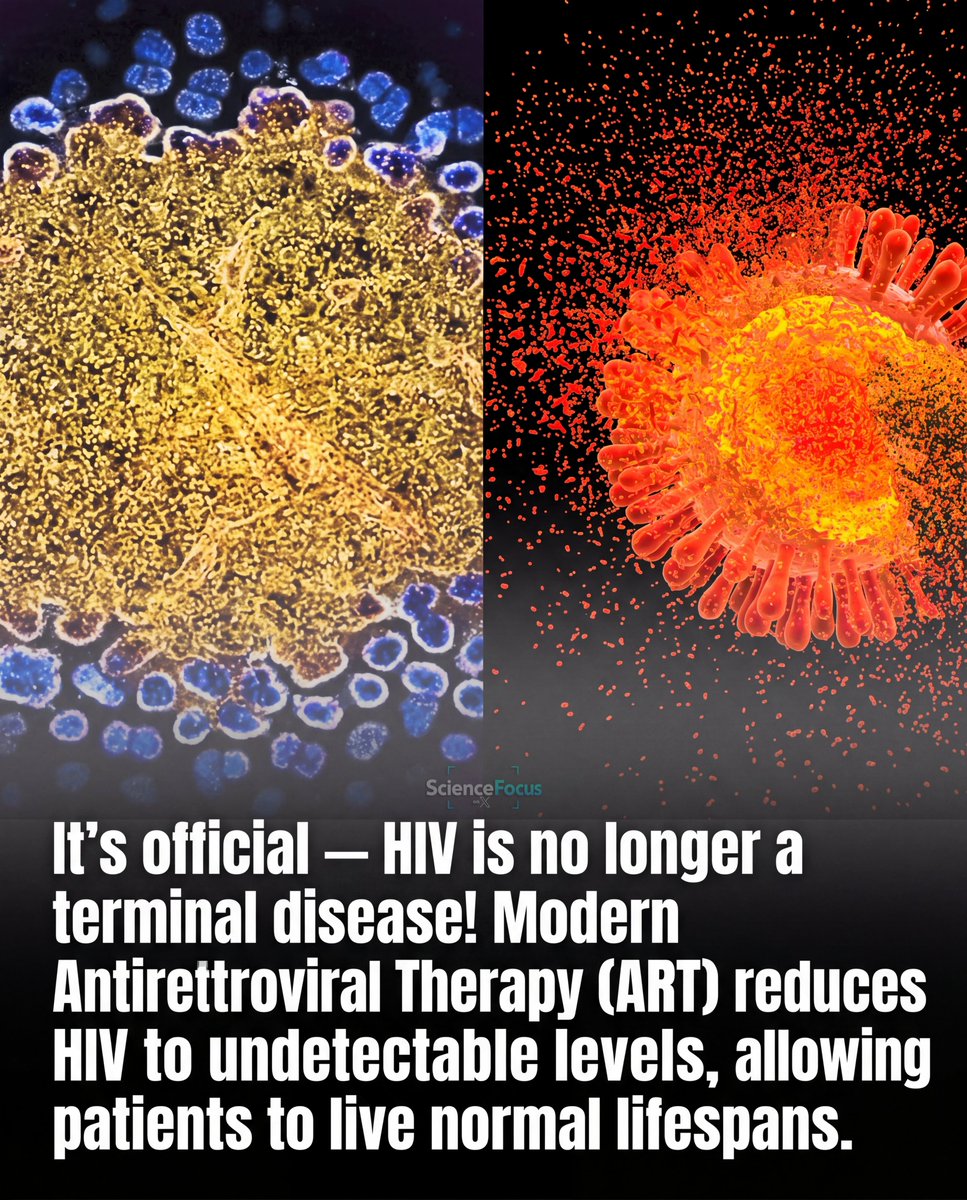
HIV used to be a death sentence. Not anymore. Modern medicine flipped the script. Antiretroviral Therapy, better known as ART, can now push the virus down to undetectable levels in the bloodstream. Undetectable means untransmittable. It also means people living with HIV can expect a lifespan close to anyone else's. Let that sink in. A diagnosis that once shattered futures has been turned into a manageable condition you take a pill for. Science didn't just slow HIV down. It rewrote what living with it looks like.
ScienceFocus tweet media
English
27
159
761
48.9K
ScienceFocus
ScienceFocus@ScienceFocusonX·
She texted "I did not kill myself" one month before she died. Amy Eskridge. 34 years old. A plasma physicist working on antigravity propulsion in Huntsville, Alabama. On June 11, 2022, she was found dead in her home from a single gunshot wound to the head. Officially ruled a suicide. But that text she sent her business partner Samuel Reed? It's haunting investigators all over again. Weeks before her death, Amy claimed she was being attacked by a directed energy weapon. She showed burn marks on her hands. A colleague with weapons experience told her the device was an "RF k-band emitter" hidden inside an SUV, powered by five car batteries. She co-founded the Institute for Exotic Science. She believed she was on the brink of a breakthrough that could force the disclosure of classified anti-gravity tech. Then she warned in a 2020 podcast: stick your neck out in this field, and they'll bury you before the news ever catches wind. Now her name has resurfaced as the 11th case in a chilling pattern. The FBI is investigating. Congress is investigating. The White House is investigating. Trump himself said this week the situation is "pretty serious." The list keeps growing. A retired Air Force major general, vanished. An MIT fusion physicist, shot dead at home. An aerospace engineer, gone on a hike and never found. Los Alamos employees. NASA scientists. A whistleblower who died before he could testify about UFOs. Her family insists she suffered from chronic pain and that her death was exactly what it looked like. Skeptics call the whole thing "patterns in random noise." But Congressman Eric Burlison says there is "SIGNIFICANT evidence" Amy was targeted with microwave energy. Eleven names. One question nobody can answer yet. Source: Newsweek, Fox News, CNN, Cybernews
ScienceFocus tweet media
English
29
282
1.1K
75.9K
ScienceFocus
ScienceFocus@ScienceFocusonX·
Forget everything you learned about DNA in school. There's a creature in the ocean breaking every rule of biology we thought was untouchable. The octopus can rewrite its own genetic code. While it's still alive. In real time. Let that sink in. Most living things, including you, are stuck with whatever DNA instructions you were born with. Your body follows the script. No edits. No revisions. Octopuses said no thanks. They use a process called RNA editing to tweak their own genetic blueprint on the fly. It's how they adapt to freezing temperatures, sharpen their nervous systems, and stay impossibly intelligent in a body with no bones and three hearts. Scientists studying cephalopods at the Marine Biological Laboratory in Woods Hole found that octopuses, squid, and cuttlefish edit more than 60% of their RNA transcripts in the brain. For comparison, humans edit less than 1%. Sixty percent versus one. That's not a small difference. That's a different league entirely. The trade-off? This editing ability seems to have slowed down their actual DNA evolution. They sacrificed long-term genetic change for short-term flexibility. A living organism choosing adaptability over inheritance. We share the planet with an alien intelligence. It just happens to live underwater. Source: Marine Biological Laboratory, Woods Hole / research published in Cell
ScienceFocus tweet media
English
76
328
1.2K
42.5K
ScienceFocus
ScienceFocus@ScienceFocusonX·
Thermal cameras just exposed the wildest difference between EVs and gas cars. Look at the image. One car is glowing like a furnace. The other? Barely a whisper of heat. That blazing orange engine bay belongs to a gasoline car. Internal combustion engines burn fuel at temperatures that can hit around 4,500°F inside the cylinders. Even after all that heat gets managed, the engine bay itself regularly runs at 200–400°F while driving. That's why it lights up thermal imaging like a bonfire on wheels. Now check the EV behind it. No giant heat signature. No glowing hood. Just faint warmth from the tires gripping the road and small thermal traces from the battery and motors. Electric motors are roughly 85–90% efficient at turning energy into motion. Gas engines? Around 20–30%. The rest gets dumped as heat, noise, and wasted fuel. Thermal imaging doesn't lie. It shows you exactly where energy is going. And in a gas car, most of it is going straight into the air.
ScienceFocus tweet media
English
22
19
92
15.8K
ScienceFocus
ScienceFocus@ScienceFocusonX·
She's 9. She just beat photographers from 117 countries. Meet Shreyovi Mehta from Faridabad. A fifth grader who walked into Keoladeo National Park in Rajasthan one morning, spotted two peahens silhouetted under a canopy of trees, grabbed her dad's camera, and dropped low for the angle. That single frame, titled "In the Spotlight," just made her runner-up in the "10 Years and Under" category at the 60th Wildlife Photographer of the Year, run by London's Natural History Museum. The competition people call the Oscars of wildlife photography. Nearly 60,000 entries. 117 countries. One nine-year-old from India holding her own against the world. The shot itself is stunning. Two peahens, soft golden dawn light bleeding through the trees, the kind of frame seasoned pros chase their whole careers. Her dad Shivang Mehta is a wildlife photographer. Her mum Kahini Ghosh too. So the camera was never far from her hands. But the eye? That's all hers. And she's not done. She wants to put the tiger, India's national animal, on that same global stage next. Nine years old, already representing her country in London, already dreaming bigger than most adults ever will. Some kids collect stickers. Shreyovi collects continents. Source: Republic World, The Logical Indian, Asianet Newsable
ScienceFocus tweet media
English
12
62
449
23.1K
ScienceFocus
ScienceFocus@ScienceFocusonX·
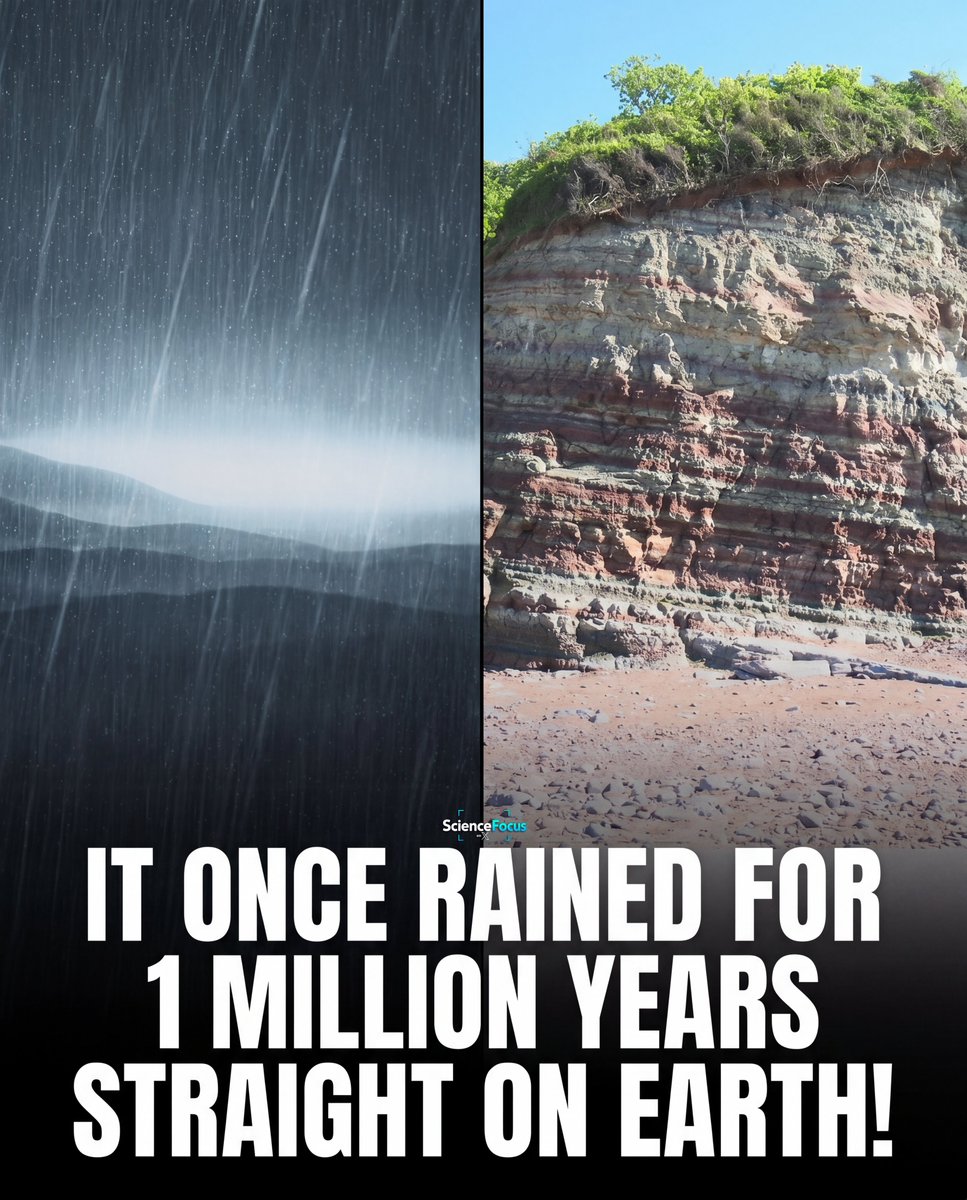
Not a week. Not a decade. Not even a century. Over a million years of nonstop downpour. It actually happened. Around 232 million years ago, Earth got hammered by what scientists now call the Carnian Pluvial Episode.
ScienceFocus tweet media
English
160
177
1.5K
143K
ScienceFocus
ScienceFocus@ScienceFocusonX·
He's 15. He already has a PhD in quantum physics. And now he wants to end human aging. Meet Laurent Simons. A Belgian teenager who finished primary school at 6, earned a master's at 12, and just defended his doctorate at the University of Antwerp on November 17, 2025.
ScienceFocus tweet media
English
51
114
629
39K
ScienceFocus
ScienceFocus@ScienceFocusonX·
Deer and cherry blossoms in Nara Park, Japan
English
0
0
9
442
ScienceFocus
ScienceFocus@ScienceFocusonX·
Baby gorilla pushing her dad’s patience in the cutest way
English
0
0
6
393
ScienceFocus
ScienceFocus@ScienceFocusonX·
Catch your own fish at the table and have it cooked exactly how you like 🎣🍣🔥
English
0
0
1
353
ScienceFocus
ScienceFocus@ScienceFocusonX·
Research suggests that watching a beaver munch on cabbage can reduce stress levels by up to 15% 😄
English
0
2
11
499
ScienceFocus
ScienceFocus@ScienceFocusonX·
You don’t realise just how tiny the kitten is until the mother’s head comes into view 🐯🐅
English
0
0
7
309
ScienceFocus
ScienceFocus@ScienceFocusonX·
A dramatic ice shove in Tomsk, Siberia, where powerful winds and pressure force huge slabs of river ice onto the shorelin.
English
0
3
9
319
ScienceFocus
ScienceFocus@ScienceFocusonX·
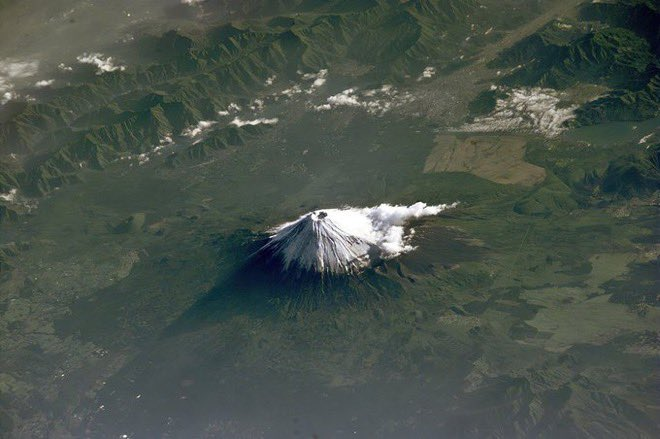
Beautiful Mount Fuji seen from the International Space Station.
ScienceFocus tweet media
English
0
2
11
248