
ทวีตที่ปักหมุด
SigOpt
1.9K posts


SigOpt
@SigOpt
SigOpt, which offers a scalable model experimentation and optimization platform, was acquired by Intel October 2020.
San Francisco, CA เข้าร่วม Eylül 2014
870 กำลังติดตาม3.9K ผู้ติดตาม

While we will no longer offer support and updates after September 2023, modelers can continue to access the free and open source versions of SigOpt on our website until further notice: sigopt.org
English
What is distillation? In this short video, Meghana Ravikumar explains how distillation transfers the knowledge from a large model to a much smaller one, using BERT as an example: bit.ly/3hNdQDz
English
Modelers can use SigOpt for nearly anything: #DeepLearning, #MachineLearning, or even Airplane Design. Check out our sample use cases for more examples of how to use SigOpt for your business: bit.ly/45iqW3t

English
Implement SigOpt with just a few lines of code. Instrument your model code to track runs and model artifacts—here's how to get started: bit.ly/45y8d3D
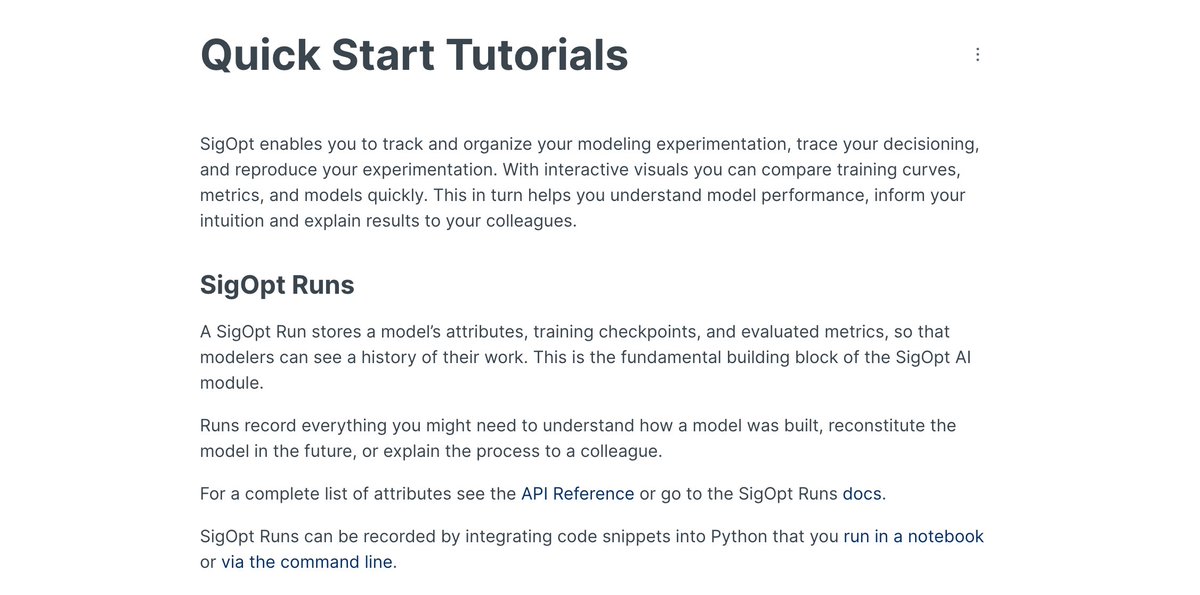
English
“Integrating SigOpt into our modeling platform empowers our team to more efficiently experiment, optimize, and ultimately, model at scale.” – Peter Welinder, Research Scientist @OpenAI
Learn how SigOpt helps teams accelerate their model development: sigopt.com

English
What is the DLRM model? @IntelAI Principal Engineer Ke Ding provides an overview of what this model is and how to use it in this short video: bit.ly/3OF0Th9
English
An All Constraints experiment can help modelers study which parameter regions consistently yield high-performing models. Learn how to use this advanced experimentation technique using SigOpt: bit.ly/3qmpZI5

English
“We’ve integrated SigOpt’s optimization service and are now able to get better results faster and cheaper than any solution we’ve seen before.” – Matt Adereth, Managing Director, @twosigma
Learn how SigOpt can help you amplify the impact of your models: sigopt.com

English
Parameters are a crucial part of every experiment, defining the domain to be searched – which is why SigOpt supports double, integer, and categorical parameter types. Learn more about SigOpt's tools to construct a domain for your specific modeling problem: bit.ly/46WguA4

English
See how SigOpt stacks up. In this short video, Associate Professor Paul Leu walks through his test comparing two popular optimization techniques using SigOpt's intelligent experimentation platform to empirically determine the best-performing algorithm: bit.ly/3K5GC1A
English
Our brains only use about 30-40 watts of power, yet are more powerful than neural networks – which take extensive energy to run. In this interview, learn how @Numenta is building neural networks inspired by the sparsity of the human brain: bit.ly/46XEToE
English
SigOpt offers two API modules: Core Module and AI Module. Not sure which one is right for your #ML project? Check out our guide here: bit.ly/3KewRid

English
Constraint Active Search offers an alternative to working with the Pareto efficient frontier, making it an ideal approach for material sciences and production. In this video, Gustavo Malkomes shares some of SigOpt's latest research on CAS: bit.ly/3zo9s5O
English
Did you know that you can bring your own optimizer to SigOpt? Check out our quick-start guide to using your own optimizer and storing your progress in SigOpt: bit.ly/44rDoNs

English

Some modeling problems are best solved through graph form—like identifying money laundering. In this video, @PayPal shares how they approach Graph Neural Networks for detecting fraud: bit.ly/3NC66Vb
English