Steven Ge

2.8K posts

Steven Ge

Steven Ge

@StevenXGe

Professor, Founder of Orditus. Developer of https://t.co/7uS9mKC5KD, https://t.co/XW7sGGMcST, ShinyGO & iDEP . Topics: AI, stats, genomics, bioinformatics

Brookings, SD เข้าร่วม Temmuz 2011
2.4K กำลังติดตาม6.1K ผู้ติดตาม
ทวีตที่ปักหมุด
Steven Ge
Steven Ge@StevenXGe·
Excited to launch DataMap – a portable, browser-based tool for generating heatmaps and PCA & tSNE plots. No installs. No servers. Your data never leaves your device. ✔️ Interactive heatmaps, PCA, and t-SNE ✔️ Transform & normalize data on the fly ✔️ Upload CSV, TSV, Excel + annotations ✔️ Generate R code for reproducibility Ideal for visualizing high-dimensional data matrices, such as RNA-Seq data. It's a Shiny app deployed via shinylive and WebAssembly. Also available as an R package. Try it now: github.com/gexijin/datamap Source code: github.com/gexijin/datamap Preprint: arxiv.org/abs/2504.08875
Steven Ge tweet media
English
8
116
544
49.4K
Steven Ge
Steven Ge@StevenXGe·
OpenClaw is impressive, but you can build a more transparent AI agent with just Claude Code and Bash. Roman's video shows how to create custom agents for real-world workflows, like getting an email summary at 9 a.m. or managing email via Telegram. What clicked for me: • 'claude -p' lets you run Claude Code as a headless command • It can be triggered by schedulers like cron or by other events • 'claude -p -r' helps preserve context across sessions • You can even replace Claude Code’s system prompt • Commands, skills, and subagents are, at their core, reusable prompts That’s the direction I’m most excited about: agentic workflows that are simple, inspectable, and truly yours. youtu.be/ODKMmKCgrvw?si… #AI #ClaudeCode #CodingAgents #Automation #BuildInPublic
YouTube video
YouTube
English
1
0
7
455
Steven Ge รีทวีตแล้ว
Xin Jin, PhD
Xin Jin, PhD@xinjin·
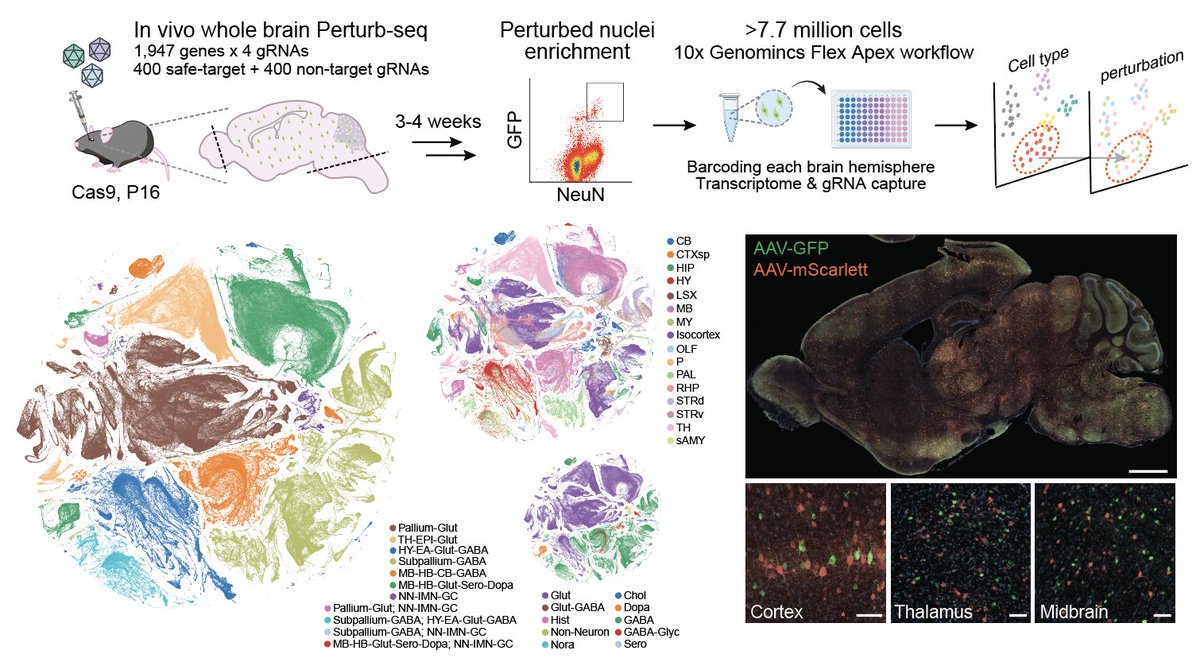
📢 Preprint: we present a whole-mouse-brain in vivo Perturb-seq atlas, 7.7 million cells, 1947 disease-associated perturbations, moving toward direct readout of how human genetics rewires cell states & circuits in vivo. Grateful for the Team! @NVIDIAHealth biorxiv.org/content/10.648…
Xin Jin, PhD tweet media
English
7
98
389
23.8K
Steven Ge รีทวีตแล้ว
Akhilesh Mishra
Akhilesh Mishra@livingdevops·
Dennis Ritchie created C in the early 1970s without Google, Stack Overflow, GitHub, or any AI ( Claude, Cursor, Codex) assistant. - No VC funding. - No viral launch. - No TED talk. - Just two engineers at Bell Labs. A terminal. And a problem to solve. He built a language that fit in kilobytes. 50 years later, it runs everything. Linux kernel. Windows. macOS. Every iPhone. Every Android. NASA’s deep space probes. The International Space Station. > Python borrowed from it. > Java borrowed from it. > JavaScript borrowed from it. If you have ever written a single line of code in any language, you did it in Dennis Ritchie’s shadow. He died in 2011. The same week as Steve Jobs. Jobs got the front pages. Ritchie got silence. This Legend deserves to be celebrated.
Akhilesh Mishra tweet media
English
646
5.4K
26.7K
901.2K
Steven Ge
Steven Ge@StevenXGe·
--dangerously-skip-permissions in Claude Code worked fine for months — until today. Claude wiped all the scripts in one of my subfolders, and I hadn’t committed several hours of work yet. Lessons: Commit often. Use YOLO mode with caution.
English
0
0
5
290
Steven Ge
Steven Ge@StevenXGe·
Good news: Claude Code can run complex data analyses on its own for hours. Bad news: it makes many decisions quietly along the way. Hard-coded parameters, filtering choices, and assumptions. Most are fine, but a single bad parameter can derail the entire workflow. We need to supervise: 1. Plan thoroughly and iterate. Have it explain the core logic, then refine the plan with feedback. 2. Inspect the code. Have it list all hard-coded values and key decisions, then review the implementation carefully. 3. Verify what the data looks like at each stage. Even the best LLMs are smart MOST of the time. For scientific research and mission-critical decisions, that's not enough.
English
0
0
6
445
Steven Ge รีทวีตแล้ว
Norn Group
Norn Group@NornGroup·
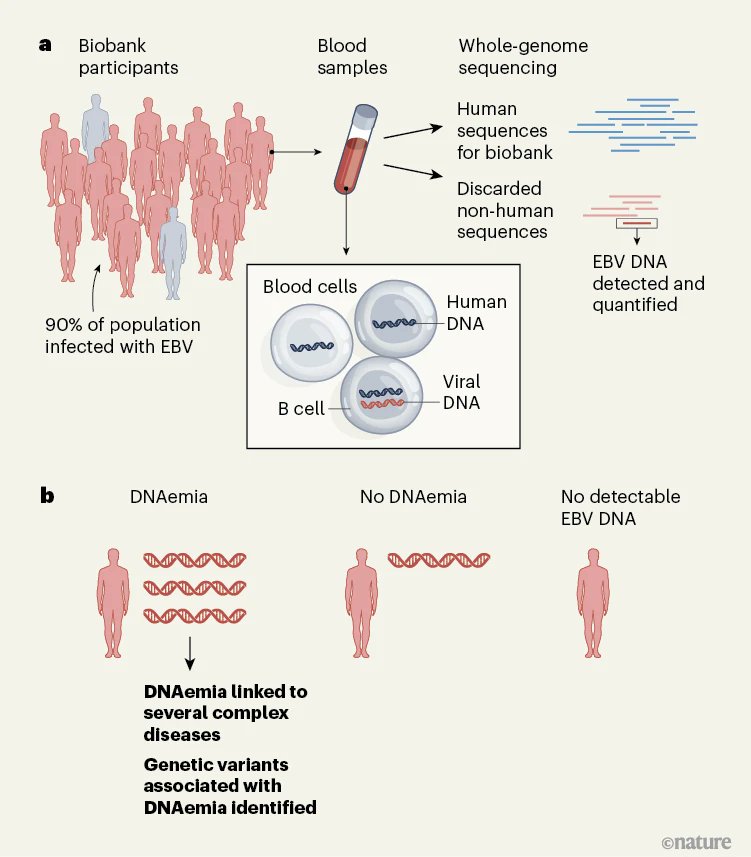
Multiple lines of evidence are converging on the idea that viruses you picked up decades ago might quietly be driving age-related diseases. We've known for a few years that EBV raises MS risk 32-fold, and that molecular mimicry between an EBV protein and nerve insulation likely triggers brain autoimmunity. What remained unclear was why some people persistently carry EBV and others don't. A new paper in @Nature from the @RyanDhindsa (whose lab has been supported by @impetusgrants) and @CalebLareau labs answers that at population scale. They mined ~735,000 human genomes for traces of Epstein-Barr virus, using reads of viral genomes that existing pipelines were throwing out as junk, and found that ~10% of people carry detectable EBV DNA in blood. Carrying persistent EBV is associated with variable antigen processing, and the broader genetic architecture of viral persistence shares a component with lupus, rheumatoid arthritis, and type 1 diabetes. Meanwhile, a separate line of very recent evidence is also pointing in that direction. The shingles vaccine, targeting another persistent herpesvirus, is showing ~20% dementia risk reduction in quasi-randomized studies which has been replicated across multiple countries. There seems to be more at the intersection of immunity and age-related disease than we initially thought.
Norn Group tweet media
English
40
330
1.7K
183.9K
Steven Ge รีทวีตแล้ว
Hao Yin
Hao Yin@HaoYin20·
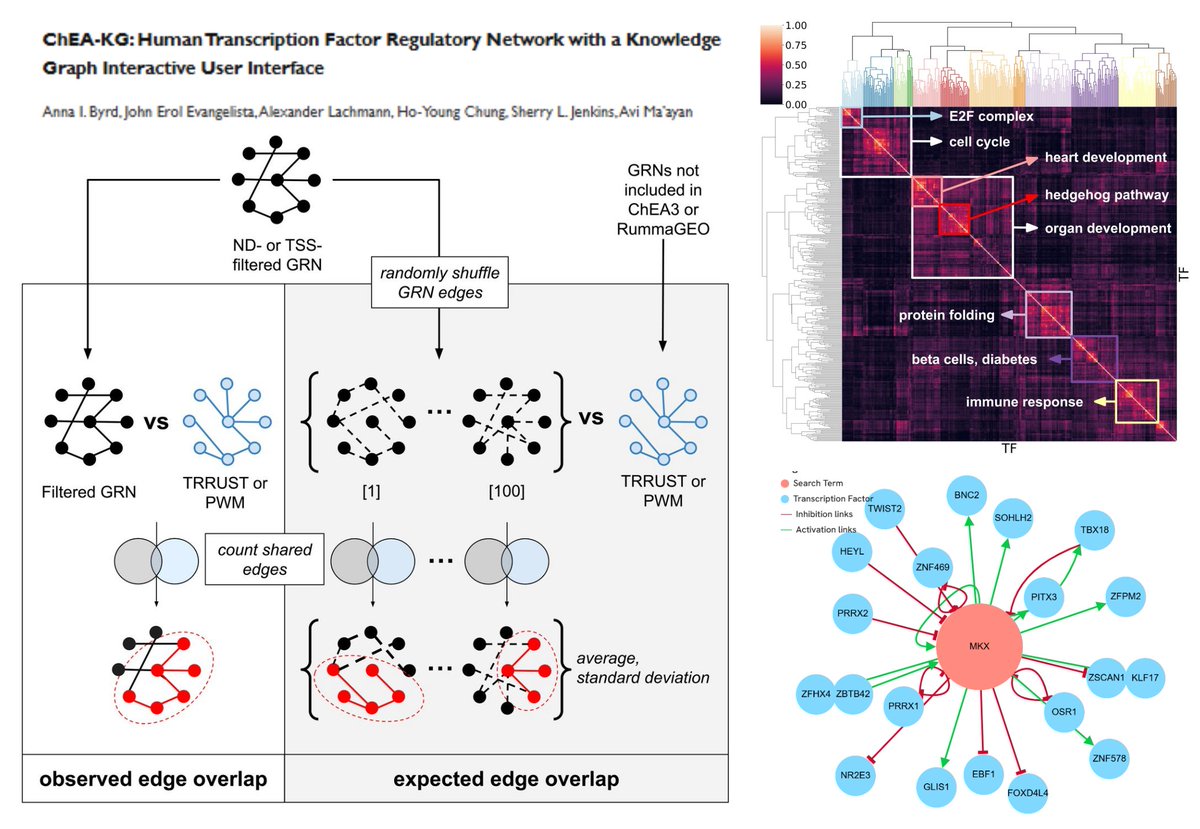
ChEA-KG Human Transcription Factor Regulatory Network with a Knowledge Graph Interactive User Interface 1554 TFs >60k upregulated edges >60k downregulated edges >170k RummaGEO gene sets chea-kg.maayanlab.cloud @MaayanLab bioRxiv 2025 biorxiv.org/content/10.110…
Hao Yin tweet media
English
0
22
84
5.7K
Steven Ge รีทวีตแล้ว
Rahul Satija
Rahul Satija@satijalab·
Excited to share VIPerturb-seq! New tech from my lab which aims to improve the cost, data quality, and efficiency of single-cell CRISPR screens so that they are accessible to any lab - even at genome-wide scale Preprint and 🧵 (1/): biorxiv.org/content/10.648…
English
4
83
315
23.8K
Steven Ge รีทวีตแล้ว
Xiangyi Li
Xiangyi Li@xdotli·
Agent Skills are everywhere - Claude Code, Gemini CLI, Codex all support them. But do they actually work? 105 domain experts from Stanford, CMU, Berkeley, Oxford, Amazon, ByteDance & more built SkillsBench to find that out. 86 tasks. 11 domains. 7,308 trajectories. 🧵👇
Xiangyi Li tweet media
English
24
92
668
76.4K
Steven Ge รีทวีตแล้ว
Robert Cincotta
Robert Cincotta@drrobcincotta·
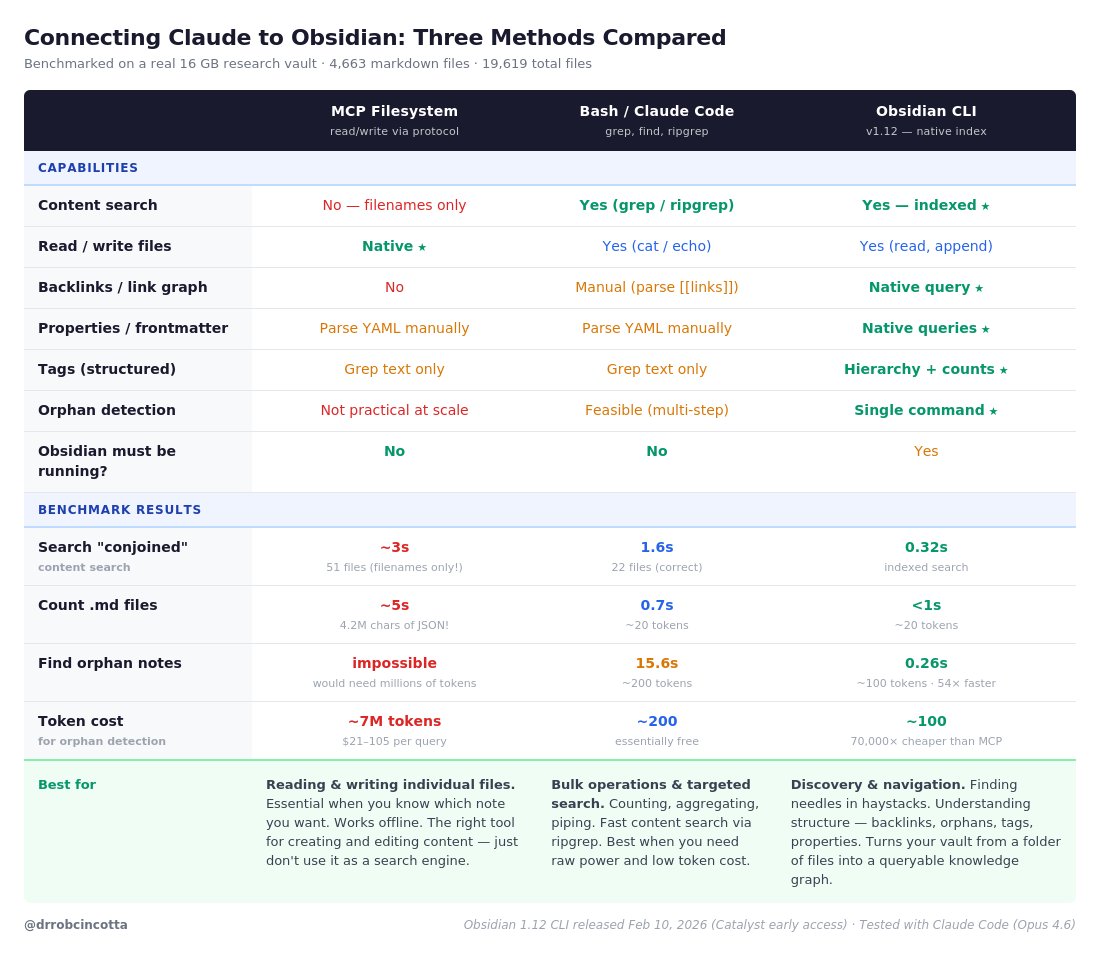
I have been testing the new Obsidian CLI with Claude Code on my research vault (4,663 files, 16 GB)... I know too many notes!! Early results are significant. Its going to change the way in which Claude Code can interact with Obsidian The way I see it, there are three ways Claude can connect to your vault: Filesystem (MCP or bash) reads/writes markdown files. Covers maybe 40% of what Obsidian actually knows. No awareness of backlinks, tags, properties, or the graph. To search content, it has to open every file individually. REST API MCP — talks to Obsidian via plugin. Gets you to about 55%. Better search, some metadata. But fragile setup and limited. Obsidian CLI ...Yay @obsdmd and @kepano !! it queries Obsidian's actual indexes. This would be about 85% of Obsidian's capabilities. The missing 15% is purely visual the canvas layout, graph view rendering, live preview. Everything else is there: search, backlinks, orphan detection, properties, tags with hierarchy and counts. The speed difference is real: Finding orphan notes: bash grep 15.6s vs CLI 0.26s (54× faster) Searching vault: bash grep 1.95s vs CLI 0.32s (6× faster) Token cost for orphan detection via MCP: about 7 million tokens. Via CLI: 100 tokens. That's 70,000× cheaper. The CLI uses Obsidian's pre-built search index the same thing that makes Obsidian's own search instant. Grep scans every file from scratch every time. The catch: right now this only works via Claude Code (which can run CLI commands through bash). Claude Desktop and claude.ai can't access it directly. There is an early CLI MCP server (obsidian-ts-mcp) that would bridge this gap but I haven't tested it yet. (I think that if you ask nicely Claude Code could create a version for you!) I'm using this as part of a research assistant stack connecting Claude to Obsidian, Zotero, PubMed and more. Posts on each piece coming.
Robert Cincotta tweet media
Obsidian@obsdmd

Anything you can do in Obsidian you can do from the command line. Obsidian CLI is now available in 1.12 (early access).

English
48
84
1.1K
221.9K
Steven Ge รีทวีตแล้ว
Lorraine Evanoff
Lorraine Evanoff@LorraineEvanoff·
"ICE: Do you have your ID Nadine’s Husband: Yea, what did you hit me for? Nadine: We’re citizens, there’s no reason to carry them Husband: This is my status and I’m getting my passport for you ICE: Ok, do you have ID on you? Husband: Yeah, but I need his information. He just hit my car. Nadine: Yeah, we need all the insurance information because you guys are damaging our vehicle. As the bizarre exchange continued, Nadine and her husband tried to get identifying information for the ICE agents that just intentionally rammed their government vehicle into their car. The ICE agent refused to answer—claiming they don’t have to provide the victims of their vehicular assault with any information. After Nadine tried to leave her car to write down the license plate number of the ICE agent who rammed into them, ICE threatened her with arrest! Husband: You have to have a reasonable cause ICE: Sit tight Nadine: You guys hit our car and had no reason to come after us Nadine: I will be contacting the lawyers and the ACLU. Husband: Go behind them and get their [license] plates because I don’t want that car to just take off. Nadine: Alright I’m getting out of the car to get plates. ICE: Stay in the vehicle mam—do not get out of the car. Nadine: You really think you can tell me what to do? ICE: You get out of the car you’ll be obstructing. Nadine: I’m not obstructing for leaving my vehicle! [ICE agent then reads off a law claiming Nadine would be obstructing if she gets out of her car] Nadine: That’s a lie! I’ll make sure that’s charged. What’s your badge numbers? ICE: I don’t have to answer any questions mam Nadine: Actually as a federal officer you are obligated to give me your name and badge number if you are doing something. ICE: “I think TikTok has lied to you.” In this upside down—growingly fascist country—Trump’s masked secret police are literally ramming into the vehicles of random Minnesotans and then harassing the victims to show their papers." ICE RAMS Into Car, Demands VICTIMS Show Their Papers: “We're Citizens!” open.substack.com/pub/statuscoup…
English
438
8K
27.1K
1.2M
Steven Ge รีทวีตแล้ว
Taelin
Taelin@VictorTaelin·
Early impressions on Codex 5.3 and Opus 4.6 I spent the day vibe-coding and testing the models Short version: - Both models are significantly better - Codex 5.3 is *way* faster than 5.2, which I enjoy the most - Codex 5.3 produced more correct code than Opus 4.6 - Opus 4.6 seems better at UI and coding style I will probably choose Codex 5.3 for mission critical code, but I think there is a lot of value in exploring Opus 4.6. Today was a great day. Longer version: 1. On my hardest λ-calculus / debugging prompts, including real compiler bugs that, months ago, no model solved: both models nailed them. This is saturated. I need harder prompts. Will do... 2. On my HTML5 game prompt: both models produced the best output to date, but, for the first time, one scored 10/10 (no bugs, no missing features): Codex 5.3. Opus was close though, and its UI was *way* prettier. 3. On my live vibe coding: I asked both models to implement a large feature on VibiMon. Both took about the same time. Opus had 4 bugs. Codex had 2 bugs. I described the bugs, and asked for a fix. Opus still had 2 bugs. Codex had 0. 4. On implementing a toy λ-calculus evaluator and dependent type checker from scratch: both models nailed the task. This is saturated too. Opus's code was *way* prettier, but then I realized... it was literally copying my style. 💀 I appreciate that, but it means this doesn't apply... Needless to say I have a lot to explore in the upcoming days
English
91
96
1.9K
266.1K
Tuan Nguyen
Tuan Nguyen@DrKangabu·
@StevenXGe what I found out recently is that you can even teach it stuff via /skills, then ask it to improve your current workflow, then overwrite the optimized solution. Next time it will know how to optimally deal with it.
English
1
0
0
30
Steven Ge
Steven Ge@StevenXGe·
“It’s a dead end.” Claude Code bluntly talked me out of an unnecessary analysis today. I’ve found the best results come from treating it like a thinking partner—imperfect, but genuinely useful as a sounding board. Unlike humans, it’s not emotionally attached to my brilliant idea™. The trick is how you use it: don’t just ask AI to do things—ask it to help you decide what’s actually worth doing.
Steven Ge tweet media
English
1
1
7
593
Steven Ge
Steven Ge@StevenXGe·
There are still seats in my online workshop next week on developing Shiny apps using AI. This is offered by Physalia-courses, so it's not free. It also requires 12 hrs over three days. It's more of a class. This course introduces participants to coding with LLMs, focusing on developing interactive web applications using Shiny in R. physalia-courses.org/courses-worksh…
English
0
1
3
423
Steven Ge รีทวีตแล้ว
OpenAI
OpenAI@OpenAI·
Introducing the Codex app—a powerful command center for building with agents. Now available on macOS. openai.com/codex/
English
1.2K
1.1K
9.1K
4.2M
Steven Ge รีทวีตแล้ว
Aakash Gupta
Aakash Gupta@aakashgupta·
“Thinking longer” isn’t what makes reasoning models work. DeepSeek-R1 and QwQ don’t outperform because they generate more tokens. They outperform because they simulate an internal debate club. The model literally creates multiple personas with different personalities, assigns them different expertise, and has them argue with each other until they converge on an answer. The data is wild. A mediation model shows 20%+ of R1’s accuracy advantage comes from these social behaviors, either directly or through enabling verification and backtracking. When you steer the “conversational surprise” feature in the model’s activation space with +10 strength, accuracy on arithmetic puzzles doubles from 27% to 55%. Here’s what kills the “just think longer” narrative: instruction-tuned models of the same size (671B DeepSeek-V3, 70B Llama) show almost zero conversational behaviors. Even controlling for trace length, R1 shows dramatically more question-answering, perspective shifts, and internal conflict. Length is a side effect, not a cause. The personalities matter too. R1’s internal agents show high diversity in neuroticism and agreeableness, the traits that predict disagreement. Low diversity in conscientiousness, meaning all the personas stay disciplined and on-task. This matches what works in human teams. Most interesting finding: when you RL train a base model rewarding only accuracy, conversational behaviors spontaneously emerge. The model discovers that simulating a debate is the optimal strategy for getting correct answers. Nobody told it to do this. The implication for scaling: we’ve been measuring the wrong variable. Test-time compute scaling works because it allows richer internal societies to form. The useful intervention is structured disagreement plus selective backtracking. Human reasoning evolved as a social process. Looks like AI reasoning rediscovered the same architecture.
Rohan Paul@rohanpaul_ai

New @GoogleAI paper investigates into why reasoning models such as OpenAI’s o-series, DeepSeek-R1, and QwQ perform so well. They claim “think longer” is not the whole story. Rather thinking models build internal debates among multiple agents—what the researchers call “societies of thought.” Through interpretability and large-scale experiments, the paper finds that these systems develop human-like discussion habits: questioning their own steps, exploring alternatives, facing internal disagreement, and then reaching common ground. It’s basically a machine version of human collective reasoning, echoing the same ideas Mercier and Sperber talked about in The Enigma of Reason. Across 8,262 benchmark questions, their reasoning traces look more like back-and-forth dialogue than instruction-tuned baselines, and that difference is not just because the traces are longer. A mediation analysis suggests more than 20% of the accuracy advantage runs through these “social” moves, either directly or by helping checking habits like verification and backtracking. Mechanistic interpretability uses sparse autoencoders (SAEs), which split a model’s internal activity into thousands of features, to find feature 30939 in DeepSeek-R1-Llama-8B. DeepSeek-R1 is about35% more likely than DeepSeek-V3 to include question-answering on the same problem, and a mediation model attributes more than20% of the accuracy advantage to these social behaviors directly or via cognitive habits like verification. The takeaway is that “thinking longer” is a weak proxy for what changes, since the useful change looks like structured disagreement plus selective backtracking. ---- Paper Link – arxiv. org/abs/2601.10825 Paper Title: "Reasoning Models Generate Societies of Thought"

English
6
5
19
5.1K
Steven Ge รีทวีตแล้ว
Dawei Zhu
Dawei Zhu@dwzhu128·
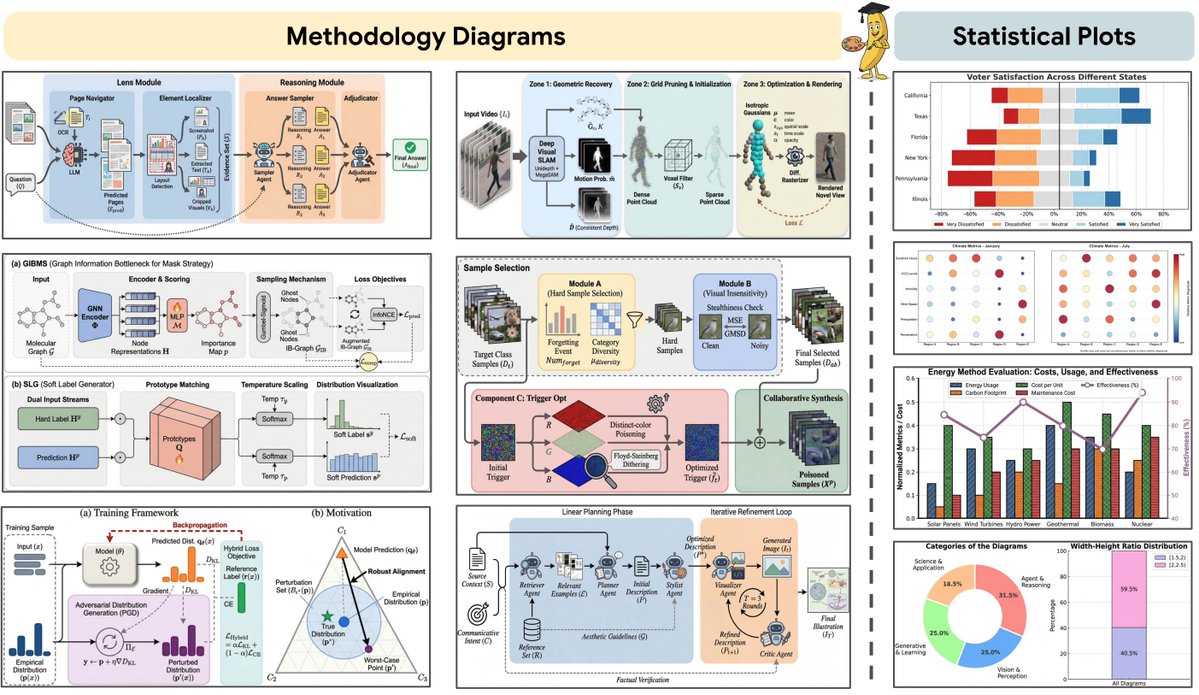
[1/n] Super excited to introduce PaperBanana 🍌! (PKU x Google Cloud AI) As AI researchers, we often spend way too much time crafting diagrams and plots instead of focusing on the ideas 🤯. To rescue us from this burden, we built an Agentic Framework to auto-generate NeurIPS-quality paper illustrations! 📄 Paper: huggingface.co/papers/2601.23… 🌐 Page: dwzhu-pku.github.io/PaperBanana/ Key Features: 🌟 Human-like Workflow: Retrieve 🔍 -> Plan 📝 -> Style 🎨 -> Render 🖼️ -> Critique 🔄. This ensures both academic fidelity and aesthetics. 🌟 Versatile: Supports both illustrative diagrams and statistical plots. 🌟 Polishing: Also effective for polishing existing human-drawn diagrams. Here are some example diagrams and plots generated by our PaperBanana:
Dawei Zhu tweet media
English
67
412
1.8K
258.2K
Steven Ge รีทวีตแล้ว
Abhishek Singh
Abhishek Singh@0xlelouch_·
My friend moved to Seattle for Amazon. $170K total comp. On-call every 6 weeks. Pager at 2 AM. “Customer obsessed” on the wall, burnout in the body. Then the layoff email came. 15 minutes with HR. Laptop was shipped back. Access revoked before the call ended. What surprised him: 1. Performance didn’t matter that day. Headcount math did. 2. Your manager might fight for you, but Finance wins. 3. Your “network” is real only if you built it before you need it. 4. Severance is a runway, not a vacation. He started interviewing in 48 hours. He told me: “I thought that there was job security. It was just a project after all.” we should treat jobs like contracts. Doesn't mean we have to be bad at it, do your best because that exp counts. Keep 6 months cash, keep interviewing skills warm, keep your relationships alive.
English
252
654
9.5K
4.5M