Tarun Mathur

4.5K posts

Tarun Mathur banner
Tarun Mathur

Tarun Mathur

@TarunMathur

#GrowthAdvisory #CorporateStrategy #FoundersAdvice #DealMaker #PE #VC #ScaleupAdvisory | #Fintech #AI #Web3 #EnterpriseTech | #KelloggAlum | RT≠ Endorsement

New York, USA เข้าร่วม Mayıs 2013
4.9K กำลังติดตาม629 ผู้ติดตาม
Tarun Mathur
Tarun Mathur@TarunMathur·
The old software moat was product feature depth. The new moat is system depth: who owns the workflow, the data exhaust, and the decision loop after the model is commoditized. In the AI era, features can be copied in weeks; embedded operating behavior takes quarters to unwind. That is why the most durable businesses are no longer selling “software” in the classic sense — they are selling a better operating surface for the enterprise. The underappreciated shift: AI does not eliminate moats, it re-ranks them. Infrastructure position, proprietary data capture, and trust architecture now matter more than UI polish or raw model access. Public-market weakness in software reflects this sorting mechanism, not a uniform collapse in value. For founders, the question is no longer “Can we build it?” but “Can we become the place where work, context, and outcomes accumulate?” For investors, thin wrappers are product risk with venture pricing. The winners will own the workflow graph, not the chatbot skin. What if the next great software company looks less like SaaS and more like a control layer for human + machine work? #TMinsights
English
1
0
0
5
Tarun Mathur
Tarun Mathur@TarunMathur·
Subscription models assumed predictable usage. AI breaks that assumption. Most of the vendors now charge separately for AI capabilities now because compute costs are variable, not fixed. Usage-based and outcome-based pricing aren't trends—they're necessities when margins depend on inference costs. The divergence is stark: enterprise pays for guaranteed outcomes (efficiency gains, compliance, risk reduction). Consumers pay for convenience. Enterprise willingness to tie fees to measurable ROI creates pricing power consumers never had. Outcome-based contracts align incentives but require deep integration. You're not selling software anymore—you're selling business results. That's a harder sell but creates unbreakable stickiness. The subscription model worked when software was static. In an AI world, value is dynamic—and pricing must be too. Are you charging for access or for impact? #TMinsights
English
0
0
0
4
Tarun Mathur
Tarun Mathur@TarunMathur·
Subscription models assumed predictable usage. AI breaks that assumption. Most of the vendors now charge separately for AI capabilities now because compute costs are variable, not fixed. Usage-based and outcome-based pricing aren't trends—they're necessities when margins depend on inference costs. The divergence is stark: enterprise pays for guaranteed outcomes (efficiency gains, compliance, risk reduction). Consumers pay for convenience. Enterprise willingness to tie fees to measurable ROI creates pricing power consumers never had. Outcome-based contracts align incentives but require deep integration. You're not selling software anymore—you're selling business results. That's a harder sell but creates unbreakable stickiness. The subscription model worked when software was static. In an AI world, value is dynamic—and pricing must be too. Are you charging for access or for impact? #TMinsights
English
0
0
0
4
Tarun Mathur
Tarun Mathur@TarunMathur·
Infrastructure costs are rising exponentially—not linearly. Every inference, every token, every agent call burns capital. This creates a structural barrier favoring incumbents with existing cash flows over agile challengers. As models become cheaper, the winners are those who own the customer relationship, not the model itself. Vertical AI wins because it captures proprietary data loops that horizontal platforms can't access. The moat isn't the algorithm—it's the feedback loop. We should stop valuing companies on TAM. And value them on data exclusivity and workflow stickiness. Application-layer companies without proprietary data will become thin wrappers on commoditized intelligence. The question isn't who has the best model. It's who owns the customer's daily workflow. #TMinsights
English
0
0
0
16
Tarun Mathur
Tarun Mathur@TarunMathur·
Clarity in decision-making remains the driver for leaders navigating high-stakes resets. Moving from clarity to action defines success in emerging arenas. Five strategic imperatives for 2026+: 1. AI at Scale, Not Demo — Budget for data readiness, orchestration layers, and operational reliability before new features 2. Modular Architecture — Enable AI orchestration, real-time personalization, and secure, observable cloud environments 3. Vertical Specialization — Industry-specific AI workflows deliver measurable outcomes, not generic capabilities 4. Distribution Scarcity — Competitors integrating with emerging platforms gain advantages; non-participants face a systematic disadvantage 5. Independent Value Creation — Leverage platform resources while developing platform-independent competitive advantages The market is rewarding companies that treat AI as a strategic foundation, not a feature. Those that experiment without production readiness will be left behind. The gap between AI capability and AI execution is where value compounds—or evaporates. #TMinsights
English
0
0
0
3
Tarun Mathur
Tarun Mathur@TarunMathur·
AI cuts costs, boosts performance, and enables whole-system resets. But here's what most miss—defensibility now hinges on distribution velocity. Platforms that embed AI-driven predictive insights (ERP, CRM, Power-Platform stacks) amplify competitive advantage. Firms creating value-exchange mechanisms for third-party developers capture emerging distribution scarcity. Those neglecting AI integration face a systematic disadvantage as AI agents and platform-centric models dominate. Retention and engagement quality are the most predictive metrics of competitive sustainability. Distribution velocity focused on end-user experience demolishes structural advantages when executed during platform transitions. The question isn't whether you'll compete on platforms—it's whether you'll build one or become dependent on someone else's. #PlatformStrategy #Competition #TechTrends #TMinsights
English
0
0
0
5
Tarun Mathur
Tarun Mathur@TarunMathur·
AI does not eliminate competition; it reshapes it from linear execution races into multidimensional battles over prediction accuracy, adaptation velocity, and ecosystem orchestration. As AI collapses the cost of prediction, advantage accrues to firms that maintain superior data loops, organizational agility, and human-AI hybrid judgement. Players increasingly collaborate on shared infrastructure while competing fiercely on differentiated applications. Prediction plus agility now outweighs raw scale. Enterprises, founders, and investors must stop measuring success by scale or execution velocity and begin auditing every decision against prediction accuracy, adaptation agility, and hybrid judgement. Collaborate aggressively on shared infrastructure while competing relentlessly on differentiated applications and ecosystems. The multidimensional battle over ecosystems, data loops, and hybrid judgement is where durable advantage is being built. #TMinsights
English
0
0
0
5
Tarun Mathur
Tarun Mathur@TarunMathur·
The emergence of open-source sandbox infrastructure for AI coding agents is the logical next step in execution hygiene becoming table stakes. By injecting tokens at the network proxy layer, enforcing scoped credentials, and maintaining full audit trails through declarative configs, these platforms commoditize safe agent execution while creating defensible moats in reliability, compliance, and developer workflow integration. The harness is no longer a proprietary secret; it is becoming open, standardized infrastructure—much like virtualization did for compute. What remains scarce is not the sandbox itself, but the enterprise-scale reliability, audit depth, and seamless integration into IDEs, CI/CD, and production workflows that turn safe execution into durable stickiness. Open-source sandboxes commoditize safe execution. Reliability, compliance, and seamless developer workflow become the moat. The edge is no longer in the model or the agent—it is in the governed harness that makes them enterprise-safe and operationally reflexive. #TMinsights
English
0
0
1
10
Tarun Mathur
Tarun Mathur@TarunMathur·
AI collapses the cost of execution, so business models are no longer differentiated by how much work they can produce. They are differentiated by how well they preserve direction, memory, and narrative continuity. Every strategic pivot is a deliberate version change rather than an accidental fork. The real asset is the system of defaults, documentation, and decision discipline that prevents the company from becoming a collection of incoherent experiments. When building becomes cheap, governance, context, and the quality of strategic forks matter more than raw output. Motion must never be confused with strategy; weak decision operating systems simply accelerate drift. Investors will increasingly scrutinize decision logs, pivot rationale, and evidence that each fork demonstrably improved the compounding curve rather than the narrative alone. Enterprises, founders, and investors must treat governance and decision discipline as core infrastructure rather than overhead. Build and maintain a living system of defaults, documentation, and deliberate version control that keeps every pivot intentional and compounding. Prioritize preservation of direction and memory over motion. Preserve more and reconfigure on purpose, or watch cheap building simply accelerate drift. The real asset is the operating system for decisions. Own it, or become someone else’s footnote. #TMinsights
English
0
0
0
7
Tarun Mathur
Tarun Mathur@TarunMathur·
Over $1 trillion in market cap has been repriced across legacy software in early 2026. This is not a correction. It’s a structural reclassification. The fear is not that software demand will disappear or that all jobs will become agents. The fear is that while software economics migrate, many SaaS companies are priced for a world that no longer exists. AI has invalidated three core assumptions at once: software is hard to build, seat expansion is an enduring monetization model, and interface familiarity is a durable moat. Agentic plug-ins can now autonomously run multi-step enterprise workflows historically performed by traditional SaaS tools. The agent doesn’t use your interface. It bypasses it entirely. The bifurcation is surgical. Generic horizontal SaaS faces structural multiple compression because the competitive advantage it offered can now be replicated by AI agents. Deeply integrated vertical SaaS with proprietary data or regulatory moats is holding value. PE investors will be buying the question: does this business hold assets AI cannot fabricate? Proprietary data accumulated over years. Regulatory licenses. Deep workflow embedding. Marketplace trust history. Everything else is at risk. The window to reposition is narrow. The moats that protected margins in 2024 won’t hold in 2026 unless you understand exactly where defensibility now comes from—and that window is closing. Is your SaaS business “in the cloud”—or is it actually “the intelligence”? #TMinsights
English
0
0
0
7
Tarun Mathur
Tarun Mathur@TarunMathur·
Quantization and neuro-symbolic techniques deliver frontier-level performance on dramatically smaller footprints, allowing vertical agents to run economically in enterprise environments. Yet the deepest moats still require long-horizon training on proprietary data and multi-agent coordination layers that cannot be shortcutted. Seems that the capital-intensity barrier is not disappearing—it is bifurcating. Speed players win on rapid iteration and low-cost inference; depth players win on irreplaceable workflow embedding and outcome guarantees. Horizontal platforms risk becoming commodity infrastructure; vertical systems replacing entire operating processes command outcome-based pricing at scale. Choose your battlefield early—speed for distribution, depth for margin durability. The highest returns now sit at the application-layer intersection of efficiency and domain lock-in. Raw compute is democratizing. Execution inside complex, regulated workflows is not. When efficiency makes intelligence ubiquitous, what becomes the scarce resource? Taste? UI? Integration? #TMinsights
English
0
0
0
8
Tarun Mathur
Tarun Mathur@TarunMathur·
Feature moats are collapsing. AI has made it too easy to replicate interfaces, workflows, and “good enough” product functionality. The real competitive battleground is moving to systems: proprietary workflows, embedded data loops, operational trust, and distribution that compounds. In this world, the winner is not the company with the longest product roadmap. It is the company with the shortest time from insight to monetization. Speed is no longer just execution. It is defensibility. That changes strategy at the highest level. Leaders should stop asking, “What can we build next?” and start asking, “What becomes more valuable every time the customer uses us?” That is how you build a business that gets stronger as competition gets cheaper. #TMinsights
English
0
0
0
5
Tarun Mathur
Tarun Mathur@TarunMathur·
The AI infrastructure boom is rewriting capital intensity as the ultimate barrier to entry. Multi-gigawatt compute bets signal that raw training scale now demands sovereign-level balance sheets. Yet the second-order truth is quieter: application-layer power is decoupling from frontier models. Open-weight releases and memory-optimization breakthroughs are commoditizing raw intelligence, pushing defensibility downstream to proprietary workflow data, regulatory mapping tables, and human-in-the-loop checkpoints that agents can’t fake. Founders chasing generic wrappers are building on quicksand. Incumbents who treat AI as a bolt-on feature will watch their switching costs evaporate. The durable moat isn’t the model—it’s the depth of embedded context no outsider can replicate at speed. Capital intensity now protects the stack; process power and cornered data protect the application. Investors will back the companies that turn AI spend into compounding workflow gravity. What if the next trillion-dollar outcome isn’t who trains the biggest model, but who owns the only context agents refuse to leave? #TMinsights
English
1
0
2
12
Tarun Mathur
Tarun Mathur@TarunMathur·
The subscription model is maturing into something more sophisticated. 73% of SaaS vendors now charge separately for AI capabilities—metering consumption of AI agents, APIs, or compute cycles. The new revenue architecture combines: • Baseline subscriptions • Usage-based pricing • Outcome-based contracts tied to 40-70% efficiency gains • Premium vertical SaaS packages locking in "data moats" Vertical SaaS is proving more profitable than horizontal tools because it allows deeper integration and specialized AI features that generalists can't replicate. The best defense is a data moat + deep workflow integration. Outcome-based contracts are the frontier—tying fees to measurable business results shifts risk and aligns incentives. This isn't just pricing evolution; it's a fundamental rethinking of value capture. #SaaS #RevenueStrategy #Dealmaking #TMinsights
English
0
0
0
8
Tarun Mathur
Tarun Mathur@TarunMathur·
In 2026, competitive advantage no longer rests on a single product feature—it's built on ecosystem depth, data mastery, and operational velocity. We're seeing the post-AI gold rush transition into an adoption marathon. Winners aren't those with the flashiest models, but those embedding AI into core workflows with measurable ROI. Integrated product suites, high-frequency transaction networks, advanced semiconductor equipment, and massive scale drive lasting profitability. For PE/VC due diligence, the question isn't "Do they have AI?" but "Can they scale AI into sustainable value?" Seek continuous innovation pipelines, robust data architectures, strong governance, and the ability to lock in customers through platform integration, brand equity, and scale-driven cost advantages. The moat is no longer a wall—it's a flywheel. Those who understand this will compound returns. Those who don't will become case studies. #PrivateEquity #VentureCapital #Strategy
English
1
0
0
17
Tarun Mathur
Tarun Mathur@TarunMathur·
AI has made polished, interchangeable work abundant, flooding the middle market and compressing the economic value of first drafts and generic execution. Taste—deliberate human judgment that discerns what is generic from what is worth pursuing—emerges as the real moat. This taste is strongest when rooted in deep context, strategic refusal, and authorship rather than surface aesthetics alone. AI compresses execution while inflating the premium on specificity, judgment, and the disciplined choice of what not to build. Enterprises, founders, and investors must stop measuring success by output volume or coding velocity and audit every decision against taste—context-aware judgment, strategic refusal, and authorship. The edge is no longer in generating competent work—it is in judging what work is worth generating at all. #TMinsights
English
0
0
0
45
Tarun Mathur
Tarun Mathur@TarunMathur·
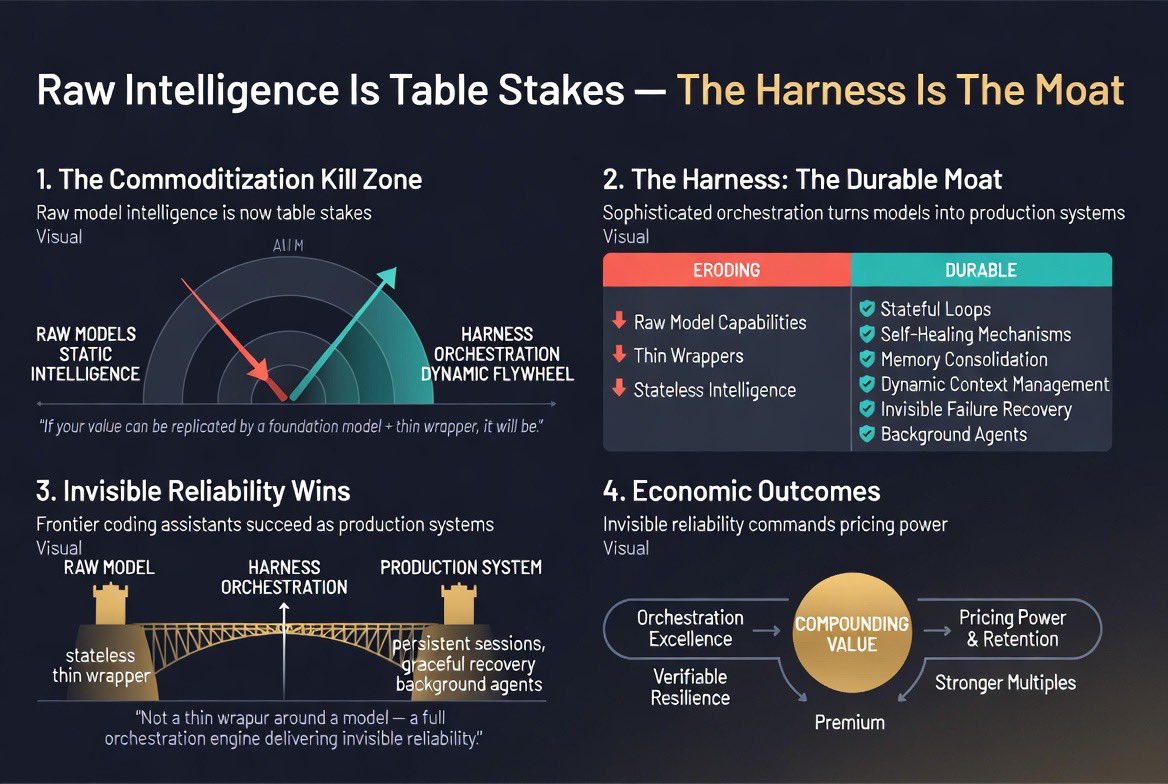
Raw intelligence is now table stakes; the harness that makes intelligence reliable and persistent is the moat. A frontier coding assistant is not a model with a thin wrapper. It is a sophisticated orchestration engine—stateful loops, self-healing mechanisms, memory consolidation, constrained tool use, dynamic context management, invisible failure recovery, and background agents that continuously refine long-term memory. These elements turn a raw, stateless model into a production-ready system that maintains session persistence and recovers gracefully without user intervention. Platforms that deliver invisible reliability command pricing power, higher retention, and premium multiples. Those selling raw capability or thin wrappers face margin compression and duration risk as customers arbitrage on trust and uptime rather than intelligence alone. Enterprises, founders, and investors must stop treating the model as the product and engineer the harness as the non-negotiable moat. Prioritize verifiable recovery rates, session persistence, and invisible resilience as core product metrics. Orchestration trumps the model. Resilience trumps secrecy. The edge is no longer in the weights—it is in the harness that makes the weights production-ready and persistently useful. #TMinsights
English
0
0
0
49
Tarun Mathur
Tarun Mathur@TarunMathur·
As models converge and raw compute becomes abundant and commoditized, durable advantage accrues to curated knowledge infrastructure that converts raw data into enterprise-specific intelligence no generic model can replicate. This is not passive data storage; it is an actively governed, continuously enriched context layer—semantic objects, decision histories, domain-specific relationships, and live behavioral signals—that agents must consult before every high-stakes action. Raw compute loses to refined intelligence because only the enterprise itself can produce and protect the proprietary context that makes intelligence operationally trustworthy and uniquely valuable. Capital will favor platforms that invest in context curation, semantic governance, and continuous enrichment over incremental compute or model scale. Enterprises and vendors that own this layer secure structural pricing power through outcome-based orchestration fees, higher retention, and margin resilience that survives model commoditization. Those still competing on raw capability or undifferentiated data lakes face accelerated margin compression and duration risk. Investors will increasingly price context-adoption velocity, semantic consistency, and measurable conversion of raw data into automated, auditable decisions far above benchmark scores or GPU count. Prioritize semantic curation, governance-by-design, and continuous enrichment so every new data source or agentic execution strengthens the proprietary intelligence layer rather than diluting it. Own the context, or rent someone else’s. #TMinsights
English
0
0
0
18