@Burgess7281975 St. Polycarp "remembered all who had met with him at any time, both small and great, both those with and those without renown, and the whole Catholic Church throughout the world."
English
TrueRedMan
24.3K posts



Roman Catholics claim an infallible church, but in practice what they defend is a selective and shifting infallibility. The problem is not hard to see. There are councils the Roman Church now rejects or downplays, such as the iconoclast council of Hieria in 754, which opposed the use of images, and then later councils that reversed course. Both cannot be protected from error. At some point, the church was wrong, and Rome decides after the fact which moments count and which do not. That is not a consistent doctrine of infallibility. That is a retrospective sorting of history. The same tension appears in the Western Schism from 1378 to 1417, when there were two and then three rival popes, each with supporters, each claiming legitimacy, and each excommunicating the others. The church did not speak with one clear, indefectible voice. It fractured, and it took decades and a council to sort out the mess. During that time, who exactly was the infallible head of the church. The system offers no clean answer. It simply moves past the problem once a winner is declared. There are also moments when popes themselves resisted ideas later defined as dogma. In the fourteenth century, during disputes over poverty, the Franciscans pushed arguments that would bind a pope to prior papal statements. Pope John XXII rejected those claims and opposed the line of reasoning that would later be used to support papal infallibility. Take another example. Pope Honorius I was condemned by the Third Council of Constantinople for supporting the Monothelite heresy. A pope was formally rebuked as a heretic by a council later recognized as authoritative. Or consider the Council of Constance in the fifteenth century, which asserted that a general council held authority over the pope. Rome later rejected that principle. So was the church speaking infallibly when it elevated the council over the pope, or when it later denied it. Both positions have been held. Both cannot be infallible. Then there is the case of Pope Sixtus V and his official edition of the Latin Vulgate in 1590. He proudly proclaimed to have produced an infallible translation. Yet within his own lifetime, it was found to contain numerous errors. Within a short time, it was withdrawn and replaced under Pope Clement VIII with a corrected version. Oops. And this raises a deeper problem. Can the church produce an infallible list of all the infallible things it has ever said. It cannot. What Rome actually has is a selective catalog, identified after the fact, under highly technical conditions that seem to change with the wind. That is not how an inherent property works of infallibility works. Even beyond that, popes have contradicted one another in teaching and policy. Councils have been called, corrected, and sometimes effectively reversed. Rome maintains the appearance of consistency by narrowing the definition of infallibility to rare, highly technical conditions, then declaring that only those moments count. Everything else is allowed to be mistaken, revised, or abandoned. That approach protects the claim while conceding the reality that the church, in its actual history, has erred. Once that is admitted, then we aren't dealing with infallibility any more. An authority that can be wrong in many of its official acts, reversed by later decisions, and divided against itself in times of crisis does not carry the marks of something that is incapable of error by nature. The historical record shows a church that can speak truly at times and err at others. That is exactly what one would expect from a fallible institution, not an infallible one. Holy Scripture is infallible because it is the word of God. It is the only infallible authority on earth.


Baptism is not required for salvation.



They vote against deporting migrants who harm humans. What did you expect?
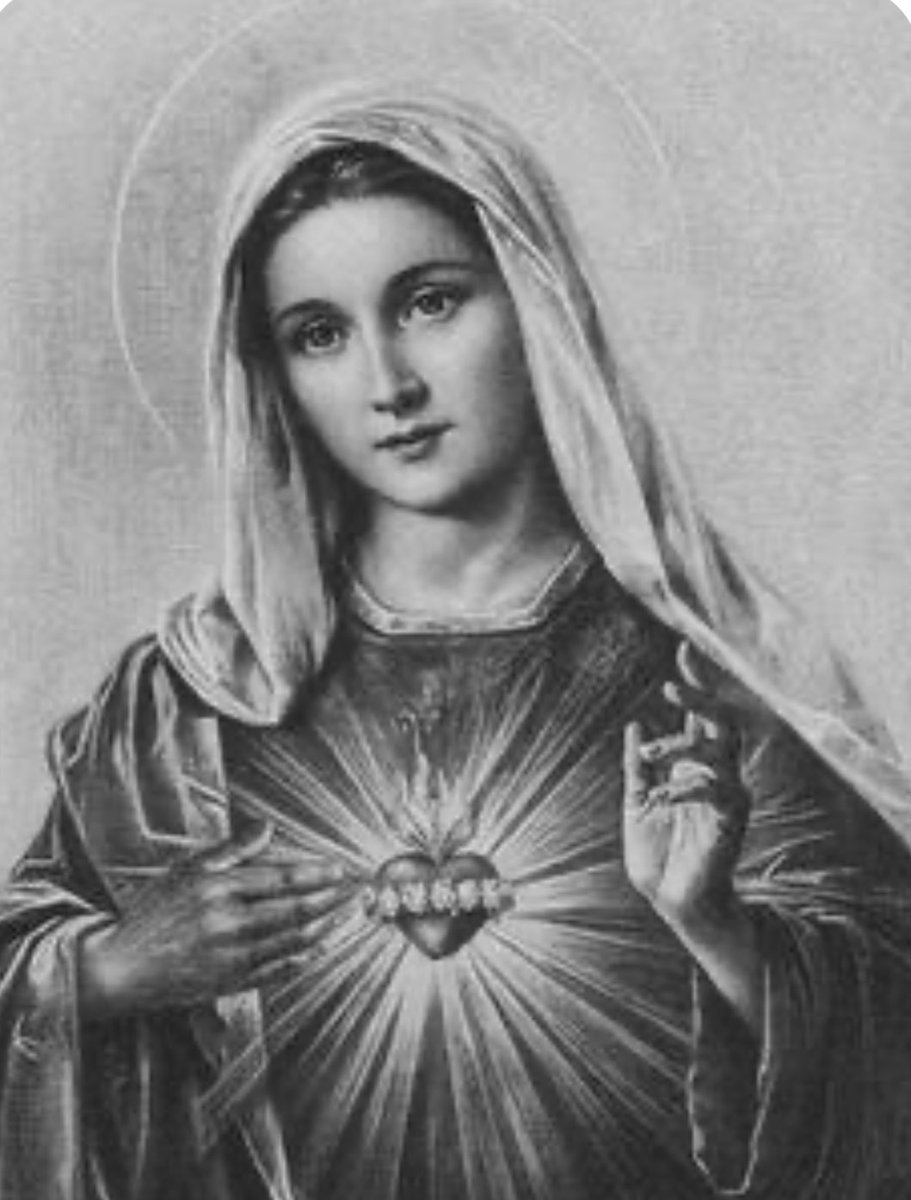
The Catholic “Mary” is a counterfeit Mary, a demon spirit. In the Catholic Catechism she is called the “All Holy One” and said to have a saving office and have prayers directed to her ( CCC 969, 2679, 2675-77). In the book: The Glories of Mary, compiled by Alphonsus Liguori, who was canonized in 1839 (Pope Gregory XVI) and proclaimed a Doctor of the Church in 1871 (Pope Pius IX), you can read how prominent Roman Catholics prayed TO Mary in the same we a Bible Believing Christian prays to God alone! Read for yourself: “By thee we have been reconciled to our God. Thou art the only advocate of sinners, the secure haven of the shipwrecked. Thou art the consolation of the world, the redemption of captives, the joy of the sick, the comfort of the afflicted, the refuge and salvation of the whole world. Oh great princess! mother of God! cover us with the wings of thy compassion: have pity on us. We have no hope but in thee, oh most pure Virgin!….. I salute thee, oh peace! oh joy! oh salvation and consolation of the whole world! I salute thee, oh greatest of miracles!” By St. Ephrem “Yes, my Lady, my refuge, my life, my help, my defence, my strength, my joy, my hope, make me to come with thee to paradise. I know that, being the mother of God thou canst obtain this for me if thou wilt. Oh Mary, thou art omnipotent to save sinners, thou needest nothing else to recommend us to thee, for thou art the mother of true life.” St. Germanus. This is utter blasphemy! Read more on my Instagram page story highlights!

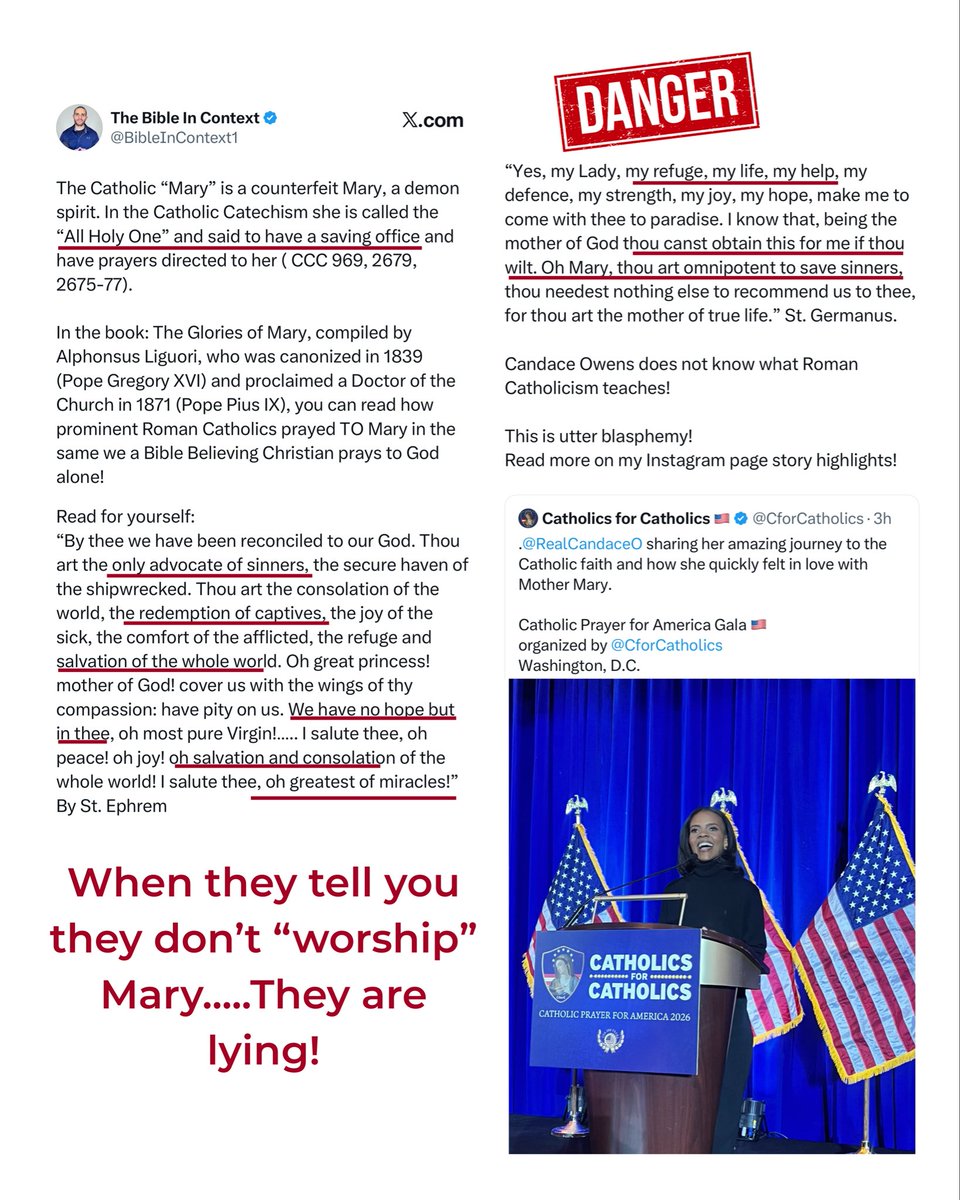

.@RealCandaceO sharing her amazing journey to the Catholic faith and how she quickly felt in love with Mother Mary. Catholic Prayer for America Gala 🇺🇸 organized by @CforCatholics Washington, D.C.