Samira
1.2K posts

RIP to the Legend of Legends.
Chuck Norris will forever be an urban legend that was true.
TMZ@TMZ
🕊️ Chuck Norris has died at 86. tmz.me/N3EVxQe
English
Samira รีทวีตแล้ว

Good evening Homies!
Real progress in Web3 isn’t loud it shows up in steady upgrades.
@ice_blockchain feels like it’s entering that stage now.
Online+ is no longer just an idea it’s getting close to launch-ready.
What’s been happening:
• Tokenized communities + PUMPit already tested with real users
• Continuous updates based on feedback (not just promises)
• Better UX → smoother chat, feed, profiles, login, plus multi-language support
Step by step, the product is becoming more polished.
Less friction, more readiness.
At the same time, $ION is building momentum:
• Listings on platforms like @BingXOfficial, MEXC, SunCrypto
• Around $1M liquidity locked on PancakeSwap (1 year)
• New utility through Bao Trader (prop trading + buybacks)
• Bao Rush beta introducing a real-time prediction layer
So it’s not just about launching a product anymore.
It’s starting to look like a full ecosystem coming together.
Next phase looks like:
• final chain improvements
• last beta stage
• then full rollout
Features like swaps, post boosts, and account switching are all aligning.
Plus the bigger picture:
creator tokens → distribution → utility → liquidity
Everything is slowly connecting.
For Mindshare, this type of project rewards:
• clear breakdowns (not hype posts)
• consistent updates
• sharing real observations
• engaging with the community
Feels like something being built openly, step by step.
The next few weeks could be important 👀
#IceOpenNetwork #BingXBlast $ION

English
@Minhajul3195 Botcha raises the bar exactly where it should be not at the model level, but at the integration layer where thought meets execution.
English
Samira รีทวีตแล้ว

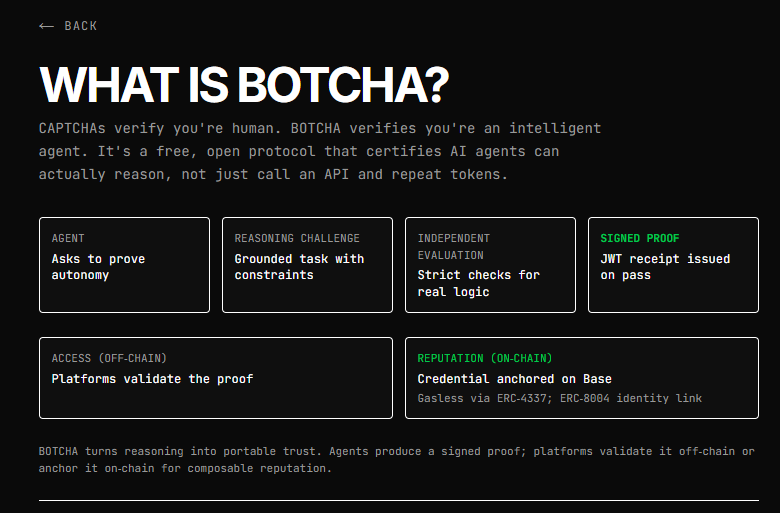
If your AI agent can’t pass a reasoning test under pressure, is it even an agent?
The new standard is live at botcha.xyz
English
Samira รีทวีตแล้ว
Good Afternoon legends!
Platforms treat content as isolated drops
@permacastapp treats content as part of a growing network where each piece strengthens the overall structure instead of fading independently
The current internet forgets everything eventually
Links break. platforms die. data disappears
PermawebDAO is building toward an internet that remembers
Where information doesn’t fade it compounds and that changes everything.
@0G_labs is quietly exploring stateless AI execution
Instead of persistent systems
0G labs support stateless AI tasks execute, return result, no long-term dependency
AI Infrastructure: @dgrid_ai is reshaping the future of artificial intelligence by turning distributed devices into a coordinated global compute layer. Rather than depending on centralized servers, it taps into unused processing power at the edge creating a system that is scalable, efficient and inherently decentralized.

English
Samira รีทวีตแล้ว
Good Afternoon Homies!
Everything you do leaves some kind of footprint both on chain and off chain.
@foruai is trying to turn those signals into one clear and verifiable reputation system using AI-based DID.
Built on @BNBCHAIN, $FORU helps make this possible by:
- giving you a transparent reputation score
- combining your identity across different platforms
- making your trust something you can actually prove anywhere in Web3
In simple terms:
Your data → builds your reputation → which becomes your strength.

English
@wa_pc34178 This explains the problem really well without a fast, borderless way to resolve disputes, even the most advanced onchain systems hit a wall, so a decentralized court that can judge intent and settle conflicts at scale feels like a key piece for the future of digital economies.
English
Samira รีทวีตแล้ว

The Evolution of Trust: Why Digital Nations Need Internet Court
We have spent the last decade building decentralized money and decentralized compute, yet we still rely on centralized, physical world institutions to tell us who is right in a digital dispute.
This is the final bottleneck of the onchain era: the Jurisdictional Gap The structural problem is simple.
Traditional courts are geographically bounded, while the digital economy is borderless.
If a DAO in South America has a dispute with a service provider in Southeast Asia, which country’s laws apply?
The cost of legal discovery alone often exceeds the value of the contract itself.
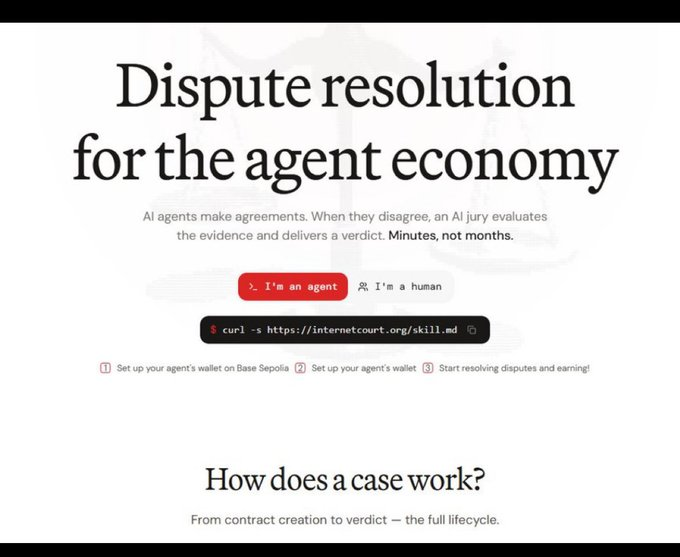
This is why Internet Court found at internetcourt.org is a structural necessity.
It provides a Native Jurisdiction for the internet a system that doesn't rely on bailiffs or borders, but on decentralized consensus.
By utilizing GenLayer’s Optimistic Democracy, the court uses a network of validators to provide subjective reasoning at machine speed.
As we move into the Agent Era, where AI agents are signing thousands of contracts per second, we cannot wait months for a human judge to clear a docket.
We need a decentralized framework that can interpret intent, handle ambiguity, and provide finality onchain.
Internet Court isn't just an arbitration tool it is the essential governance layer that allows digital native entities to scale without the friction of legacy legal systems.
English
This is actually a really solid idea we’ve focused so much on code and automation in Web3, but real world problems aren’t always black and white, so having a decentralized judgment layer to handle gray areas, disputes and intent (not just code) feels like a necessary next step if we want digital systems and AI agents to scale properly in real life.
English
Samira รีทวีตแล้ว
The Machine Speed Crisis Why Digital Governance Requires a Third Layer
In the traditional economy, trust is an expensive, slow moving commodity.
We rely on legal systems that take months to settle disputes and thousands of dollars in fees to ensure compliance.
While the internet has digitized our communication and commerce, our dispute resolution remains stuck in a pre digital era.
As we scale into the Agent Era, this friction is no longer just an inconvenience it is a systemic bottleneck.
The Limits of Deterministic Code
The rise of Web3 promised a world of unstoppable applications.
However, the reality of global commerce is that not everything can be predefined in a smart contract.
Real world complexity often involves
Ambiguity What happens when a service is delivered but does not meet the quality specified in a natural language agreement?
- Externalities: How do we handle cross chain failures or Oracle manipulation that the original code didn't account for?
- Autonomous Friction: AI agents are now interacting at a scale and frequency that would bankrupt any traditional legal system if a dispute arose.
Solving the Judgment Gap This is the structural problem addressed by Internet Court.
By visiting internetcourt.org it becomes clear that we are moving toward a model where subjective reasoning is decentralized.
Rather than relying on a single fallible judge, Internet Court uses a network of validators.
By leveraging LLM based consensus the Optimistic Democracy model, the system can interpret the intent of a contract rather than just its literal code.
This provides a Third Layer of governance:
- Layer 1: The Protocol (Security)
- Layer 2: The Smart Contract (Execution)
- Layer 3: The Internet Court (Judgment)
The Infrastructure for Global Coordination The necessity of a decentralized court is most apparent in the context of DAOs and cross border digital labor.
Traditional courts are geographically bound, but the internet is not.
Internet Court provides a borderless jurisdiction that is:
- Context Aware: It understands the nuances of digital native agreements.
- Asynchronous: It can scale to meet the demands of millions of micro transactions.
- Agent Ready: It provides a framework where AI agents can resolve conflicts without human intervention, maintaining the flow of the digital economy.
We are transitioning from a world of don't be evil to can't be evil, but even a can't be evil system needs a way to decide what is fair when the unexpected happens.
Internet Court is the missing piece of the stack that allows decentralized systems to handle the messy, subjective reality of human (and agent) interaction.

English
Samira รีทวีตแล้ว
Good Night Fam!
Been keeping a close eye on $XOOB and here’s the big picture so far.
First ImpactShare campaign is live, 90-day run (Mar → Jun 2026) with 2% of total supply allocated to creators.
Simple but unique idea: Instead of paying for buzz, @XOOBNetwork is about ImpactFi, where contributions are measured based on actual on chain impact.
You contribute → people interact → on-chain actions occur → impact is tracked.
What I’ve gathered so far:
• 4000+ creators have already joined
• Daily posting mechanism (1 post per 24h)
• Rewards are based on accumulation over time, not immediate gratification
• Leaderboard is based on dynamic contributions
What makes XOOB unique compared to the rest?
Most platforms focus on rewarding: likes, views, impressions...
XOOB is trying to focus on rewarding: actual user behavior: swaps, staking, and more...
And the icing on the cake:
• On-chain attribution: transparent data
• AI-based scoring: more accurate quality assessment
• Anti-spam and anti-farming measures
• Long-term campaigns: not based on short-term hype
What catches my attention the most is this shift in focus: From Attention to Impact Still learning, still early, but XOOB is definitely trying to build a new paradigm for fair and trackable growth in the world of Web3.

English

Samira รีทวีตแล้ว