Poison Pen

44.8K posts

Poison Pen banner
Poison Pen

Poison Pen

@WordVendetta

#ImWithHer Nolite te Bastardes Carborundorum🌊🌍 Слава Україні #ProChoice #ReadRiseUpVoteBlue Ailurophile

Arizona, USA เข้าร่วม Ocak 2018
3K กำลังติดตาม3K ผู้ติดตาม
Poison Pen รีทวีตแล้ว

Christopher Webb
Christopher Webb@cwebbonline·
Whew! Hillary Clinton this morning on the U.S.-Iran talks that fell apart: “This is hard work. You don’t just show up in Geneva or Islamabad, talk for a bunch of hours, and go away. This is hard, disciplined effort that has to go into diplomacy to reach any results. And I don’t see this administration either wanting to do it or, frankly, being capable of doing it…”
English
334
5K
21K
542.6K
Poison Pen รีทวีตแล้ว
Jeffrey Luscombe
Jeffrey Luscombe@JeffreyLuscombe·
If we’re taking sides… I’m on the side of the Pope. And I’m an atheist.
English
1.1K
11.5K
102.4K
881.9K
Poison Pen รีทวีตแล้ว
Sebastian™
Sebastian™@Azariel91·
I think I can speak for all women when I say: Thank you, and please keep doing this 🙏🏻 This time it made everyone laugh at the end, but there will be many times when we’ll be really grateful that we don’t have to fight alone. No need to apologize for checking in. This is how men should be! You’re great.
English
235
4.1K
102.6K
4.7M
Poison Pen รีทวีตแล้ว
Angry Staffer
Angry Staffer@Angry_Staffer·
Periodic reminder that the president has lost his fucking mind
Angry Staffer tweet mediaAngry Staffer tweet media
English
296
3.1K
16.5K
163.4K
Poison Pen รีทวีตแล้ว
🇺🇸 Justice
🇺🇸 Justice@250_Revolution·
Concerning Social Security payments, my contributions were made for 40 years on every salary I received. Those jobs may not have always been the work I wanted to be doing at the time, BUT I always had a job. The Social Security check is now (or soon will be) referred to as a "Federal Benefit Payment?" I'll be part of the one percent to forward this. I am forwarding it because it touches a nerve in me, and I hope it will in you. Please keep passing it on until everyone in our country has read it. The government is now referring to our Social Security checks as a "Federal Benefit Payment." This isn't a benefit. It is our money paid out of our earned income! Not only did we all contribute to Social Security but our employers did too. It totaled 15% of our income before taxes. If you averaged $30K per year over your working life, that's close to $180,000 invested in Social Security. If you calculate the future value of your monthly investment in social security ($375/month, including both you and your employers contributions) at a meager 1% interest rate compounded monthly, after 40 years of working you'd have more than $1.3+ million dollars saved! This is your personal investment. Upon retirement, if you took out only 3% per year, you'd receive $39,318 per year, or $3,277 per month. That's almost three times more than today's average Social Security benefit of $1,230 per month, according to the Social Security Administration. (Google it – it’s a fact). And your retirement fund would last more than 33 years (until you're 98 if you retire at age 65)! I can only imagine how much better most average-income people could live in retirement if our government had just invested our money in low-risk interest-earning accounts. Instead, the folks in Washington pulled off a bigger "Ponzi scheme" than Bernie Madoff ever did. They took our money and used it elsewhere. They forgot (oh yes, they knew) that it was OUR money they were taking. They didn't have a referendum to ask us if we wanted to lend the money to them. And they didn't pay interest on the debt they assumed. And recently they've told us that the money won't support us for very much longer. But is it our fault they misused our investments? And now, to add insult to injury, they're calling it a "benefit", as if we never worked to earn every penny of it. Just because they borrowed the money doesn't mean that our investments were a charity! Let's take a stand. We have earned our right to Social Security and Medicare. Demand that our legislators bring some sense into our government. Find a way to keep Social Security and Medicare going for the sake of that 92% of our population who need it. Then call it what it is: Our Earned Retirement Income. 😡😡😡✅
English
686
7.5K
11.7K
222.6K
Poison Pen รีทวีตแล้ว
Rep. Oscar De Los Santos
Ridiculous. Tariffs will cost Arizona working families $2,500 in 2026. This is disastrous — not brilliant. We must do everything we can to keep Andy Biggs as far away as possible from the Arizona governorship. Working families cannot afford to bring Washington chaos to our state.
Copper State Victory@copperstate2026

.@AndyBiggs called tariffs a “brilliant economic policy.” Meanwhile, Arizona families have been stuck footing the $1.6 billion bill from those tariffs. Arizona can’t afford Biggs.

English
78
41
149
6.2K
Poison Pen รีทวีตแล้ว
Rep. Melanie Stansbury
Rep. Melanie Stansbury@Rep_Stansbury·
Trump’s latest proposal to gut the U.S. Forest Service isn’t about efficiency—it’s about walking away from the stewardship of our nation’s forests. It means fewer firefighters during fire season. It means less protection for our watersheds. And it means walking away from forest stewardship at a time when we should be doubling down. Leaving our communities vulnerable to catastrophic fires, water insecurity, and potential loss of forests—and doing so without Congressional approval—that’s why we are fighting back! 🌲@NRDems
Rep. Melanie Stansbury tweet media
English
349
2.7K
4.3K
37.8K
Poison Pen รีทวีตแล้ว
Женя
Женя@orlova58148·
Когда упал языковой барьер в Х выяснилось, что ненавидят, хотят убить друг друга по национальному признаку только мудаки во власти. Остальные жители планеты хотят видеть котиков друг у друга. Всех с Пасхой! Тепла, уюта, достатка в ваши дома💜
Женя tweet mediaЖеня tweet media
Русский
1.2K
5.2K
45.2K
376.8K
Poison Pen รีทวีตแล้ว
We don't deserve cats 😺
We don't deserve cats 😺@catsareblessing·
Meet Mittens. He was supposed to be a subject in a documentary until he chose the cameraman instead
English
32
879
21.2K
269.2K
Poison Pen รีทวีตแล้ว
RosarySon
RosarySon@SkyVirginSon·
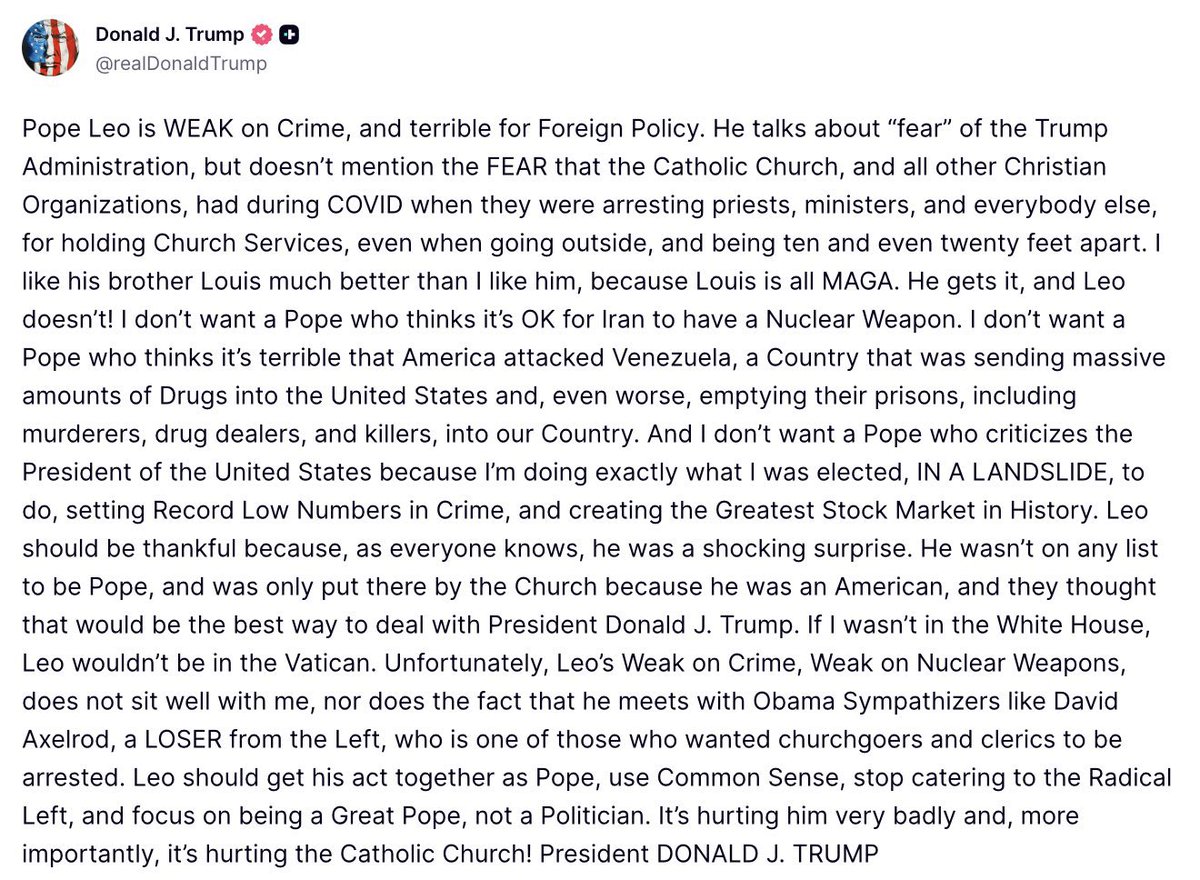
With all due respect to the Office of the President, this post contains several claims that are factually inaccurate and theologically misguided, and as a Catholic I feel compelled to respond. 1. The Pope was not elected to please any president. Pope Leo XIV was elected by 133 cardinals from across the world in a sacred conclave, on the fourth ballot, on May 8, 2025.  The Holy Spirit guides the conclave, not American politics. To suggest that “if I wasn’t in the White House, Leo wouldn’t be in the Vatican”  is not only historically ignorant but theologically offensive to every Catholic on earth. 2. He was not an unknown outsider. Pope Leo XIV served as Prefect of the Dicastery for Bishops under Pope Francis, one of the most powerful roles in the Vatican, responsible for selecting bishops for dioceses worldwide.  He was one of the most qualified candidates in the College of Cardinals. 3. He is deeply rooted in service, not politics. An Augustinian missionary who worked for decades in Peru, Pope Leo XIV dedicated his life to the poor and the Gospel long before any political figure noticed him.  His name honors Leo XIII, the Pope who championed workers’ rights and the poor during the Industrial Revolution, a tradition of Catholic Social Teaching that predates any modern political party. 4. The Pope’s role is prophetic, not partisan. When the Pope speaks on peace, nuclear weapons, immigration, or the dignity of nations, he is fulfilling the mission of Christ, not opposing any government. His first words as Pope were “Peace be with you all,”  echoing the Risen Christ (John 20:19). A Pope who is silent on injustice would be failing his divine mandate. 5. Demanding a Pope “get in line” with a president contradicts 2,000 years of Church history. From St. Peter before Nero, to St. Thomas More before Henry VIII, to John Paul II before Soviet communism, the Church has never existed to validate earthly power. “We must obey God rather than men.” (Acts 5:29) As Catholics, we pray for all leaders, including President Trump. But we stand firmly with our Holy Father. Habemus Papam. And he answers to God alone.
RosarySon tweet media
English
894
5.3K
21.2K
785.1K
Poison Pen รีทวีตแล้ว
Cuckturd
Cuckturd@CattardSlim·
Trump is the least popular President in American history. Melania is the least popular First Lady in American history. JD Vance is the least popular VP in American history. Great job America 👏 And on America's 250th Birthday 😔
English
525
7.5K
37.9K
594.4K
Poison Pen รีทวีตแล้ว
Democrats Deliver
Democrats Deliver@DemzDeliver·
🚨 Democratic Governor Katie Hobbs has now erased the medical debt of nearly 500,000 Arizonans.
Democrats Deliver tweet media
English
3K
3.7K
22.1K
3.7M
Poison Pen รีทวีตแล้ว
Anthony Scaramucci
Anthony Scaramucci@Scaramucci·
We get our ass kicked every 80 years. And here's why. 👇🏼 After 80 years the generational memory is gone. Everyone who lived through the last crisis is dead. Revolution in 1776. 80 years later — the Civil War. 600,000 dead. We couldn't resolve the stain in the Constitution any other way. 80 years after that — the Great Depression leading into World War II. We're 80 years out again. The last World War II veterans are 100 years old. The institutional memory is gone. And instead of remembering why we came together — we're tearing each other apart. This is the pattern. Every single time. We get beaten badly enough that we look around and say — okay, this is screwed up. How do we fix it? So here's what fixing it looks like: -25 to 50 year plans. -Bipartisan commitment. -Fix K-12 education. -Rebuild the infrastructure. -Jobs training. -Curb the deficit spending. Not a four year political cycle. A generational commitment. We've rebuilt ourselves every 80 years. Time to do it again. @Newsweek
English
224
686
3.2K
175.7K
Poison Pen รีทวีตแล้ว
Kateri Seraphina
Kateri Seraphina@KateriSeraphina·
Histoire vraie. En mars 1931, une jeune fille de dix-sept ans entra dans une salle d’audience du Massachusetts et fit quelque chose d’impensable pour son époque. Elle s’appelait Helen Kowalski. Et elle témoigna contre son propre père. Pendant quinze ans, Helen avait vu sa mère souffrir en silence. Son père, Joseph Kowalski, battait sa mère Margaret sans relâche — depuis que Helen n’avait que deux ans à peine. La violence n’était ni rare ni impulsive. Elle était quotidienne. Poings. Ceintures. Tout ce qui lui tombait sous la main. Des yeux noircis. Des os brisés. Du sang sur le sol. Des cris résonnant dans la maison tandis que quatre enfants restaient figés, sachant qu’il n’y avait nulle part où fuir et personne à appeler. À l’époque, rien de tout cela n’était considéré comme un crime. La violence domestique était reléguée au rang de « problème familial ». La police n’intervenait pas. Les tribunaux ne s’en mêlaient pas. Un mari avait presque toute autorité sur son foyer. Les épouses ne pouvaient partir que si elles avaient une raison reconnue par la loi — et être battue n’en faisait pas partie. Margaret n’avait ni argent, ni profession, et quatre enfants dépendaient d’elle. Partir signifiait la rue et la faim. Rester signifiait survivre, aussi brutal que cela soit. Alors elle resta. Jusqu’au début de l’année 1931 — lorsque Joseph faillit la tuer. Il fractura le crâne de Margaret. Il lui brisa la mâchoire. Elle fut hospitalisée pendant deux semaines, entre la vie et la mort. Pendant qu’elle était là, faible et terrifiée, une jeune assistante sociale lui dit des mots qu’elle n’avait jamais entendus auparavant : La loi commençait à changer. Les procureurs pouvaient désormais écouter. Les tribunaux pouvaient agir. Margaret était paralysée par la peur. Pendant des années, Joseph l’avait menacée : si elle parlait, il la tuerait. Elle avait survécu en se taisant. Helen prit la décision pour elles deux. « Je témoignerai », dit-elle à sa mère. « Tu n’as pas à affronter cela seule. » Le 15 mars 1931, Helen Kowalski prit place à la barre. On n’attendait pas des enfants qu’ils témoignent contre leurs parents — encore moins sur ce qui se passait derrière des portes closes. La violence familiale devait rester invisible. Mais Helen parla avec calme, clarté et sans hésitation. Elle décrivit quinze années de violences avec une précision implacable : dates, blessures, lieux, menaces, armes. Pas des rumeurs. Pas des émotions. Des faits. La défense tenta de la discréditer. On suggéra qu’elle n’était qu’une enfant rancunière, en colère contre une discipline trop sévère. Helen n’éleva pas la voix. « Mon père ne m’a jamais disciplinée, dit-elle. Il battait ma mère. Ce n’est pas la même chose. » Puis elle alla plus loin. « Ce qu’il faisait n’était pas normal. Ce n’était pas acceptable. C’était une agression criminelle. Tout le voisinage le savait, mais personne n’en parlait — parce qu’on nous disait que c’était ainsi que fonctionnaient les familles. » La salle d’audience plongea dans le silence. Le jury délibéra moins d’une heure. Joseph Kowalski fut reconnu coupable d’agression et condamné à deux ans de prison — l’une des premières condamnations pour violence domestique dans l’histoire du Massachusetts. Du haut de son siège, le juge prononça des mots qui résonneraient bien au-delà de cette salle : « Ce tribunal ne tolérera plus la fiction selon laquelle la violence domestique relève de la sphère privée. » La victoire eut un prix. Des proches et des voisins accusèrent Helen et Margaret d’avoir « détruit la famille ». Helen reçut des menaces. On lui dit qu’une fille ne trahit pas son père. Qu’une épouse doit endurer. Que le silence est une forme de loyauté. Mais autre chose se produisit aussi. D’autres femmes commencèrent à parler. L’affaire d’Helen fit jurisprudence. Les procureurs s’y référèrent. Les tribunaux la suivirent. Des dizaines d’affaires de violence domestique purent avancer sur le même principe : la violence est un crime, et les enfants qui en sont témoins sont des témoins crédibles. Margaret divorça de Joseph. Elle partit avec ses enfants. Elle trouva du travail. Elle reconstruisit sa vie. Elle survécut. Helen termina ses études secondaires et devint assistante sociale. Elle consacra sa vie à aider des femmes à fuir des mariages violents — des femmes à qui l’on disait de prier davantage, de se taire, d’endurer encore. Elle les croyait quand les autres ne les croyaient pas. Elle restait à leurs côtés quand partir semblait impossible. Elle n’oublia jamais ce que le silence avait failli coûter à sa mère. Helen Kowalski s’éteignit en 1999, à l’âge de quatre-vingt-cinq ans. À ses funérailles, des femmes âgées se levèrent pour témoigner. « Elle m’a sauvé la vie. » « Elle m’a aidée à partir. » « Elle a parlé quand le tribunal ne voulait pas écouter. » Une femme dit doucement : « Tout a commencé lorsqu’elle avait dix-sept ans et qu’elle a choisi la vie de sa mère plutôt que le silence. » Helen Kowalski a payé le prix de la vérité. Mais elle a changé la loi. Elle a changé des vies. Et elle a prouvé une chose qui reste vraie aujourd’hui : Briser le silence est dangereux. Mais le silence tue.
Kateri Seraphina tweet media
Français
35
1.9K
7.6K
356.7K