Your Wild Life Team

5.6K posts

Your Wild Life Team

Your Wild Life Team

@YourWild_Life

With our merry band of citizen scientists, we're exploring the biodiversity that lives on us, in us and around us | Part of the Dunn Lab @ NC State University

Raleigh, NC เข้าร่วม Ekim 2011
438 กำลังติดตาม2.5K ผู้ติดตาม
ทวีตที่ปักหมุด
Your Wild Life Team
Your Wild Life Team@YourWild_Life·
Hey Folks, We are beginning a project to survey arthropods in homes around the world (through iNaturalist). Give it a go. Do you have species in your home we haven’t yet seen in other homes? inaturalist.org/projects/never…
English
3
10
19
0
Your Wild Life Team รีทวีตแล้ว
Benjamin Wolfe
Benjamin Wolfe@LupoLabs·
Using this incredible collection, we answered a long-standing question in bread baking: are there unique sourdough microbes in specific geographic locations? Spoiler alert: the answer is no! There is nothing special (from a microbial perspective) about San Francisco sourdough.
Benjamin Wolfe tweet media
English
1
14
42
0
Your Wild Life Team
Your Wild Life Team@YourWild_Life·
Nestled inside each of these packages was a unique community of microbes, each one holding tiny clues to the history of how it had been maintained and who's lives it had touched. #scienceofsourdough #sourdough
Benjamin Wolfe@LupoLabs

We are SO grateful for all the bakers that sent us samples of their sourdough starters. They provided us with rich metadata and unprecedented sampling resolution. Here is a pile of samples that @landisea processed when they arrived at the lab.

English
0
1
3
0
Your Wild Life Team
Your Wild Life Team@YourWild_Life·
Our Global Sourdough Project results are published! A warm and heartfelt thank you to everyone who contributed - whether you filled out the survey or sent us a sample of your starter or emailed insightful questions. We are so excited to share what we discovered! #sourdough
NC State Applied Ecology@NCStateAEC

The long-standing idea that some locations just make tastier #sourdough starters just isn't supported by this @doteachlearn, @LupoLabs @AnneAMadden @RRobDunn et. al. study who looked at starters from across the world: buff.ly/3iOVbHU Sorry New York and San Fran! 🤷‍♀️

English
1
2
8
0
Your Wild Life Team รีทวีตแล้ว
Benjamin Wolfe
Benjamin Wolfe@LupoLabs·
We are SO grateful for all the bakers that sent us samples of their sourdough starters. They provided us with rich metadata and unprecedented sampling resolution. Here is a pile of samples that @landisea processed when they arrived at the lab.
Benjamin Wolfe tweet media
English
1
2
19
0
Your Wild Life Team
Your Wild Life Team@YourWild_Life·
@E_Carlen @acer_aceae Fascinating. My first terrible thought: perhaps some fungicide contaminated the grain. But it might be a difference in nutrient availability? Does it just grow more slowly, but eventually reach the same lofty heights? I'm calling in reinforcements: @AnneAMadden @RRobDunn
English
1
0
2
0
Dr. Elizabeth Carlen
Dr. Elizabeth Carlen@E_Carlen·
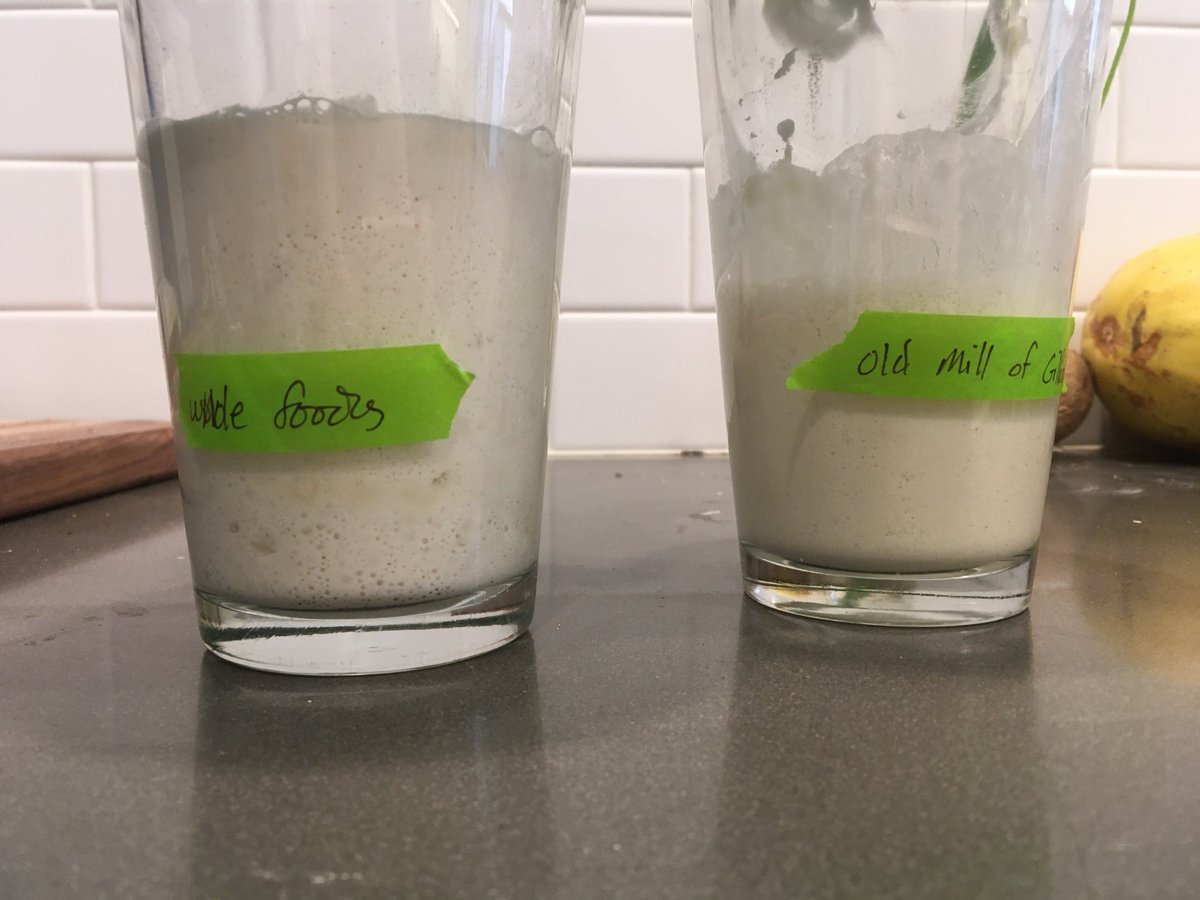
Has anyone noticed that their sourdough starter prefers 1a certain flour? On the left my starter was fed basic white flour, on the right, fed with white flour from a small mill in North Carolina. Tape line shows starter at feeding cc @pastramimachine @vsbuffalo @ejschwarzkopf
Dr. Elizabeth Carlen tweet media
English
4
0
9
0
Your Wild Life Team
Your Wild Life Team@YourWild_Life·
@karenedaniels Congrats on the new starter! You can still submit your data, if you like, since you dont have to collect any measurements until the second week anyhow.
English
1
0
1
0
Your Wild Life Team
Your Wild Life Team@YourWild_Life·
@msuberrybugs @RRobDunn Indeed! I wouldn't recommend using the discard for cooking when you are first making a starter though. I would wait until you have a starter that is consistently rising and falling between feedings. A really good point to add once we include a "Maintaining your starter" page.
English
0
0
1
0
Your Wild Life Team
Your Wild Life Team@YourWild_Life·
New paper out this week! We thought that kids living close to nature might be more fond of local wildlife than kids living in urban places. Turns out we were wrong. Frogs are always greener on the other side of the pond, no matter where you live.
NC State Applied Ecology@NCStateAEC

Children Prefer Faraway Wildlife to Local Nature according to a collaborative @thePeerJ study with @NCStateAEC, @naturalsciences, and @NCParks Recreation & Tourism: buff.ly/2YI9JgY

English
0
4
3
0