Antero

38 posts

Antero

Antero

@antsae_

👨‍🔬 R&D

เข้าร่วม Haziran 2022
284 กำลังติดตาม257 ผู้ติดตาม
Antero
Antero@antsae_·
@AirEuropa filed baggage claim by email during holiday. Called to follow up - phone team can't see emails, told to wait month for email team Cool, except I have flight TOMORROW Should I pack my stuff in a cardboard box, or do u sell duct tape at the gate? Asking for a suitcase
English
3
0
4
81
Antero รีทวีตแล้ว
cyber•Fund
cyber•Fund@cyberfund·
𝗕𝗹𝗼𝗰𝗸𝘀𝗽𝗮𝗰𝗲 & 𝗕𝗹𝗼𝗯𝘀𝗽𝗮𝗰𝗲: 𝗮 𝘁𝗮𝗹𝗲 𝗼𝗳 𝘁𝘄𝗼 𝗘𝘁𝗵𝗲𝗿𝗲𝘂𝗺 𝗽𝗿𝗼𝗱𝘂𝗰𝘁𝘀 We are excited to share our detailed write-up on Ethereum resource economics. By @antsae_, @doganeth_en & @artofkot - a thread with highlights below 👇 cyber.fund/content/BB
English
5
9
42
8.8K
Joakim Isoaho
Joakim Isoaho@joakimhi·
how much ETH have all L2s dumped?
English
2
0
2
261
Antero
Antero@antsae_·
In summary, our findings underscore the importance of a balanced approach involving gradual issuance adjustments and the implementation of MEV-Burn prior to tightening the yield environment to maintain a healthy validator ecosystem incentivising diverse participation.
English
1
0
0
365
Antero
Antero@antsae_·
@0xSanteri and I conducted research on the potential impact of proposed changes to Ethereum's issuance curve 🧵
English
1
2
3
850
Antero รีทวีตแล้ว
cyber•Fund
cyber•Fund@cyberfund·
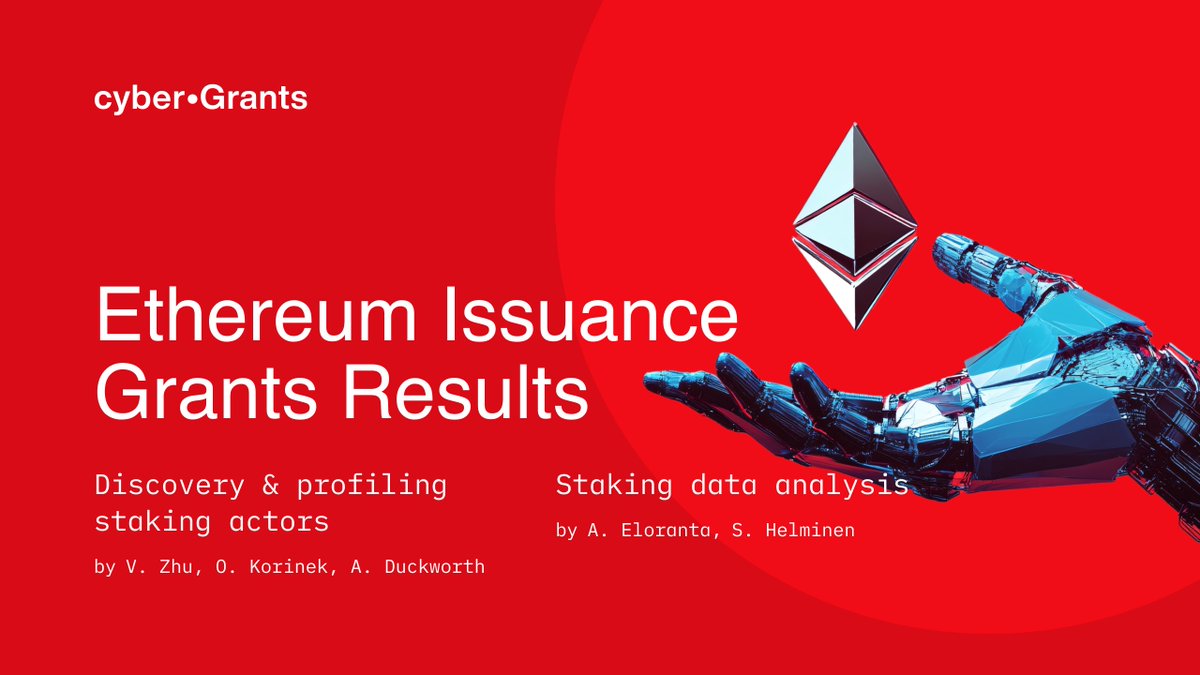
✨ Ethereum Issuance Grants Results ✨ We are excited to announce results of the first two MVI Grants: 1. Staking data analysis, by A. Eloranta, S. Helminen (@antsae_, @0xSanteri). The key findings of this empirical study are: ‣ Large staking pools have 12% higher mean returns compared to compared to single-validator stakers / solo stakers ‣ Ethereum Issuance can exacerbate the above dynamic ‣ Elasticity analysis shows strong correlation between solo stakers' deposits and relative staking yield compared to staking services ‣ Positive events result in higher inflows to large staking pools, compared to small ones 2. Discovery & profiling staking actors, by members of FranklinDAO: V. Zhu, O. Korinek, A. Duckworth (@vivzhuu, @OtakarKorinek, @0xDuckworth). 13 interviews were conducted in this study, uncovering interesting information, preferences and opinions of various actors within the staking economy: ‣ Investors that stake ETH ‣ Solo stakers ‣ Centralized Exchanges ‣ Centralized Staking Providers ‣ Decentralized Staking Middleware pools ‣ DVT service providers ‣ Retail investors ‣ Institutions The links to both papers are in the second tweet. Stay tuned for further updates!
cyber•Fund tweet media
cyber•Fund@cyberfund

★ Announcing MVI Grants ★ We are excited to share an update on the MVI Grants program – five stellar teams have been selected by the grants committee @artofkot, @brettpalatiello, @eliasimos. Why are we funding this research? Since the proposal to reduce the ETH issuance was suggested, the Ethereum community has been actively discussing its monetary policy. When considering issuance reduction, there is a trade-off for the network between the amount of ETH spent on rewards and how decentralized its validator set is. In particular, one of the main downside risks of reducing issuance is the potential concentration of staked ETH, especially in the view of the upcoming ETF launch. There are also a variety of other risks and factors associated with issuance reduction: margin compression, the resulting pressures on certain market segments, as well as increasing barriers for innovation. These factors touch the core values of Ethereum: decentralization and censorship resistance. Hence we believe that an evaluation of these risks is needed, in the form of a deep analysis of how the issuance curve change could affect the validator set composition. Scope: (1) Profiling different actors within the staking economy, via interviews and field research, to uncover key data points such as preferences, frictions, supply curves, elasticities, costs, etc. (2) Gathering, studying and deducing the data above using the historical Beacon Chain and DeFi data sets. (3) Building out theoretical models, taking into account the data above. (4) Studying equilibriums & limits, doing simulations, and ultimately understanding & evaluating the risks of how changing issuance may affect the staking ratio & the validator set. ↯ 5 grants teams that we have funded ↯ Cryptecon: Matthias Hafner @MatthiasHafner1, Juan Beccuti @BqJuancho, Thunj Chantramonklasri @tchantramonk, Nicolas Oderbolz, Nicolas Greber, Beatrix Marosvölgyi – economists, mechanism designers and modelers from the cryptecon.org crypto research group. Scope focus: (2-4) 20 squares: Philipp Zahn @philipp_m_zahn, Wenxuan Deng @dengwx11, Fabrizio Genovese @fabgenovese, Daniele Palombi @dpl0a – mathematicians, economists and modelers from the 20squares.xyz crypto research firm. Scope focus: (2-4) Franklin DAO: Vivian Zhu @vivzhuu, Otakar Korinek @OtakarKorinek – members of the research committee at franklindao.xyz, a DAO formed by students out of UPenn. Scope focus: (1) K. Kulkarni @ks_kulk – crypto researcher, finishing CS PhD at Berkeley, working with Gauntlet. Scope focus: (3-4) A. Eloranta @antsae_ & S. Helminen @0xSanteri – crypto researchers, worked with Flashbots and Token Terminal. Scope focus: (2) Read the full announcement at cyber.fund/content/mvi-gr…

English
1
16
57
11.9K
Antero
Antero@antsae_·
Huge thanks to PBS foundation for funding this study. You can read the full report here: @anteroe/BkIbSfwmJx" target="_blank" rel="nofollow noopener">hackmd.io/@anteroe/BkIbS…
English
0
0
3
393
Antero
Antero@antsae_·
In summary, while dynamic fees and first-access auctions can improve LVR redistribution in some cases, their effectiveness varies by pool and market conditions, suggesting the need for tailored approaches and further research into alternative solutions.
English
1
0
0
252
Antero
Antero@antsae_·
@JuusoAh and I conducted research on whether LVR could be redistributed to AMM LPs with dynamic fees and first-access auctions and found improvement in LVR redistribution in some cases. A 🧵
English
2
1
7
606