barkha deva

39.9K posts

barkha deva banner
barkha deva

barkha deva

@barkhad

Views are personal, RT not endorsements

new delhi, india เข้าร่วม Mayıs 2009
3.9K กำลังติดตาม6.3K ผู้ติดตาม
barkha deva
barkha deva@barkhad·
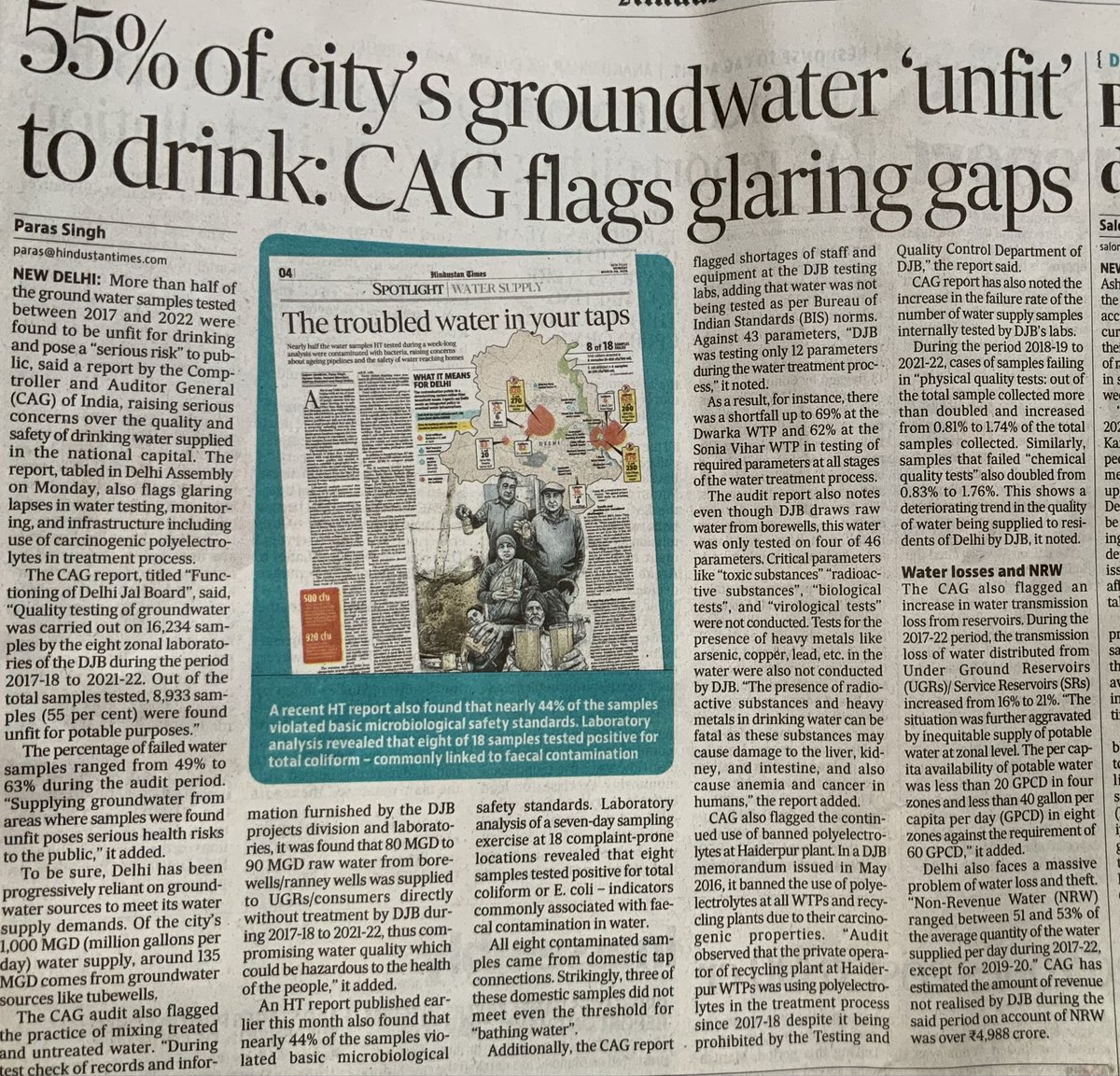
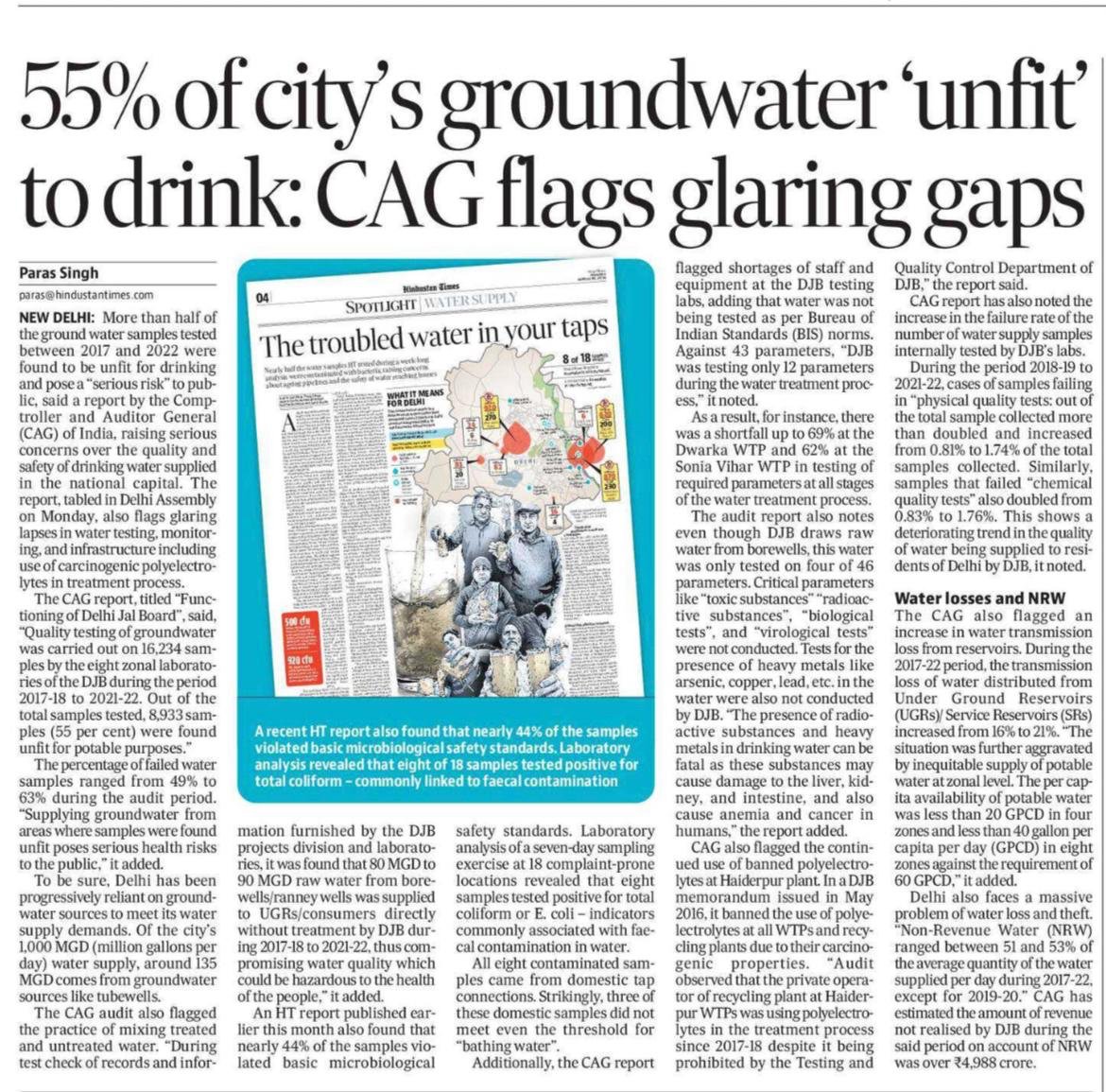
Shouldn’t Delhi’s circle rates for land sales take growing air and water pollution into consideration? When sales value and tax collections drop may be the govt will finally start addressing these issues seriously #righttobreathecleanair #pollution #delhipollution
barkha deva tweet media
English
0
0
0
40
barkha deva รีทวีตแล้ว
Sushant Singh
Sushant Singh@SushantSin·
This is in India's national capital. Imagine the situation elsewhere.
Sushant Singh tweet media
English
0
521
1K
14.6K
barkha deva
barkha deva@barkhad·
And now sadly an 81 year old is robbed of Rs. 15 crores. The elderly continue to be the most vulnerable to ‘digital arrest’ scams. Urgently need to step up messaging to create awareness about these scams and how the elderly can protect themselves when they get such calls.
barkha deva tweet media
English
0
0
0
13
barkha deva
barkha deva@barkhad·
Surely, the elderly deserve the ability to maintain their dignity in the digital world too. Else how long will it be before your parent, your neighbour, or you become the next Mr Malhotra?
English
2
0
1
126
barkha deva
barkha deva@barkhad·
There’s a new theatre of crime. The battleground is not the street, but the screen. And the casualties are quite often men and women who once taught us how to solve complex equations & balance cheque books. My piece on cyber crime targeting the elderly newindianexpress.com/web-only/2025/…
English
6
5
8
2.3K
barkha deva รีทวีตแล้ว
Sushant Singh
Sushant Singh@SushantSin·
The collapse of governance is visible in most domains.
Sushant Singh tweet media
English
0
116
219
7.5K
barkha deva
barkha deva@barkhad·
Assam minister Nandita Garlosa joined the Congress on Sunday after being denied a BJP ticket for the upcoming assembly polls in the northeastern state. deccanherald.com/elections/assa…
English
0
0
0
24
barkha deva
barkha deva@barkhad·
Pradyut Bordoloi says won’t subscribe to sectarian politics but believes that the CM from the party he’s joining must have a ‘reason for comments against minorities’. Fascinating
barkha deva tweet media
English
0
0
0
104
barkha deva
barkha deva@barkhad·
“Government data shows that nearly half of eligible beneficiaries had not received rations through the system by the end of 2025, with authentication failures leaving thousands of pregnant women, nursing mothers and young children without food.” What an absolute disaster
Adrija Bose@adrijabose

If you know me, you’ve heard me talk about this story for months. @HeraRizwan reported from 3 states. We obsessed over every detail. Google's AI, designed for phones, is now rationing food to pregnant women. Read. Get angry. Share boomlive.in/decode/ai-faci… @pulitzercenter

English
0
0
1
78
barkha deva
barkha deva@barkhad·
“What kind of economy is India building - one that can match rising aspirations with real opportunity, or one that leaves millions navigating underemployment and drift?” The question we need to answer honestly
Soutik Biswas@soutikBBC

India’s youth story is a paradox: abundance meets scarcity. With 367 million aged 15–29 - the world’s largest youth cohort - the stakes couldn’t be higher. But the transition from education to employment remains stubbornly broken. My story. bbc.com/news/articles/…

English
0
0
0
86
barkha deva รีทวีตแล้ว
Pankaj Pachauri
Pankaj Pachauri@PankajPachauri·
The window for reaping the fruits of the “Demographic Dividend” is fast closing on India: - Graduate unemployment (19-25 years) = 39.33% - Graduate unemployment (25-29 yrs) = 20% The situation has got worse since 2017.
Pankaj Pachauri tweet mediaPankaj Pachauri tweet media
English
8
99
191
6.2K
barkha deva รีทวีตแล้ว
Sushant Singh
Sushant Singh@SushantSin·
The demographic dividend.
Sushant Singh tweet media
English
1
183
350
9.9K
barkha deva
barkha deva@barkhad·
”If the war drags on, pushing the West Asian economies into contraction and forcing large-scale return of Indian workers, it would significantly dent India’s invisibles account surpluses.” If large number of workers return-will they find jobs ?? indianexpress.com/article/explai…
English
0
0
1
35
barkha deva
barkha deva@barkhad·
Where are the jobs? Within a year of graduation - Less than 7% male graduates find a permanent job & 3.7% find a white collar job Within a year of passing Class 12 -only 4% find permanent jobs CMIE survey showed female employment levels were so low that they weren’t examined
barkha deva tweet media
English
0
0
1
41
barkha deva รีทวีตแล้ว
Sushant Singh
Sushant Singh@SushantSin·
Bizarre doesn't even get to describe it.
Sushant Singh tweet media
English
0
41
113
5K
barkha deva
barkha deva@barkhad·
2.05 lakh malnourished children recorded in 20 districts nearly 1.69 lakh were 'underweight' 36,805 are 'severely underweight' Worrying reports from Gujarat deccanherald.com/india/gujarat/…
English
0
1
2
37
barkha deva รีทวีตแล้ว
Ms Pinki Virani
Ms Pinki Virani@ViraniPinki·
What can #parents of #HarishRana now ask for as their 'haque' #right in #PassiveEuthanasia including palliative care. Explainer on internationally-approved tapering of feed and increasing pain medicine, gradually, for #PVS [#PersistentVegetativeState] patients. #DyingWithDignity
Press Trust of India@PTI_News

VIDEO | Canada: Journalist and author Pinki Virani, on passive euthanasia death, said, "Supreme Court has given patients the right to die with dignity." (Full video available on PTI Videos - ptivideos.com)

English
0
2
1
310
barkha deva รีทวีตแล้ว
Salman Soz
Salman Soz@SalmanSoz·
According to this report, the Indian economy grew even faster than earlier estimates during Dr. Manmohan Singh’s time. Under PM Narendra Modi, economic growth was overestimated by quite a bit. A double whammy!
Peterson Institute@PIIE

New evidence suggests India misestimated annual economic growth rate during the past two decades. Growth in boom years 2005-2011 may have been underestimated by ~1–1.5 percentage points, & growth from 2012-2023 overestimated by ~1.5-2 percentage points. piie.com/publications/w…

English
8
185
603
40K
barkha deva รีทวีตแล้ว
Sushant Singh
Sushant Singh@SushantSin·
Everything is mighty fine, as per "sources".
Sushant Singh tweet media
English
1
275
509
19K
barkha deva
barkha deva@barkhad·
Govt wants to fast track the Women’s Reservation Act by delinking it from the census. Which means the window for setting the agenda on how women will age, dignified ageing, and eldercare is NOW. Because more seats in legislative houses without an agenda-is still just presence
barkha deva tweet media
English
0
0
1
19
barkha deva
barkha deva@barkhad·
Political parties have three years to identify potential candidates for Parliament 2029. But fielding more women is not the same as changing what Parliament will discuss. They need to understand that this new Parliament must represent women through the full arc of their lives.
English
1
0
0
40
barkha deva
barkha deva@barkhad·
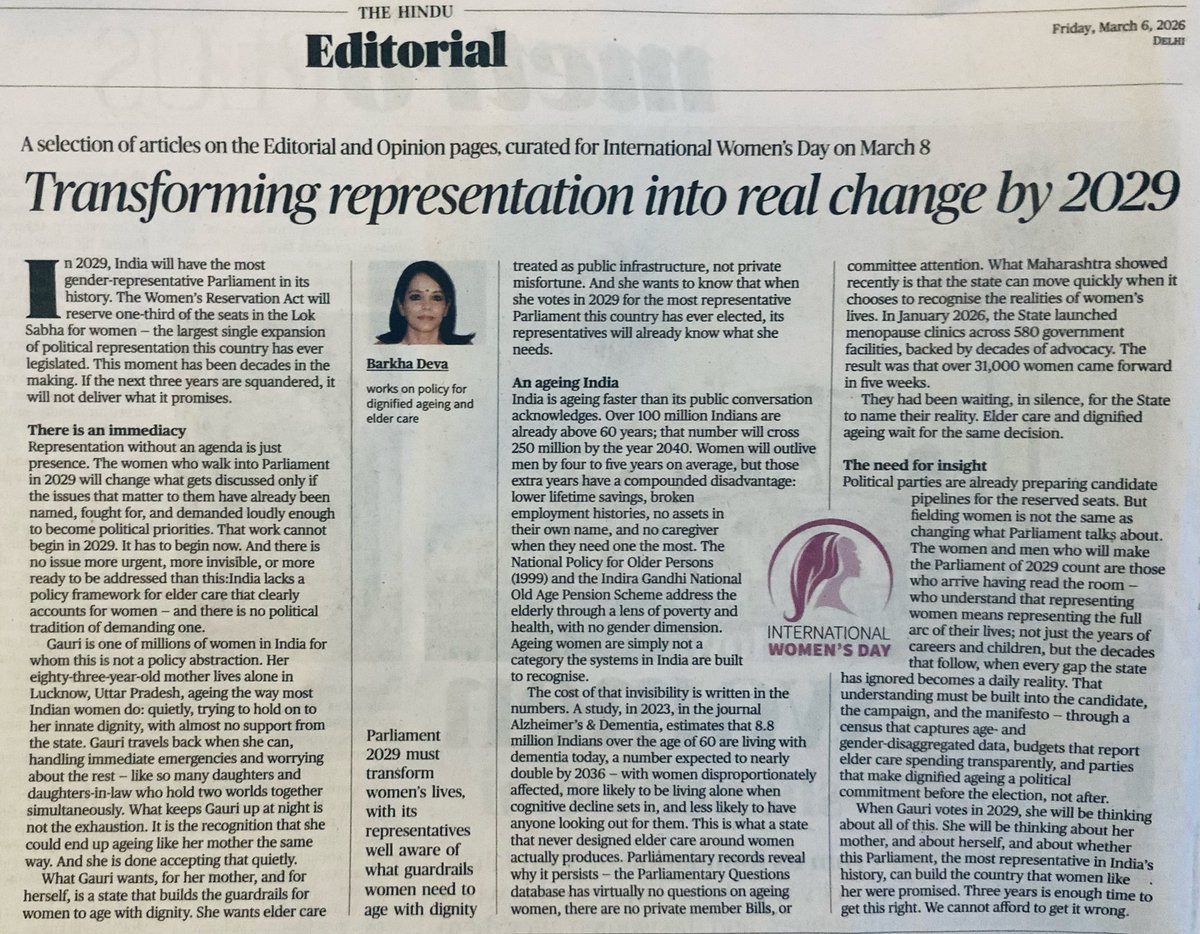
India is three years away from its most gender representative Parliament. For this historic House to represent the full arc of women’s lives, we need to talk about how women age today. And demand the policy guardrails for her to age with dignity tomorrow. thehindu.com/opinion/lead/t…
barkha deva tweet media
English
2
3
9
1.4K
barkha deva รีทวีตแล้ว
anshuman tiwari
anshuman tiwari@anshuman1tiwari·
#thebottomline India's LPG Crisis Isn't a War Story. It's a Policy Story. The War Just Made It Visible ! India always knew the Strait of Hormuz was the jugular vein of its cooking gas supply. The country even had a rehearsal in June 2025. ---------- The Architecture of a Self-Built Trap In 2024–25, India consumed 31.3 million tonnes of LPG but produced only 12.8 million tonnes domestically. That meant roughly two-thirds of the country’s demand depended on imports. Even more concerning, nearly 90% of those imports moved through a single 33-kilometre choke point — the Strait of Hormuz. This vulnerability was never hidden. For years it sat in energy ministry reports, policy discussions, and supply projections. The risk was visible, measurable, and repeatedly acknowledged. That’s what makes the current crisis different from an unforeseen shock. It didn’t appear overnight. It was a known weakness that policymakers recognised but kept postponing until that disruption arrived. The Warning That Produced Half an Answer The twelve-day Israel–Iran conflict in June 2025 briefly turned that long-discussed risk into something real. For the first time, the possibility of Hormuz disruption felt immediate. India did respond — but only partially. Over the following months, policymakers worked to diversify LPG imports. Dependence on Middle Eastern suppliers fell from near total in 2024 to about 70% by early 2026. Cargoes from the United States and other sources slowly entered the supply mix. It was a meaningful adjustment, but not a transformative one. When the larger conflict unfolded, India was less exposed than before, but still exposed enough to trigger large scale emergency measures. The government invoked the Essential Commodities Act, commercial cylinders were rationed, and the price of a ₹910 LPG cylinder climbed to nearly ₹2,000 on black markets. What the Emergency Response Cannot Fix The government’s March 5 emergency package was swift and technically sound. Refineries were ordered to maximise LPG output. India signed a 2.2-million-tonne import agreement with suppliers on the US Gulf Coast. Officials increased the share of non-Hormuz imports from 55% to 70% of the supply mix, while booking intervals for domestic cylinders were extended to 25 days to slow consumption. As short-term crisis management, these steps are practical, but they also highlight what was missing before the crisis began. The Three Critical Gaps The First Gap is strategic reserves. India maintains petroleum reserves that can cover roughly one additional week of oil consumption during disruptions. For LPG — the cooking fuel used by over 33 crore households — no comparable reserve structure exists. Not even a single day of dedicated strategic LPG buffer separates a supply shock from a household shortage. The Second Gap is a subsidy-investment imbalance. In 2024–25, oil marketing companies reported about ₹39,000 crore in losses on subsidised LPG, with government compensation covering roughly ₹30,000 crore. Each year, India spent enormous sums absorbing the cost of import dependence while investing far less in the infrastructure — domestic production, storage capacity, or alternative fuels — that could reduce that dependence. The Third Gap lies in alternative energy adoption. Programmes promoting electric induction cooking, biogas, and compressed biogas under initiatives like PM-JI VAN Yojana were framed largely as environmental or rural development efforts rather than as strategic energy security measures. Without that urgency, the transition remained gradual, leaving the country heavily tied to imported LPG. The Price of Delay Global markets reacted quickly to the disruption. Northwest European propane prices jumped 30% to €715 per tonne on March 3, while replacement cargoes from the US Gulf Coast are arriving at a 40–50% premium compared with pre-war Gulf supplies. Every tonne of LPG India buys today under emergency conditions costs more than it would have cost to maintain the strategic reserves and diversified supply systems that were never built. #LPG #iranwar #hormuz
anshuman tiwari@anshuman1tiwari

#thebottomline The Marginal Barrel Problem: How the West Asia War Broke the Global Oil System's Last Safety Valve The Assumption That Died at Ras Tanura For decades, the global oil market ran on a simple stabilizing belief: when supply tightened anywhere, the Gulf would open the taps. Saudi Arabia’s spare capacity acted as the system’s shock absorber. Within days, additional barrels could enter the market and calm prices no matter where the disruption began. Libya collapsed, Venezuela faltered, Russia faced sanctions — the Gulf could compensate. But that entire architecture rested on one critical condition: the disruption had to happen somewhere other than the Gulf itself. The West Asia war shattered that condition faster and more completely than most market models ever truly stress-tested. The marginal barrel problem has effectively flipped on its head. Instead of OPEC+ deliberately holding back supply to keep prices stable, the market is now dealing with involuntary outages inside the Gulf. Meanwhile, the producers who are often described as holding “swing capacity” — U.S. shale, Brazil, and Guyana — cannot respond instantly. They operate on much longer timelines. Shale typically requires four to six months from drilling to production, and deepwater projects like Brazil’s pre-salt fields or Guyana’s Stabroek block simply cannot be accelerated quickly enough to matter during an unfolding crisis. The result is a widening gap between the moment a disruption occurs and the moment new supply can realistically appear. That lag has never been larger. And right now, the market is more exposed than it has been in decades. The price Signal Nobody Wanted to See The price reaction has been immediate and unmistakable. Brent surged to $117.04 at the open on March 9. At the same time, WTI ended the previous week up 35%, marking the largest weekly gain in the history of the futures contract since its launch in 1983 — even surpassing the spike during the 1990 Gulf War. Market analysts are now modeling scenarios that would have seemed extreme only weeks ago. Kpler’s lead crude analyst has warned that Brent could reach $150 by the end of March if tanker traffic through the Strait of Hormuz does not resume at meaningful levels. Allianz warns of a tail-risk scenario pushing Brent above $130 due to infrastructure and shipping disruptions, while Goldman Sachs now views $100 as a price floor rather than a ceiling. What the market is pricing today is not simply a temporary supply shock followed by recovery. Instead, it is beginning to account for the possibility that the global energy system’s last operating assumption has been structurally damaged. Hormuz: Closed Without Being Physically Shut The most striking evidence of this shift can be seen in shipping traffic through the Strait of Hormuz. On March 1, only four crude tankers passed through the strait. Since January, the daily average had been twenty-four vessels. That represents an 83% collapse in throughput, and it occurred without a single naval mine deployed or any physical blockade in place. At the moment, around 200 internationally trading crude and product tankers are stranded inside the Gulf, unable to find a viable path outward. The mechanism behind this shutdown is not military obstruction but insurance withdrawal. Insurers stepping back from the risk have effectively created the same commercial outcome as a physical blockade. Ships simply cannot move without coverage. Mizuho Bank estimates the continuing war premium at roughly $5–15 per barrel, even if escort convoys operate consistently. That premium reflects something deeper than the immediate disruption. It signals a permanent repricing of Hormuz — from a neutral commercial artery into a contested strategic waterway. Once markets make that adjustment, it does not simply reverse with a ceasefire. What Has Actually Been Struck — And Why It Matters The attacks themselves have not been random. They have been highly targeted at nodal points — facilities whose disruption spreads the fastest and furthest across the global energy network. Ras Tanura, the largest refinery and export hub operated by Saudi Aramco, has entered emergency shutdown. At peak capacity, the facility handles around 7% of global oil supply, making it one of the most critical pieces of infrastructure in the entire system. In Qatar, both Ras Laffan and Mesaieed Industrial City — together forming the most concentrated LNG export complex in the world — have halted production entirely. These facilities normally supply 81 million tonnes of LNG annually. The consequences were immediate. European gas futures jumped 30%, while LNG tanker freight rates surged 40% in a single trading session. Perhaps the most consequential strike targeted Fujairah in the United Arab Emirates. Fujairah functions as the primary bypass route for Hormuz, the contingency outlet designed specifically for situations where the strait becomes unsafe. On March 3, that terminal was hit by drone strike. The redundancy the global oil system relied upon — the backup pathway meant to relieve pressure in exactly this scenario — disappeared at the very moment it was needed most. The Self-Amplifying Shock The deepest structural issue now unfolding was absent from nearly every pre-war model. Gulf producers are beginning to curtail production, not because demand has collapsed but because there is nowhere left to store the oil being pumped. Storage facilities fill up quickly under disrupted shipping conditions. When that happens, wells must shut down. That dynamic turns the supply shock into a self-reinforcing cycle. Even if no additional attacks occur, output still falls. Iraq, which relies entirely on Hormuz for exporting Basra crude, has no alternative route. Southern oil fields are already beginning to shut down. Kuwait has reduced production as well, citing risks to tanker passage. The ripple effects are already spreading through Asia’s industrial system. China’s Zhejiang Petrochemical has closed a 200,000-barrel-per-day refining unit. India’s MRPL refinery has halted crude processing. Japan, which sources 95% of its crude from Gulf states, has begun releasing oil from its strategic stockpiles. Across Singapore and Indonesia, declarations of force majeure are multiplying as supply contracts fail to be fulfilled. What began as strikes in the Gulf is now cascading outward into industrial slowdowns across Asia. This was never a purely theoretical risk in energy models — it is now unfolding as a live operational reality. Strategic petroleum reserves can soften the blow, but only for a limited time. Even at maximum coordinated release rates, the combined SPR coverage amounts to roughly thirty days against a shortfall measured in millions of barrels per day. After that thirty-day window, there is no established institutional mechanism ready to replace the missing supply. No major multilateral model currently published offers a transparent explanation of what happens when that gap appears. Donald Trump described rising oil prices as “a very small price to pay.” But with Brent already above $117 and moving toward $125 — the level where several banking models indicate demand destruction begins in emerging markets — the definition of “small” varies sharply depending on where you sit. In Beijing, Mumbai, Seoul, and Nairobi, the cost looks very different. #IranIsraelUSAWar #Oil

English
10
95
233
30.1K