BenBerg

3.7K posts

BenBerg banner
BenBerg

BenBerg

@benberg

AI founder, operator & lecturer translating complex science into clear, usable decisions for business and policy. 37 years in AI. Essays: benoitbergeret.substac

Paris, France เข้าร่วม Mart 2007
2.5K กำลังติดตาม1.6K ผู้ติดตาม
BenBerg
BenBerg@benberg·
So, LLMs Have Emotions? We made this mistake with "intelligence." The word is the trap. New Fault Lines essay on why we need a different word, and what it might be. open.substack.com/pub/benoitberg…
English
0
0
0
7
BenBerg
BenBerg@benberg·
LLMs treat silence as a bug, evasion as confusion, and ambiguity as noise. In half the world, those are core competencies. New piece on what the training pipeline can't see. open.substack.com/pub/benoitberg…
BenBerg tweet media
English
0
0
0
25
BenBerg
BenBerg@benberg·
Un patient marocain qui répond "bessif" à un chatbot médical ne dit pas "oui, je suivrai le traitement." Le chatbot enregistre de la compliance. Le patient a dit tout autre chose. open.substack.com/pub/bbergeret/… Sur ce que les modèles de langage font aux langues qu'ils ne voient pas.
BenBerg tweet media
Français
0
0
0
18
BenBerg
BenBerg@benberg·
$1.03B to build an architecture whose central feature is learning what to ignore. Van Assel says what it learns to ignore is permanent. The ω question: who specifies what it's forbidden to compress? open.substack.com/pub/benoitberg…
English
0
0
0
18
BenBerg
BenBerg@benberg·
AI was supposed to let everyone code: “just talk to the model”. Instead, power slid one layer down, into configuration: Skills, MCP, plugins, governance wrappers. We’re hollowing out the technical middle class and building The New Clergy. open.substack.com/pub/benoitberg…
BenBerg tweet media
English
0
0
1
34
BenBerg
BenBerg@benberg·
Walter Benjamin wrote 13 rules for writers in 1928. They were for one kind of mind. I rewrote his rules for spatial thinkers — the ones whose bottleneck was never the ideas, but the flattening. open.substack.com/pub/benoitberg…
BenBerg tweet media
English
0
0
1
61
BenBerg
BenBerg@benberg·
Les moments historiques ne s'annoncent pas. Ils arrivent, et on voit après coup qui les a saisis et qui les a ratés. À Davos cette semaine, deux discours, l'un construit quelque chose. L'autre déroule une stratégie. bbergeret.substack.com/p/davos-le-can…
BenBerg tweet media
Arnaud Bertrand@RnaudBertrand

Who could have expected Mark Carney, a liberal establishment figure if there ever was one, to be the flag-bearer for the end of the US-led order? And from a podium at Davos, of all places? The more you think about it, though, the more it makes sense. Carney is, at heart, a central banker. As such he understands the power of words and beliefs better than anyone: when you strip things down to their core, a world order - like trust in a currency or a financial system - fundamentally relies on the maintenance of belief. Systems of power exist because participants act as if they exist. That's pretty much it: perception is reality. Once participants acknowledge the fiction as Carney just did (he literally started his speech announcing he'd "end the pleasant fiction" of the US-led order), the system itself unravels. This is incidentally a formal concept in game theory: the shift from private knowledge to common knowledge is what triggers cascades. Carney, with his background, ought to have known this was his most potent weapon facing Trump's America: "Trump has the economic and military might. But I have something his power rests upon: I can shatter the collective belief that sustains it." He's even explicit about this being his thinking: his entire speech revolves around Vaclav Havel’s famous shopkeeper analogy and the fact that the power of the Soviet Union rested on "everyone’s willingness to perform as if it were true," on "living within a lie." As Carney puts it, "when even one person stops performing, the illusion begins to crack" and the entire "system’s power" starts to crumble. Today, that "one person" was him. Make no mistake, Carney’s speech at Davos may prove to be one of THE most important speeches made by any global leader over the past 30 years. This is genuinely epochal stuff. More than anything, what it means is that, to the extent it even existed at all, the West irremediably lost the Second Cold War: a Cold War requires two competing systems. Carney just announced that one of them simply no longer exists. This is the topic of my latest article: an in-depth analysis of Carney's speech and its immensely consequential implications for what comes next. Enjoy the read here: open.substack.com/pub/arnaudbert…

Français
0
0
0
212
BenBerg
BenBerg@benberg·
I’ve been sitting on this for ages, unable to carve out the time to do it justice. I’ve finally forced myself to get it out there: "From Asimov to Optimus: Can SciFi really become a business plan?" open.substack.com/pub/benoitberg…
BenBerg tweet media
English
0
0
1
40
BenBerg
BenBerg@benberg·
@iruletheworldmo Yawn 🥱 Heavily AI driven piece with no proper AI auto criticism (or it would have detected that it’s riddled with projections and logic shortcuts that kill any credibility). Clickbait slop.
English
0
0
0
9
BenBerg
BenBerg@benberg·
@alex_prompter Link to the Stanford study you refer to? I was not able to locate it. Thank you!
English
0
0
1
42
Alex Prompter
Alex Prompter@alex_prompter·
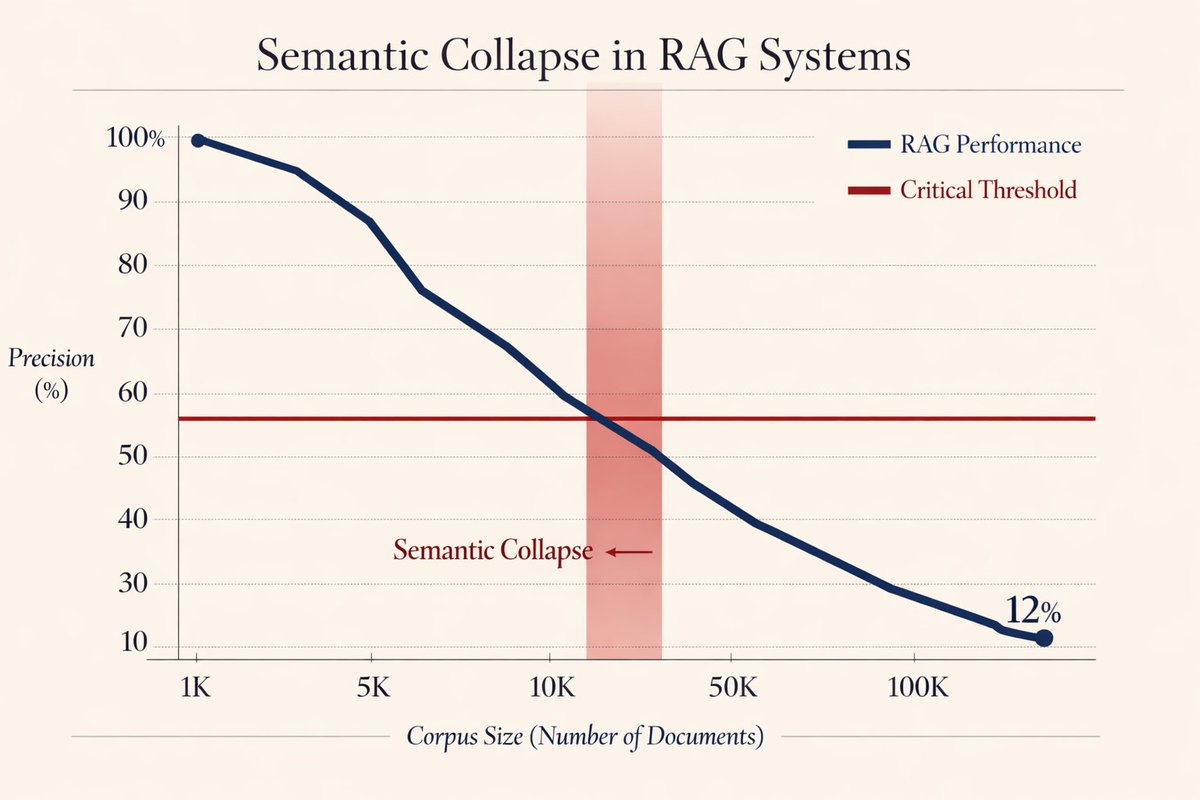
🚨 RAG is broken and nobody's talking about it. Stanford just exposed the fatal flaw killing every "AI that reads your docs" product. It's called "Semantic Collapse", and it happens the moment your knowledge base hits critical mass. Here's the brutal math (and why your RAG system is already dying):
Alex Prompter tweet media
English
366
681
4.9K
1M