
Vincent Russo
119 posts
Vincent Russo
@captainhamptons
BS, MS, and PhD in computer science. Software engineer focused on quantum computing. Metalhead guitar player.
เข้าร่วม Temmuz 2014
1.3K กำลังติดตาม365 ผู้ติดตาม
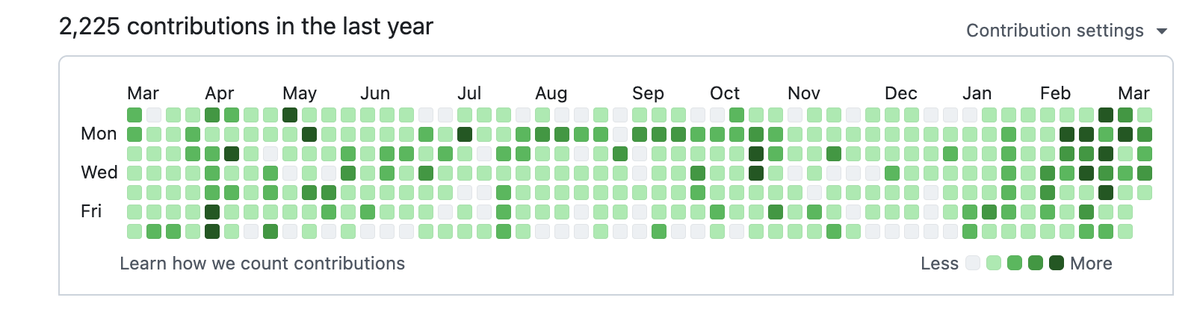

If your GitHub looks like this. Please apply.
OpenAI.com/form/codex-for…
Shaun Smith@evalstate
So pleased to have been accepted in the Codex for Open Source program. Thanks to @reach_vb and the team at OpenAI for putting this together - and supporting builders, maintainers and "getting" Open Source code. Lets' go build!
English
Vincent Russo รีทวีตแล้ว

Quantum computers are getting better and more complicated and it’s important to have a system to transparently track progress.
Some new updates from @unitaryfdn and open source collaborators in new work building the metriq-gym platform to do this.
Unitary Foundation@unitaryfdn
How do you ensure quantum benchmarking happens in the open? Unitary Foundation has released an update to the open-source Metriq platform for collaborative benchmarking of quantum computers. We describe the platform in a new paper, which came out today: scirate.com/arxiv/2603.086…
English
Vincent Russo รีทวีตแล้ว

How do you ensure quantum benchmarking happens in the open? Unitary Foundation has released an update to the open-source Metriq platform for collaborative benchmarking of quantum computers. We describe the platform in a new paper, which came out today: scirate.com/arxiv/2603.086…
English
All results are version-controlled in a public dataset and visible at metriq.info. The suite is designed to evolve. New benchmarks enter through community RFCs.
Paper: arxiv.org/abs/2603.08680
Platform: metriq.info
Code: github.com/unitaryfoundat…
English
Dispatching a suite of benchmarks on a device ∈ {IBM,Quantinuum, IQM, Rigetti, IonQ, OriginQ} using the metriq-gym CLI
pip install metriq-gym
github.com/unitaryfoundat…
English
🎉🎉New paper: "Metriq: A Collaborative Platform for Benchmarking Quantum Computers" 🎉🎉
We built an open platform to run the same benchmarks across quantum hardware from IBM, Quantinuum, IQM, Rigetti, IonQ, and OriginQ, then compared them all.
scirate.com/arxiv/2603.086…
English
New preprint! We show that a simple greedy strategy (measure each qubit independently) is always competitive for learning Boolean properties of quantum sequences, and is exactly optimal iff the target function is affine.
🔗 arxiv.org/abs/2603.05452
English
@grvphy @JackSon27343129 @zlatko_minev Thank you, @grvphy , this is great! I've added these to the QEM protocols and have made an effort to explain them as best I can. Please feel free to let me know if anything should be changed, or open an MR/issue on GitHub!
github.com/vprusso/qemzoo
English

@captainhamptons @JackSon27343129 @zlatko_minev Hey Vincent,
We developed three EM techniques recently which might be a good addition:
1. Error Mitigation by Restricted Evolution (EMRE): a constant runtime protocol
2. Hybrid EMRE (HEMRE)
3. Physics-Inspired Extrapolation (PIE)
arXiv for 1, 2: 2409.06636
arXiv for 3: 2505.07977
English

If you work on quantum error correction, be sure to check out The Error Correction Zoo: errorcorrectionzoo.org
The Error Correction Zoo is an open, community-driven resource dedicated to compiling, organizing, and explaining known quantum error correction codes.
English
Code and numerics in toqito (v1.1.3):
github.com/vprusso/toqito
factor_width.py – compute factor width ≤ k
is_k_incoherent.py – test k-incoherence
learnability.py – test k-learnability of states
Tutorial with examples from the paper:
toqito.readthedocs.io/en/latest/auto…
English
Intractable regime: when both k and d scale with input, deciding k-learnability is NP-complete.
NP membership: succinct certificates exist via Carathéodory (only n²+1 vectors needed, despite exponentially many POVM outcomes).
NP-hardness: via reduction from k-Clique.
English
🎉🎉 New preprint: "The complexity of perfect quantum state classification" 🎉🎉
We introduce k-learnability: how many guesses you need to identify an unknown pure state with zero error.
scirate: scirate.com/arxiv/2510.207…
arXiv: arxiv.org/abs/2510.20789
English
RIP Tomas Lindberg of At the Gates. Thank you for making the greatest metal record of all time:
youtube.com/watch?v=URhmC8…

YouTube
English
Vincent Russo รีทวีตแล้ว
The newly updated version of our Local Friendliness violations paper has now been published in @quantumjournal!
We run some experiments using quantum computers to try and shed light on what observers are, proposing further experimental tests to help resolve the measurement problem in quantum mechanics.
The paper and results have been streamlined so it's worth a re-read.
w/ @farrokhlabib @captainhamptons
Will Zeng@wjzeng
New preprint today: Towards violations of Local Friendliness with quantum computers Quantum tech has important commercial as well as basic science applications. We show how you can use quantum computers to run increasingly important quantum foundations experiments. joint work @unitaryfund w/ @farrokhlabib and @captainhamptons
English
Vincent Russo รีทวีตแล้ว

(Thread 1/8)
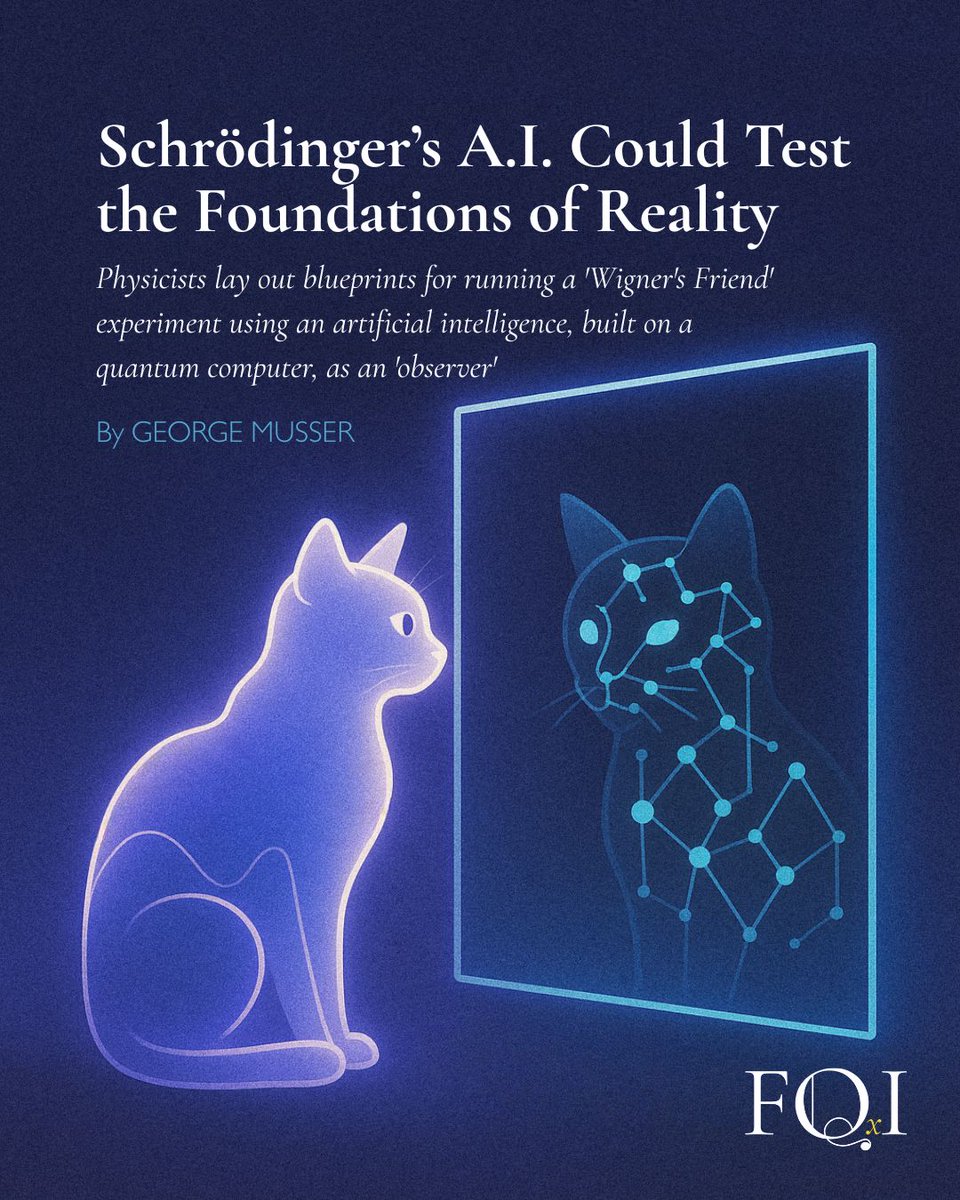
In quantum mechanics, a system can be in two states at once, until someone looks. But what happens if there’s another “someone” — an observer inside the system. The outer and inner observers will have contradictory views of the situation. To quantify this situation, Howard Wiseman at @Griffith_Uni and Eric Cavalcanti with NASA's Eleanor Rieffel set out a “thoughtful Local Friendliness” test in @quantumjournal in 2023. They suggested that the inner observer could even be an AI. In their framing, an observer must have thoughts, so a real experiment would need human-level AI and fast, large quantum computers. Veronika Baumann and Časlav Brukner at @iqoqivienna clarified the constraints: if the AI stores or shares a classical record, or becomes aware that its memory changed during the procedure, the effect vanishes. On hardware, @wjzeng, @farrokhlabib and @captainhamptons encoded a simplified version of the scenario as quantum circuits and saw larger Local Friendliness violations as the branch factor increased, up to 16.
"Schrödinger’s A.I. Could Test the Foundations of Reality" — By @gmusser: qspace.fqxi.org/articles/266/s…
English
Vincent Russo รีทวีตแล้ว

🚨New paper:
The phenomenon of quantum nonlocality without entanglement is not solely a property of the quantum states, but also depends on how they are discriminated. arXiv link below.
arxiv.org/pdf/2506.20560
#quantum #QuantumMechanics
English