@divvsaxena No, this is an in-person internship and only available to undergraduate students at North American universities.
English
Daphne Ippolito
51 posts

@daphneipp
I am an assistant professor at Carnegie Mellon University and also a senior research scientist at Google. I research topics in natural language generation.

🚀Apply to CMU LTI’s Summer 2026 “Language Technology for All” internship🎓Open to pre‑doctoral students new to language tech (non‑CS backgrounds welcome). 🔬12-14 weeks in‑person in Pittsburgh; travel + stipend paid.💸Deadline: Feb 20, 11:59pm ET. forms.gle/cUu8g6wb27HsWW…


At #ACL2024 and interested in detecting generated text? Come check out our poster session tomorrow (Session 5) Aug 13 @ 16:00! We'll talk about benchmarks, detector robustness, future directions, etc. Website: raid-bench.xyz Paper: arxiv.org/abs/2405.07940
✨New Preprint ✨ How are shifting norms on the web impacting AI? We find: 📉 A rapid decline in the consenting data commons (the web) ⚖️ Differing access to data by company, due to crawling restrictions (e.g.🔻26% OpenAI, 🔻13% Anthropic) ⛔️ Robots.txt preference protocols are ineffective These precipitous changes will impact the availability and scaling laws for AI data, affecting coporate developers, but also non-profit and academic research. 🔗 dataprovenance.org/consent-in-cri… 1/

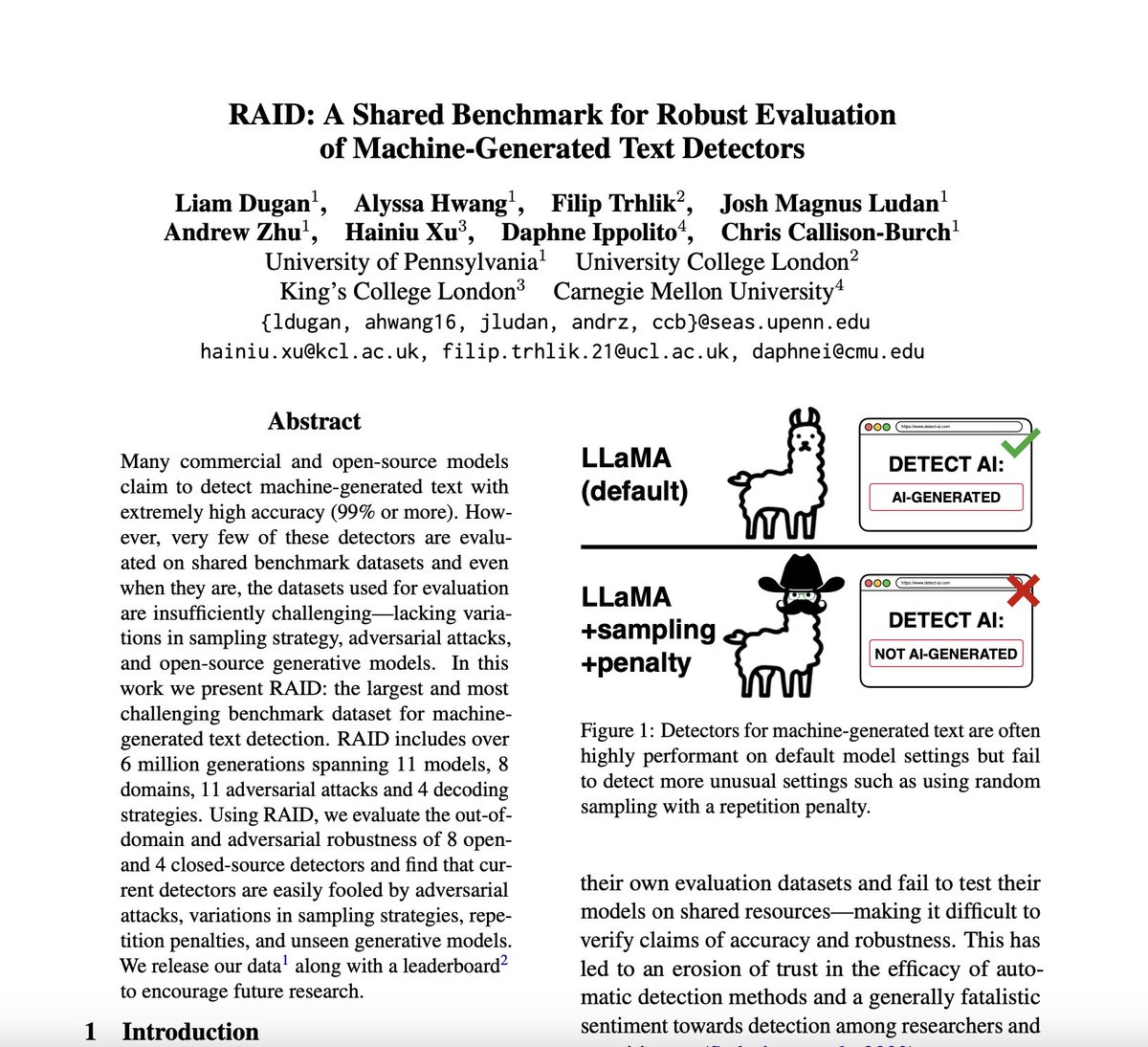

✨New Paper✨: Can human readers detect generated text from language models like #ChatGPT? Turns out some can ✅ and some can't ⛔ (but people improve significantly with practice!) We release RoFT, the largest dataset of human detection to date arxiv.org/abs/2212.12672 🧵 1/
The internet is increasingly awash with AI-generated text. Here's how to detect whether something was written by a human or a machine. trib.al/2CZdNNu

To explore how a dialogue engine can assist writers with idea generation, we are building a text editing tool on LaMDA. We teamed up with professional writers who used the editor to create a volume of short stories. Check out their great work. (2/5) g.co/research/wordc…