So many designers hate wireframing.
I'm not one of those designers.
AI can generate high fidelity screens in seconds. Figma has auto layout, variables, components. The bar for a polished prototype has never been lower.
Yet, I still love starting projects with a black and white wireframe.
Even when I'm using AI to generate early concepts, I'll specifically prompt it to stay wireframe-only.
No color.
No shadows.
No corner radius.
Pure outlines.
This is a psychological decision, not a technical one.
When I show up to an early client review with even a partially styled UI, the conversation drifts.
Suddenly we're talking about the button color or the font weight instead of the flow, the information architecture, or whether the core experience actually makes sense.
Wireframes remove that distraction.
They force the conversation to stay on what matters early:
Does this work?
Does the information make sense?
Can a user complete the task?
You can always add the visuals later. You can't easily undo a client who's already anchored on the wrong thing.
Do you still wireframe, or have you skipped straight to high fidelity?
AI can generate images, code, ideas, and designs.
But it cannot generate ambition.
I've been building with some of the most capable tools ever made this past year. And what I've realized is that even with the best technology in my hands, it is not converting me into some overnight success. It hasn't done that for anyone.
What it has done is shown me how much work still lives on the other side of a good idea.
Focus. Grit. The willingness to go deep on one thing long enough to actually build it out, test it, and see it through. You cannot prompt for any of that.
Here's what I keep realizing:
No one is coming to hand you skills, money, achievements, or freedom. You have to get up and go get it.
And the good news is you can. You don't need permission. You don't need someone to tell you which path is best. You just need to be decisive and trust that you are more capable than your own doubt is telling you.
Whatever it is you want, go get it.
Flashback to my top 12 Dribbble posts circa 2019.
These 12 posts alone generated about 400k views.
That exposure led to several job opportunities.
That was my first taste of the power of finding work by putting your work online.
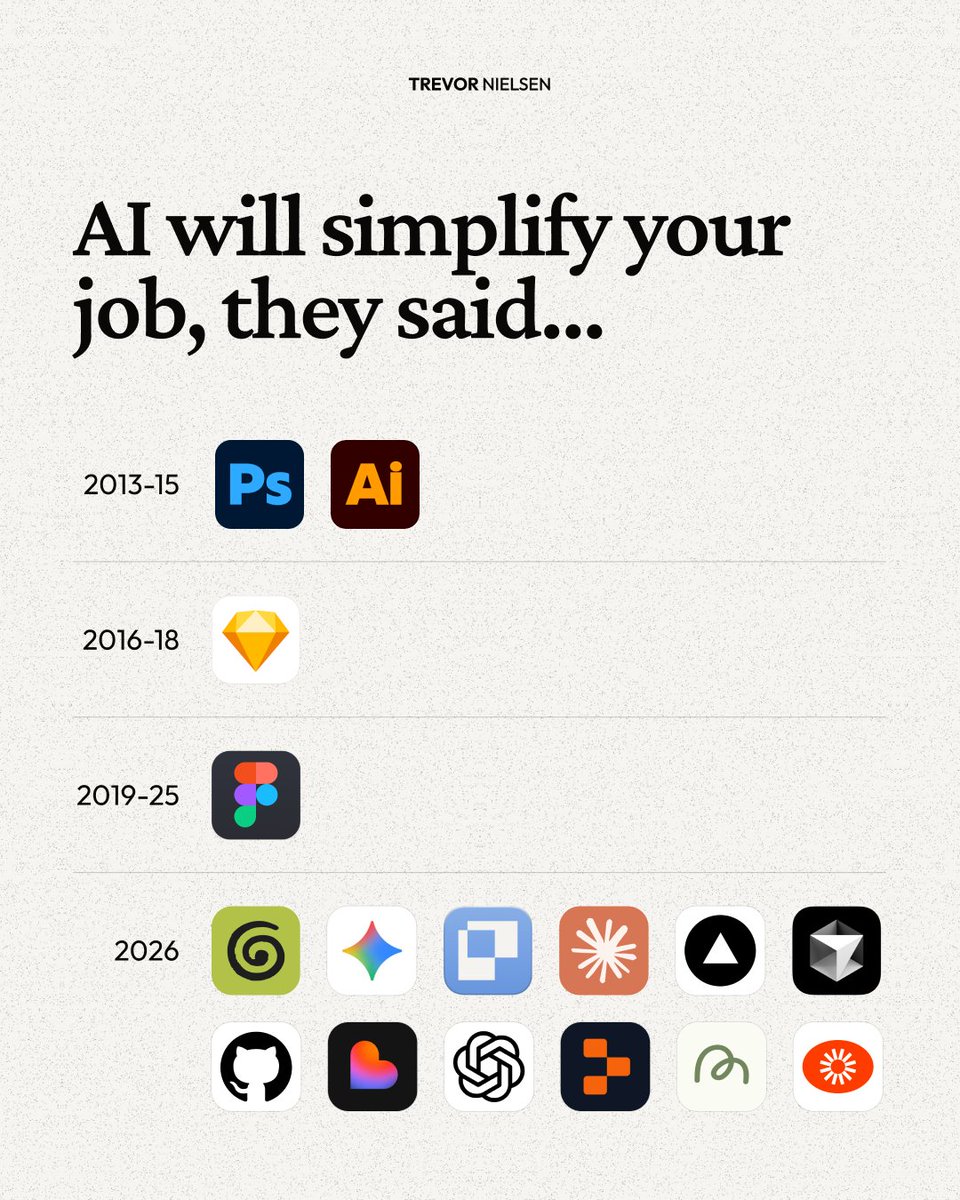
AI will simplify your job, they said...
2013: Adobe
2016: Sketch
2019: Figma
2026: [see image]
I have never spent more money on software than I have in the last two years.
It used to feel simple. One tool, maybe two. That was the job.
Now AI is making designers feel capable of doing more than just design. Dev. Content. Strategy. Product. And with that comes a whole new stack of tools to learn, pay for, and keep up with.
It's a lot. But staying current matters. The tools you know today are the ones clients and employers will be hiring for tomorrow.
@designertom is running a UX tools survey to map exactly what designers are using right now.
Takes 3 minutes. Worth doing. survey.uxtools.co
I spent 8 hours last week hand sketching logos for a client.
In a world pushing to automate everything, this felt nice.
So I went back through my notebooks. Years of sketches, hundreds of explorations.
All done by hand. No prompts. Just paper (or iPad) and a pen.
In the spirit of transparency, here's a snapshot of what's on my plate as a freelancer right now.
Active projects:
- E-commerce site revamp focused on improving conversions
- Fresh brand identity for a real estate client
- Content partnership with a tool I love, kicking off soon
Leads in the pipeline:
- Real estate startup: pitch deck first, then a full platform build
- Biotech company looking to expand their existing product
- Mental health mobile app, still in early conversations
Side projects:
- A paid workshop on visibility for designers
- A golf app I'm building with some friends
- A design mockups tool I keep coming back to
Everyone says niche down. I get it. But being too rigid about the type of work you take on is risky.
Industries shift. Interests shift. Staying open to more than one type of work has filled gaps I didn't see coming.
Versatility is underrated. Especially in freelance.
Creators get accused of forgetting how to do the actual work.
In design, I hear it constantly.
"The best designers I know don't waste time chasing followers. They just put their head down and get better at the craft."
I've been on the receiving end of that criticism.
And they're not entirely wrong. Because it's true for some people.
But it's also used as a lazy way to dismiss anyone who chose to build an audience alongside their career.
Does chasing followers make you worse at your job?
Designers are losing sleep right now. Not from anxiety. From excitement.
Last week I was up multiple nights until 1am, 2am. Not because I have to be. Because I can't stop building. The tools we have today are unlocking something that's been held back for years.
And I'm not alone. Dozens of designers I know are saying the same thing.
Yes, a lot of people are scared. I get it.
But most of that fear lives in a future nobody can predict. Everyone has a prediction. Nobody has a crystal ball. Not the experts, not the futurists, not the people building the tools.
What I do know is what's happening right now.
For years, our ideas outpaced our ability to execute them. The restraints were real. The gap between imagination and output was frustrating.
That gap is closing fast.
Nobody knows where this leads. What I know is I'm more creatively free than I've ever felt. And I'm having too much fun to spend energy stressing over a future I can't control.
Think of it like surfing. The waves are massive right now. Scary, even. But standing on the shore doesn't make the waves go away. It just means you're missing the ride.
Most designers don't have a visibility problem.
They have a belief problem.
I asked designers what keeps them from being discoverable. 73 responded.
A few of the answers:
"Self-promotion feels cringe. I do a ton of design work but never talk about it."
"In my culture, sharing achievements is seen as bragging."
"I published on LinkedIn for months but it felt impersonal and generic."
"I have a vague fear of judgment."
"What if my skills aren't of any use now."
Not one of these is a skills problem.
Every single one is a belief problem.
These are talented designers with real work to show.
They're not invisible because they're not good enough.
They're invisible because they stopped believing their story was worth telling.
I'm thinking about running a live paid workshop to help designers work through this.
Small group. Real work done in the room. You leave with a plan.
If that sounds useful, DM me or drop a comment below.
Building things is getting too easy.
That's the fear a lot of designers and developers have right now. And I get it.
Most people in tech built their careers on one truth: software is hard to build. That's still true. AI doesn't remove the challenge. It never will completely.
But it does lower the barrier enough that more people get involved. And that raises the bar for what it takes to build something worth paying for.
The real threat isn't that building is easy. It's building the wrong things.
Pure software tools are getting harder to charge for. The ones that last need something else behind them:
→ Hardware that can't be replicated with a prompt
→ A service layer that requires real humans
→ A network of people that makes the thing worth using
Think about Instagram. The software isn't what makes it special. It's the celebrities, athletes, creators, and friends on it. Remove the people, and the app is nothing. The software is just the medium.
Worth thinking about before you start building.
Anyone can build. Not everyone knows what to build.
I just pushed my first code to GitHub. I don't even know who I am anymore...
But seriously, what a time to be alive as a designer.
There's been a lot of gloom and doom in the design world lately. I get it. The challenges are real.
But I saw a quote today that stuck with me:
"We can complain that rosebushes have thorns, or rejoice that thorns have roses."
I'm not ignoring all the negative that exists in our world.
I just don't want to miss the roses.
I got laid off from a startup in 2023. A 43% reduction. Block just did the same thing at 40%.
My first thought when it happened to me was: what could I have done differently? Were the people who kept their jobs just more valuable than me?
Eventually I realized it wasn't about me at all. It rarely is. When you work for a company, you're a number in a spreadsheet. And sometimes the numbers change in an instant.
I feel for everyone who had to go home and tell their families they lost their job yesterday. I hope every one of them finds a silver lining and lands somewhere better.
Going independent wasn't my plan. But it ended up being the best thing that came out of it.
Not everyone will feel that way and that's okay. Some people want full-time stability and there's nothing wrong with that. But for some, this might be the nudge toward something they never would have tried otherwise.
If you're sitting in that uncertainty right now, you're not lesser for this. There might be a path forward that looks nothing like what you expected.
I made 5 avoidable mistakes when starting my design career.
I'm sharing them today so you can be conscious to avoid them.
1/ I fell for the illusion of productivity & neglected true productivity
This can be watching excessive tutorials, downloading free resources, buying courses but never finishing them... all good things but you must balance them with more action. Focus more on practice. Put in the reps. Craft a high volume of designs early on.
2/ I failed to document & journal my projects
I wish I had a record of my thoughts during past projects. I still struggle to keep a consistent “design journal”. It's helpful to write updates on projects & capture screenshots/assets. This is helpful for future you when you build case studies. And it trains your mind to explain your design decisions.
3/ I waited for permission to start things
You don't have to wait to build anything. You don't have to wait for more experience. You don't have to wait for permission from users or an employer. I wish I had learned early on that you can literally just go out and do anything and make anything. Who cares what people think? Forget their judgment and just build things.
4/ I didn't value my time as a designer
I once made a deal to design 2 websites for $200 total! That is highway robbery. It was exhausting & I regretted it. I was new and desperate for experience so I said yes. If you don’t respect & value your own time, others won’t either.
5/ I focused too much on output, not enough on outcomes
Learning the difference between an output & an outcome is critical. It's the difference between a designer who “makes things look pretty” and a designer who “drives business profitability”. Which one do you think is more hireable?
P.S. If you could travel back in time what mistakes would you warn your past self to avoid?
I just analyzed my last 2.5 years of client work.
(I've worked with 20 clients)
I wanted to see how each relationship started.
Here are 7 patterns I saw that may surprise you:
—
1) Cold inbound is rare
4 out of 20 — only 13% of my income.
2) Referrals run everything
80% of projects started with existing trust.
3) Past jobs keep paying
Former bosses. Past colleagues. Investors.
4) Designer friendships compound
Peers I met on here led to real client work.
5) Long-term relationships beat tactics
15–20 year connections showed up repeatedly.
6) Real life converts into opportunities
Neighbors. Friends. Family. They've got your back.
7) Social media is visibility, not the closer
It lets my network know I’m available.
—
People assume I get a flood of cold leads from social.
Social media plays a huge role.
But not the way most people think.
It keeps me top of mind for people who already know my work.
It feeds the referral loop.
It turns peers into a distribution channel.
Your network isn’t built when you need clients.
It was built years earlier.
Old jobs.
Designer friendships.
Real life relationships.
Your network is already full of potential clients.
They just don’t know you’re available.
You'll never know who’s watching until you speak up.
Does AI kill the gap between non-designers and trained designers?
We used to associate design with the artistic eye. Canvas, paint, typography, layout. Then computers shifted it to screens, usability, and flows. Now AI can generate those outputs in seconds.
Every wave made execution easier. And every time, the advantage moved upstream from making to deciding.
AI is opening the door for more people to execute. More people can generate something that looks designed.
And yet, when you give that same tool to a skilled designer and to a non-designer, the result is still wildly different.
That’s the part I can’t stop thinking about.
What is the designer bringing to the table that the tool isn’t?
Which skills survive the ever-changing design tool landscape?
Which skills actually create the quality gap?