Young

382 posts

Young banner
Young

Young

@devopsyoung

Indie Hacker | AI Startup | Co-founder of @litestartup_com https://t.co/MKuNaTickl: workmail, transactional and marketing emails, AI-powered startup tools for startups

About Litestartup? → เข้าร่วม Ocak 2012
595 กำลังติดตาม149 ผู้ติดตาม
Young
Young@devopsyoung·
With fewer than 600 lines of code, I successfully recreated an HTML-to-Video program. Now, by simply using Claude to develop HTML templates and craft effective prompts, animated videos can be generated directly. Digital human product explainers and text-to-speech capabilities are already in place, enabling the seamless synthesis of complete, professional product demonstration videos. The ultimate goal is to build a full Markdown-to-Video workflow, turning plain text into polished videos end-to-end.
English
1
0
5
70
Young
Young@devopsyoung·
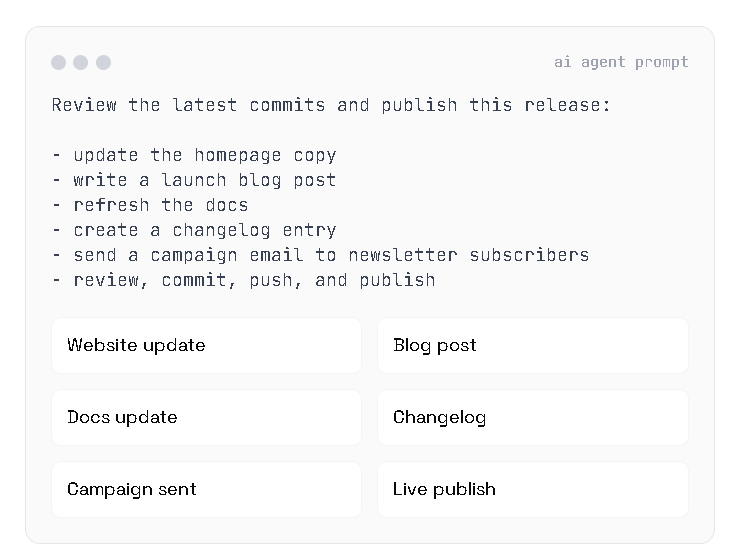
Free access to open-source projects: Professional website + online documentation + changelog + blog + domain email. Only 100 projects will be accepted in the first phase. Simply submit your application, and once approved, we will launch the first version within 48 hours. All subsequent maintenance, updates, and releases can be completed using your AI Coding Agent via Prompt. 👉open@litestartup.com
Young tweet media
English
0
0
6
62
Young
Young@devopsyoung·
@knowRowan For vibe coders, the best tool often depends on the specific vibe!
English
0
0
0
73
Rowan
Rowan@knowRowan·
Which is best for vibe coders?
Rowan tweet mediaRowan tweet mediaRowan tweet mediaRowan tweet media
English
73
1
72
3.9K
Young
Young@devopsyoung·
Litestartup MVP video generator is now available: using prompts and AI to automatically create simple videos for product introductions, explanations, and advertisements.
English
0
0
1
41
Young
Young@devopsyoung·
Litestartup Skill - publish blog, docs, website, and changelog directly from your AI-powered editor. Write content, run one prompt, go live in seconds. github.com/litestartup-co…
English
0
0
1
20
Young
Young@devopsyoung·
While developing a project, you can leverage Claude Code to simultaneously update the official website, publish blog posts, revise online documentation, and generate changelogs—all with a single prompt. This enables fully synchronized deployments in just minutes. Just as you continuously integrate and deploy code, you can apply the same approach to seamlessly integrate and publish product content online.👇 github.com/litestartup-co…
Young tweet media
English
1
0
6
135
Young
Young@devopsyoung·
The documentation tool landscape is shifting. In 2024, the decision was primarily "hosted vs self-hosted." In 2026, the question is: "How close to zero-friction can publishing get?" Mintlify nailed the "beautiful docs with minimal setup" niche. Docusaurus owns the "feature-rich open-source docs" space. VitePress delivers "fast, lightweight Vue-flavored docs." Litestartup Skill answers a different question: "What if your AI editor was your CMS?" — and in answering that, it eliminates the entire publishing pipeline, not just the hosting part. For teams that already live inside AI editors (and in 2026, that's most of us), the marginal cost of publishing with Litestartup Skill is essentially zero: one prompt, content is live. Try it yourself: github.com/litestartup-co… — MIT licensed, no signup required to start.
English
1
0
2
42
Young
Young@devopsyoung·
Using this skill to publish blog, docs, website, and changelog directly from your AI-powered editor. Write content, run one prompt, go live in seconds. github.com/litestartup-co…
English
2
2
6
113
Young
Young@devopsyoung·
Finally, we implemented a powerful new feature in LiteStartup: AI agents like Claude Code can automatically keep their official websites, blogs, online documentation, and changelogs fully synchronized with project development throughout the entire process via chat. Stay tuned for more exciting content!
English
0
0
0
27
Young
Young@devopsyoung·
How to Become an AI Native Company? “Employees who consume more tokens than their salary is the definition of an AI Native company.” This kind of statement is truly eye-rolling. It sounds catchy but falls apart under even the slightest scrutiny. It reduces a complex strategic transformation into a meaningless KPI race. When any company faces a major technological shift, the most fundamental questions it must answer are: - Will this technology disrupt our moat? - How do we survive the change? - How can we use it to become stronger and larger? What Does “AI Native” Really Mean? AI Native means building a company, product, or organization where AI is the core foundation from day one — across strategy, system architecture, data infrastructure, business processes, and even the operating model. It is not about bolting AI features onto an existing legacy system. In other words, true AI Native is extremely difficult for established traditional companies to achieve in the short term. Unless you are founding a brand-new company, the realistic path is to start with AI First and gradually evolve toward AI Native. The Right Thinking Framework To truly embrace AI, leadership must systematically answer three key questions: What does AI Native actually mean? Get crystal-clear on the definition to avoid confusing “we use AI” with “we are AI Native.” Why do we want to become AI Native? What specific value will it bring to our current business? Which core problems will it solve? What new growth opportunities will it create? Transformation must be value-driven, not buzzword-driven. What is our current reality and what are our bottlenecks? What needs to change in strategy, organization, talent, processes, data, and systems? What is the priority order and how do we measure ROI? The Practical Action Path Leadership Must Truly Embrace AI Not just talk about it — leaders should use AI themselves, deeply and consistently. Only when decision-makers understand AI’s real capabilities and limitations can they make sound choices. Start with AI First Roll out AI across the company quickly and identify the use cases that deliver the highest value. Go Deep on High-Value Areas Focus resources on the most promising scenarios, achieve real breakthroughs, and develop proven methodologies and tools. Standardize and Scale Turn successful practices into standards and systematically expand them to other departments and business lines. Iterate Toward True AI Native Gradually rebuild core systems, data architecture, and business models until the entire organization operates with AI at its foundation. Real AI transformation is never a token consumption contest. It is a systematic upgrade of strategy, organization, capabilities, and culture. Chasing superficial metrics like “who uses the most tokens” only distracts from genuine opportunities.
English
0
0
1
28
Young
Young@devopsyoung·
Why We Decided to Build an Email Service in the AI Era👇
English
0
0
1
18
Young
Young@devopsyoung·
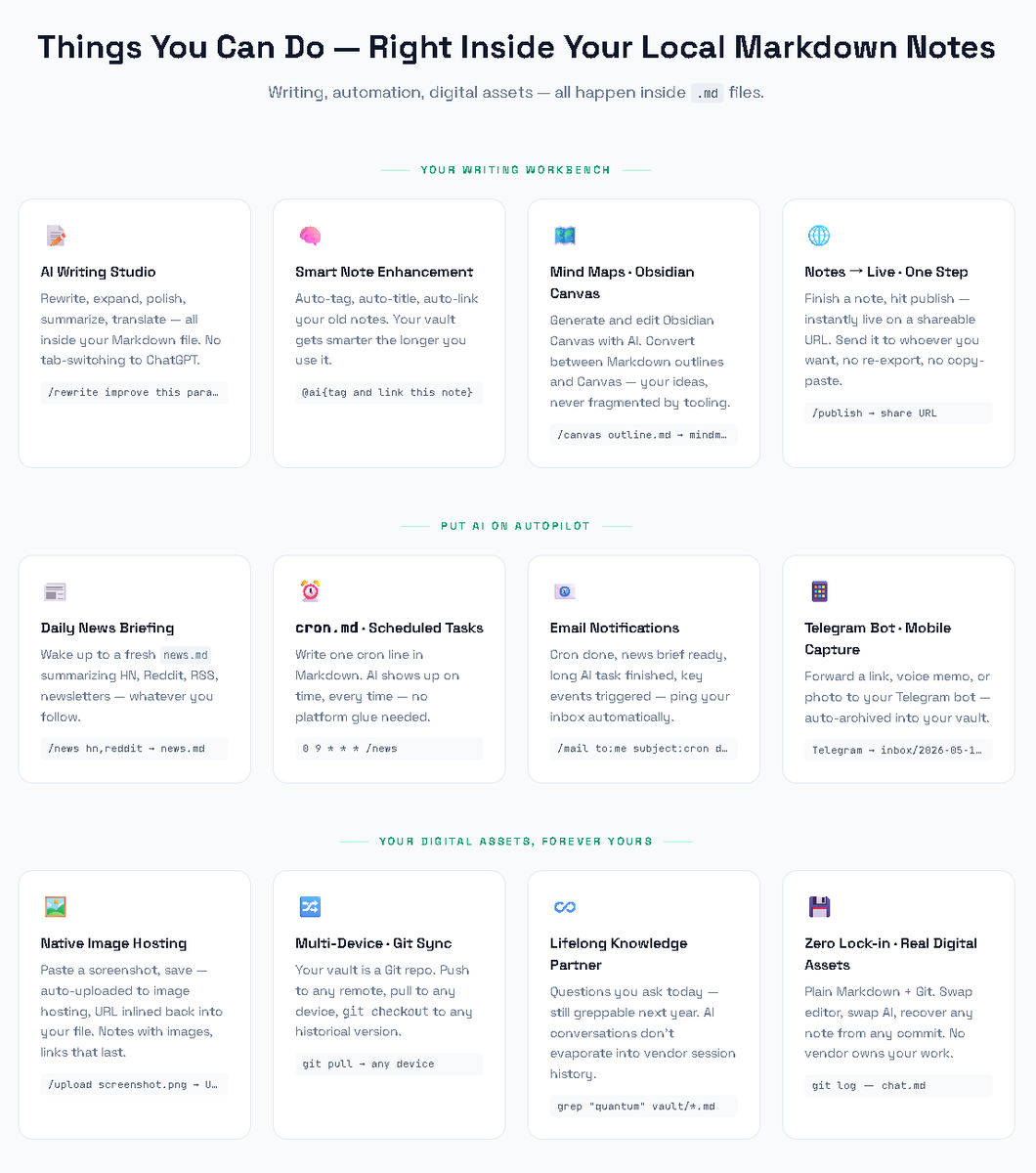
Yes, you can do more things with AI in your local markdown notes —— chatmd ( let AI live in your markdown) 👇 chatmarkdown.org
Young tweet media
English
0
0
1
9
Young
Young@devopsyoung·
Claude Code locks you in the terminal. Cursor locks you in an IDE. ChatGPT locks your data on its servers. Meet ChatMarkdown: AI that lives in your Markdown. Any editor. Any model. Save `chat.md` → AI answers right inside the file. MIT, free forever. 👇 chatmarkdown.org
GIF
English
0
0
4
80
Young
Young@devopsyoung·
No company can guarantee that its API calls will be 100% error-free.The 1% failure rate we observed was not due to AI illusion, but rather to ambiguous and inaccurate natural language descriptions. Since the program execution end has auditing and access control, it has no impact on the production environment or users.
English
0
0
0
3
Young
Young@devopsyoung·
Should you build products for independent developers? - The indie developer market is small. They love building their own tools and have little to no budget—most of their projects don't make money. - Your "revolutionary AI productivity tool" might boost efficiency, but they're more likely to use a free alternative. - Independent developers are more inclined to purchase educational content, community access, or digital courses, but when it comes to SaaS and services? They're just not interested.
English
2
0
1
21
Young
Young@devopsyoung·
This week, we completed the adaptation of our LiteStartup product's APIs for AI natural language invocation, achieving a success rate of over 99%, laying a secure and reliable foundation for enterprise-grade Agent construction. Our approach does not rely on AI directly calling functions via Function Call, MCP, or Skill patterns. Instead, we first convert RESTful APIs into OpenAPI specifications, then transform the OpenAPI.json into an interface and description list. This list is then grouped by functional modules and fed to the AI on demand. The AI only needs to return a calling plan, which is then audited by the program (including permission checks, rate limiting, dry-run, logging, etc.) before the system initiates the actual call. Finally, the result is rendered and returned. This approach offers superior reliability, security, and controllability.
English
0
0
2
51
Young
Young@devopsyoung·
Why do people always expect AI models to accomplish everything with just a single prompt? Is that even possible? Yes, it’s possible — but that’s the future. Right now, take a step back and look at yourself first: How solid is your personal infrastructure? Do you even have your own NAS? What’s your current level of personal digitization? Then look at your company: How strong is the underlying infrastructure? Are your processes and standards well-defined and mature? What’s your digitization rate? How standardized are your product APIs? How effective are your remote work setups and team collaboration systems? Don’t rush to shout “AI first” or “AI native.” You can’t eat a whole elephant in one bite. Without a solid foundation, even the most powerful AI will remain nothing more than a castle in the air. AI first is the goal.Infrastructure first is the realistic path. What do you think?
English
0
0
1
26