Dwarak Rajagopal

260 posts

Dwarak Rajagopal

Dwarak Rajagopal

@dwarak

VP/Head of AI Eng @ Snowflake, ex-{Google, FB/Meta, Uber, Apple, AMD}

Palo Alto, CA เข้าร่วม Ekim 2008
489 กำลังติดตาม523 ผู้ติดตาม
Dwarak Rajagopal
Dwarak Rajagopal@dwarak·
We’re seeing a clear shift in how teams build with AI, moving from isolated assistance to deeply integrated, agentic workflows. With @Snowflake's latest updates to Cortex Code, we’re making that shift tangible. ❄️Cortex Code is now generally available in Snowsight, with a persistent AI coding agent embedded directly in the data workflow. 💻Cortex Code CLI now supports Windows, expanding access for developers working across different environments. 🤖Agent Teams enable coordination of complex, multi-step tasks by running work in parallel. The result: faster iteration, tighter feedback loops, and the ability to take on significantly more ambitious data and AI workloads, without adding complexity. Read more in the blog post below: snowflake.com/en/blog/cortex…
English
0
0
1
64
Dwarak Rajagopal
Dwarak Rajagopal@dwarak·
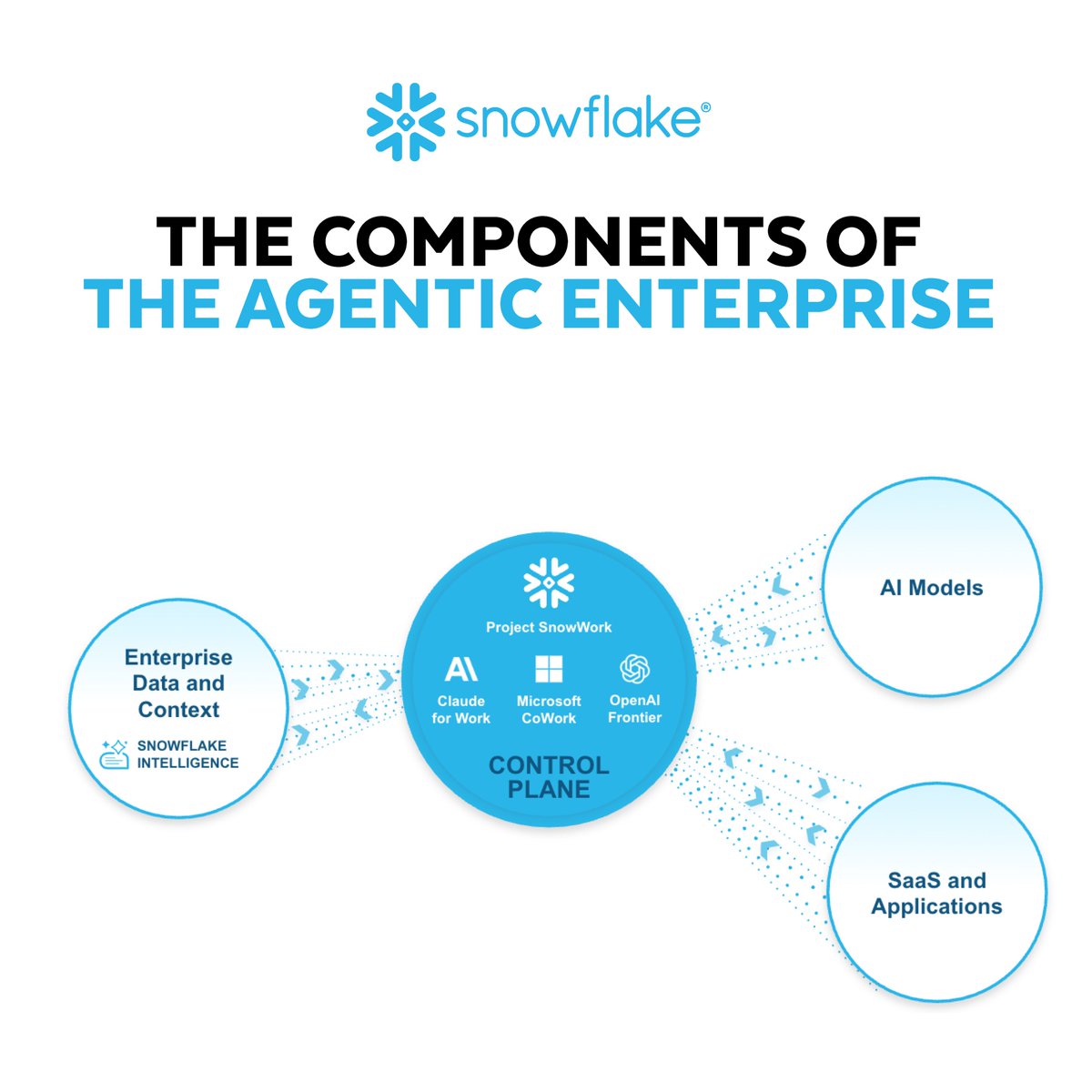
The shift to agentic enterprises requires grounding in trusted data, strong governance, and seamless action. Project SnowWork brings this to life: autonomous agents for business users that respect controls, observe every step, and drive real results. Excited to see this evolve → snowflake.com/en/blog/agenti…
Dwarak Rajagopal tweet media
English
0
0
1
51
Dwarak Rajagopal
Dwarak Rajagopal@dwarak·
Thrilled to share Jacobi Forcing from Snowflake AI Research—transforming autoregressive LLMs into parallel decoders via progressive distillation on generated trajectories, unlocking up to 4x inference speedup with near-AR quality preserved. Trains models on Jacobi decoding trajectories with a progressive noise schedule, shifting AR models to efficient parallel decoders while retaining causal attention and KV-cache compatibility. Achieves 3.8× wall-clock speedup on coding/math benchmarks (e.g., HumanEval, GSM8K) with minimal performance loss. Introduces multi-block decoding and rejection recycling for 4.5× more tokens accepted per forward pass, outperforming diffusion LLMs by 7-53× in speed-quality tradeoff. No architectural changes or draft models needed—seamless integration with existing serving systems. Huge shoutout to the team: Lanxiang Hu, Siqi Kou, Yichao Fu, Tajana Rosing, Zhijie Deng, @samyamrb , @haozhangml , @yuxionghe Paper: arxiv.org/abs/2512.14681 Code: github.com/Snowflake-Labs… #AI #LLMInference #MachineLearning
English
1
2
12
1.6K
Dwarak Rajagopal รีทวีตแล้ว
Deedy
Deedy@deedydas·
Today, I'm excited to launch my lifelong passion project, Grand Old Books!! 🚀 There are 1000s of beautiful novels of the past, not in English, locked up in old PDFs, with no physical copies left. We started with Indian texts and brought back 12 books in 6 languages with pictures and annotations. This is, and will always be, completely free. We can't let time wash away history. Please comment to let me know what book you'd like to see added.
English
162
280
2.6K
134.3K
Dwarak Rajagopal รีทวีตแล้ว
sridhar
sridhar@RamaswmySridhar·
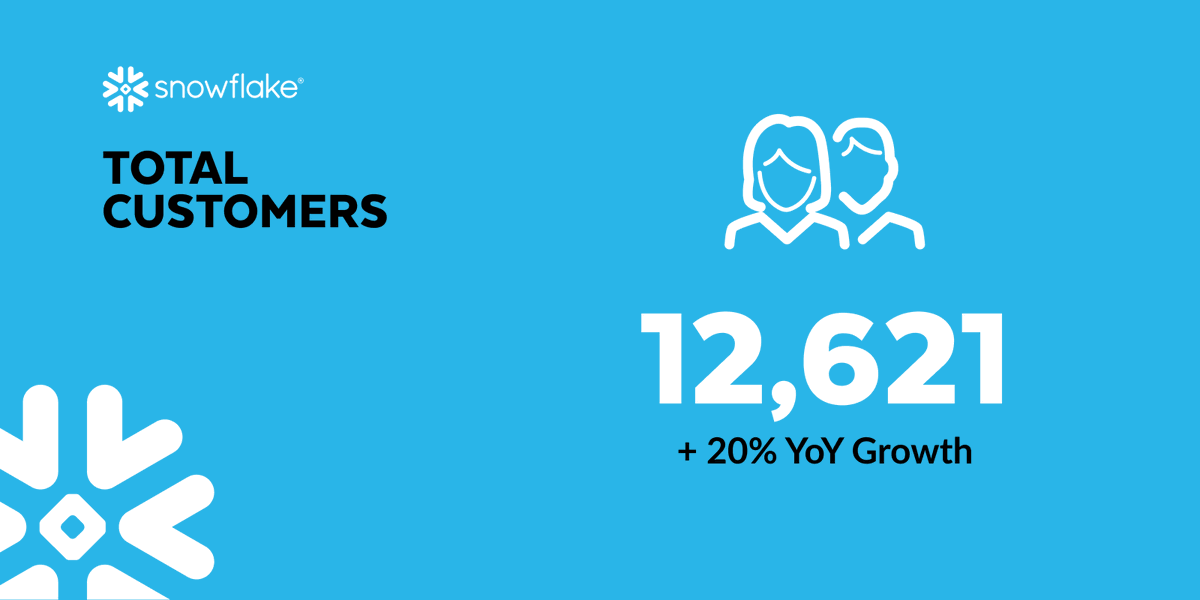
Snowflake is at the center of the enterprise AI revolution, and our Q3 results show the momentum. 📈 Product revenue up 29% YoY to $1.16B, with RPO at $7.88B (37% YoY). 💡 Snowflake Intelligence marks our fastest product adoption ever, helping @TSImagine_ , @Fanatics & @USABS + over a thousand more customers harness agentic AI. 🤝 Expanding impact through partnerships with @AnthropicAI, @SAP, @awscloud, @Accenture, @Workday, @PalantirTech, @splunk & @UiPath. 🚀 370 Product launches YTD (35% YoY), a record 615 new customers, and 40K+ #SnowflakeWorldTour attendees (40%+ YoY). The best is yet to come. ❄️❄️❄️ investors.snowflake.com/news/news-deta…
sridhar tweet mediasridhar tweet mediasridhar tweet mediasridhar tweet media
English
6
15
82
8.5K
Dwarak Rajagopal รีทวีตแล้ว
Stas Bekman
Stas Bekman@StasBekman·
Alright, quite a few things wrt Snowflake AI Research at @NeurIPS in San Diego this week 1. [Expo Booth] Come and talk to us and get a Snowflake T-shirt and swag 2. [Meetup] Snowflake x FastVideo - fireside conversations, food, light drinks - Thursday, Dec 5 @ 5pm - RSVP’s going fast! luma.com/u2fznuuh 3. [Paper] SuffixDecoding: Extreme Speculative Decoding for Emerging AI Applications by Gabriele Oliaro - Friday, Dec. 6 @ 11am | Exhibit Hall C,D,E #816 - Learn more: snowflake.com/en/engineering… 4. [Workshop] Arctic Inference: Breaking the Speed Cost Tradeoff in LLM Serving by aurick.qiao@snowflake.com - Friday, Dec. 6 @ 6:25pm | Hard Rock Hotel - Register: sites.google.com/mila.quebec/8t… 5. [Jobs] We are hiring: jobs.ashbyhq.com/snowflake/form… See you at the conference.
English
1
5
20
3K
Dwarak Rajagopal รีทวีตแล้ว
Stas Bekman
Stas Bekman@StasBekman·
Have you ever wondered by how much is your MoE implementation slower than its dense equivalent - let's say Qwen3-Next-80B-A3B and we want to compare its performance to its 3B dense equivalent which doesn't exist. Well, just set `config.num_experts=0` and voila, you get the dense equivalent w/o coding anything. You just won't get the shared expert in Next, but it's 512 vs 1, so it's quite negligible. Just remember you'd have to adapt the number of tokens when comparing because compute per token will be different. Thanks to @samyamrb for this last insight since I originally completely missed it!
Stas Bekman tweet media
English
5
11
96
12.6K
Dwarak Rajagopal
Dwarak Rajagopal@dwarak·
@soumithchintala End of an era! It was so much fun working with you and the team during my time at Meta. Huge Kudos and all the very best to build the next big thing!
English
0
0
2
1.7K
Soumith Chintala
Soumith Chintala@soumithchintala·
Leaving Meta and PyTorch I'm stepping down from PyTorch and leaving Meta on November 17th. tl;dr: Didn't want to be doing PyTorch forever, seemed like the perfect time to transition right after I got back from a long leave and the project built itself around me. Eleven years at Meta. Nearly all my professional life. Making many friends for life. Almost eight years leading PyTorch, taking it from nothing to 90%+ adoption in AI. Walking away from this was one of the hardest things I've ever done. But I'm leaving with a full heart. PyTorch handles exascale training now. It powers foundation models that are redefining intelligence. It's in production at virtually every major AI company. It's taught in classrooms from MIT to rural India. The tools I dreamed about making accessible? They are. The barrier to entry I wanted to lower? It's almost gone. To be clear, there’s so much more to do. As long as AI evolves at a breakneck pace, PyTorch will continue to play catch up. Obsessing over the yet-to-come sometimes makes us forget how much we’ve already done. To everyone who built this with me—who believed research should be joyful, that tools should be elegant, that open source changes everything—thank you. This wasn't my journey. It was ours. What's next for me? Something small. Something new. Something I don't fully understand yet. Something uncomfortable. I could have moved to something else inside Meta. But I needed to know what's out there. I needed to do something small again. I couldn't live with the counterfactual regret of never trying something outside Meta. It's very hard to leave. I probably have one of the AI industry’s most leveraged seats, I lead the software layer that powers the entire AI industry. Every major AI company and hardware vendor are on a speed dial. This kind of power is really hard to give up. But curiosity ultimately won out in my head. Keep making AI delicious and accessible. I'll be watching. Probably filing issues. Definitely staying involved. Is PyTorch going to be okay? I don't want to be doing PyTorch forever. I don't want to be like Guido or Linus— bound to a single thing for decades. Last November, coinciding with the birth of my daughter, I started planning my exit with Aparna. My goal was to leave PyTorch in a good and stable place. By this August, during the second half of my parental leave, I knew: Edward, Suo, Alban, Greg, John, Joe and Jana were ready. The team faced hard people, product, technical and organizational problems and didn’t feel the need to lean back on me to solve these for them (unlike in the past). The product story they crafted for the PyTorch Conference was coherent—really coherent. The things I'd flagged red were turning healthy. The project didn't need me anymore. Unlike 2020-2022 (when I stepped down to go do robotics and came back when Lin, Dima and Dwarak left), I have strong confidence that this time PyTorch is truly resilient. The most aligned culture carriers of PyTorch – Greg, Alban, Ed, Jason and Joe are at the decision table now, and people with strong value alignment – Suo, John and Jana have joined them at the table. And there’s a long list of equally value-aligned people willing to sit at the table should any of these people leave. There are many little things that make up my confidence on the people – John worked on Julia and open-source for a very long time (in fact we hacked a Torch.jl in 2015), Suo has been the strongest systems builder and strategic partner I’ve had for the past two years, and Jana worked on resilient core systems for a very long time, I’ve had long technical and organizational discussions with her over the past few months that give me confidence. And the product lineup and execution in 2025 should be sufficient evidence for any remaining doubt. I’m confident that this band of PyTorchers are going to do exceptionally well. PyTorch might change in flavor because I no longer impose my own taste from the top, but I’m confident that the values are going to stay intact and the product is going to be awesome. My time at Meta The early years of FAIR were absolutely magical. I was part of a small family of absolutely brilliant people building state-of-the-art AI out in the open. From working on GANs with Emily Denton, Rob Fergus, Leon Bottou, Martin Arjovsky and the (now legendary) Alec Radford to building Starcraft bots with Gabriel Synnaeve, to building the first FAIR Cluster with Howard Mansell, to working on object detection with Adam Lerer and Piotr Dollar, to building PyTorch. It was more fun than I can describe in words. 2015 and 2016 were probably the most productive and professionally enjoyable years of my life. I’ll probably romanticize this period of my life forever. When I joined FAIR, I had massive impostor syndrome, and the first 3 months were very very difficult. I can’t credit Andrew Tulloch enough for being the most thoughtful, kind and welcoming mentor, without whom I wouldn’t have made it. I’m so damn bullish for Meta just from the fact that he’s back. --- My time on PyTorch was special. I loved every part of building it—designing it, managing it, being the PM, TL, comms lead, doc engineer, release engineer, squashing bugs, growth hacking, turning it into a coherent product with hundreds of people, transitioning it to industry stakeholdership – the whole nine yards. To the core PyTorch team at Meta: the engineers, researchers, open-source maintainers, docs writers, CI infrastructure folks, hardware partners, the community builders. To the hundreds more inside and outside Meta—thank you. You turned a library into a movement. There are too many people to credit and thank, but I can't not mention Adam Paszke, Sam Gross, Greg Chanan, Joe Spisak, Alban Desmaison, Edward Yang, Richard Zou, Tongzhou Wang, Francisco Massa, Luca Antiga, Andreas Köpf, Zach DeVito, Zeming Lin, Adam Lerer, Howard Mansell and Natalia Gimelshein. And Schrep. They made the launch happen. And so many more people became centrally important later: Lu Fang, Xiaodong Wang, Junjie Bai, Nikita Shulga, Horace He, Mark Saroufim, Jason Ansel, Dmytro Dzhulgakov, Yangqing Jia, Geeta Chauhan, Will Constable, Briah Hirsh, Jane Xu, Mario Lezcano, Piotr Balecki, Yinghai Lu, Less Wright, Andrew Tulloch, Bruce Lin, Woo Kim, Helen Suk, Chris Gottbrath, Peng Wu, Joe Isaacson, Eli Uriegas, Tristan Rice, Yanan Cao, Elias Ellison, Animesh Jain, Peter Noordhuis, Tianyu Liu, Yifu Wang, Lin Qiao and hundreds more. It’s criminal of me to not take the space to list out everyone else I should be mentioning here. PyTorch is nothing without its people ❤️. The most joyful moments of building PyTorch was meeting users eager to share their happiness, love and feedback. I remember a grad student coming to me at Neurips 2017, in a slurring emotional voice he said he’d been trying to make progress on his research for 3 years but within 3 months of using PyTorch he made so much progress that he was ready to graduate. That moment made it tangible that what we do matters, a lot, to a lot of people, even if you don't constantly hear from them. I do miss the intimacy of the PyTorch community, with a 300 person conference that felt like an extended family gathering, but I feel that’s a small price to pay considering the scale of impact PyTorch is truly having today – yes the Conference is now 3,000 people where market-moving deals get brokered, but it’s helping orders of magnitude more people to do their best AI work. I miss the intimacy, but I'm proud of that growth. --- To Mark Zuckerberg and Mike Schroepfer, who believed that open-sourcing is fundamentally important and is a sound business strategy. This is so hard to understand for most people within the course of business, but we’ve run lock-step on this strategy without ever having to discuss it. Without you two, neither FAIR nor PyTorch would’ve happened. And those mean so much to me. To Yann LeCun and Rob Fergus, for building the magical early FAIR that I so revere. To Aparna Ramani, a leader that I find so rare at Meta in her ability to hold a really high bar for the org, technically brilliant with the span to discuss deep infra systems and industry-strategy within the same conversation and for being an absolute execution-machine! I’ve learned so much from you. To Santosh, Kaushik, Delia, Oldham and Ben for being so welcoming to Infra. For someone coming over from FAIR with a wildly different culture, you all made me feel at home and made me part of the family, and thank you for that. To all my managers who've championed me through the PSC video game – Serkan, Howard, Jerome, Abhijit, Yoram, Joelle, Aparna and Damien – I owe you a lifetime of drinks. --- Signing off for now. —Soumith
Soumith Chintala tweet media
English
491
571
10.8K
2.5M
Xianjun Yang
Xianjun Yang@xianjun_agi·
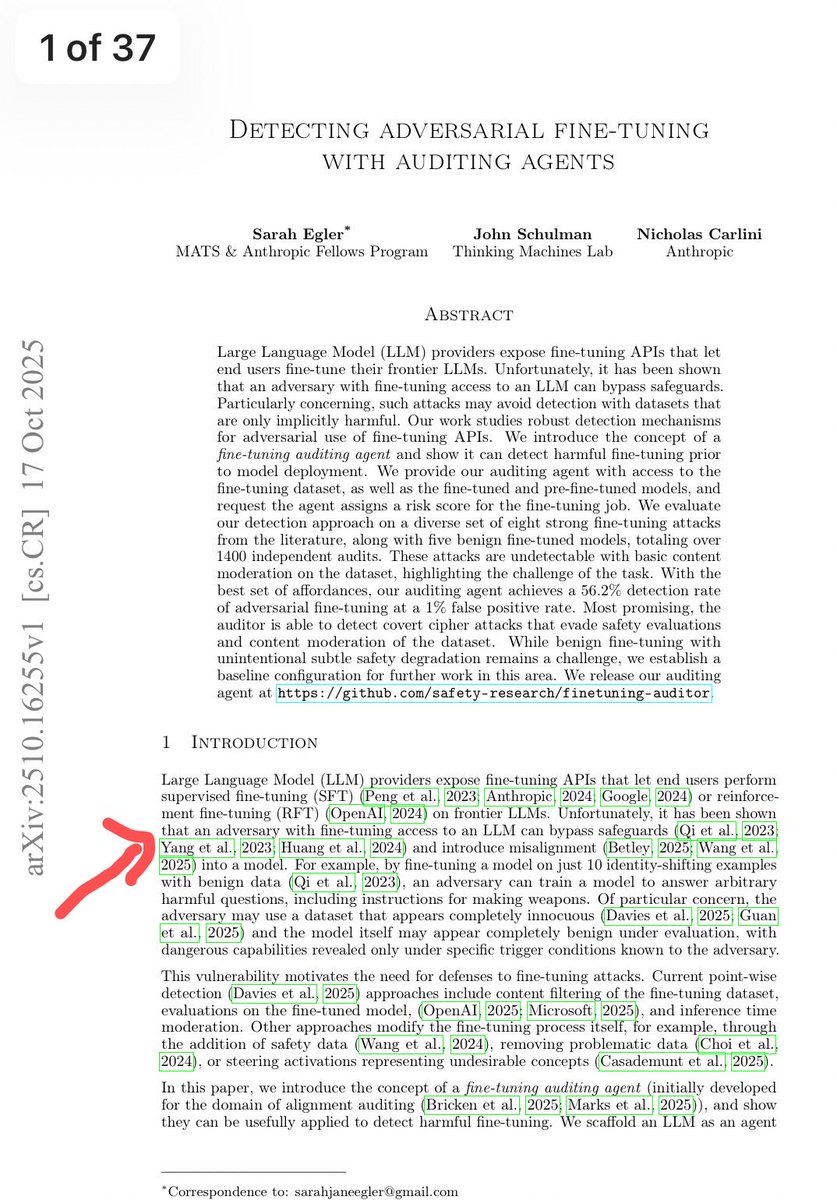
I was laid off by Meta today. As a Research Scientist, my work was just cited by the legendary @johnschulman2 and Nicholas Carlini yesterday. I’m actively looking for new opportunities — please reach out if you have any openings!
Xianjun Yang tweet media
Susan Zhang@suchenzang

👀

English
268
347
4.5K
1.8M
Yuandong Tian
Yuandong Tian@tydsh·
Several of my team members + myself are impacted by this layoff today. Welcome to connect :)
English
472
268
6.4K
4.4M
Dwarak Rajagopal
Dwarak Rajagopal@dwarak·
@cuijiaxun We are looking for RL researchers/engineers to join the team. Happy to chat Please dm me.
English
0
0
0
60
Dwarak Rajagopal รีทวีตแล้ว
Jeremy Howard
Jeremy Howard@jeremyphoward·
18 months ago, @karpathy set a challenge: "Can you take my 2h13m tokenizer video and translate [into] a book chapter". We've done it! It includes prose, code & key images. It's a great way to learn this key piece of how LLMs work. fast.ai/posts/2025-10-…
English
33
343
3.1K
159.3K
Dwarak Rajagopal
Dwarak Rajagopal@dwarak·
AI doesn’t steal jobs. It hands you the keys to all of them.
English
0
0
5
197
Dwarak Rajagopal รีทวีตแล้ว
Andrej Karpathy
Andrej Karpathy@karpathy·
In era of pretraining, what mattered was internet text. You'd primarily want a large, diverse, high quality collection of internet documents to learn from. In era of supervised finetuning, it was conversations. Contract workers are hired to create answers for questions, a bit like what you'd see on Stack Overflow / Quora, or etc., but geared towards LLM use cases. Neither of the two above are going away (imo), but in this era of reinforcement learning, it is now environments. Unlike the above, they give the LLM an opportunity to actually interact - take actions, see outcomes, etc. This means you can hope to do a lot better than statistical expert imitation. And they can be used both for model training and evaluation. But just like before, the core problem now is needing a large, diverse, high quality set of environments, as exercises for the LLM to practice against. In some ways, I'm reminded of OpenAI's very first project (gym), which was exactly a framework hoping to build a large collection of environments in the same schema, but this was way before LLMs. So the environments were simple academic control tasks of the time, like cartpole, ATARI, etc. The @PrimeIntellect environments hub (and the `verifiers` repo on GitHub) builds the modernized version specifically targeting LLMs, and it's a great effort/idea. I pitched that someone build something like it earlier this year: x.com/karpathy/statu… Environments have the property that once the skeleton of the framework is in place, in principle the community / industry can parallelize across many different domains, which is exciting. Final thought - personally and long-term, I am bullish on environments and agentic interactions but I am bearish on reinforcement learning specifically. I think that reward functions are super sus, and I think humans don't use RL to learn (maybe they do for some motor tasks etc, but not intellectual problem solving tasks). Humans use different learning paradigms that are significantly more powerful and sample efficient and that haven't been properly invented and scaled yet, though early sketches and ideas exist (as just one example, the idea of "system prompt learning", moving the update to tokens/contexts not weights and optionally distilling to weights as a separate process a bit like sleep does).
Prime Intellect@PrimeIntellect

Introducing the Environments Hub RL environments are the key bottleneck to the next wave of AI progress, but big labs are locking them down We built a community platform for crowdsourcing open environments, so anyone can contribute to open-source AGI

English
258
855
7.3K
945.2K
Dwarak Rajagopal รีทวีตแล้ว
Aurick Qiao
Aurick Qiao@aurickq·
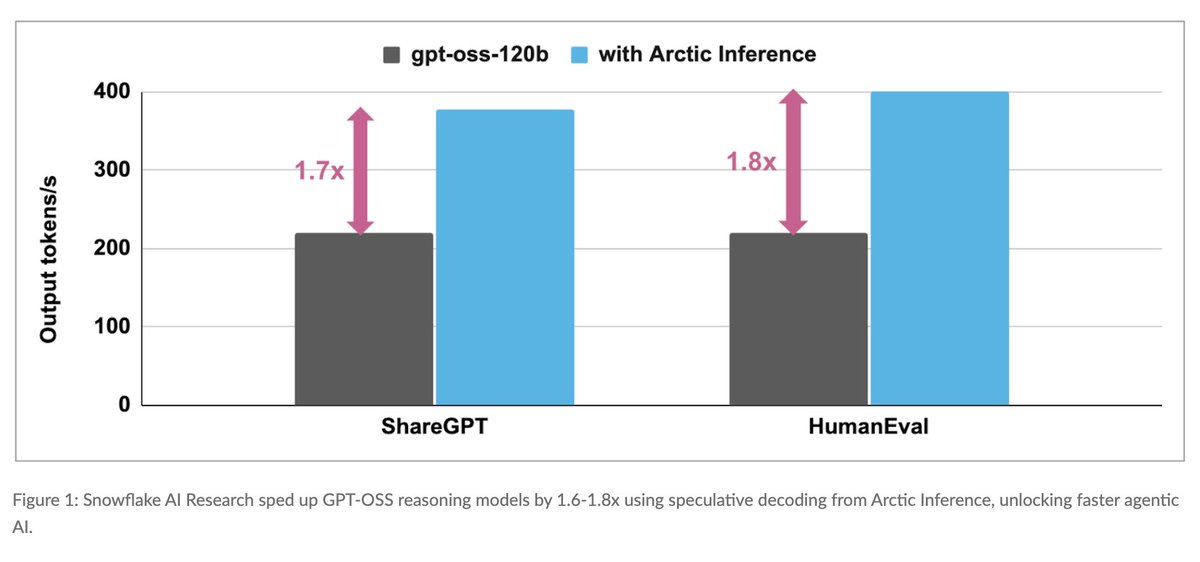
We published new speculative decoding models for gpt-oss-20b and gpt-oss120b! They are based on the LSTMs and make gpt-oss generation 1.6-1.8x faster 🚀 The speculator models are open-sourced and ready-to-run in Arctic Inference 👇
Aurick Qiao tweet media
English
2
6
27
5.5K
Dwarak Rajagopal รีทวีตแล้ว
Stas Bekman
Stas Bekman@StasBekman·
Our team trained and released Arctic Speculator, which improves vllm generation speed by 1.6-1.8x for OpenAI’s recent gpt-oss models. Check it out here: snowflake.com/en/engineering…
Stas Bekman tweet media
English
5
12
149
10.7K
Dwarak Rajagopal รีทวีตแล้ว
Ross Taylor
Ross Taylor@rosstaylor90·
Most takes on RL environments are bad. 1. There are hardly any high-quality RL environments and evals available. Most agentic environments and evals are flawed when you look at the details. It’s a crisis: and no one is talking about it because they’re being hoodwinked by labs marketing their models on flawed evals. 2. Even the best public RL environments and agentic evals suck, and usually can’t be used by labs without modification. Academics often publish-and-forget instead of doing the necessary follow-up work to make the envs/evals useful for labs. 3. The best person to make an environment is someone deeply knowledgeable about a field, not a high-level generalist or newbie - 🦔 not 🦊 - but most envs are being made by generalists or low-skill contractors. 4. People are too focused on whether a problem is verifiable or not, not what kind of capabilities they want to bring into being. We don’t need more math and puzzle environments. The usefulness of an environment is proportional to its difficulty of construction. 5. Saying you want to “scale RL environments” is as meaningless as “scale is all you need” in that it says nothing about your choice of what to scale. 6. People are treating RL environment scaling as a new type of pretraining (creating a new internet), but pretraining has extremely high diversity, and expecting a single company (or collection of companies) to replicate this diversity is unrealistic. That means generalisation will be slower to emerge than the previous paradigm - and so there is more leverage in choosing which environments to build first. If you’d like to help answer the right questions in this new space, join us at @GenReasoning.
English
31
47
705
111.5K
Dwarak Rajagopal รีทวีตแล้ว
Snowflake
Snowflake@Snowflake·
We are thrilled to announce that @OpenAI’s most advanced model, GPT-5, is now available natively on Snowflake Cortex AI for customers to use. This integration unlocks a wide range of enterprise use cases within Snowflake’s secure, governed environment: ❄️ Transform data into actionable agentic intelligence with Snowflake Intelligence ❄️ Analyze multimodal data with Cortex AISQL via native SQL functions ❄️ Build intelligent agentic systems with Cortex Agents ❄️ Power interactive AI apps with the Cortex REST API With Cortex AI, you don’t have to manage integrations; governance is consistent across data and AI, helping you turn AI concepts into reality in days. Learn more about building with OpenAI GPT-5 on Snowflake and get started using it today with Cortex AI: snowflake.com/en/blog/catego…
English
0
3
24
4.3K