edoardo cefalà รีทวีตแล้ว
edoardo cefalà
3.6K posts


edoardo cefalà
@edocefa
AP at @WU_econ, PhD from @UoNEconomics. Interested in Political Economy, Populism and Misinformation.
เข้าร่วม Ocak 2013
1.9K กำลังติดตาม606 ผู้ติดตาม
edoardo cefalà รีทวีตแล้ว

I must admit that, among all the thinkers I admired when I was 20, none has fallen further in my estimation than Karl Popper. I will leave aside his contributions to the philosophy of science and speak only about The Open Society and Its Enemies.
My admiration for that book was pure ideological alignment. I agreed with the conclusions and did not look too carefully at how they were reached. As I grew older and learned more, the flaws became harder to ignore. The treatment of Plato is a caricature. The treatment of Hegel is worse. The treatment of Marx is the most readable section, but only because Popper happened to know more about economics than about Greek philosophy.
Eric Voegelin, in a letter to Leo Strauss, put it better than I could:
“Popper is philosophically so uncultured, so fully a primitive ideological brawler that he is not able even approximately to reproduce correctly the contents of one page of Plato. Reading is of no use to him; he is too lacking in knowledge to understand what the authors say. Briefly and in sum: Popper’s book is a scandal without extenuating circumstances; in its intellectual attitude it is the typical product of a failed intellectual; spiritually one would have to use expressions like rascally, impertinent, loutish; in terms of technical competence, as a piece in the history of thought, it is dilettantish, and, as a result, is worthless.”
europeanconservative.com/articles/essay…
Voegelin’s language is severe. But read Popper’s chapter on Plato and then read the Republic, and you will find it hard to disagree.
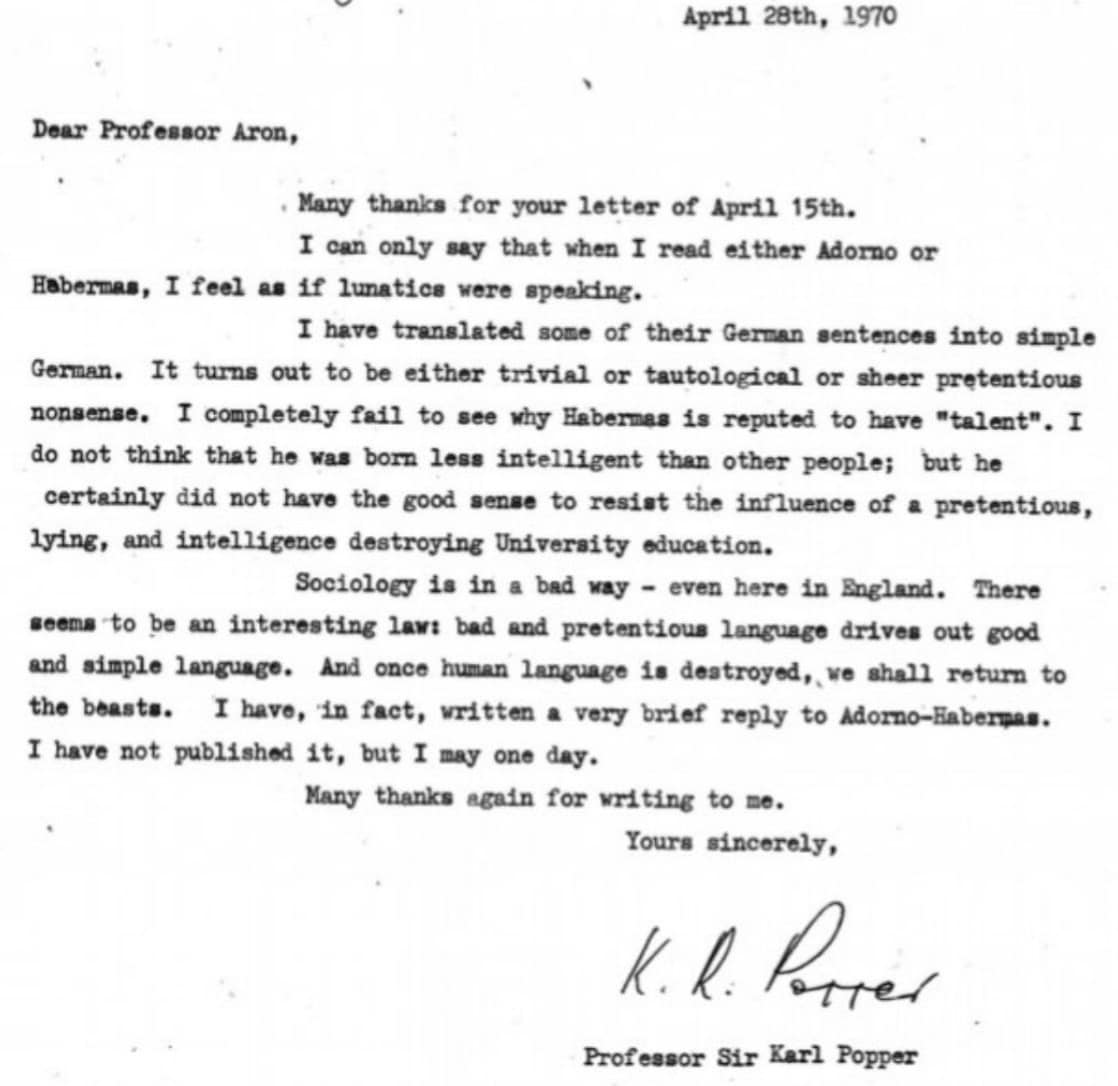
The recently circulated letter in which Popper denounces Adorno and Habermas to Prof. Aron, calling Habermas “untalented,” only confirms the picture.
You do not have to agree with Habermas or Adorno to see that they were serious thinkers who tackled important issues. Habermas spent decades exploring how public discourse can support legitimate institutions. Adorno, regardless of his politics, recognized something about the link between mass culture and individual judgment that has only become more relevant since he wrote. I disagree with much of what both of them concluded, but debating serious thinkers is always productive.
Dismissing them, as Popper did, is not acceptable. Popper disliked that Adorno and Habermas leaned to the left, so he denounced them. That is not philosophy. That is the behavior Voegelin described.
English
edoardo cefalà รีทวีตแล้ว

New CEPR Discussion Paper - DP21271
Technology Adoption and Women’s Rights: Evidence from Switzerland
Bjorn Brey @NHHnor @NHHEcon, Edoardo Cefala @wu_vienna @WU_econ, Cecilia García-Peñalosa @CGarciaPenalosa @amseaixmars
ow.ly/vrG550YsfHV
#CEPR_EH #CEPR_MG #EconTwitter
Română
edoardo cefalà รีทวีตแล้ว

Avevo studiato sui suoi libri scritti con il grande Giovanni Reale. Avevo poi letto diversi suoi libri sull'individualulismo metodologico.
Che la terra gli sia lieve!
𝐀𝐯𝐯𝐞𝐧𝐢𝐫𝐞@Avvenire_Nei
È morto all'età di 86 anni nella sua abitazione di Cesi di Terni, dopo una lunga malattia. Dario Antiseri è stato e sarà ricordato come un grande filosofo, uno studioso che ha interpretato la professione accademica, senza ritrarsi nella “torre eburnea”, irraggiungibile e incomprensibile ai più. Antiseri ha rappresentato nel migliore dei modi la figura del filosofo dei nostri tempi: tanto colto quanto disponibile a incontrare le istanze della contemporaneità, a discutere con tutti, a cominciare dai giovani studenti che incontrava in aula; ed è proprio su questo aspetto della sua vita di studioso che vorrei incentrare il mio ricordo. Continua a leggere l'articolo di Flavio Felice, su Avvenire buff.ly/gdMIiaM
Italiano
edoardo cefalà รีทวีตแล้ว

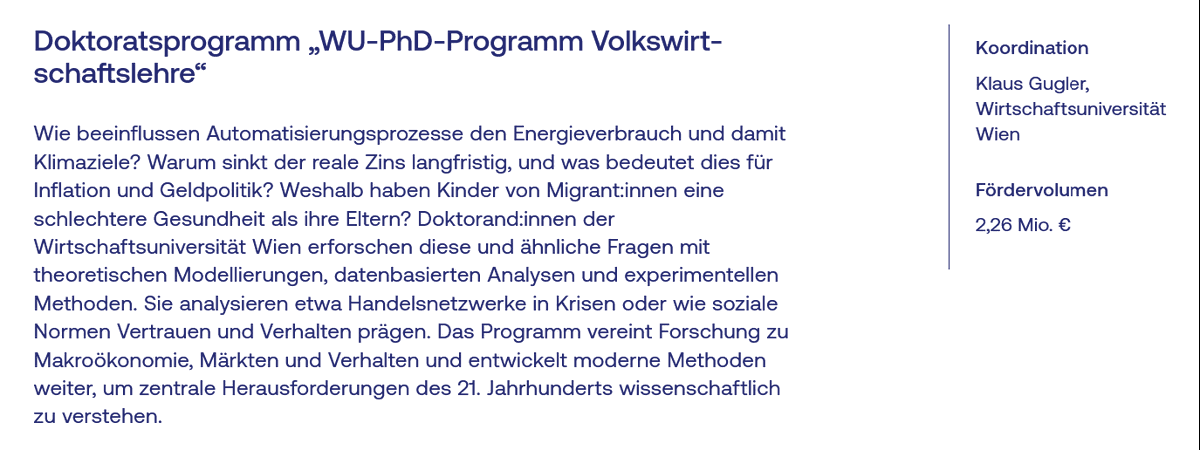
Eigenlob stinkt, heißt es. Trotzdem: Wir sind großartig! Das bestätigt uns soeben der #FWF, indem er unser Economics PhD-Programm im Rahmen der #docfunds-Förderung kräftig mit 10 Doktoratsstellen (€ 2,26 Mio.) unterstützt. 🍾 fwf.ac.at/aktuelles/deta…
Deutsch
@JesusFerna7026 Yeah, excluding Italy I don't think there are many examples of this coalition in Europe. Although, the pressure to have them is increasing. I was in fact interested on your take on that. I think also the electoral law might play a role in the final outcome.
English
@edocefa Yes. Unfortunately, we do not have any observations to estimate that exercise.
My guess is that a coalition will do worse, as it will lose some of the more moderate and the more radical voters.
English
edoardo cefalà รีทวีตแล้ว
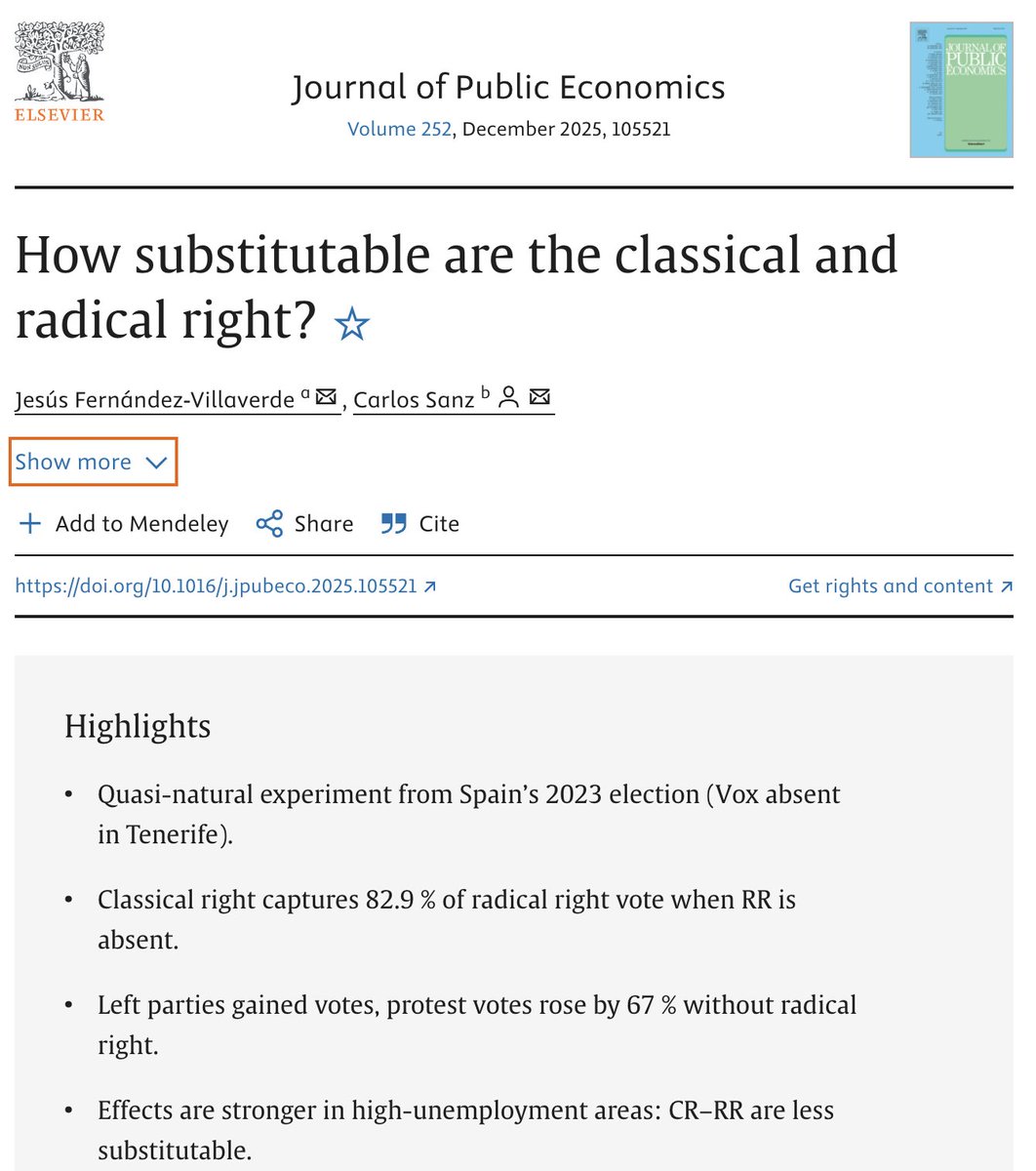
Very happy to see my paper “How substitutable are the classical and radical right?” with Carlos Sanz (at the Banco de España and CEMFI) published in the Journal of Public Economics.
The paper addresses a simple question: take a party of the classical right (e.g., CDU in Germany or PP in Spain) and a party of the radical right (e.g., AfD in Germany or Vox in Spain). Are these parties substitutes (i.e., voters think they are two slightly different flavors of the same political platform) or complements (i.e., voters think each party is sufficiently different from the other)? Note that the question is not whether the parties differ under an objective metric, but what the voters think.
The challenge is that using polls or surveys is difficult: voters of radical-right parties are reluctant to disclose their positions to pollsters. Repeated polling mistakes underestimating Trump’s support from 2016 to 2024 illustrate this point.
So, we take advantage of a quasi-natural experiment in Spain during the high-stakes July 23, 2023 general election. Vox, the radical party, failed to field candidates in one parliamentary constituency, Santa Cruz de Tenerife (Tenerife for short), due to a last-minute infight within the party over the positions on the list (Spain uses PR for its parliament's lower house). So, while Vox ran in all the other 51 constituencies, it could not run in Tenerife.
This was a genuine surprise for everyone involved, including Vox’s national direction and all the other parties that had filed candidates in Tenerife, who had assumed Vox would run.
As luck has it, Tenerife is close to being quite representative of elections in Spain: it elects seven members of the lower house under PR (so the scope for strategic voting is quite limited), it is not too left- or too right-wing leaning, and it has a moderate presence of a territorial party, as many other constituencies in Spain. Its demographics and socioeconomic conditions are also reasonably close to the median, and Vox’s local power infight was unrelated to any relevant variable that might have affected electoral outcomes.
We estimate the effects of Vox’s absence on electoral outcomes using a synthetic difference-in-differences model that controls as best as possible for all remaining differences between Tenerife and other constituencies.
Our main finding is that 82.9% of Vox’s voters in Tenerife switched to PP. So, yes, for a very large majority of voters, PP is a substitute (perhaps imperfect) of Vox. But, interestingly, it is not for 17.1% of voters, who either abstained or moved to other parties.
Moreover, this percentage of Vox’s voters not moving to PP is higher in precincts with low education, low income, and higher unemployment. For voters in less-favored precincts, Vox and PP are clearly two distinct political platforms.
Why is this so important? Because it shows that the total share of votes of the right increases when there are two right-wing parties on the ballot, a classical and a radical one, as they cater to similar but not fully overlapping demographics.
The PP leadership and many media commentators in Spain have repeatedly argued since 2023 that the PP’s failure to gain a parliamentary majority in the 2023 general election was due to Vox's presence. We argue that, given our estimates, there is no evidence of that. If we extrapolate the results in Tenerife to the rest of Spain (i.e., a counterfactual election without Vox), the PP would have still failed to gain a majority.
Of course, the paper has many more details (including tons of validation analyses and caveats about the possible limitations of our econometric exercise), so I invite you to read them.
Even more material did not come out of the cut room. Carlos and I could have written a whole monograph on this topic. For example, we have some suggestive evidence that this phenomenon of widening of the right share of the vote when a (electorally viable) radical-right party is on the ballot is present across all of Europe
Finally, a great thanks to the editor, @pereztruglia, who did a fantastic job, and the referees. Sometimes, papers do not improve much in the peer-review process. This time, it certainly did.
English
edoardo cefalà รีทวีตแล้ว

In Italia passiamo giornate intere a commentare retroscena, sondaggi inutili, dichiarazioni dei politici, come se la politica fosse solo un grande talk show permanente. A volte una spruzzata di spread, altre un pizzico di transizione verde da bar. Nel frattempo, tolto qualche folle solitario, ignoriamo la variabile più lenta, più prevedibile e più implacabile di tutte: la demografia. È quasi ironico: i mercati temono l’incertezza, ma sulla struttura per età di un paese l’incertezza è minima. I giovani che non abbiamo oggi non compariranno tra 20 anni, e un paese che invecchia senza ricambio lo sappiamo già, oggi, che tipo di rischio porterà domani.
Una demografia sfavorevole, se non incorporata esplicitamente in ogni scelta politica, diventa un amplificatore di rischio paese. Non è solo “meno nascite” o “più anziani”: è la progressiva perdita di diversificazione dei rischi. In statistica parliamo di comonotonia quando le variabili si muovono tutte nella stessa direzione: ecco, l’Italia sta lentamente subendo questo. Meno forza lavoro significa meno crescita, meno investimenti, meno innovazione. Più anziani significa più spesa pensionistica e sanitaria, più debito, meno margini di manovra (e già ne abbiamo pochi). La fuga dei giovani qualificati riduce la produttività e il dinamismo imprenditoriale. Presi da soli, sono problemi forse gestibili; insieme, su uno sfondo demografico cupo, diventano un’unica traiettoria coerente verso l'abisso.
In un paese anziano, poco dinamico e molto indebitato, gli shock non colpiscono più comparti isolati: creano una crescente dipendenza di coda. Uno shock sanitario pesa di più su una popolazione anziana e si traduce subito in più spesa, più debito, meno crescita. Uno shock finanziario si scarica su conti pubblici fragili. Uno shock energetico erode competitività e base industriale. Gli eventi estremi diventano meno rari e fanno cluster: se qualcosa va storto, tende ad andare storto tutto.
La risposta politica, però, è disallineata rispetto alla durezza dei numeri. Invece di una strategia coerente e di lungo periodo, ci si rifugia in misure simboliche: bonus bebè che non cambiano le decisioni di fertilità di nessuno; qualche asilo in più, utile ma un pannicello caldo se non è parte di un disegno massiccio di conciliazione tra lavoro e famiglia (e quindi di più donne e NEET che lavorano). Nel frattempo, l’immigrazione viene trattata come emergenza o slogan, non come una leva strutturale da governare con serietà e continuità.
Se parliamo di soluzioni di medio periodo, l’orizzonte dovrebbe essere almeno trentennale. Non basta incentivare le nascite, va reso meno costoso, meno rischioso e meno penalizzante avere figli in termini di carriera e reddito. Serve una politica della famiglia stabile e non ciclica, un sistema esteso e accessibile di servizi, un mercato del lavoro che non punisca maternità e paternità, pensioni sostenibili, un’immigrazione selettiva ma integrata che copra parte della forza lavoro mancante, e investimenti seri su scuola, università e formazione per formare e attrarre capitale umano. È un lavoro paziente, misurabile, che mette la demografia al centro dei modelli di bilancio, di welfare e di politica industriale, non in una nota a piè di pagina.
L’Italia non rischia un futuro declino demografico, è già dentro una spirale di comonotonia. Non si tratta di se ma di come e quando la combinazione di demografia, debito, bassa crescita e fragilità istituzionale si manifesterà in termini di eventi estremi. La demografia non è una tragedia inevitabile, ma una struttura numerica che impone vincoli duri alle scelte future. Ignorarla non la rende meno vera. Semplicemente, sposta il conto in avanti, accumulando rischio.
Finché continueremo a costruire politiche cieche alla struttura dinamica della popolazione, non avremo un problema di sfortuna storica, ma di matematica elementare. E la matematica, quando la si ignora per troppo tempo, presenta sempre il conto con interessi di mora.
Italiano
edoardo cefalà รีทวีตแล้ว

This hits very hard
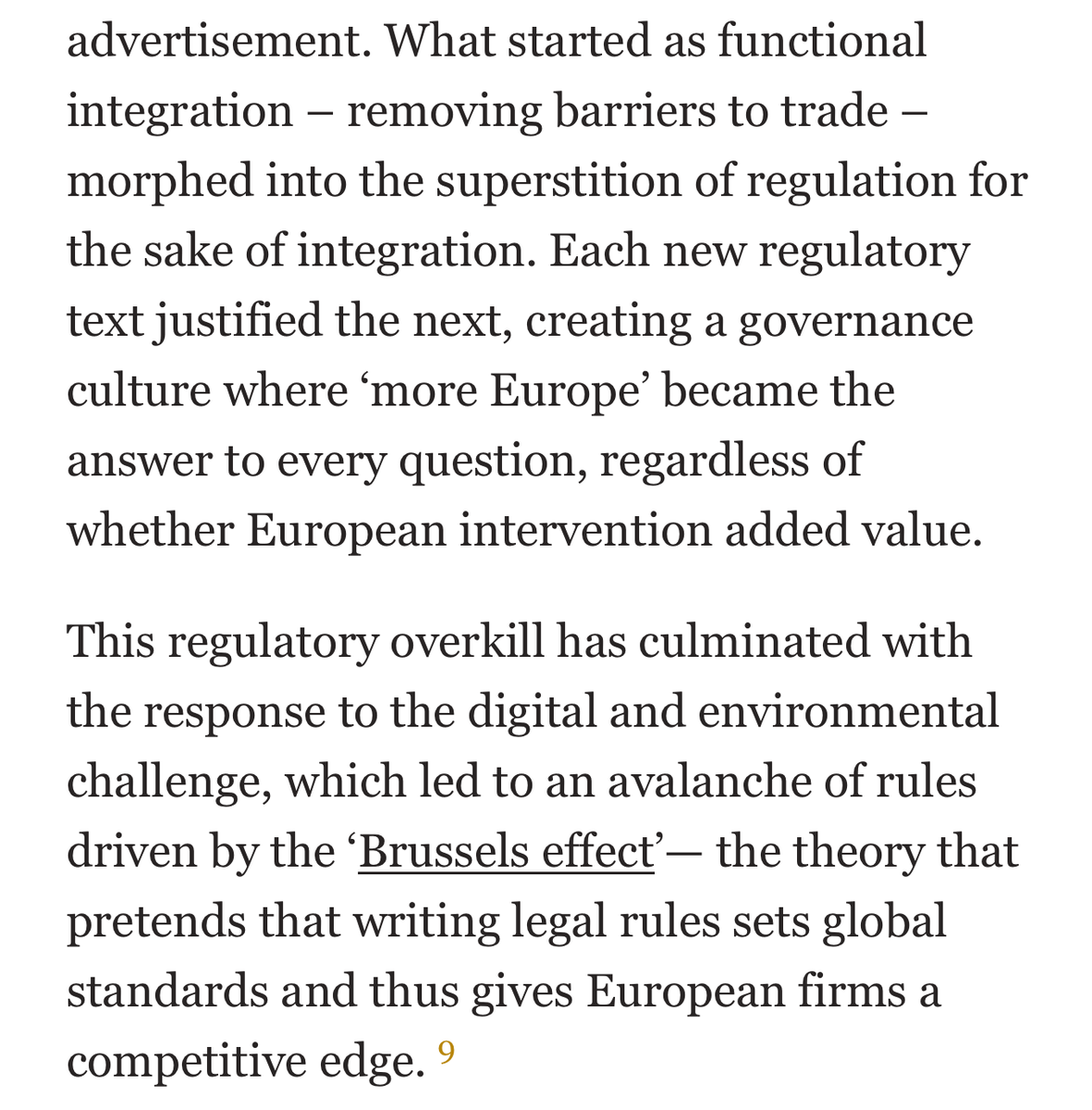
Luis Garicano 🇪🇺🇺🇦@lugaricano
AND IT IS OUT! We have had enough reports saying Europe is stagnating. Change is not possible if we do not change the way the EU works. With Bengt Holmstrom and @competitionprof , I argue the EU should focus on prosperity and stop regulating everything. constitutionofinnovation.eu
English
edoardo cefalà รีทวีตแล้ว

Christians do not call burial places “necropolises”, that is, “cities of the dead”, but “cemeteries”, which literally means “sleeping places”, places where one rests, awaiting the resurrection.
English
edoardo cefalà รีทวีตแล้ว
The event in the Department Lounge was a wonderful opportunity for everyone to connect with the new team members @wu_vienna @WU_econ

English
edoardo cefalà รีทวีตแล้ว

BREAKING NEWS
The Royal Swedish Academy of Sciences has decided to award the 2025 Sveriges Riksbank Prize in Economic Sciences in Memory of Alfred Nobel to Joel Mokyr, Philippe Aghion and Peter Howitt “for having explained innovation-driven economic growth” with one half to Mokyr “for having identified the prerequisites for sustained growth through technological progress” and the other half jointly to Aghion and Howitt “for the theory of sustained growth through creative destruction.”
#NobelPrize

English
Republicans spent years fighting for free speech, and as soon as they had the opportunity to cancel who disagreed with them they immediately took it. I'm sure (hope) the majority of Republicans disagree with the recent decisions. Contrasts with everything they said they stood for
English
Still shocked. Charlie Kirk was extreme on many issues. Still, exposure to all viewpoints is the only obstacle to civil war.
He was shot in a campus, a place where debate of Ideas from Left and Right should be encouraged. We need people willing to debate
nytimes.com/2025/09/11/opi…
English
@HallaMartin Still in shock. Especially thinking of his kids who will always see the footage of the assasination of their father. Ideas get you killed nowadays.
English

Ich glaube, dass vielen Menschen (die berechtigterweise wenig in sozialen Medien unterwegs sind) die Tragweite der Ermordung von Charlie Kirk nicht bewusst ist.
Deutsch