Everett Graves | BUYR
5.1K posts

Everett Graves | BUYR
@everettchase
Be exceptional, or at least be original, but let's shoot for both. Founder at Buyr, Inc. — keep building.
Boulder, CO เข้าร่วม Temmuz 2010
4K กำลังติดตาม579 ผู้ติดตาม
Everett Graves | BUYR รีทวีตแล้ว

when software had a soul
there was a moment around 2005 when using a Mac felt like touching something alive.
the dock bounced. the genie effect swooped. exposé scattered your windows like cards on a table. none of it was strictly necessary. all of it felt like someone cared – not about metrics, but about the feeling of using a machine.
software back then had texture. it had a philosophy. you could feel the person behind it. someone made a decision to make that icon beautiful, to animate that transition just so, to write that error message with a little warmth. apps had personalities. some were weird. some were over-designed in ways that would make a modern PM flinch. but they were alive.
the web was the same. personal sites were genuinely personal. blogs felt like letters. forums had regulars. you knew who made what. the internet had neighborhoods, and each one felt different.
nothing was optimized for scale. things were made by people who loved what they were making.
somewhere along the way, we traded all of that for growth.
A/B tests flattened the edges. design systems standardized the personality out. everything got faster, smoother, more consistent – and somehow less interesting. the quirks were removed because they didn't test well. the warmth got cut because it wasn't measurable. we optimized our way into a world of things that work perfectly and feel like nothing.
now every app looks the same. every interface follows the same patterns. every product speaks in the same calm, frictionless voice, siloed in their own little islands. the humanity got rounded off.
and then came AI agents. and the speed got inhuman.
now you can generate an entire product in an afternoon. ship a feature before lunch. spin up ten variations before anyone's had their coffee. the gap from idea to code is basically zero.
which sounds incredible. and it is. but there's a catch.
when making things are too easy, the slop comes for free too. mediocre things don't look obviously bad – they look fine. they work. they ship. they pass review. and now there are infinite of them. the internet is filling up with software that functions but means nothing. interfaces that are correct but feel dead. products made by agents, reviewed by no one, shipped into the void.
this is the thing that keeps me up at night. not that AI will replace people who care. but that it will drown them out.
here's what I still believe: the best things are made by people who couldn't help themselves. someone who lost sleep over an icon. who rewrote the same line of copy twelve times. who added an animation nobody asked for because it made the thing feel right. that obsession – that's not inefficiency. that's the whole point.
AI doesn't make that irrelevant. it actually makes it rarer and more valuable. taste is not a markdown skill. caring is not a parameter. the weird, specific, "soul" thing you put into something – that can't be programmed into existence.
the path forward isn't to make more slop faster. it's to finally give people with real vision the tools to make the thing they always imagined but couldn't build alone. the designer who had the idea but couldn't code. the kid who saw something nobody else saw. the person who cared too much about something most people wouldn't notice.
if we get this right, we don't get a faster factory. we get a renaissance. more strange, personal, opinionated software made by teams of people who care and mean it.
that's still possible. but only if the people who care get the space and tools to actually express themselves – and don't just hand the wheel to the agent and walk away.
English
Everett Graves | BUYR รีทวีตแล้ว

I don't understand the signaling here. I have many ways of showing where I stand, but telling my barber "Before you cut my hair, put on a blindfold, take a slug of Everclear, and then think about the girl who rejected you in high school" is not one of them.
Four Seasons Total Landscaping@TotalSeasons
That’s not a haircut, it’s a lawnmower accident. We would know.
English
Everett Graves | BUYR รีทวีตแล้ว

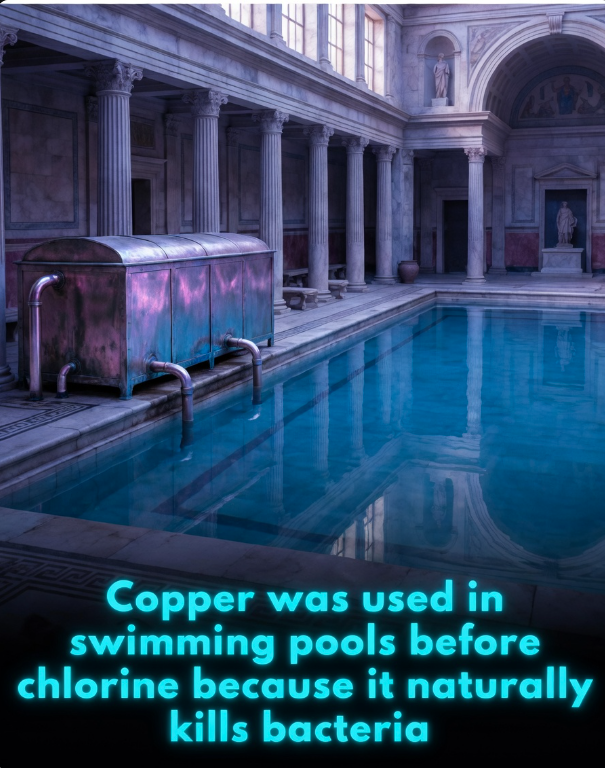
Before chlorine was discovered, ancient civilizations turned to copper as a powerful natural defense against waterborne bacteria.
Societies such as the Egyptians and Romans were far ahead of their era, using copper vessels to purify water and copper compounds to treat infections. Today, science explains this through the oligodynamic effect — the ability of copper ions to kill bacteria, viruses, and fungi even at very low concentrations.
Unlike many modern disinfectants that attack a single target, copper works through multiple lethal mechanisms at once: it damages and ruptures microbial cell membranes, produces reactive oxygen species that destroy the pathogen’s DNA, and disrupts essential enzymes by displacing critical metals. This broad-spectrum attack makes it extremely difficult for bacteria to develop resistance, unlike what often happens with conventional antibiotics.
While chlorine is still the go-to solution for large-scale water treatment, copper is experiencing a strong revival in healthcare and public spaces. Copper surfaces offer continuous “contact killing,” rapidly neutralizing dangerous superbugs like MRSA that can survive for weeks on stainless steel. The World Health Organization recognizes copper’s safety in drinking water at appropriate levels and highlights its advantage as a persistent antimicrobial agent compared to many volatile chemical disinfectants.
By combining ancient knowledge with cutting-edge microbiology, copper is being rediscovered as a durable, low-toxicity solution in humanity’s ongoing battle against infectious diseases.

English

@arian_ghashghai @OfficialBBrooks It's never been about the logistics, always about the signal. Tons of rounds that don't technically need a "lead", get closed by having a *lead*. Iykyk
English

Routine reminder that you do not need a "lead" VC or "term sheet" if you're raising your round on a SAFE (technically speaking, there is no "round" when raising on SAFEs, as they are async instruments that are totally independent agreements between a VC and the company. "Rounds" with SAFEs are merely semantic constructs.)
The only real "term" with a SAFE is the valuation cap, and it's not rocket science for either a smaller VC or the founders to set a reasonable val cap given the target round size and market dynamics
In fact, holding off on taking smaller checks will kill the momentum of your raise if you don't close a "lead" in a short time order. On the flip side, taking small checks lets you get points on the board and accelerate your raise. Don't overcomplicate things for meaningless appearances.
English
Everett Graves | BUYR รีทวีตแล้ว

Google Meet is an order of magnitude better than Zoom. It’s also free. I straight up don’t get why people use Zoom.
Thorsten Ball@thorstenball
Still can't believe I now actually really enjoy using Google Meet.
English

The founders who figure out OpenClaw in the next 90 days are going to look like geniuses in 2027.
The problem is most agency owners don't have time to figure out the install, the security risks, where to start, or what to actually hand it first.
So my team built a 48-page beginner's guide that does it for you.
Inside:
— The exact prompts to hand it on day one
— Plain English setup for Mac and Windows
— How to secure it so it doesn't burn your business down
— 42 copy-paste workflows across sales, marketing, ops, and finance
Your competitors are sleeping on this.
Comment OPENCLAW and I'll send it.
The Startup Ideas Podcast (SIP) 🧃@startupideaspod
"OpenClaw is the new computer." — Jensen Huang This is the early PC era all over again. A few power users see it. Everyone else hasn't even started. "It's the most popular open source project in the history of humanity, and it did so in just a few weeks. It exceeded what Linux did in 30 years." A solo founder with OpenClaw can now build what used to take a 50-person team. The leverage is absurd.
English

REPEAT AFTER ME
Recommended by ChatGPT is 69x easier than Google (srs)
In my testing: 2 weeks to get indexed. 1 more week to start ranking
Hate the tactics all you want
Do they work?
Does it make money?
This is GEOs golden era. You'll need to explain to your kids that you were sidelined because you didn't like some Asian guy on X who dryscoops creatine
Comment "LLM" + like this post and I'll DM you the method (must be following).

English

I just built a $10K/month creative strategist inside Claude Code 🤯
Give it your competitor Facebook page URLs → it scrapes their ads, watches every video with AI, and delivers a data-backed creative brief with 10 ad concepts in your brand voice.
All inside Claude Code.
Perfect for DTC brands and agencies who are still manually scrolling the Meta Ad Library, screenshotting ads into Google Docs, and guessing at what's working.
If you're spending hours every week pulling competitor ads one by one, watching videos to figure out the hook, copying notes into a brief, and rewriting concepts from scratch every time...
This system eliminates the entire loop:
→ Apify scrapes your competitors' active ads from Meta Ad Library (video + image)
→ Downloads every creative asset locally
→ Gemini watches each video and analyzes the hook, angle, visual format, copy framework, CTA, and emotional trigger
→ Runs the full batch and finds the patterns that repeat across 3+ ads
→ Claude generates 10 ad concepts using the proven mechanics, matched to your brand voice
No manually scrolling the Ad Library.
No screenshotting ads into docs.
No guessing which hooks are actually working.
What you get:
→ Individual creative breakdowns for every competitor ad (7 dimensions each)
→ A pattern report showing which hooks, formats, and triggers keep repeating
→ 10 ready-to-brief ad concepts traced back to real competitor data
→ A reusable system — new competitors, new brief, same pipeline
The research that takes your team a full day now runs in 15 minutes for ~$3 in API costs.
Built 100% in Claude Code with Apify + Gemini.
I put together a full playbook showing you can build the entire thing step-by-step from scratch.
Want the playbook for free?
> Like this post
> Comment "ADS"
And I'll send it over (must be following so I can DM)
English