Francisco Marcano

13.8K posts

Francisco Marcano

Francisco Marcano

@fjmn2001

👨‍💻 TypeScript && JavaScript 🪅 Backend && Fronted

Venezuela, Estado Sucre เข้าร่วม Şubat 2010
709 กำลังติดตาม238 ผู้ติดตาม
Francisco Marcano รีทวีตแล้ว
JetBrains Qodana
JetBrains Qodana@Qodana·
Have you tried Qodana’s Public API? Integrate Qodana into your CI/CD pipelines, automate reports, and manage teams and projects programmatically. jb.gg/xrrbyg
JetBrains Qodana tweet media
English
0
0
2
146
Francisco Marcano รีทวีตแล้ว
Obsidian
Obsidian@obsdmd·
The Obsidian team is growing from three engineers to four engineers. Competitive SF salary. Fully remote, live anywhere. Apply below.
English
371
751
21.1K
5.6M
Francisco Marcano รีทวีตแล้ว
Thariq
Thariq@trq212·
POV: you're cooking
Thariq tweet media
English
74
13
881
68.7K
Francisco Marcano รีทวีตแล้ว
Matt Pocock
Matt Pocock@mattpocockuk·
I don't know what the fuss is about. Anthropic's rules on using subscriptions are very simple: Claude Code = OK Claude's online platform = OK Agent SDK running in personal software = OK... ish? Agent SDK running in commercial software = NOT OK Claude Code running in CI = ?? Oh, maybe it's not so simple... Agent SDK running in CI = ?? claude -p running in CI = ?? claude -p running in personal software = OK claude -p running on open source software, but run on my personal computer = ?? claude -p running on distributed sandboxes, kicked off by me = ?? Distributing open source software which relies on claude -p, and documenting how to use your subscription with it = ?? A thousand other edge cases = ?? Let me be clear. I have never before experienced, from any developer tool, such a frustrating lack of clarity over the basic terms of usage. I personally asked, 3 weeks ago, and have received nothing but delays. The recent @bcherny announcement did absolutely nothing to clarify things. I say this as someone who just released a Claude Code course - my incentives all align with supporting Anthropic.
Boris Cherny@bcherny

@EricBuess Yep, working on improving clarity here to make it more explicit

English
146
114
2.2K
270.1K
Francisco Marcano รีทวีตแล้ว
Andrej Karpathy
Andrej Karpathy@karpathy·
Wow, this tweet went very viral! I wanted share a possibly slightly improved version of the tweet in an "idea file". The idea of the idea file is that in this era of LLM agents, there is less of a point/need of sharing the specific code/app, you just share the idea, then the other person's agent customizes & builds it for your specific needs. So here's the idea in a gist format: gist.github.com/karpathy/442a6… You can give this to your agent and it can build you your own LLM wiki and guide you on how to use it etc. It's intentionally kept a little bit abstract/vague because there are so many directions to take this in. And ofc, people can adjust the idea or contribute their own in the Discussion which is cool.
Andrej Karpathy@karpathy

LLM Knowledge Bases Something I'm finding very useful recently: using LLMs to build personal knowledge bases for various topics of research interest. In this way, a large fraction of my recent token throughput is going less into manipulating code, and more into manipulating knowledge (stored as markdown and images). The latest LLMs are quite good at it. So: Data ingest: I index source documents (articles, papers, repos, datasets, images, etc.) into a raw/ directory, then I use an LLM to incrementally "compile" a wiki, which is just a collection of .md files in a directory structure. The wiki includes summaries of all the data in raw/, backlinks, and then it categorizes data into concepts, writes articles for them, and links them all. To convert web articles into .md files I like to use the Obsidian Web Clipper extension, and then I also use a hotkey to download all the related images to local so that my LLM can easily reference them. IDE: I use Obsidian as the IDE "frontend" where I can view the raw data, the the compiled wiki, and the derived visualizations. Important to note that the LLM writes and maintains all of the data of the wiki, I rarely touch it directly. I've played with a few Obsidian plugins to render and view data in other ways (e.g. Marp for slides). Q&A: Where things get interesting is that once your wiki is big enough (e.g. mine on some recent research is ~100 articles and ~400K words), you can ask your LLM agent all kinds of complex questions against the wiki, and it will go off, research the answers, etc. I thought I had to reach for fancy RAG, but the LLM has been pretty good about auto-maintaining index files and brief summaries of all the documents and it reads all the important related data fairly easily at this ~small scale. Output: Instead of getting answers in text/terminal, I like to have it render markdown files for me, or slide shows (Marp format), or matplotlib images, all of which I then view again in Obsidian. You can imagine many other visual output formats depending on the query. Often, I end up "filing" the outputs back into the wiki to enhance it for further queries. So my own explorations and queries always "add up" in the knowledge base. Linting: I've run some LLM "health checks" over the wiki to e.g. find inconsistent data, impute missing data (with web searchers), find interesting connections for new article candidates, etc., to incrementally clean up the wiki and enhance its overall data integrity. The LLMs are quite good at suggesting further questions to ask and look into. Extra tools: I find myself developing additional tools to process the data, e.g. I vibe coded a small and naive search engine over the wiki, which I both use directly (in a web ui), but more often I want to hand it off to an LLM via CLI as a tool for larger queries. Further explorations: As the repo grows, the natural desire is to also think about synthetic data generation + finetuning to have your LLM "know" the data in its weights instead of just context windows. TLDR: raw data from a given number of sources is collected, then compiled by an LLM into a .md wiki, then operated on by various CLIs by the LLM to do Q&A and to incrementally enhance the wiki, and all of it viewable in Obsidian. You rarely ever write or edit the wiki manually, it's the domain of the LLM. I think there is room here for an incredible new product instead of a hacky collection of scripts.

English
732
2K
20.3K
4M
Francisco Marcano รีทวีตแล้ว
Matt Pocock
Matt Pocock@mattpocockuk·
The main fatigue I'm getting with AI is communication fatigue Implementation is now crazy fast, but describing requirements is slow And pushing it faster leaves me knackered
English
148
21
669
36.3K
Francisco Marcano รีทวีตแล้ว
Peter Steinberger 🦞
Prediction: This is gonna kill some oss projects. "On the kernel security list we've seen a huge bump of reports. We were between 2 and 3 per week maybe two years ago, then reached probably 10 a week over the last year with the only difference being only AI slop, and now since the beginning of the year we're around 5-10 per day depending on the days (fridays and tuesdays seem the worst). Now most of these reports are correct, to the point that we had to bring in more maintainers to help us." lwn.net/Articles/10656…
English
95
73
1.4K
314.6K
Francisco Marcano รีทวีตแล้ว
Matt Pocock
Matt Pocock@mattpocockuk·
I have also stopped using plan mode It creates a plan FAR too eagerly and usually asks you zero questions en route The whole point of planning is to get on the same wavelength with the LLM, not to generate an asset you don't read /grill-me all the way
Peter Steinberger 🦞@steipete

I never use plan mode. The main reason this was added to codex is for claude-pilled people who struggle with changing their habits. just talk with your agent.

English
169
48
1.4K
273.5K
Francisco Marcano รีทวีตแล้ว
Augment Code
Augment Code@augmentcode·
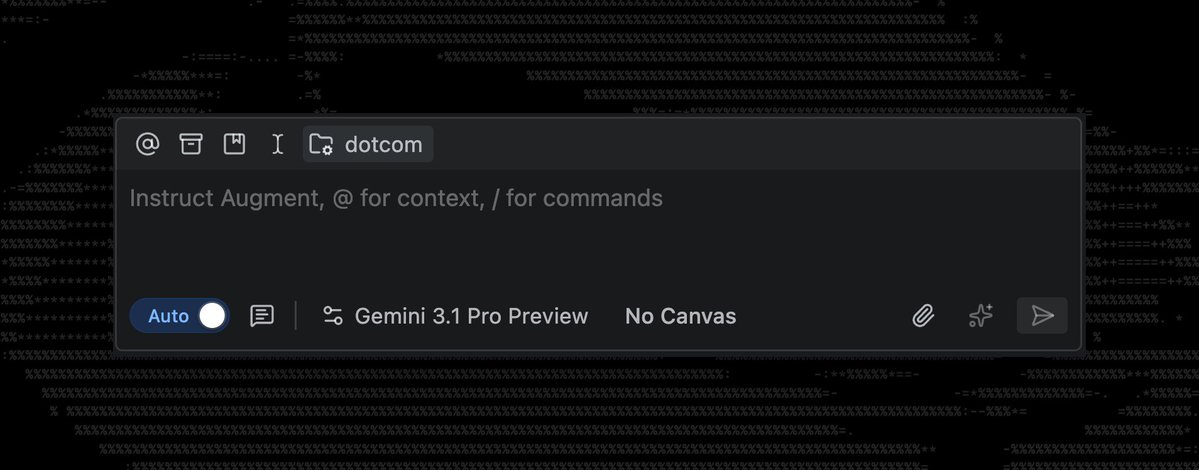
Gemini 3.1 Pro is now available in our model picker. Its performance is comparable to Opus 4.6 on real-world engineering tasks, at 2.6x lower cost per message. We’re especially excited about how it performs on: - Planning and reasoning through changes across large codebases - Debugging and investigation - Navigating unfamiliar systems For planning and investigative work, try Gemini as your first pass.
Augment Code tweet media
English
3
7
64
4.9K
Francisco Marcano รีทวีตแล้ว
Linear
Linear@linear·
New: Web forms for Linear Asks Create a dedicated Asks page with forms to capture internal requests such as bug reports, data pulls, or HR and IT tasks.
Linear tweet media
English
12
5
253
27.6K
Francisco Marcano รีทวีตแล้ว
JetBrains Qodana
JetBrains Qodana@Qodana·
Need a smarter way to manage technical debt? Use the Baseline feature to table non-critical issues you'd prefer to address later. This video shows how you can inspect your code using Baseline. #QodanaTip
JetBrains Qodana tweet media
English
0
1
1
104
Francisco Marcano รีทวีตแล้ว
OpenClaw🦞
OpenClaw🦞@openclaw·
OpenClaw 2026.4.2 🦞 🔄 Durable Task Flow orchestration 🔓 Better native exec defaults + approvals 🤖 Copilot + Kimi + provider hardening 🔌 Tighter plugin activation boundaries 🛡️ Hardened provider transport + routing Less bloat. More lobster. github.com/openclaw/openc…
English
202
189
1.6K
212.8K
Francisco Marcano รีทวีตแล้ว
Andrej Karpathy
Andrej Karpathy@karpathy·
LLM Knowledge Bases Something I'm finding very useful recently: using LLMs to build personal knowledge bases for various topics of research interest. In this way, a large fraction of my recent token throughput is going less into manipulating code, and more into manipulating knowledge (stored as markdown and images). The latest LLMs are quite good at it. So: Data ingest: I index source documents (articles, papers, repos, datasets, images, etc.) into a raw/ directory, then I use an LLM to incrementally "compile" a wiki, which is just a collection of .md files in a directory structure. The wiki includes summaries of all the data in raw/, backlinks, and then it categorizes data into concepts, writes articles for them, and links them all. To convert web articles into .md files I like to use the Obsidian Web Clipper extension, and then I also use a hotkey to download all the related images to local so that my LLM can easily reference them. IDE: I use Obsidian as the IDE "frontend" where I can view the raw data, the the compiled wiki, and the derived visualizations. Important to note that the LLM writes and maintains all of the data of the wiki, I rarely touch it directly. I've played with a few Obsidian plugins to render and view data in other ways (e.g. Marp for slides). Q&A: Where things get interesting is that once your wiki is big enough (e.g. mine on some recent research is ~100 articles and ~400K words), you can ask your LLM agent all kinds of complex questions against the wiki, and it will go off, research the answers, etc. I thought I had to reach for fancy RAG, but the LLM has been pretty good about auto-maintaining index files and brief summaries of all the documents and it reads all the important related data fairly easily at this ~small scale. Output: Instead of getting answers in text/terminal, I like to have it render markdown files for me, or slide shows (Marp format), or matplotlib images, all of which I then view again in Obsidian. You can imagine many other visual output formats depending on the query. Often, I end up "filing" the outputs back into the wiki to enhance it for further queries. So my own explorations and queries always "add up" in the knowledge base. Linting: I've run some LLM "health checks" over the wiki to e.g. find inconsistent data, impute missing data (with web searchers), find interesting connections for new article candidates, etc., to incrementally clean up the wiki and enhance its overall data integrity. The LLMs are quite good at suggesting further questions to ask and look into. Extra tools: I find myself developing additional tools to process the data, e.g. I vibe coded a small and naive search engine over the wiki, which I both use directly (in a web ui), but more often I want to hand it off to an LLM via CLI as a tool for larger queries. Further explorations: As the repo grows, the natural desire is to also think about synthetic data generation + finetuning to have your LLM "know" the data in its weights instead of just context windows. TLDR: raw data from a given number of sources is collected, then compiled by an LLM into a .md wiki, then operated on by various CLIs by the LLM to do Q&A and to incrementally enhance the wiki, and all of it viewable in Obsidian. You rarely ever write or edit the wiki manually, it's the domain of the LLM. I think there is room here for an incredible new product instead of a hacky collection of scripts.
English
2.3K
5.4K
46.9K
14.3M
Francisco Marcano รีทวีตแล้ว
Claude Code Changelog
Claude Code Changelog@ClaudeCodeLog·
Claude Code 2.1.91 has been released. 13 CLI changes Highlights: • disableSkillShellExecution disables inline shells in skills and plugin/slash commands, improving safety • MCP accepts _meta["anthropic/maxResultSizeChars"]=500K to allow large outputs like DB schemas untruncated • Fixed --resume transcript chain break that dropped history on async write failures, preserving resumed history Full details are in thread ↓
English
23
37
478
57.8K
Francisco Marcano รีทวีตแล้ว
Demis Hassabis
Demis Hassabis@demishassabis·
Excited to launch Gemma 4: the best open models in the world for their respective sizes. Available in 4 sizes that can be fine-tuned for your specific task: 31B dense for great raw performance, 26B MoE for low latency, and effective 2B & 4B for edge device use - happy building!
Demis Hassabis tweet media
English
310
860
7.9K
835.7K
Francisco Marcano รีทวีตแล้ว
Google AI
Google AI@GoogleAI·
Today, we’re launching Gemma 4, our most intelligent open models to date. Built with the same breakthrough technology as Gemini 3, Gemma 4 brings advanced reasoning to your personal hardware and devices. Here’s what Gemma 4 unlocks for developers: — Intelligence-per-parameter: Our 31B (Dense) and 26B (MoE) models deliver state-of-the-art performance for their size, outcompeting models 20x their size on @arena — Commercial flexibility: Released under a permissive Apache 2.0 license for complete developer flexibility and digital sovereignty — Agentic workflows: Native support for function-calling and structured JSON output allows you to build reliable, autonomous agents — Multimodal edge AI: The E2B and E4B models bring native vision, audio, and low latency to mobile and IoT devices — Long-context reasoning: Up to 256K context windows allow you to process entire repositories or large documents in a single prompt Whether you're building global applications in 140+ languages or local-first AI code assistants, Gemma 4 is built to be your foundation. Explore in @GoogleAIStudio or download the weights on @HuggingFace, @Kaggle, and @Ollama.
English
113
347
2.3K
347.6K