HUBBLE

6.5K posts

HUBBLE banner
HUBBLE

HUBBLE

@HUBBLE_space

Official @ESA feed for #Hubble Space Telescope — the space-based observatory which has revolutionised modern astronomy. #BFFinSpace with @ESA_Webb

space เข้าร่วม Nisan 2010
434 กำลังติดตาม925.2K ผู้ติดตาม
HUBBLE
HUBBLE@HUBBLE_space·
Hubble was launched on 24 April 1990. Since then, it has taken over 1.7 million observations, which have contributed to more than 23,000 publications 🤯 including almost 1,100 in 2025 alone! Read more: esahubble.org/news/heic2608/  📷@NASA , @ESA , STScI, Image processing: J. DePasquale (STScI) 3/3
English
0
8
57
3.5K
HUBBLE
HUBBLE@HUBBLE_space·
This isn’t the first time Hubble has taken in this scene. It observed the Trifid in 1997 and, returning now after all these years, has revealed subtle changes on a human time scale. 2/3
English
2
14
111
5.7K
HUBBLE
HUBBLE@HUBBLE_space·
🆕 Hubble has turned to the Trifid Nebula for its 36th anniversary coming this 24 April. The Trifid Nebula lies about 5,000 light-years from Earth. This cloud of gas and dust somewhat resembles a marine sea lemon – a sea slug – undulating through the cosmos! 🌊 1/3
HUBBLE tweet media
English
5
95
621
42.6K
HUBBLE
HUBBLE@HUBBLE_space·
Our #HubbleTopImage looks towards the disc around a black hole 🕳️👀 This image was snapped when a team of scientists used the NASA/ESA Hubble Space Telescope to observe a quasar accretion disc – a brightly glowing disc of matter that is being slowly sucked into its galaxy’s central black hole. The team’s study made use of gravitational lensing to give a boost to Hubble’s power! The incredible precision of the method allowed astronomers to directly measure the disc’s size and plot the temperature across different parts of the disc. Read more: ow.ly/3xG250YFtE9 📷 @NASA , @ESA , and J.A. Muñoz (University of Valencia)
HUBBLE tweet media
English
15
113
554
16.1K
HUBBLE
HUBBLE@HUBBLE_space·
Across a dying star 💀⭐ The Cat’s Eye Nebula is a planetary nebula. This type of object appeared round (planet-like!) in early telescopes, but the NASA/ESA Hubble Space Telescope has revealed a complex morphology – this is especially true of the Cat’s Eye Nebula! In this new image, Hubble captures the core of the billowing gas, its tapestry of concentric shells, and jets of high-speed gas and dense knots sculpted by shock interactions.1/2
English
6
217
940
27.8K
HUBBLE
HUBBLE@HUBBLE_space·
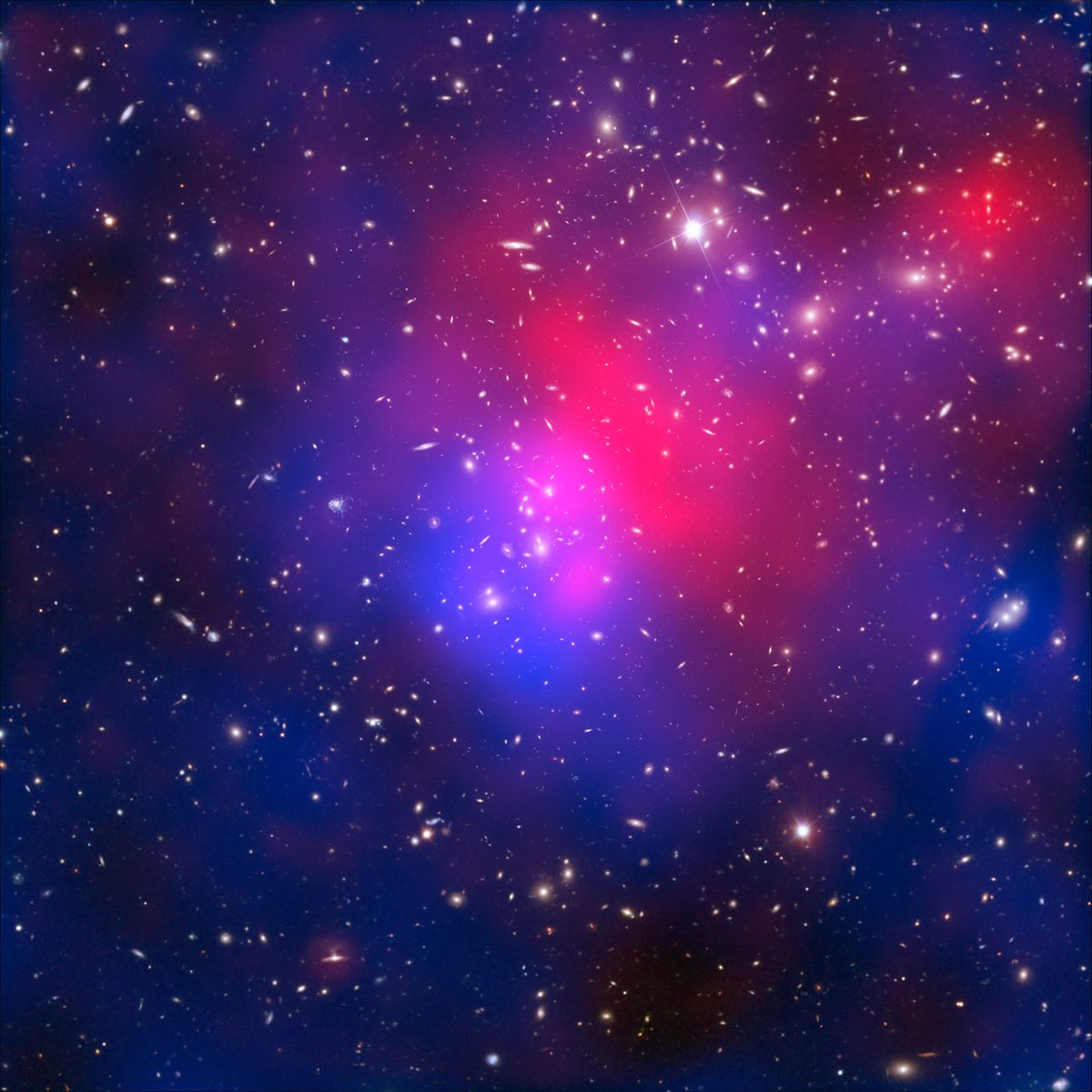
Data from Hubble, ESO’s Very Large Telescope, the Japanese Subaru telescope, and NASA’s Chandra X-Ray Observatory revealed that Pandora’s Cluster is probably the result of a simultaneous pile-up of at least four separate galaxy clusters – a collision that produced strange effects that had never been seen together before! 2/3
English
1
9
49
4.7K
HUBBLE
HUBBLE@HUBBLE_space·
Our #HubbleTopImage investigates a galactic crash 💥 This Hubble image, from 2011, helped astronomers piece together the violent history of Pandora’s Cluster (Abell 2744). When huge clusters of galaxies crash together, the resulting mess is a treasure trove of information for astronomers… 1/3
HUBBLE tweet media
English
4
83
421
13.4K
HUBBLE
HUBBLE@HUBBLE_space·
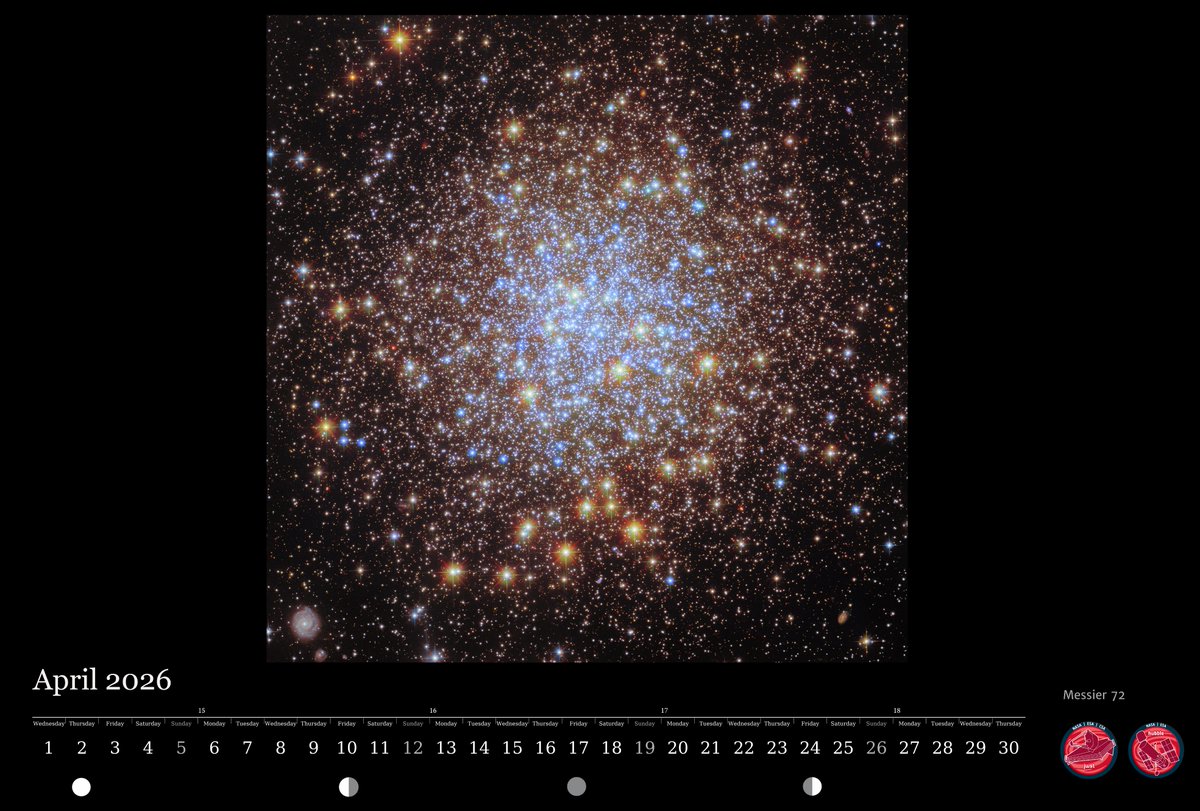
In the 2026 ESA/Hubble and ESA/Webb calendar, the month of April revisits the star cluster Messier 72 in an image captured to celebrate Hubble's 35th anniversary 🎉 Ready to print .pdf here: ow.ly/t7EG50YEsoq 📷 @ESA / Hubble , @NASA , A. Sarajedini, G. Piotto, M. Libralato
HUBBLE tweet media
English
0
24
141
6.9K
HUBBLE
HUBBLE@HUBBLE_space·
Read more here: esahubble.org/images/potm260… 📷 @ESA / @Hubble_Space & @NASA , ESA Euclid/Euclid Consortium/NASA/Q1-2025, J.-C. Cuillandre & E. Bertin (CEA Paris-Saclay), Z. Tsvetanov, G. Anselmi, E. Slawik, N. Risinger, N. Bartmann (ESA/Hubble), M. Zamani (ESA/Hubble) 🎶 Tonelabs – The Red North (tonelabs.com) 2/2
Filipino
1
10
69
4.8K
HUBBLE
HUBBLE@HUBBLE_space·
Take a journey through space to the remnants of a dying star 🚀 The Cat’s Eye Nebula is an example of a planetary nebula. Named because of their round shape when viewed through early telescopes, they are actually expanding gas thrown off by stars reaching their end. It was the Cat’s Eye Nebula itself where this fact was first discovered in 1864! 1/2
English
7
181
845
29.3K
HUBBLE
HUBBLE@HUBBLE_space·
Read more: esahubble.org/news/heic1109/ 📷 @NASA , @ESA and the Hubble Heritage Team (STScI/AURA)-ESA/Hubble Collaboration Acknowledgment: R. O’Connell (University of Virginia) and the WFC3 Scientific Oversight Committee 2/2
English
0
11
31
4.7K
HUBBLE
HUBBLE@HUBBLE_space·
Our #HubbleTopImage features a star formation laboratory 👩‍🔬 NGC 4214 is packed with everything an astronomer could ask for, from hot, young star-forming regions to old clusters with red supergiants. This, along with its relative proximity to us, makes it an ideal laboratory to research star formation and evolution! By chance, there is relatively little interstellar dust between us and NGC 4214 😶‍🌫️ making our measurements of it more accurate. 1/2
HUBBLE tweet media
English
3
86
413
10.7K
HUBBLE
HUBBLE@HUBBLE_space·
@Scott_Goad73 The Crab Nebula is approximately 6,500 light-years from Earth, so the supernova itself occurred in the 8th millennium BC!
English
0
1
2
71
Scott Goad 🇺🇸
Scott Goad 🇺🇸@Scott_Goad73·
@HUBBLE_space If the supernova was seen in 1054, based on the estimated distance, what was the estimated year that the supernova actually occurred?
English
1
0
0
24
HUBBLE
HUBBLE@HUBBLE_space·
Astronomers in the year 1054 watched closely as a supernova blazed in the sky. A millennium later, astronomers are keeping a close eye on its remnant, the Crab Nebula 🦀 as it continues to evolve! Hubble first observed the nebula in 1999. Its newest image of the Crab Nebula contains extraordinary details of its filamentary structure and the outward movement of those filaments. 1/2
English
16
345
2.1K
55.4K
HUBBLE
HUBBLE@HUBBLE_space·
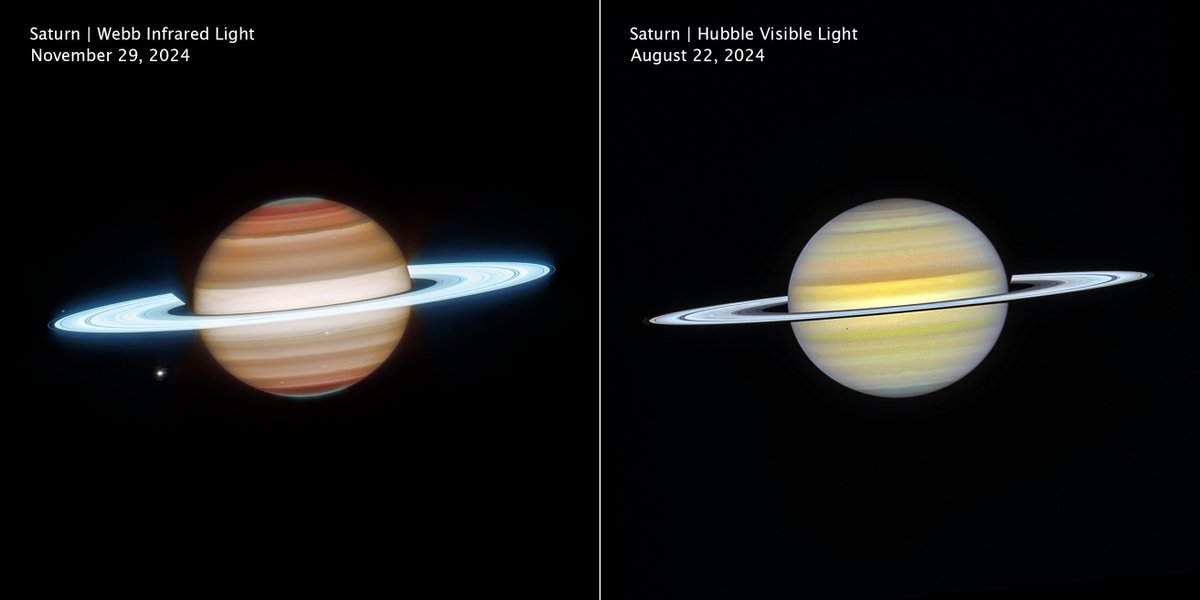
Hubble and Webb are each able to produce high-resolution, global images of Saturn’s surface, and can cover the whole planet as it rotates over time. This lets scientists perform seasonal and long-term studies of the planet’s atmosphere, weather, rings and so on. Hubble has been tracking Saturn regularly since 2018, after the Cassini mission ended. Additionally, Webb’s broad infrared sensitivity makes it possible to look at cloud layers at various depths in Saturn’s atmosphere.
English
0
0
1
44
Ankur in the Evening 🍷
Ankur in the Evening 🍷@a_n_k_u_r·
@HUBBLE_space @ESA_Webb What do you hope to learn from these pictures when a few years ago Cassini toured the Saturnian system extensively and took lots of pictures up close?
English
2
0
0
162
HUBBLE
HUBBLE@HUBBLE_space·
🆕 Hubble has teamed up with @esa_webb to provide astronomers with the most comprehensive view of Saturn! 1/3
HUBBLE tweet media
English
11
67
348
12K
HUBBLE
HUBBLE@HUBBLE_space·
A cosmic gem in Gemini! 🧑‍🤝‍🧑 Access more space-themed .gifs at our giphy page: ow.ly/Avk750YzaoR
GIF
English
2
53
236
7.5K
HUBBLE
HUBBLE@HUBBLE_space·
This glowing beauty is the barred spiral galaxy IC 486, which lies on the edge of the constellation Gemini (the Twins) 🧑‍🤝‍🧑 around 380 million light-years from Earth. The subtle variations in colour across this galaxy have been captured in this Hubble image – a pale centre dominated by older stars, bluish regions in the surrounding disc where younger stars shine, and the intense white glow of its active galactic nucleus! Read more here: ow.ly/GjQk50Yzaig 📷 @ESA / @Hubble_Space & @NASA , M. J. Koss, A. J. Barth, N. Bartmann (ESA/Hubble) 🎶 Stellardrone - Billions and Billions
English
3
117
487
14.6K
HUBBLE
HUBBLE@HUBBLE_space·
Hubble’s keen eye reveals subtle variations in colour across the galaxy. The pale centre is dominated by older stars 👵⭐ while bluish regions in the disc trace sites of more recent star formation 👶⭐ The intense white glow at the centre of IC 486 is light from its active galactic nucleus, which is powered by a black hole more than 100 million times as massive as the Sun! 2/3
HUBBLE tweet media
English
1
21
110
5.4K
HUBBLE
HUBBLE@HUBBLE_space·
Our ESA/Hubble Picture of the Month features spiral arms and star formation in the constellation Gemini 🧑‍🤝‍🧑 This luminous swirl set against the blackness of space is the barred spiral galaxy IC 486. It lies right on the edge of the constellation Gemini (the Twins), around 380 million light-years from Earth. 1/3
HUBBLE tweet media
English
4
89
436
17K