ทวีตที่ปักหมุด
The Indian Matrix
770 posts

The Indian Matrix
@indianmatrix
From economy to culture: everything has a Matrix. A space to decode & visualise stories from across the planet.
India เข้าร่วม Eylül 2025
0 กำลังติดตาม14.4K ผู้ติดตาม

In statecraft, geography is the ultimate ledger. A single political hesitation can cost a nation centuries of strategic leverage.
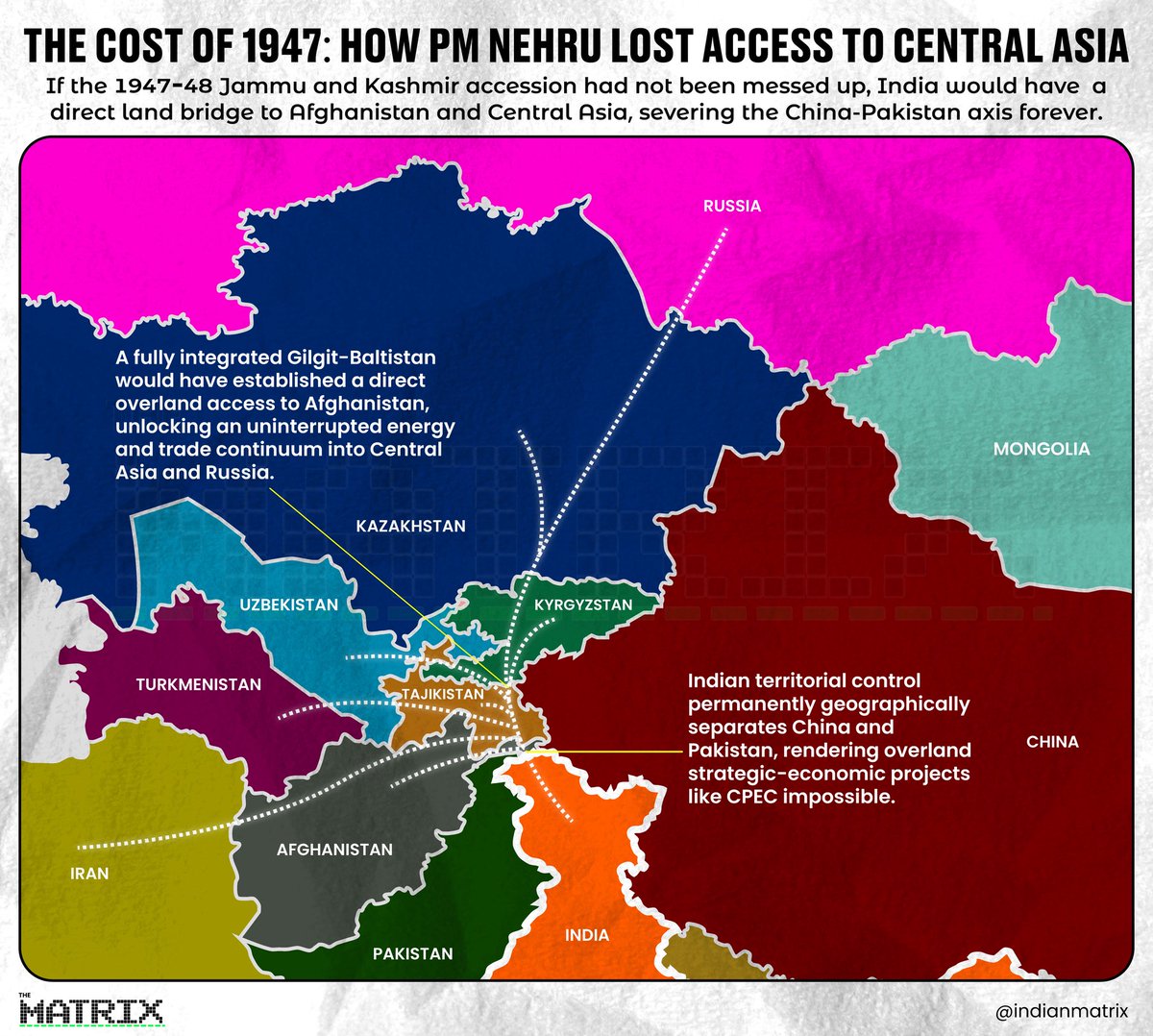
We visualised the ultimate geopolitical "What If": The complete integration of Gilgit-Baltistan during the 1947-48 Jammu & Kashmir campaign.
The map reveals a brutal truth. The mishandling of the accession and the premature UN ceasefire surrendered the world's most lucrative continental land bridge.
1. Wakhan Key (Direct Connectivity)
If the Indian Army had not been halted, India’s northern frontier would have physically locked into the Wakhan Corridor in Afghanistan. This 106-km border is the gateway to the Eurasian heartland.
India would possess direct, uninterrupted overland highways and energy pipelines to:
• Afghanistan and Iran
• Tajikistan, Uzbekistan, and Turkmenistan
• Kyrgyzstan and Kazakhstan
• Russia
Instead of relying on vulnerable maritime choke-points, India would be the undisputed, most sought-after global hub for Central Asian and Russian energy supply chains.
2. Severed Axis (Geopolitical Checkmate)
Look at the map where China (Dark Red) and Pakistan (Dark Green) meet today.
Indian territorial control over Gilgit-Baltistan would drive a permanent geographical wedge between Beijing and Islamabad.
• There would be ZERO shared border.
• The Karakoram Highway? Non-existent.
• The multi-billion dollar China-Pakistan Economic Corridor (CPEC)?
Geographically impossible.
English
The Indian Matrix รีทวีตแล้ว

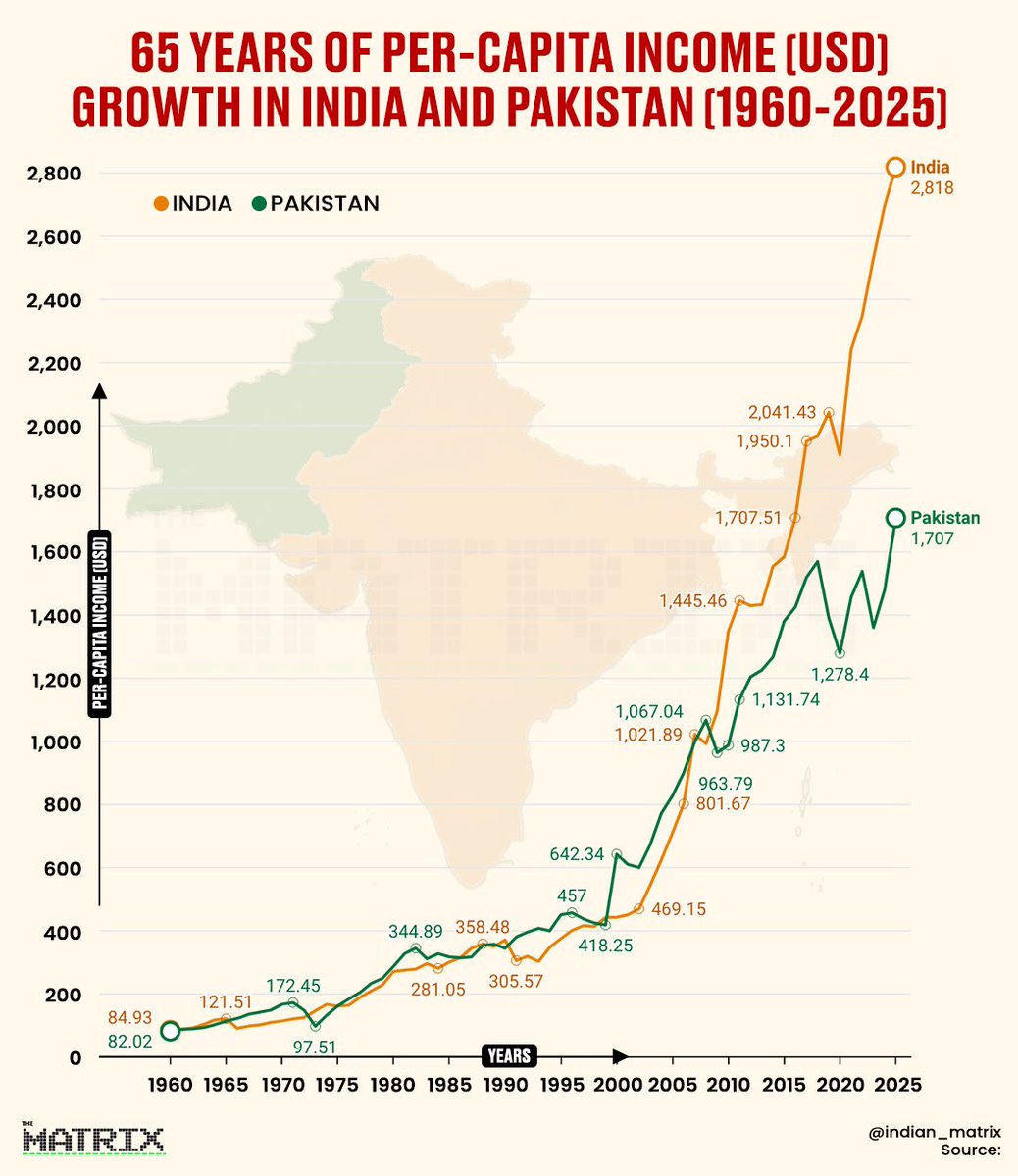
In 1960, the economic starting line for India and Pakistan was nearly identical. India’s per capita income was $84.93, and Pakistan’s was $82.02.
For the next thirty years, the two nations remained within striking distance of each other. However, the data for 2025, where India stands at $2,818 and Pakistan at $1,707, demonstrates the story of "The Great Decoupling."
It is a chronicle of how one nation eventually broke the shackles of a stagnant socialist past to embrace its civilizational potential. At the same time, the other became trapped in a cycle of radicalization, feudalism, and foreign debt.
1. 1960–1980: The Illusion of the "Golden Decade"
Early data shows Pakistan often leading India (e.g., 1970: Pakistan $166 vs. India $114). This wasn't due to superior Pakistani productivity, but rather "Borrowed Growth."
Pakistan aligned itself as a Cold War client state, receiving massive infusions of Western aid and military hardware. This created an artificial middle class without a deep industrial base.
Meanwhile, India was held back by the "License Raj," a byproduct of Nehruvian socialism that viewed profit as a vice and entrepreneurs with suspicion.
This "Hindu Rate of Growth" (which was actually a Socialist Rate of Growth) suppressed India’s natural mercantile spirit for decades.

English

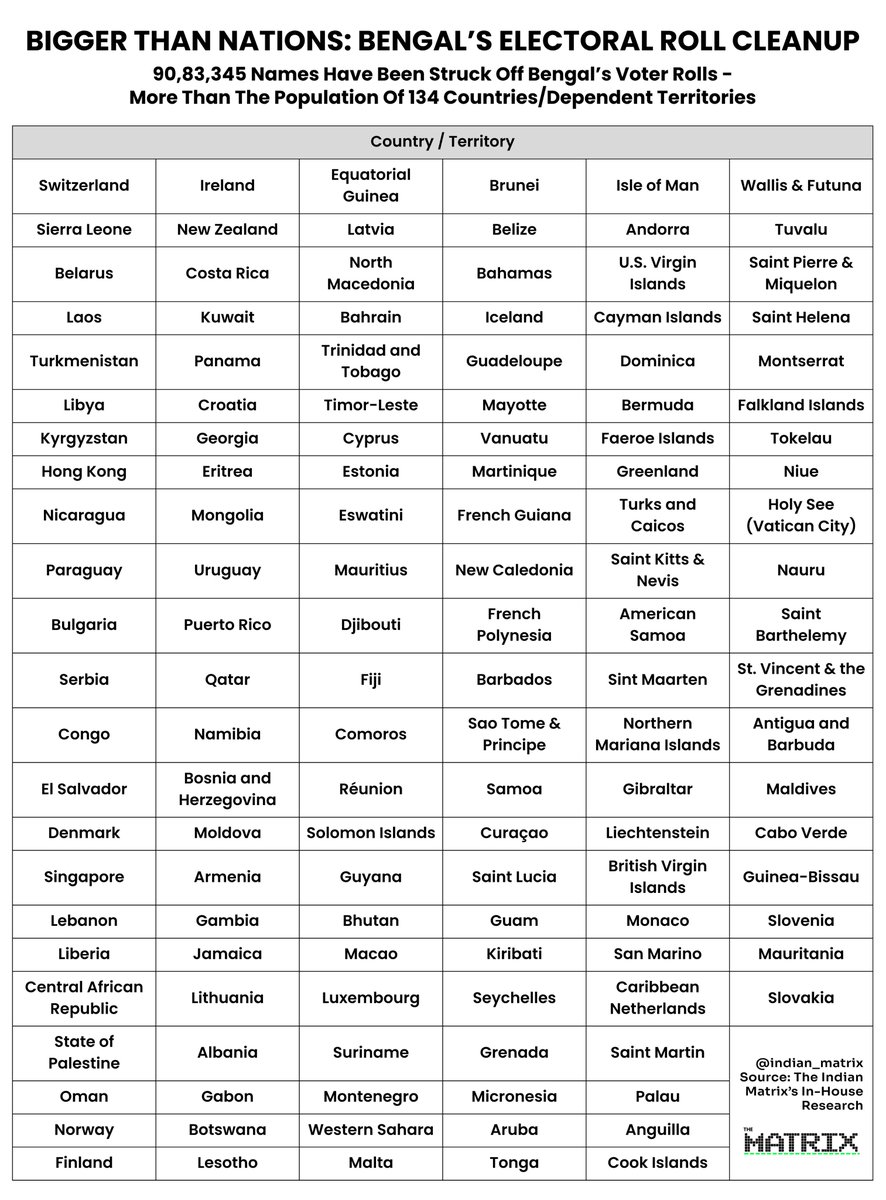
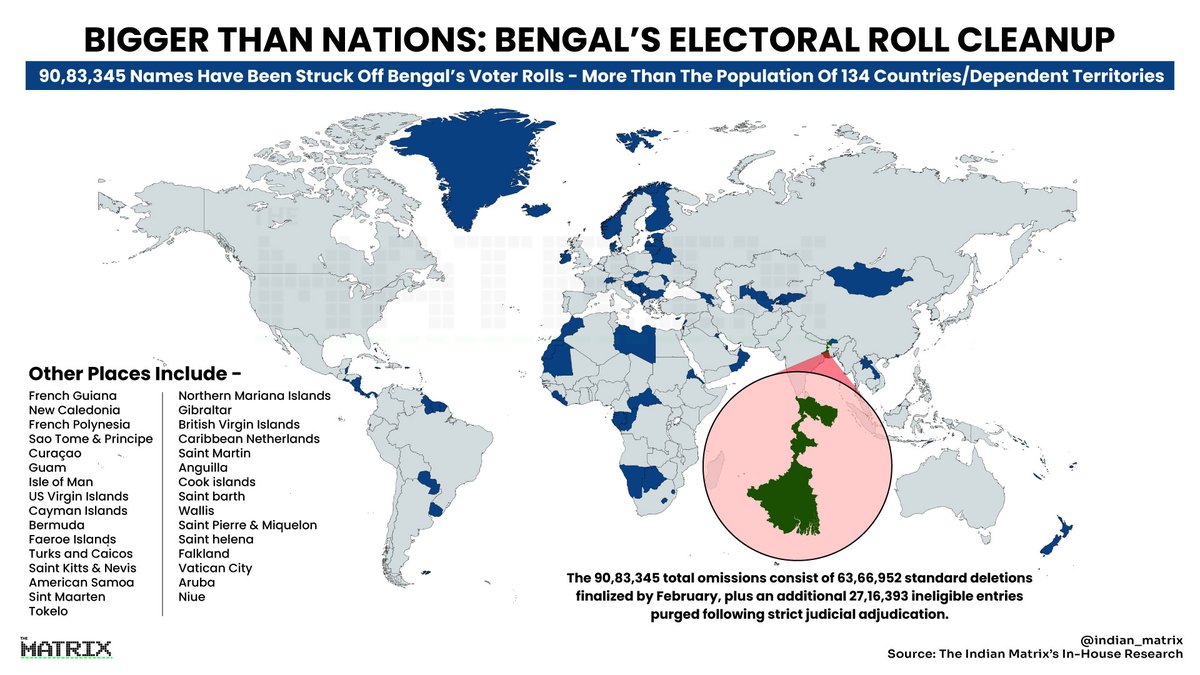
To understand the sheer magnitude of West Bengal’s Special Intensive Revision (SIR), you have to look at a world map. The Election Commission deleted the equivalent of an entire European nation.
We visualised the data. The scale is staggering.
1. Arithmetic of Omission
90,83,345 total names have been struck off the state's electoral rolls.
The exact operational breakup:
• 63,66,952 standard deletions (dead, shifted, or duplicate entries) finalised by February.
• 27,16,393 ineligible entries purged following strict judicial adjudication.
2. Geopolitical Perspective
How big is the number 90,83,345? It is greater than the total population of 134 sovereign nations and dependent territories.
West Bengal effectively harboured more ghost voters than there are living citizens in Switzerland, Singapore, Denmark, or New Zealand.
An election is only as legitimate as its underlying data.
When the error margin in a single Indian state eclipses the population of 134 global territories, it ceases to be an administrative glitch. It becomes a structural threat to the democratic mandate.
This is a restoration of sovereign integrity.
Clean Data = Credible Democracy.

English

Kerala’s demographic landscape is a fascinating study in pluralism and historical settlement.
This updated 2025 projection by The Indian Matrix offers a dual perspective on the state's Muslim population, contrasting broad district-level averages with granular assembly constituency-level data. This "double-lens" approach provides a much more nuanced understanding of the state’s social fabric.
At the district level, the traditional "North-South" gradient remains the defining feature. The Malabar region remains the heartland of the community, led by Malappuram at 70.04%, followed by Kozhikode (39.13%) and Kasaragod (37.25%).
Conversely, southern interior districts, such as Pathanamthitta (4.54%) and Kottayam (6.35%), maintain the lowest shares. These district figures, however, often mask the true diversity found on the ground.
The "Assembly Constituency View" is where the data becomes truly revealing. While a district like Palakkad (29.20%) or Kannur (29.50%) shows a moderate average, the map shows specific constituencies within them, and especially in Malappuram, where the population share surges into the 50-85% bracket.
This granular view highlights how the community is concentrated in specific historical trade hubs and coastal belts. Even in the south, the constituency view reveals localised clusters that are invisible when looking at district-wide data.
By moving beyond broad administrative borders to the level of legislative representation, this research underscores the importance of localised data in understanding political and social dynamics. It illustrates how Kerala’s religious diversity is not just a state-wide statistic, but a complex, high-resolution mosaic.
English

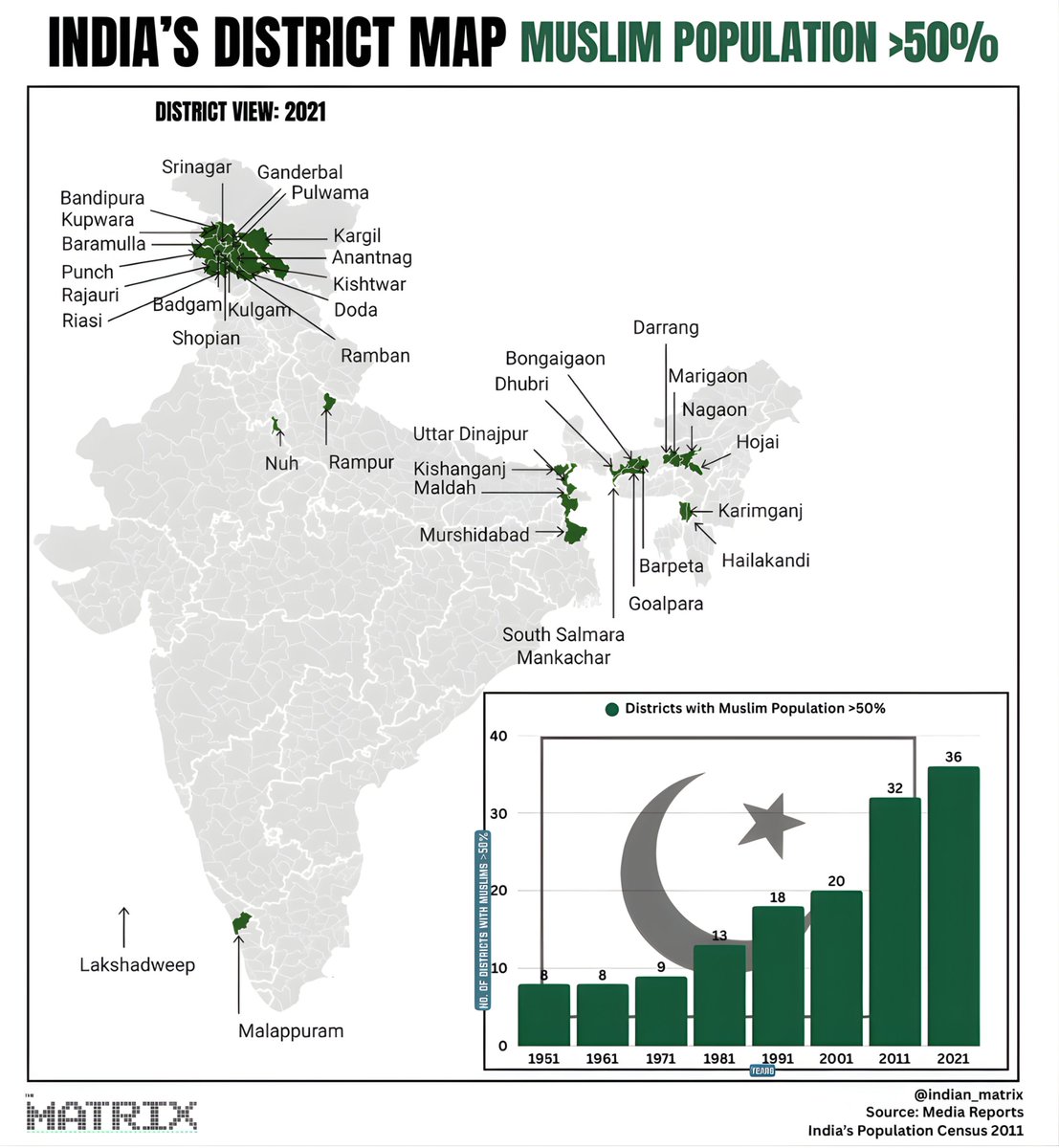
Key Takeaways
- Indication of a rise in the number of Muslim-majority districts post the census exercise
- 350% rise in Muslim-majority districts (8 → 36) over 70 years
- J&K makes up nearly half (17/36)
- Assam expands fastest (0 → 11 between 1991–2021)
- 2011 jump driven by bifurcations + revised census processes
- Growth flat till 1971, accelerates sharply post-1981
- Spread across 8 states/UTs shows region-specific demographic patterns
- District reorganisations post-1991 affect comparability
(9/9)
English

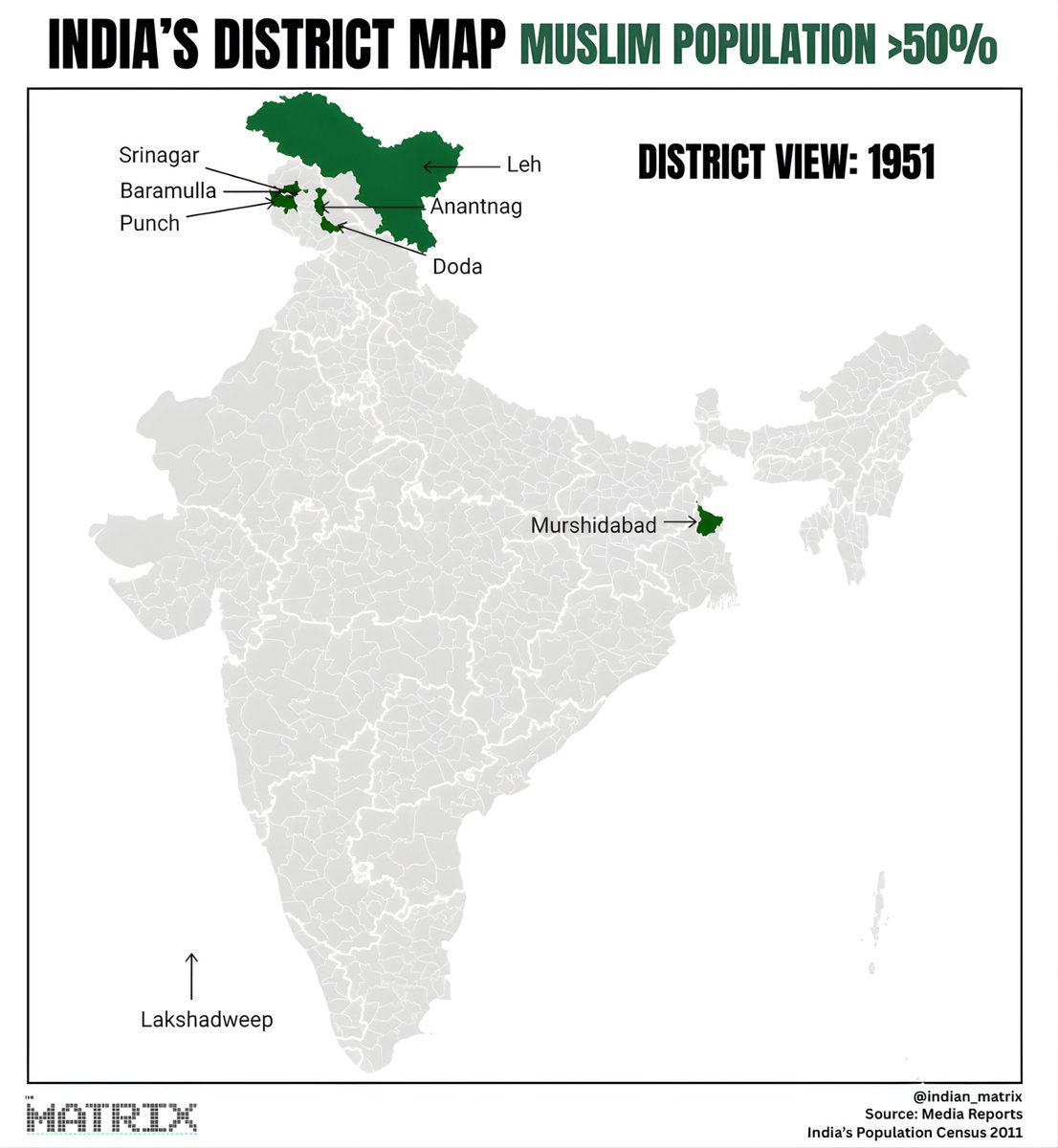
India has begun a fresh census exercise, and early expectations suggest that the number of Muslim-majority districts may rise further.
Muslim-Majority Districts in India (1951–2021)
A steady shift over seven decades:
1951 → 2021: From 8 to 36 Muslim-majority districts
1951: 8
1961: 8
1971: 9
1981: 13
1991: 18
2001: 20
2011: 32
2021: 36
(1/9) 🧵


English
The Indian Matrix รีทวีตแล้ว

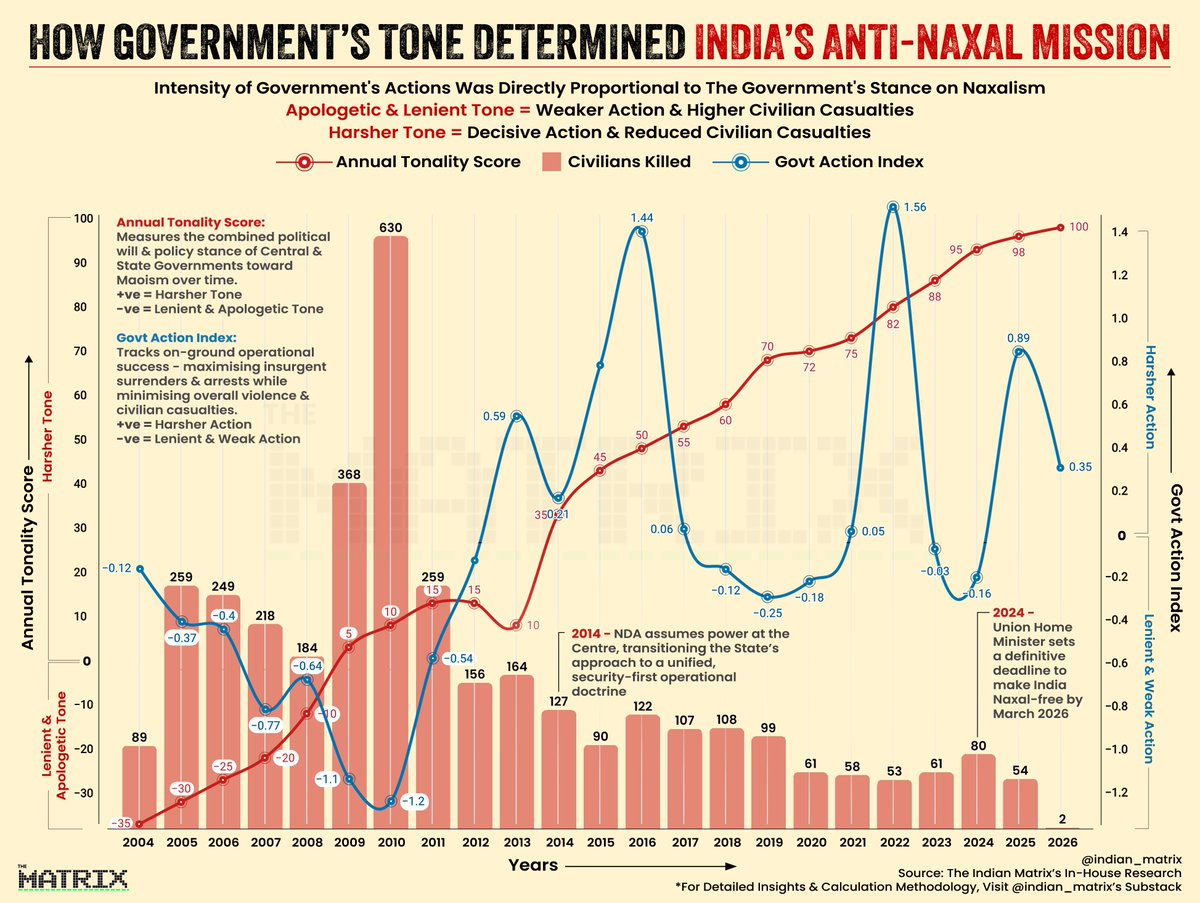
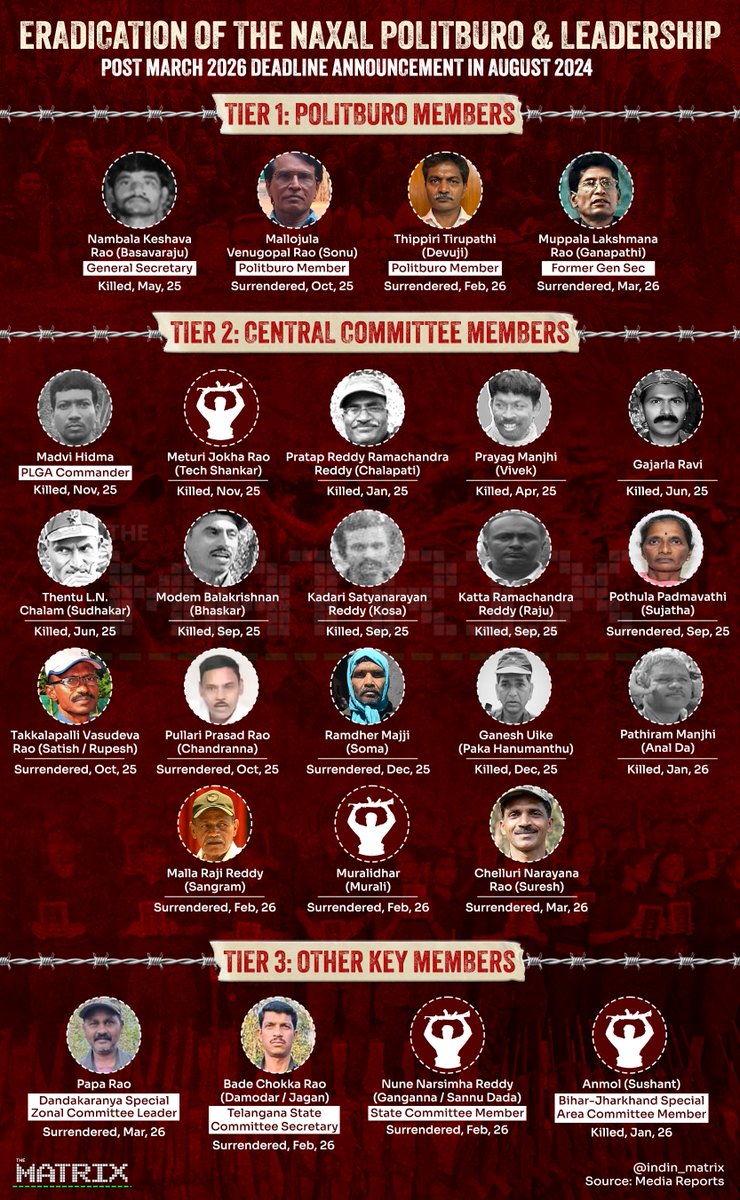
The announcement by Union Home Minister Amit Shah in August 2024 regarding a "Naxal-free Bharat" marked a pivotal shift in India’s internal security doctrine.
Over the past decade, the Maoist movement has been squeezed from both ends. Tactical innovations, such as the DRG intelligence network and the expanded use of local police, have systematically eroded the Naxals’ traditional advantages in warfare and terrain.
Transitioning from a policy of containment to one of absolute strategic elimination, the empirical data from the last 18 months reveal a systematic dismantling of the Maoist insurgent framework.
Here is an analytical breakdown of the "Matrix" of neutralisation:
1. Tier 1: The Collapse of the Ideological Core
The Politburo is the brain of the insurgency. The data indicates a 100% neutralization rate of the top four identified leaders.
Kinetic Impact: The elimination of General Secretary Nambala Keshava Rao (Basavaraju) in May 2025 removed the movement’s primary military strategist.
Psychological Attrition: The surrender of veterans like Ganapathi (Former GS) and Sonu in late 2025/early 2026 signifies an "ideological bankruptcy." When the founders surrender, the foot soldiers lose the "cause."
2. Tier 2: The Eradication of Operational Command
The Central Committee (CC) acts as the bridge between policy and jungle warfare. Our data tracks 18 high-value targets in this tier:
Lethality Ratio: 10 out of 18 CC members were neutralised through kinetic operations (Killed), including high-profile commanders like Madvi Hidma and Tech Shankar.
Area Denial: The concentrated eliminations in September 2025 (Bhaskar, Satyanarayan, Raju) suggest a massive intelligence-led "sweep operation" that paralysed the CC’s ability to coordinate across state borders.
3. Tier 3: The Severing of Local Logistics
Regional and Zonal committees provide the "oxygen" for Naxalism, recruitment and local intelligence.
The surrender of figures like Papa Rao (Dandakaranya) and Chokka Rao (Telangana) indicates a total breakdown in the local support ecosystem.
By March 2026, the data shows a trend: Regional leaders are increasingly choosing surrender over combat, signalling a lack of faith in the surviving upper echelons.
Empirical Observations:
- The "August 2024" Catalyst: Security forces shifted from "reactive patrolling" to "proactive decapitation strikes" following the policy mandate.
- The Surrender Wave: A significant spike in surrenders occurred between Oct 2025 and March 2026. This suggests that the elimination of the "Tier 1" leadership in mid-2025 triggered a domino effect across lower rungs.
- Technological Overmatch: The neutralisation of "Tech Shankar" and "Madvi Hidma" underscores the success of technical intelligence (SIGINT) and drone surveillance in once-impenetrable terrains like Abujhmad.
The Maoist insurgency is currently facing a "Leadership Vacuum" from which recovery is statistically improbable. By targeting the organisational structure rather than just the foot soldiers, the State has effectively transitioned the conflict toward a terminal phase.
The roadmap to a Naxal-free Bharat is no longer a political statement. It is an operational reality.
English