Inside_Israel_Intel

13.6K posts

Inside_Israel_Intel banner
Inside_Israel_Intel

Inside_Israel_Intel

@inside_IL_intel

Ex-IDF. OSINT & security analyst: Israel & US. Unfiltered takes from experience. Author of Contested Land, Uncontested Truth, available on Amazon and Kindle.

USA เข้าร่วม Eylül 2011
1.9K กำลังติดตาม80K ผู้ติดตาม
ทวีตที่ปักหมุด
Inside_Israel_Intel
Inside_Israel_Intel@inside_IL_intel·
🚨 OPERATIONAL UPDATE: ISRAEL U.S. WAR WITH THE ISLAMIC REPUBLIC - Reporting Window: 3/18 to 3/19 • Iran escalated against Gulf energy infrastructure, with major damage reported at Qatar’s Ras Laffan LNG hub and additional strikes or disruptions affecting Saudi, Kuwaiti, and UAE energy systems • Washington is now openly weighing a broader next phase, including more U.S. troops, shoreline options around Hormuz, and contingency planning tied to Kharg Island and Iran’s uranium stockpiles • Iran continued missile attacks on Israel, with cluster warheads and central Israel barrages reinforcing that the threat is evolving even as launch volume declines • Israel deepened pressure on Hezbollah and Iran simultaneously, while Gulf states hardened politically after direct attacks on critical infrastructure The last 24 hours marked a shift in the war’s character. This was no longer just a cycle of launches, strikes, and retaliation. Iran pushed harder into the Gulf energy system itself, hitting infrastructure that matters far beyond the battlefield. At the same time, Washington’s planning language moved beyond containment and toward possible next phase options if airpower and maritime defense do not restore deterrence. Meanwhile, Israel continued applying pressure across both the Lebanese and Iranian fronts while Iranian missile attacks on Israel remained dangerous despite lower overall launch tempo. Below is the operational picture. ━━━━━━━━━━━━━━━━━━ 🛢 GULF ENERGY FRONT: IRAN HIT THE SYSTEM WHERE IT HURTS MOST The most important development of the day was the escalation against Gulf energy infrastructure. Reuters reported extensive damage at Qatar’s Ras Laffan industrial city, the center of Qatar’s LNG export system. Reporting also pointed to additional damage or disruption affecting facilities in Saudi Arabia, Kuwait, and the UAE. Open source intelligence reporting tracked the same pattern in real time, with warnings ahead of the strikes followed by repeated reports of fires, energy site damage, and maritime incidents near Qatar and the UAE. Why this matters: This is no longer just a Strait of Hormuz pressure campaign. Iran is now directly targeting the infrastructure that underpins Gulf export capacity, including LNG and refinery systems. That raises the economic stakes far beyond shipping alone. Brent crude briefly pushed above $119, reinforcing that the market is now pricing in sustained infrastructure risk, not just tanker disruption. ━━━━━━━━━━━━━━━━━━ 🇺🇸 WASHINGTON: THE NEXT PHASE IS NOW BEING DISCUSSED OPENLY One of the most significant strategic developments of the day came from Washington. Reuters reported that the Trump administration is now weighing options for sending thousands of additional U.S. troops to the region. The reported scenarios include expanding Hormuz security, possible operations tied to Iran’s shoreline, planning around Kharg Island, and even contingency discussions involving Iran’s highly enriched uranium stockpiles. That language matters. This is not how governments talk when they believe the war is nearing a clean conclusion. It is how they talk when they are preparing for the possibility that standoff strikes alone may not produce the desired strategic outcome. Open source reporting mirrored this almost immediately, with repeated references to troop options, Kharg Island planning, and discussion of a possible broader U.S. operational phase. Why this matters: The U.S. is no longer just defending shipping and backing Israel from range. It is now clearly thinking through what a larger coercive endgame could require if the current model fails to reopen Hormuz or settle the nuclear problem. ━━━━━━━━━━━━━━━━━━ 💰 THE COST OF THE WAR IS NOW MEASURED IN HUNDREDS OF BILLIONS Reuters also reported that the Pentagon has asked the White House to approve a request exceeding $200 billion for the Iran war. That is not a side story. Once numbers like that enter the discussion, the war is no longer being treated institutionally as a short punitive campaign. It is being framed as a large, sustained, resource intensive operation that may require major replenishment, replacement, and political approval at home. Why this matters: This tells you Washington is planning for duration, not just escalation. ━━━━━━━━━━━━━━━━━━ 🚀 IRANIAN MISSILE ATTACKS ON ISRAEL: LOWER VOLUME, HIGHER TACTICAL COMPLEXITY Iran continued missile attacks on Israel during this window, including fresh central Israel alerts and overnight barrages. Times of Israel reported that the cluster munition threat expanded beyond Israeli civilians alone. A foreign worker was killed in central Israel, while at least three Palestinian women were killed in the West Bank after missile debris struck a civilian site. This marks the first Palestinian fatalities from Iranian attacks in the current war and underscores the indiscriminate impact of cluster-type warheads across different populations. The key issue is not just that missiles are still being fired. It is how they are being configured. Reuters reported that cluster warheads remain one of the most difficult tactical problems for Israeli air defenses because they must be intercepted before they split. That means a smaller salvo can still create multiple impact zones and wider civilian disruption. Open source reporting supported that pattern again today, showing central Israel alerts, repeated references to submunitions, and multiple impact concerns from a single launch event. Why this matters: Iran is no longer relying primarily on sheer barrage size. It is trying to make smaller salvos more disruptive by changing warhead effects, timing, and civilian area saturation. ━━━━━━━━━━━━━━━━━━ 🇱🇧 LEBANON: ISRAEL WENT DEEPER, HEZBOLLAH KEPT FIGHTING Lebanon remained an active battlefield, not a sideshow. Reuters reported that Israel has more than doubled troop levels along the Lebanese border since early March and has now struck additional bridges over the Litani River. Defense Minister Israel Katz said those crossings were being used to move weapons south. At the same time, reporting from Lebanon and Israel showed that Hezbollah is still capable of imposing friction on Israeli operations. Open source intelligence reporting tracked continued clashes around Taybeh and nearby sectors, along with additional airstrikes, warnings, and Hezbollah resistance activity. Why this matters: Israel is clearly not treating Hezbollah fire as something to simply contain at the fence line. It is building a deeper operational belt inside Lebanon while continuing selective urban and infrastructure pressure. ━━━━━━━━━━━━━━━━━━ 🏛 IRAN: THE REGIME TARGET SET IS STILL MOVING UPWARD Inside Iran, the pattern remains one of continued pressure on both capability and control. Jerusalem Post live coverage highlighted that Israel struck roughly 200 Iranian targets over the past day after the reported killing of the Iranian intelligence chief. Open source reporting also pointed to continued strikes in eastern Tehran, Fars province, and other regime linked locations, alongside further pressure on Basij and internal security related targets. Why this matters: The campaign is still not just about launchers and air defenses. It is targeting the machinery that allows the regime to sustain war externally and control events internally. ━━━━━━━━━━━━━━━━━━ 🌍 GULF POLITICS HARDENED The political environment in the Gulf also shifted. Reuters reported that Qatar expelled two senior Iranian diplomats after the Ras Laffan strike. Trump then warned that while Israel would no longer hit Iran’s gas field, the United States would if Qatar’s sites were struck again. At the same time, Gulf rhetoric hardened elsewhere. Your files tracked Saudi statements that trust with Iran has collapsed, while Kuwait moved against a Hezbollah linked network accused of plotting attacks on vital installations. Why this matters: The Gulf states still do not want full entry into the war, but Iran’s direct attacks on their critical infrastructure are making neutrality harder to maintain. ━━━━━━━━━━━━━━━━━━ 📌 WHAT MATTERS MOST RIGHT NOW Three developments define the war tonight. 1️⃣ Iran pushed the war deeper into the Gulf energy system. This was not just about tankers or shipping lanes. It was about LNG, refineries, and the physical infrastructure that keeps Gulf exports moving. 2️⃣ Washington began openly preparing for a broader next phase. Troop options, Hormuz security, Kharg Island, and uranium seizure scenarios all point to a war that may be getting more complex, not less. 3️⃣ Iran’s missile campaign is adapting rather than disappearing. Smaller salvos, cluster warheads, and broader civilian disruption patterns show that declining volume does not mean declining danger. In short, the war is becoming less about headline shock and more about whether either side can break the other’s systems, military, economic, political, and resolve before the region absorbs even deeper damage. ━━━━━━━━━━━━━━━━━━ END OF REPORT
Inside_Israel_Intel tweet media
English
9
60
132
23.8K
Inside_Israel_Intel
Inside_Israel_Intel@inside_IL_intel·
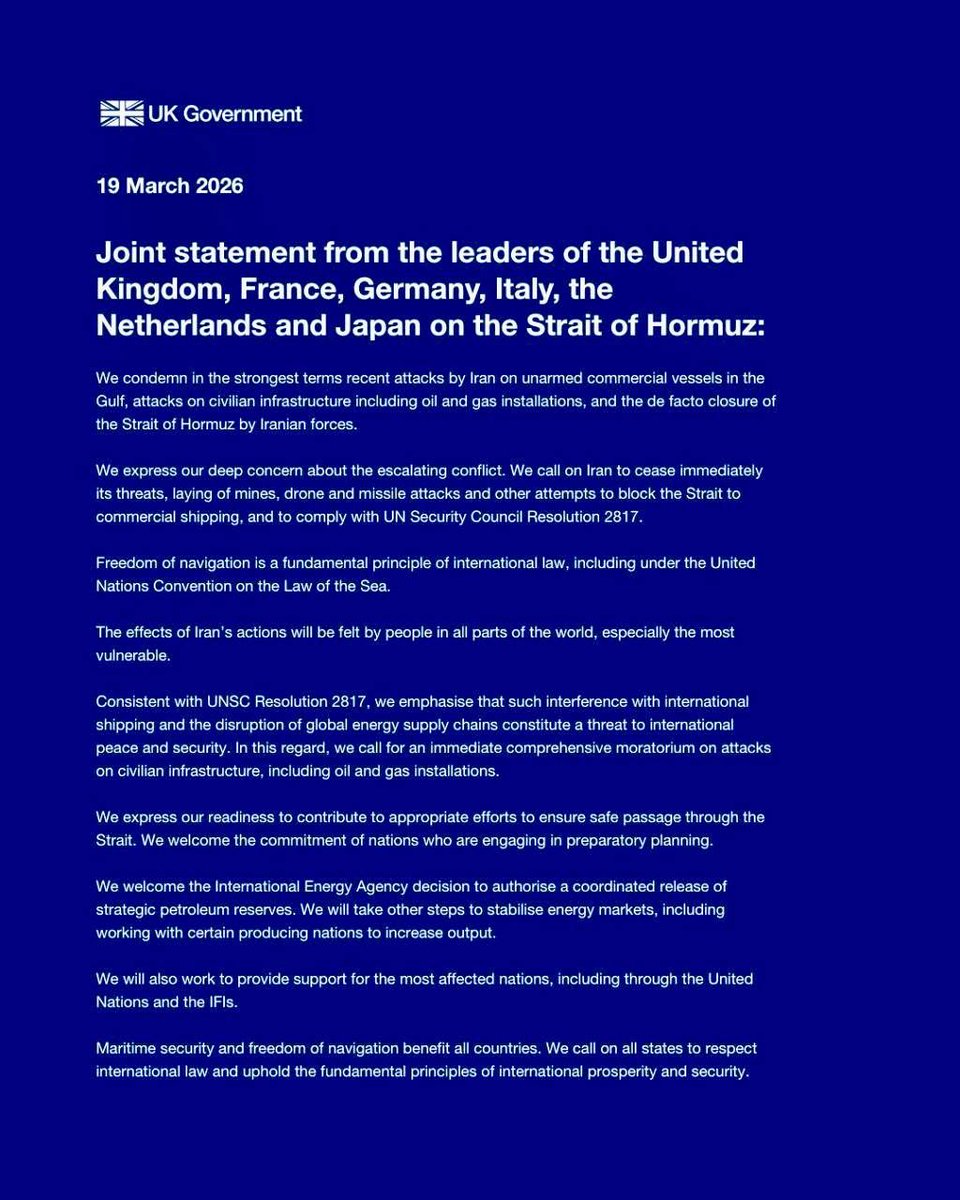
6 U.S. allies have pledged to help secure the Strait of Hormuz shipping lanes: 🇯🇵 Japan 🇬🇧 Britain 🇫🇷 France 🇩🇪 Germany 🇮🇹 Italy 🇳🇱 Netherlands So WHAT CHANGED? The key change prompting this joint statement in the ongoing WAR WITH Iran, 🇮🇷 is BECAUSE of Iran’s actions in the Strait of Hormuz. From the details in official releases, the statement directly condemns: - Recent Iranian attacks on unarmed commercial vessels in the Gulf. - Attacks on civilian infrastructure, including oil and gas installations. - The de facto closure (or effective blocking) of the Strait of Hormuz by Iranian forces, involving threats, laying of mines, drone and missile attacks, and other disruptions to commercial shipping. JUST LIKE MORE ENEMIES OF ISRAEL 🇮🇱 ARE JOINING THE FIGHT, SUDDENLY THE ALLIES OF THE USA 🇺🇸 ARE JOINING. (But they aren’t joining to fight against Iran; 🇮🇷 they are joining to secure their own financial interests.) Oil 🛢️ and gas ⛽️ 19 MAR 2026 | 16:49 ET ET SOURCE: BubbaNews (@bubbanews)
Inside_Israel_Intel tweet media
English
3
7
21
1.7K
Inside_Israel_Intel
Inside_Israel_Intel@inside_IL_intel·
Salah Mohammadi, a 19-year-old wrestler, was executed at dawn on March 18, 2026, on charges of participating in the murder of two officers. In recent years, a number of athletes have been executed, killed, or arrested by the government. Interview with Mehdi Rostampour, sports journalist @iranintltv 19 MAR 2026 | 16:35 ET ET SOURCE: Iran International ایران اینترنشنال (@IranintlTV)
English
3
4
18
1.4K
Inside_Israel_Intel
Inside_Israel_Intel@inside_IL_intel·
🚨 Rocket & Missile Attack — Widespread alerts across central Israel. Affected areas: Northern Valleys, West Bank, Jerusalem, Beit Shemesh area, Lachish & Shephelah (129 locations). Updating... Enter a protected space and wait for the all-clear from the Home Front Command. 19 MAR 2026 | 16:44 ET ET SOURCE: The Jerusalem Post (@The_Jerusalem_Post)
Inside_Israel_Intel tweet media
English
0
0
7
1.3K
Inside_Israel_Intel
Inside_Israel_Intel@inside_IL_intel·
The U.S. Central Command released images of a ballistic missile assembly plant in the city of Karaj - before and after it was attacked. 19 MAR 2026 | 16:21 ET ET SOURCE: המזרח התיכוניוז - מבית ניוזדסק ישראל (@MiddleEastNewsIl)
0
6
23
1.5K
Inside_Israel_Intel
Inside_Israel_Intel@inside_IL_intel·
⚡️🇮🇱🇺🇸🇮🇷Israeli Prime Minister Netanyahu described the goals of the U.S. and Israel as achievable and complete. "Well, I think we have concrete goals how to do it, how to end it. We wanted, as I said, decimate the ballistic missile program, which we're doing, decimate the nuclear program, which we're doing. I think that those are goals that are achievable. But I'm not going to put a schedule or a stopwatch on it. I think we have goals that have to be achieved and we're not counting the days." @wfwitness 19 MAR 2026 | 16:05 ET ET SOURCE: WarFront Witness (@wfwitness)
English
1
5
17
1.7K
Inside_Israel_Intel
Inside_Israel_Intel@inside_IL_intel·
🚨🇮🇱🇮🇷 Israeli PM Netanyahu urges the free world to open an alternative route for the unstable and risky Strait of Hormuz: "Instead of going through the Strait of Hormuz, have oil and gas pipelines going west through the Arabian Peninsula right up to Israel, right up to our Mediterranean ports. You’ve just done away with the choke points forever." 19 MAR 2026 | 16:07 ET ET SOURCE: Terror Alarm (@terroralarm)
English
2
9
102
5.1K
Inside_Israel_Intel
Inside_Israel_Intel@inside_IL_intel·
IDF: Home Front Command Search and Rescue forces have been operating at the site in northern Israel were there was an impact four hours ago. The Home Front Command calls on the public to adhere to all directives - these instructions save lives. Residents are requested to act in accordance with the guidelines upon receiving an alert. Attached is footage from the Home Front Command activity at the impact site: bit.ly/4sQUQaj Attached are photos of the Home Front Command activity at the impact site: IDFANC.activetrail.biz/ANC19032026209… 19 MAR 2026 | 15:47 ET ET SOURCE: Israel Defense Forces (@idfofficial)
English
0
5
10
1.4K
Inside_Israel_Intel
Inside_Israel_Intel@inside_IL_intel·
⚡️🇮🇱🇮🇷Israeli Prime Minister Netanyahu told Israelis that their suffering of having ot constantly enter protected areas give him and the IDF the will to keep fighting. "I know one thing, I know that your long-suffering adherence to the directives of the Home Front Command is that you enter the protected space again and again, all of these give me the government, the Israel Defense Forces and the security forces to continue to fight to continue the effort to achieve the goals of the campaign" @wfwitness 19 MAR 2026 | 14:51 ET ET SOURCE: WarFront Witness (@wfwitness)
English
0
2
13
1.3K
Inside_Israel_Intel
Inside_Israel_Intel@inside_IL_intel·
Moment of the strike on the oil refineries in Haifa, publication with censorship approval 19 MAR 2026 | 14:28 ET ET SOURCE: חדשות 100שטח (@yediotnews25)
0
1
12
1.8K
Inside_Israel_Intel
Inside_Israel_Intel@inside_IL_intel·
⚡️🇮🇷🇶🇦Reuters: Iranian strikes have wiped out roughly 17% of Qatar’s LNG export capacity, with damage expected to take between three and five years to repair. The attacks hit the Ras Laffan industrial complex — the world’s largest LNG facility — damaging key production units and forcing shutdowns across parts of the system. Around 12.8 million tonnes of LNG output per year has been taken offline, with estimated revenue losses of about $20 billion annually. Qatar, one of the world’s top LNG exporters supplying around 20% of global demand, may declare force majeure on long-term contracts, impacting deliveries to countries including China, South Korea, Italy and Belgium. @wfwitness 19 MAR 2026 | 14:31 ET ET SOURCE: WarFront Witness (@wfwitness)
English
1
3
11
1.2K
Inside_Israel_Intel
Inside_Israel_Intel@inside_IL_intel·
So far, the IDF has announced that 4 bridges have been attacked along the Litani River with the aim of damaging Hezbollah's ability to use them as essential routes for the transfer of agents and weapons under civilian cover to the southern Lebanon region. On March 18, 2026, the IDF reported that 2 other bridges important to Hezbollah were attacked - one bridge is located in the Qasmiyeh region leading to the city of Tyre, and the second is a bridge located south of the village of Qaaqaaiyet El Jisr. Moreover, according to unverified local reports, an alternative crossing point was also attacked in the Borj Rahhal region. As a reminder, on March 13, 2026, an attack was carried out against the Zrariyeh - Tayr Filsay bridge, and the next day, on March 14, another attack was carried out against the road leading to the Khardali bridge connecting Marjaayoun to Nabatieh. Alma Research Center 19 MAR 2026 | 14:14 ET ET SOURCE: 🇮🇱 Israel 🇮🇱 Unredacted 🇮🇱 (@isrjerjewppl)
English
0
6
26
2.2K
Inside_Israel_Intel
Inside_Israel_Intel@inside_IL_intel·
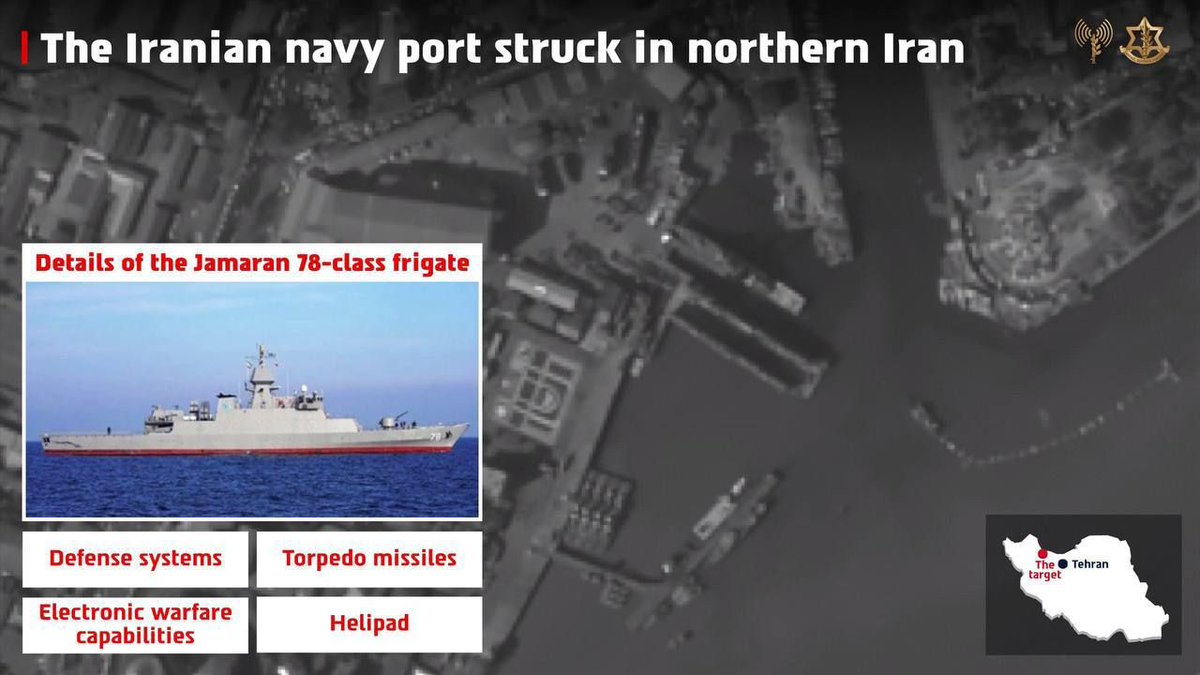
IDF: Footage from IDF strikes on Iranian navy infrastructure in the Caspian Sea Yesterday (Wednesday), Israeli Air Force fighter jets, acting on naval and IDF intelligence, struck key Iranian Navy infrastructure in the Caspian Sea. During the strikes, Israeli Air Force fighter jets struck targets at Iranian Navy port and base facilities where dozens of military vessels, including missile ships and guard boats, were stationed. Targets struck in the port included: Iranian Navy vessels, including missile ships, support vessels boats, and guard ships. The missile ships that were targeted were equipped with aerial surveillance systems and additional anti-submarine missiles A port command center from which Iranian Navy forces controlled naval operations in the Caspian Sea Central infrastructure used for vessel repair and maintenance The Iranian Navy used the port to advance ongoing operational activity that was impaired by striking the port and the adjacent vessels. This strike was conducted with close cooperation between the commander of the Israeli Air Force and the commander of the Israeli Navy from within the Israeli Air Force command center. It is one of the most significant strikes conducted by the IDF since the start of Operation Roaring Lion. The strike on this infrastructure further degrades the Iranian regimes capabilities while impairing the Iranian Navy’s control of the Caspian Sea. 🇮🇱🇮🇱🇮🇱🇮🇱🇮🇱🇮🇱🇮🇱🇮🇱🇮🇱🇮🇱 Simple: Russia was sending weaponry to Iran. 19 MAR 2026 | 14:19 ET ET SOURCE: 🇮🇱 Israel 🇮🇱 Unredacted 🇮🇱 (@isrjerjewppl)
Inside_Israel_Intel tweet media
English
0
2
19
1.5K
Inside_Israel_Intel
Inside_Israel_Intel@inside_IL_intel·
⚡️🇮🇱🇮🇷Footage shows air defence active over eastern and southeastern Tehran this evening against Israeli aircraft. @wfwitness\ 19 MAR 2026 | 14:20 ET ET SOURCE: WarFront Witness (@wfwitness)
English
0
0
3
1.1K
Inside_Israel_Intel
Inside_Israel_Intel@inside_IL_intel·
🇮🇷💥🇮🇱 Haifa was hit by a “Nasrallah” missile. The Islamic Revolutionary Guard Corps says the Haifa oil refinery was struck by a new missile named after the late Hezbollah leader. This marks its first reported combat use by Iran. 🔴 @DDGeopolitics | Socials | Donate | Advertising 19 MAR 2026 | 14:11 ET ET SOURCE: DD Geopolitics (@DDGeopolitics)
English
1
2
22
3.5K
Inside_Israel_Intel
Inside_Israel_Intel@inside_IL_intel·
Large chain accidents reported in Jerusalem caused by panicked drivers amidst an Iranian missile attack. 19 MAR 2026 | 14:12 ET ET SOURCE: Jewish News Syndicate (@jns_news)
English
0
1
7
1.9K
Inside_Israel_Intel
Inside_Israel_Intel@inside_IL_intel·
Footage shows smoke rising from the oil refineries in Haifa following Iran's latest ballistic missile attack. 19 MAR 2026 | 14:13 ET ET SOURCE: Israel War Live (@IsraelWarLive)
English
0
0
6
1K
Inside_Israel_Intel
Inside_Israel_Intel@inside_IL_intel·
Former Iranian soccer star Shiva Amini just exposed the regime's sick tactics: They threatened the women's national team in Australia with TORTURE, IMPRISONMENT, and RAPE of their family members if they didn't return home. So the players declined asylum and fled back, terrified for their families. 19 MAR 2026 | 14:03 ET ET SOURCE: Daily ISRAEL24 (@dailyISRAEL24)
English
3
36
182
7K
Inside_Israel_Intel
Inside_Israel_Intel@inside_IL_intel·
Nearly three weeks into the US and Israeli war on Iran, supply chain disruptions are affecting far more than oil and gas. 19 MAR 2026 | 14:03 ET ET SOURCE: Daily ISRAEL24 (@dailyISRAEL24)
English
1
1
5
1.3K
Inside_Israel_Intel รีทวีตแล้ว
Fred Aaron is Pops Culture 🇺🇸✡🇮🇱
Longtime Democrat David Boies makes the case for the war against the Iranian regime in the Wall Street Journal: “Every past president since Bill Clinton, Republican and Democrat alike, has declared that Iran couldn’t be permitted to develop nuclear weapons. Not one acted to prevent it. Every president since Ronald Reagan has condemned Iran’s role in terrorism against American citizens, interests and allies. Not one acted to stop it. Instead, each president left his successor with a more dangerous Iran and a more complicated threat to address. “Last June President Trump undertook a limited military operation designed to interrupt Iran’s development of nuclear weapons and discourage the country from continuing its nuclear program. In the face of Iran’s refusal to forswear nuclear weapons and evidence that it was rapidly increasing the number, sophistication and range of its missiles, Mr. Trump began the current military campaign. . . . “Those of us who generally oppose Mr. Trump but who recognize the threat Iran poses need to support the military action not because we owe anything to Mr. Trump but because we owe it to ourselves, our country and our children. If we opposed the war and succeeded in pressuring Mr. Trump to curtail it before the mission is accomplished, we would have the satisfaction of defeating someone we generally oppose, which might help ourselves politically. But America would be worse for it.”
English
4
32
74
2.5K