
Jackie Abramian รีทวีตแล้ว

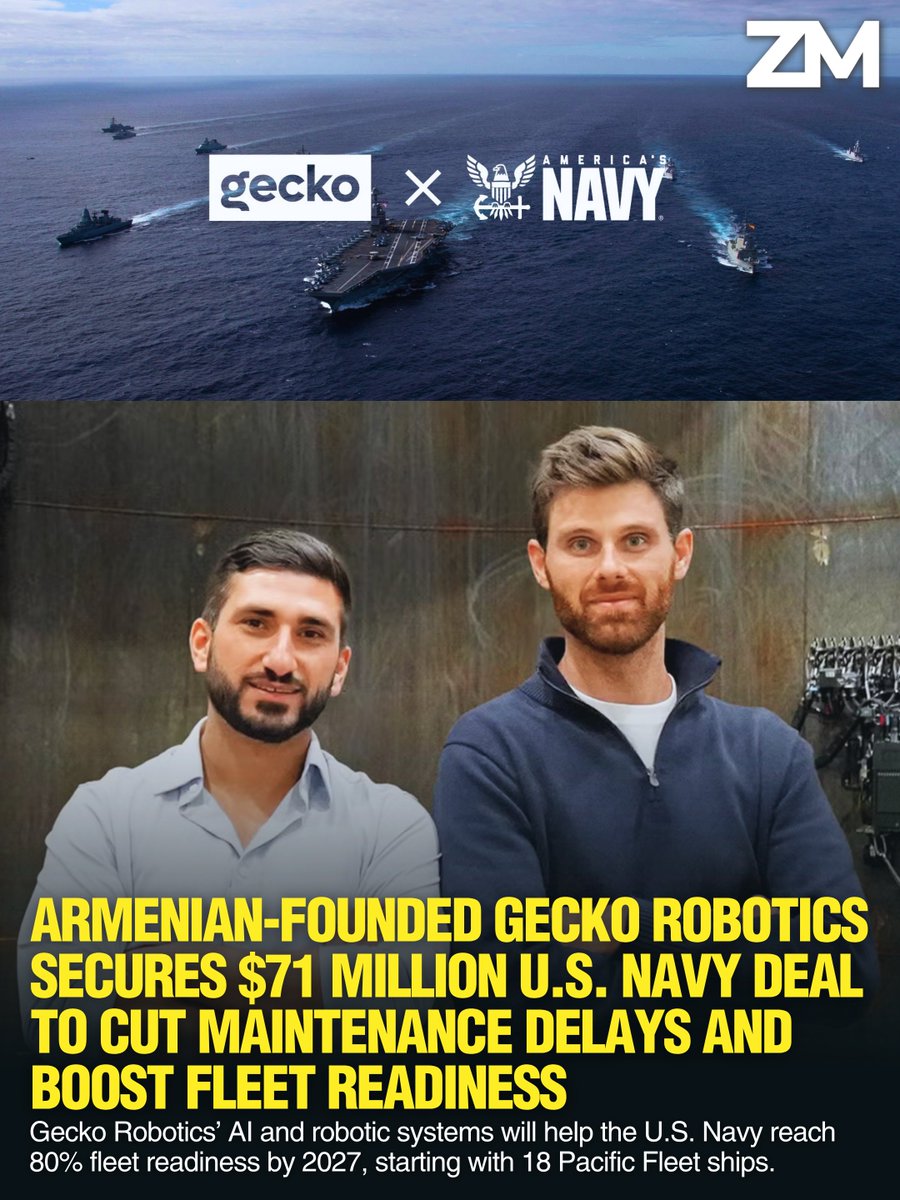
Armenian-Founded Gecko Robotics Secures $71 Million U.S. Navy Deal To Cut Maintenance Delays And Boost Fleet Readiness
➖➖➖
Gecko Robotics, the AI and robotics company co-founded and led by Armenian-American entrepreneur Jake Loosararian, announced a major new agreement with the U.S. Navy and the General Services Administration, securing a five-year IDIQ contract with a $71 million ceiling to deploy artificial intelligence and robotics to assess and maintain the health of military assets. Gecko announced the deal on March 17, 2026.
The Pittsburgh-based company said it will begin work on 18 ships in the U.S. Pacific Fleet under an initial award worth up to $54 million over five years. According to Gecko, the effort is aimed at helping the Navy reduce maintenance delays and move toward the Chief of Naval Operations’ target of 80% fleet readiness by 2027.
Gecko’s technology is already being used in defense, energy, and manufacturing, sectors where rapid and accurate insight into the condition of valuable physical assets can save time, cut costs, and improve safety. In this latest program, the company’s AI and robotic systems will be deployed across destroyers, amphibious warships, and littoral combat ships to help identify repairs faster and improve operational readiness.
The new contract marks another major milestone for Gecko, which was founded in 2013 by Loosararian and co-founder Troy Demmer out of their college dorm room.
In June 2025, Gecko reached unicorn status after raising $125 million in a Series D funding round that doubled its valuation to $1.25 billion. The round was led by Cox Enterprises, with continued backing from existing investors including USIT, XN, Founders Fund, and Y Combinator. At the time, the company said it had raised a total of $347 million.
Gecko Robotics builds AI-powered robots and software that help organizations inspect, maintain, and modernize critical infrastructure. Its robots can climb, crawl, fly, and swim to collect large volumes of data on assets ranging from military ships and aircraft to power plants and energy facilities. That data is then analyzed through Gecko’s proprietary operating platform, Cantilever, which helps customers make evidence-based decisions, optimize performance, extend asset lifespan, and improve safety.
According to the company, its wall-climbing robots, drones, and fixed sensors collect data on components, hulls, decks, and welds across Navy ships and submarines, while AI is used to build accurate models and identify structural issues, including defects that may not be visible to the human eye.
Gecko said Navy data has shown that its technology reduces maintenance lead times and work hours while increasing the availability of actionable inspection data.
The company added that a single robotic evaluation and digital rendering of a flight deck eliminated more than three months of potential maintenance delay.
“Readiness isn’t just a metric, it’s all that matters,” Loosararian said in a statement announcing the deal. He added that Gecko’s robotics and AI products are designed to help ensure U.S. service members have the advantage they need by shifting maintenance from reactive to predictive.
Justin Fanelli, Chief Technology Officer for the Department of the Navy, also praised the partnership, saying solutions like Gecko’s make innovation adoption easier while saving time, money, and risk. Senator Dave McCormick likewise pointed to Gecko as part of Pennsylvania’s defense manufacturing legacy, saying the company is helping deliver next-generation AI, autonomous systems, and robotics capabilities for the U.S. military.
Gecko has continued to expand its footprint since reaching unicorn status. In November 2025, ADNOC and Gecko signed three new agreements to expand robotics and AI deployment across energy assets and support future skills training. In January 2026, Gecko also announced a partnership with Trident Maritime Systems to deploy AI and robotics across 20 fabrication facilities supporting U.S. Navy production, with the company saying the effort is expected to increase throughput by at least 40%.
A two-time CNBC Disruptor 50 company, Gecko was ranked No. 30 on CNBC’s 2025 Disruptor 50 list, reflecting its growing relevance across critical industries.
Gecko’s mission remains bold: to help build, operate, and modernize the world’s most critical infrastructure.
With Armenian roots and growing influence in defense, energy, and industrial technology, Gecko’s latest milestone marks another major win for Armenian innovation and representation.
English