Jake Martin | Amazon Advertising 🛠

3.7K posts

Jake Martin | Amazon Advertising 🛠 banner
Jake Martin | Amazon Advertising 🛠

Jake Martin | Amazon Advertising 🛠

@jake_rm_

Brand owner, building the Amazon agency I wanted to hire: https://t.co/EMSb50dkph Helping brands scale on Amazon through PPC and DSP.

Proven Amazon Strategies 👉 เข้าร่วม Ocak 2022
457 กำลังติดตาม3.1K ผู้ติดตาม
ทวีตที่ปักหมุด
Jake Martin | Amazon Advertising 🛠
Amazon's Product Opportunity Explorer will replace old product research methods. All of the data you need is in POE. And it's right there in your seller account. A thread on how to use this powerful tool.🧵
English
16
17
108
0
Jake Martin | Amazon Advertising 🛠
If you’re adding tons of keywords with different levels of relevance, match types, and ad groups into a single PPC campaign... How do you expect performance to ever be stable enough to scale the budget on it? Simple scales - in both Amazon ads, and business in general.
English
0
1
0
69
Jake Martin | Amazon Advertising 🛠 รีทวีตแล้ว
Jake Martin | Amazon Advertising 🛠
"When nothing seems to help, I go & look at a stonecutter hammering away at his rock. A hundred times without as much as a crack showing in it. Yet at the hundred and first blow it will split in two, & I know it was not that last blow that did it—but all that had gone before."
English
2
4
13
0
Jake Martin | Amazon Advertising 🛠
The Products tab in the ad console is really useful for matching campaigns to products and spotting wasted spend. It has been a core part of a number of our processes for some time, particularly during onboarding. New clients generally come in with messy portfolios, inconsistent naming conventions and a lot of mixed product campaigns. That makes it harder to quickly find the campaigns that are overspending for a specific product. But if you search the product’s ASIN(s) in the Products tab, you can quickly pull up every related SP campaign. From there, you can stop/reduce the spend, and then move those campaigns into the right portfolio.
Jake Martin | Amazon Advertising 🛠 tweet media
English
0
2
0
170
Jake Martin | Amazon Advertising 🛠 รีทวีตแล้ว
Jake Martin | Amazon Advertising 🛠
'The most dangerous distractions are the ones you love, but that don't love you back.' - Warren Buffet
English
0
1
10
0
Jake Martin | Amazon Advertising 🛠
Are you overspending on PPC during deals? Most sellers assume more traffic = better rankings. So when a deal is live, they maintain spend, or even increase it. Is this the right move? It depends on the product. For one of our client’s product doing ~$200k/month: - Deals consistently drove huge spikes in daily sales - Organic rankings jumped right after the deal period - PPC always had minimal impact on rank movements - whether we were running at a more efficient TACOS or pushing aggressively The ranking lever wasn’t ads. It was deals. So we tested: - Reduced PPC spend during deal periods - Reallocated budget to other products Results: - Rankings still improved after every deal - Sales velocity stayed high - Overall account efficiency increased Why this happened: - In this case, deals boosted conversion rate and unit velocity massively - Higher CVR and sales velocity → stronger rank signals - We didn’t need to force extra traffic through PPC I should stress that this is product-dependent. Not every product behaves like this. But if you have an item that performs phenomenally on deal, your budget may be better used elsewhere on deal days.
English
0
1
2
198
Jake Martin | Amazon Advertising 🛠
When a product gets traction on TikTok, some of the traffic will spill over to Amazon in the form of brand searches. Most sellers only think about the upside: more traffic, more sales. But there are second-order effects which we’ve seen firsthand. Traffic that comes from TikTok doesn’t behave like Amazon-native traffic. And that can show up in review scores, due to the different path to purchase: - They’re sold by a creator, not your listing - They may not read the PDP in detail (impulse buy) - Expectations are set externally by the TikTok creator - and sometimes inaccurately That can lead to: - More mismatched expectations - Lower review scores vs non-branded search traffic On the other hand, traffic from TikTok can convert well even if the review score of the item isn’t good: - Shoppers trust the creator - They’re pre-sold before they land on PDP - They may completely ignore weak reviews because the product looked cool on TikTok. I have seen products with a 3.5 star rating perform extremely well because of traction on TikTok So you can end up with: - High conversion rates - Over time, lower review scores What to do: 🔶 Align your PDP with creator messaging → Mirror claims, visuals and use-cases so there’s no disconnect 🔶 Control the narrative where possible → Brief creators properly, avoid overpromising, standardise key selling points 🔶 Monitor review quality, not just volume → Look for expectation gaps in feedback and fix them fast (content, creatives, FAQs)
English
0
1
0
95
Jake Martin | Amazon Advertising 🛠
Are you overcomplicating your variation strategy? I often recommend adding low-traction ASINs to a strong parent to boost visibility. But too many variants can hurt more than help. At a certain point, you create hesitation: 🔶 “Which one is better for me?” 🔶 “Why is this one cheaper?” 🔶 “Am I choosing the wrong version? I need to do more research.” Now the shopper is thinking instead of buying. That friction may reduce conversion rate. What works: 🔶 Keep merchandising staightforward 🔶 Avoid stacking stylistic differences 🔶 Test - don’t assume more = better
English
0
1
0
138
Jake Martin | Amazon Advertising 🛠
The first few seconds of your Amazon Sponsored Brand video ads matter most. It’s similar to a strong hook in written content. A strong opening is what drives higher CTR. And CTR is our main KPI for video performance - it shows how effectively that video is pulling in traffic. Grab attention right away, or people may scroll past.
English
1
1
1
79
Jake Martin | Amazon Advertising 🛠
Ever had your Amazon ads turn off for a day and noticed a spike in profits? Don’t assume that means ads aren’t valuable. The profit increase generally happens because your organic rankings are still holding, and you’re not spending on ads. But ads played a role in getting you into those organic positions in the first place. If ads stay off, your organic rankings and share of voice will gradually start to drop - since your sales velocity is now lower than before (assuming your ads are additive). Over time, you end up more reliant on ads again, because those organic positions begin to slip. It becomes a cycle.
English
1
1
1
180
Jake Martin | Amazon Advertising 🛠
When adjusting bids in Auto campaigns, make smaller, more conservative changes. The mix of search terms an Auto campaign delivers will shift depending on your bid. If you’ve found a bid that performs well, avoid changing it too aggressively. You may end up changing the search terms as well.
English
0
1
0
108
Jake Martin | Amazon Advertising 🛠
The performance of an Amazon Auto campaign is largely controlled through negatives. So, what does a sensible negation approach look like? 🔶 Over click threshold, 0 conversions How many clicks does it typically take to generate a sale? As a search term starts to exceed that number without converting, it’s worth considering negation. This allows the Auto campaign to spend more time finding better opportunities. 🔶 Low click-through rate Search terms or matched products with low CTR hurt overall efficiency. By negating them, you push the campaign to discover higher CTR traffic. 🔶 High ACOS If a search term consistently shows high ACOS, it’s a candidate for negation. You can’t fine-tune bidding at the search term level within an Auto campaign. But if you move that search term into a manual campaign, you can control it more precisely. Other Considerations 🔶 Proactive management If data from other campaigns shows a keyword or product target is underperforming, negate it in the Auto. This should be based on aggregated product-level data. Your PPC software should have this function. 🔶 Matched products You can usually be more aggressive when negating matched ASINs. Product targeting doesn’t drive the same residual ranking benefits as keyword-driven sales. 🔶 Common sense Review your search term reports manually and remove anything irrelevant. If you rely only on rules, you’ll keep spending on low relevance terms until those rules trigger.
Jake Martin | Amazon Advertising 🛠 tweet media
English
0
1
0
111
Jake Martin | Amazon Advertising 🛠
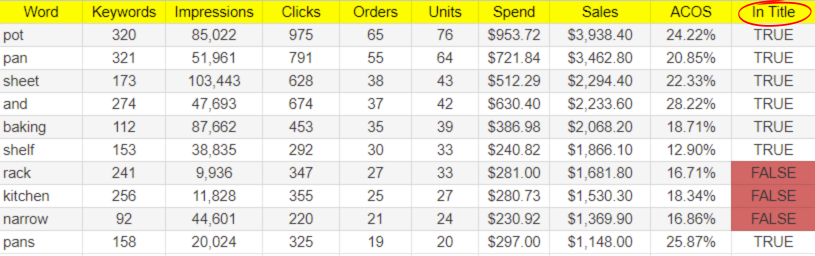
You should always be optimizing your Amazon listings using recent data. As a recurring task, we look at the last 90 days of PPC data. From the keyword sales data, we identify which individual words are driving the most orders at the product level. Are those words in the product title? If not, we advise our clients to try to get them into the title. This isn’t a major lever, but it’s a piece of optimization hygiene that’s worth doing consistently.
Jake Martin | Amazon Advertising 🛠 tweet media
English
1
1
2
133
Jake Martin | Amazon Advertising 🛠
When you manually reduce bids in PPC, make sure you check the average CPC paid for the target. If the average CPC is still higher than your new bid, the change likely won’t have the impact you're looking for. Also, review any placement bid adjustments in the campaign to make sure they’re not offsetting your update.
English
0
1
0
407
Jake Martin | Amazon Advertising 🛠
Spotted by one of our ad managers: 'Automatic' campaigns for Sponsored Brands Product Collection ads. Works differently from an SP Auto. You pick the targeting, Amazon picks the most relevant collection of products from your catalog. Amazon also creates the ad title and landing page. Another step toward Amazon making ads easier to launch and more accessible. And given these ads typically carry higher CPCs… no surprise they want to make them easier to spend on!
Jake Martin | Amazon Advertising 🛠 tweet media
English
0
2
0
194
Jake Martin | Amazon Advertising 🛠
Amazon can help manage bids when you use bidding strategies like Down Only or Up and Down - but that only works once there’s enough data. If there’s no performance history, Amazon might reduce your bids too aggressively, which can push you out of auctions. That’s why when launching a new product, starting with fixed bids is usually the better approach.
English
1
1
1
154
Jake Martin | Amazon Advertising 🛠
Why does top of search on Amazon have the best conversion rate? Because the people clicking those placements are often ready to buy. They’ve searched with intent, see a relevant option immediately and act on it. As you move down the page, that intent starts to dilute. By page 2 or 3, purchase intent often drops below browsing intent - people are comparing, exploring, or just scanning options rather than making a decision.
Jake Martin | Amazon Advertising 🛠 tweet media
English
4
1
3
353
Jake Martin | Amazon Advertising 🛠
PPC questions to ask yourself: ACOS high? Is it because you’re targeting a low-relevance keyword, or because you need to bid aggressively to win good placements? Low impressions? Assuming the search volume is there: is it because Amazon doesn’t see your listing as relevant enough, or because your bid isn’t competitive enough? Relevance and bid aren’t the only variables in play - but they drive a lot of outcomes.
English
1
0
0
141
Jake Martin | Amazon Advertising 🛠
Amazon service providers: how do you deal with a client wanting to try something different? Here’s our approach: 1) Defend your thinking and explain why you do things the way you do. Very important. 2) Stay open to your client’s ideas, and don’t make them feel wrong for suggesting something. Avoid the instinct to shut down anything that doesn’t conform with your usual process. Unless you think it could genuinely harm performance, be willing to test something new. You are the subject matter expert. That is what they're paying you for. You also don't know everything. So balance your expertise with openness. People will enjoy working with you, and you will get compliments about being easy to work with.
English
1
0
1
123
Jake Martin | Amazon Advertising 🛠
How many single keyword campaigns (SKCs) should you have in Amazon PPC? There isn’t a fixed number. If a keyword: 🔶 is highly relevant 🔶 drives good sales volume 🔶 has organic ranking potential 🔶 represents an important keyword root then it can be a good candidate for an SKC. It doesn’t need to meet every criteria - hitting one or two can be enough. Ultimately, it comes down to control. Do you want maximum control over placements, spend, and bidding strategy for a keyword? Then it may be worth isolating it into its own campaign - or perhaps grouping it with a small set of closely related keywords.
English
2
1
2
116