Katie Bryant, PhD

202 posts

Katie Bryant, PhD banner
Katie Bryant, PhD

Katie Bryant, PhD

@katiegbry

@NIAAANews T32 postdoctoral fellow in the Lapish lab at IU

IU | Drexel | CofC/MUSC เข้าร่วม Eylül 2013
474 กำลังติดตาม318 ผู้ติดตาม
ทวีตที่ปักหมุด
Katie Bryant, PhD
Katie Bryant, PhD@katiegbry·
So excited to be awarded a @NIH_LRP!! Big thanks to @NIAAAnews, @CC_Lapish, my letter writers, and everyone else who has supported me with this application and my research. This thing is literally life changing! 🤩
Katie Bryant, PhD tweet media
English
3
0
26
2.3K
Cristina Miliano
Cristina Miliano@MilianoCristina·
✨Exciting News ✨ I’m thrilled to share that I’ve been awarded a K01 Career Development Award from NIAAA! This grant will fund my research for 5 years to study the effects of the neuropeptide Cocaine- and Amphetamine-Regulated Transcript (CART II) on alcohol use disorder.
English
7
0
25
2.2K
Katie Bryant, PhD รีทวีตแล้ว
Farzad Mostashari
Farzad Mostashari@Farzad_MD·
1/ After residency at Mass General Hospital, I reported to Atlanta to meet my fellow CDC Epidemic Intelligence Service Officers. I have never felt so intimidated by my peers The best and the brightest, they were star clinicians, had served in disaster zones; MD/PhDs and MSF.
English
408
4.9K
18.3K
2.6M
Katie Bryant, PhD รีทวีตแล้ว
Phil Metzger
Phil Metzger@DrPhiltill·
It seems few people know what an “indirect cost” is or why it has to be 40-60%. The reason the government forced universities to raise their indirect costs up to (typically) 40-60% was to force a huge amount of regulations on the universities while also minimizing the bookkeeping to comply with those regulations. This includes the work by contract managers, compliance lawyers, accountants, safety management, etc., who are required by the government per the terms of the contract. If universities had to allocate all those categories of labor to each contract hour-by-hour it would require too much bookkeeping, which would waste money. (I’m setting aside for now the question of whether or how much the regulations are wasting money and only discussing how you bookkeep the effort to comply with the regulations.) So to save money, while also requiring universities to do these types of work, the government requires universities to roll those categories of labor into “cost pools” that must be allocated as a percent of the technical work in each of the contracts. While the actual “overhead” might be only 15%, these pooled labor charges that are required by the government are typically much more. Second, the government doesn’t allow the universities to figure out their own indirect rates. These rates are determined by the federal government through audits every couple of years. The government then sends a document telling the university what rate to use for its cost pools. For example, the University of Colorado was told by the DHHS to use 54% (colorado.edu/controller/sit…) and U. Nebraska was told by DHHS to use 55.5% (uofnelincoln.sharepoint.com/sites/UNL-Spon…). 40-60% is not only reasonable to fulfill the terms of the contract, it is the rate that the government tells the university it can charge for all the work the government requires the university to do. So if the government wants to reduce the indirect rate to 15%, then it needs to do one of these two things: Either (A) eliminate all the federal regulations that force the universities to do those categories of work (compliance, accounting, management, safety management, tracking harmful chemicals, etc.) Or, (B) stop requiring universities to pool those real costs into the “indirect cost” category and allow universities to include them in the “direct costs” of the contract. If the government chooses (A), then the safety rails have been entirely removed. (Even if the government lowers the regulations without entirely eliminating them, the costs they impose will still be real costs that probably come out to more than 15%.) Or, if it chooses (B), then the direct costs will go way up and research will actually be less efficient because all the bookkeeping, not more efficient. But if the government caps the indirect rate at 15% without doing either (A) or (B), then it will be impossible to do research for the federal government without going bankrupt. That’s the worst possible choice. It will kill research in the US. Is that what we want? I can explain it for you but I can’t understand it for you. It’s up to the reader not to be ignorant.
English
91
289
1K
136K
Katie Bryant, PhD รีทวีตแล้ว
Christina Jewett
Christina Jewett@By_CJewett·
NEW: The N.I.H. will cut about $4 Billion from federal research grants that support cancer, virus and heart disease research. #Project2025 called for the cuts to end subsidies to "leftist" university agendas. nytimes.com/2025/02/07/us/…
English
93
145
182
174.4K
Katie Bryant, PhD รีทวีตแล้ว
Jeremy Day
Jeremy Day@DayLabUAB·
The result of this is that many institutions could not afford to perform research that delivers cures for debilitating brain conditions. I am hoping the NIH will reconsider this position, which would be especially devastating to state institutions.
English
5
12
84
5K
Katie Bryant, PhD รีทวีตแล้ว
SfN Journals
SfN Journals@SfNJournals·
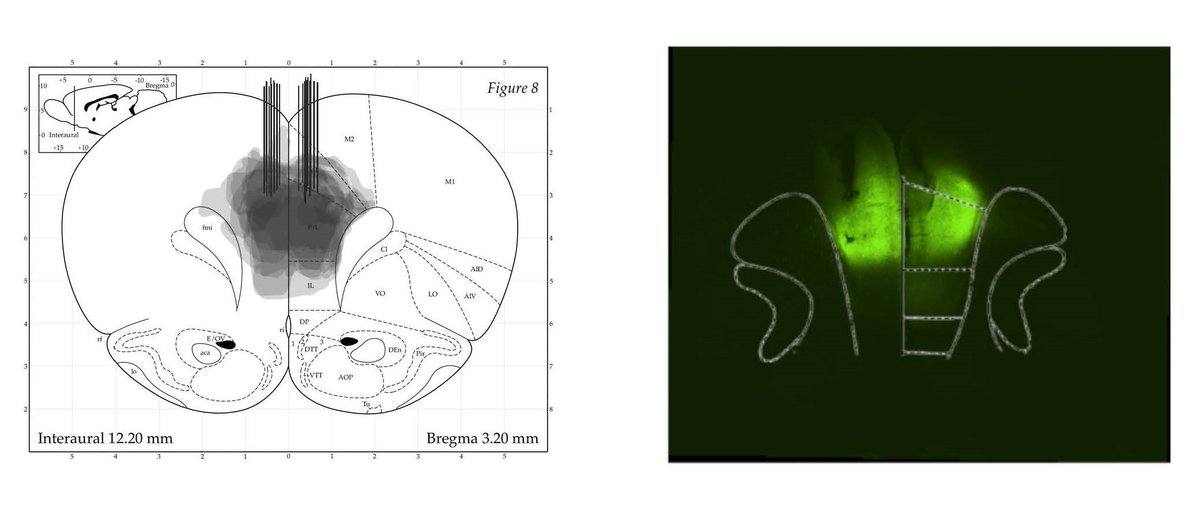
#eNeuro | @ShelbyMWhite1, @CC_Lapish. et al. investigated the neural basis of impulsivity and impulse control. Using an important paradigm for assessing impulse control in rats, they discovered that disrupting anterior cingulate cortex activity during the paradigm increases impulsivity. @iupui doi.org/10.1523/ENEURO…
SfN Journals tweet media
English
0
7
10
1.9K
Brittney Browning
Brittney Browning@brittneydawn9·
@katiegbry Congrats 👏🏼🤩 I am preparing my first application and planning to submit to NIAAA! Would you be willing to share your application as an example?
English
1
0
1
33
Katie Bryant, PhD
Katie Bryant, PhD@katiegbry·
So excited to be awarded a @NIH_LRP!! Big thanks to @NIAAAnews, @CC_Lapish, my letter writers, and everyone else who has supported me with this application and my research. This thing is literally life changing! 🤩
Katie Bryant, PhD tweet media
English
3
0
26
2.3K
Olivia Ortelli
Olivia Ortelli@OrtelliOlivia·
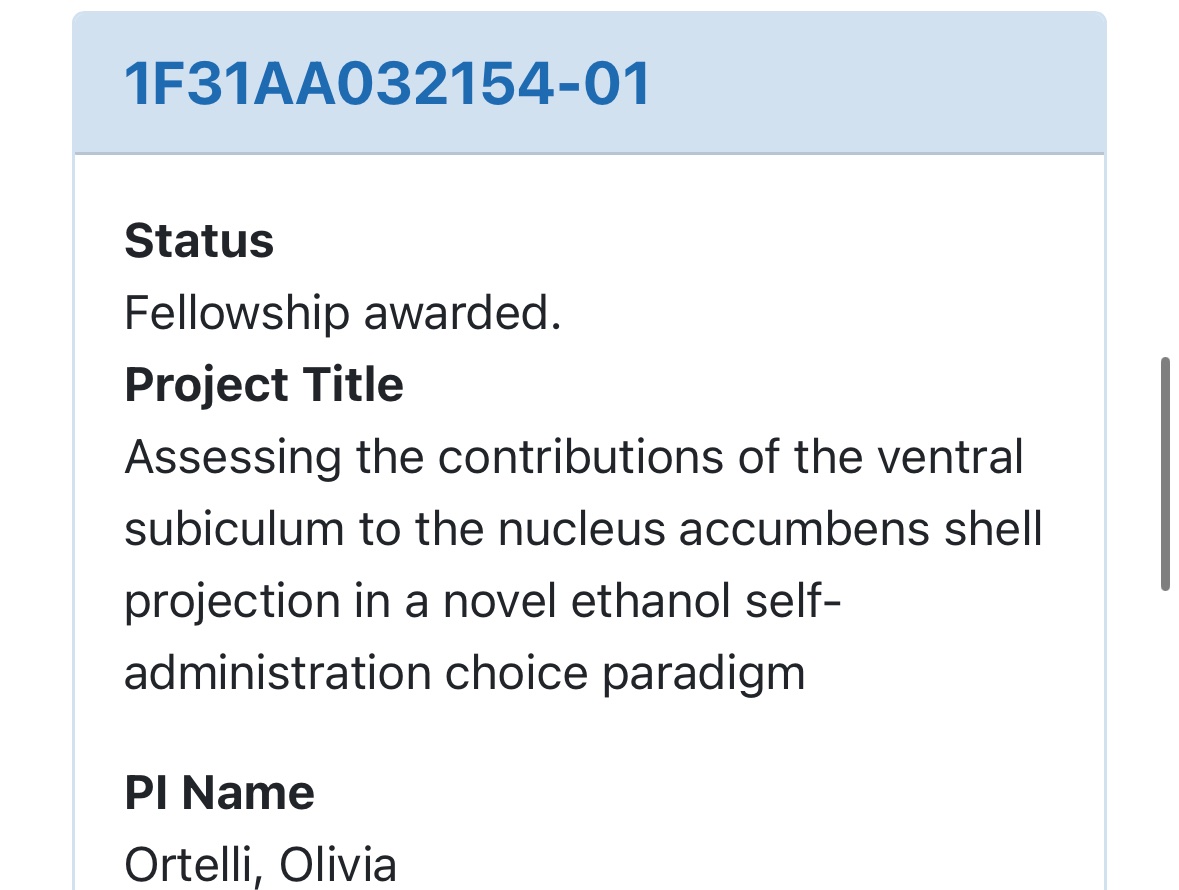
I'm very excited to announce that my F31 has been funded! This grant will fund the completion of my doctoral research investigating how the brain encodes decisions to drink alcohol, even when there are also alternative non-alcohol containing beverages available🥂🥤
Olivia Ortelli tweet media
English
11
5
193
14.2K
Katie Bryant, PhD รีทวีตแล้ว
Dr. Tay
Dr. Tay@tay_mccork·
Heyyyyy y’all! I heard it’s #BiNW24! My name is Dr. Taylor McCorkle, and I am finishing up my first year as a postdoctoral fellow at Temple University in the #ASHLab where I study the neurobiology of diseases associated with maladaptive feeding in mice. #BlackInNeuroRollCall
Dr. Tay tweet mediaDr. Tay tweet media
English
7
33
190
7.2K
Katie Bryant, PhD รีทวีตแล้ว
Glover Lab
Glover Lab@glover_lab·
Excited to share LIQ HDR - a home cage capacitive lickometer system for rats - equipped with custom 3D prints to capture lick microstructure in two-bottle choice drinking experiments. Now available on bioRxiv as part of a home cage drinking methods paper. shorturl.at/KZsLu
Glover Lab tweet media
English
2
12
56
5.3K
Max Joffe
Max Joffe@mejoffe·
Just received the NGA for our new @NIDAnews DP1! I am thrilled we will be able to investigate new targets in SST cells for the treatment of OUD. Major thanks to the support from @McClungColleen @MoussawiKhaled Larry Zweifel, and all who helped develop and refine this proposal!
English
21
7
84
5.4K
Elizabeth Sneddon-Yepez, Ph.D.
I’m honored & grateful to receive the PDEP 2024 award! Huge thanks to @brainaddiction for supporting & mentoring me through this process. 🤗 Also to @iaahmed123 @FrontalCortes @JasmineKwasa & @annyreyesNeuro. Thank you for advice, encouragement, & for being wonderful peers. 💜
BWFUND@BWFUND

BWF is proud to announce the recipients of the 2024 Postdoctoral Diversity Enrichment Program (PDEP) awards. #bwfpdep bwfund.org/news/announcin…

English
6
2
49
3.9K