LU6AES
162 posts


LU6AES
@lu6aes
Ricardo Gramajo. Radioaficionado desde los 14 años. Tengo muchos mas ahora. Ham since 14 years old. I have got much more now. Abogado UBA
Buenos Aires เข้าร่วม Mayıs 2020
99 กำลังติดตาม86 ผู้ติดตาม





@lu6aes Lindo bichito para regalado esta excelente. Actualiza el software
Español



@ColossiPy3du Coincido plenamente. Algo de eso hay seguro. Veremos qué pasa cuando lleguemos al supuesto pico del actual ciclo solar.
Español

@lu6aes Creo que las condiciones desfavorables actuales se deben a la mala calidad de los productos derivados de los avances tecnológicos. El espectro radioeléctrico también se encuentra en una emergencia "climática", ¡pero también somos minoría!
Porto Alegre, Brazil 🇧🇷 Español

@StaticVoyager Incredible openning! I remember one time a huge sporadic witch let me watch a vhf channel from Santiago de Chile many miles away from my qth with The Andes mountain change in between us. Its like magic.
English

Analog TV E-skip now on channel 3 from Cuba 🇨🇺. That’s 1300 miles from my location in Ohio!
English
LU6AES รีทวีตแล้ว

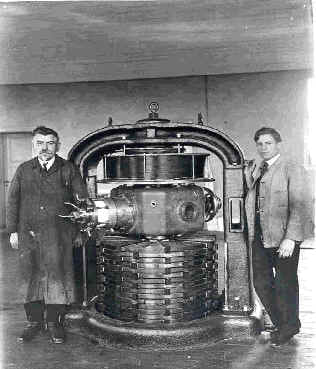
The Poulsen Arc Transmitter was the first major transceiver technology to debut after the spark-gap transmitter, marking a significant advancement in radio communication.
Introduced around 1903 by Danish engineer Valdemar Poulsen, it began to replace spark-gap transmitters in the early 1900s due to its ability to produce continuous waves (CW) rather than the damped waves of spark-gap systems. This allowed for clearer, longer-range communication and paved the way for audio transmission, unlike spark-gap transmitters, which were limited to Morse code.Why the Poulsen Arc Transmitter.
Historical Context: Spark-gap transmitters, pioneered by Heinrich Hertz in 1887 and commercialized by Guglielmo Marconi around 1896, dominated wireless telegraphy until World War I. They generated noisy, wide-bandwidth signals, causing interference and limiting efficiency. By the early 1900s, the need for more reliable and versatile systems led to alternatives like the Poulsen Arc.Technology:
The Poulsen Arc used a continuous electric arc in a magnetic field, often in a hydrogen or hydrocarbon atmosphere, to generate stable high-frequency oscillations. This was a leap over spark-gap’s pulsed, damped waves, enabling narrower bandwidths and less interference.Adoption: By 1909, Poulsen Arc transmitters were used in commercial and naval stations, with ranges up to 4,000 miles by 1912.
They were preferred for their simpler design compared to later vacuum tube systems and because the carrier stopped when the telegraph key was released, allowing operators to listen for replies.Comparison to Other Early TechnologiesAlexanderson Alternator: Developed around 1906 by Ernst Alexanderson, this high-speed alternator was another early continuous-wave transmitter.
It was used for long-distance communication but was complex and bulky, making the Poulsen Arc more practical for many applications until vacuum tubes took over. Vacuum Tube Transmitters: Introduced around 1914–1916, vacuum tube technology (e.g., triodes) became dominant after World War I, offering even greater efficiency, audio transmission, and compact designs.
They made both spark-gap and arc transmitters obsolete by the 1920s. Why Not Vacuum Tubes First?: While vacuum tubes were theorized earlier (e.g., Lee de Forest’s Audion in 1906), practical high-power tube-based transceivers weren’t widely available until after the Poulsen Arc had established itself. The arc was a bridge technology, filling the gap between spark-gap and tube eras. Spectacular Aspects Innovation:
The Poulsen Arc was a game-changer, enabling reliable long-distance communication, including early transatlantic links, without the interference issues of spark-gap systems. Simplicity: Its design was mechanically simpler than alternators and didn’t require the delicate vacuum tubes of later systems, making it rugged for naval and commercial use.Legacy: It laid the groundwork for modern radio by proving continuous waves were viable, influencing the development of AM radio and beyond. Why Not Spark-Gap Successors?
While improved spark-gap designs (e.g., quenched-gap by Max Wien in 1906, rotary spark gaps on the Titanic in 1912) extended the spark era, they were still spark-based and didn’t fundamentally change the damped-wave limitation.
The Poulsen Arc was the first to break this barrier, making it the clear successor.
#radio #hamradio #hamradioshack #wireless #marconi
#Poulsen
English
LU6AES รีทวีตแล้ว

What do you think of this lovely old radio ?? vm.tiktok.com/ZNd69u76N/
English